

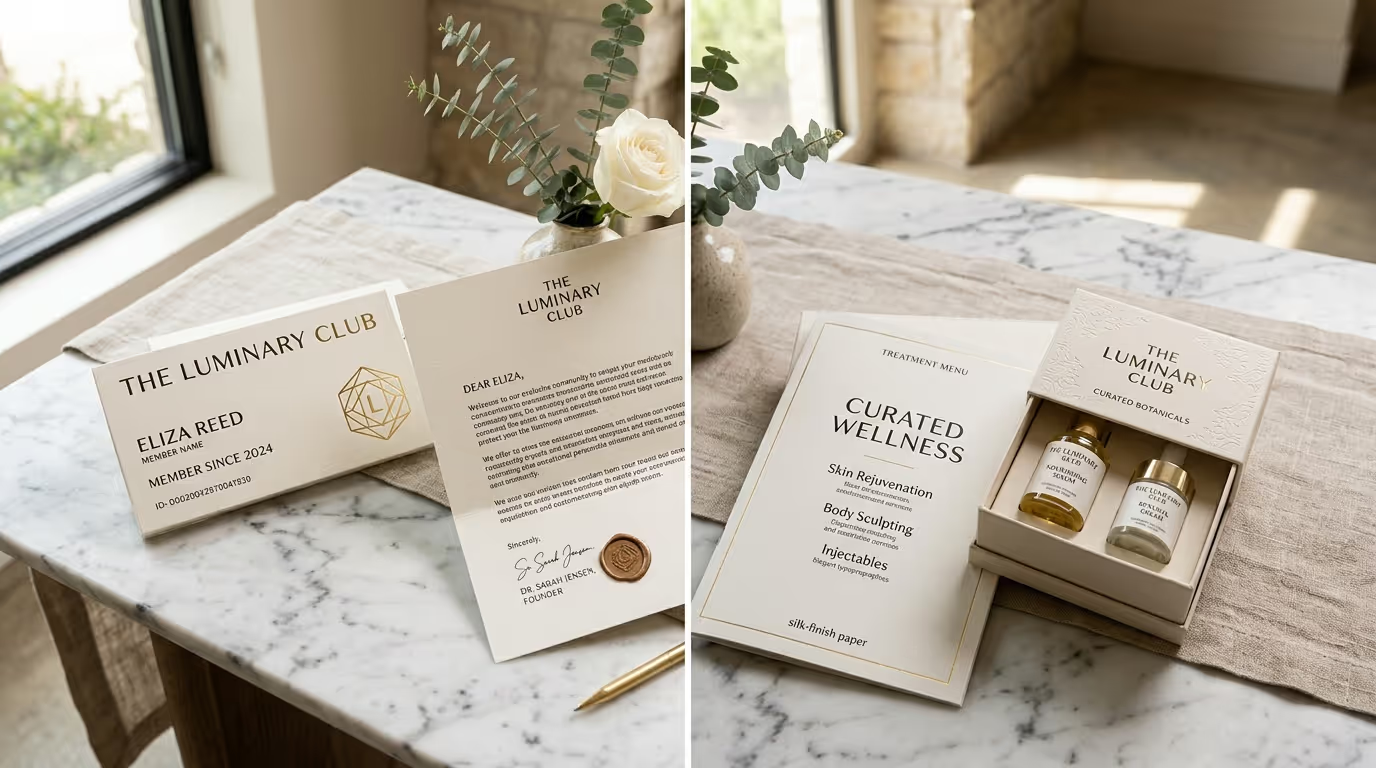
Your revenue graph looks like a heart monitor. Up one month, down the next. A strong January from New Year's resolutions, a dead February, a spike before summer, a crater in August. You are running a practice that generates $80K one month and $45K the next, and you have no idea which version you are getting until the month is halfway over.
This is the fundamental problem with transaction-based med spa revenue — and exactly why the med spa membership model has become essential. Every month starts at zero. Every dollar depends on a patient deciding, right now, to book and show up. You are building a business on hope, and hope is a terrible revenue model.
A med spa membership program fixes this. Not a loyalty program — those reward past behavior. A membership program guarantees future revenue. It is the difference between "come back and maybe we will give you a discount" and "you pay us $199 every month and get these specific treatments and benefits."
The best-run med spas in the country generate 25% to 40% of their total revenue from memberships. That means on a $100K month, $25K to $40K is locked in before a single walk-in crosses the threshold. That kind of med spa recurring revenue changes everything — your hiring decisions, your equipment purchases, your ability to sleep at night.
This guide gives you the complete framework: why memberships beat packages, how to structure your tiers, what to include at each level, how to price it, and how to launch and market a program that patients actually want to join.
Why Memberships Beat Packages for Revenue Predictability
Med spa owners often confuse memberships with packages. They are fundamentally different business models, and the distinction matters.
Packages are prepaid bundles. A patient buys 6 sessions of laser hair removal for the price of 5. You get cash upfront, but once those sessions are used, you are back to zero. Packages create a burst of revenue followed by a cliff. They also train patients to think in terms of "finishing" their treatment rather than maintaining an ongoing relationship with your practice.
Memberships are recurring subscriptions. A patient pays a monthly fee and receives defined benefits each month. The revenue is smaller per transaction but continuous. A $199/month membership generates $2,388 per year — and that patient is showing up every month, which means they are seeing your other services, buying products, and referring friends.
Here is the math that makes memberships superior:
Scenario: 100 patients buying a $1,200 package vs. 100 patients on a $149/month membership
- Packages: $120,000 in revenue, collected irregularly, with zero revenue after redemption
- Memberships: $14,900/month, $178,800/year, recurring automatically, with patients visiting monthly
The membership scenario generates 49% more total revenue and distributes it evenly across 12 months. But the real advantage is what happens in month 13. The packages are done. The memberships keep paying.
Additional membership advantages:
- Higher lifetime value. Membership patients stay an average of 14 to 22 months. At $199/month, that is $2,786 to $4,378 per patient — often 2x to 3x higher than non-member LTV.
- Increased ancillary spending. Members visit more frequently, which means more exposure to upsells. Data across practices shows members spend 30% to 50% more on non-membership services and retail products than non-members.
- Lower acquisition costs. You acquire the patient once and retain them for years. Your effective cost per visit drops with every month they stay.
- Predictable cash flow. When you know $30K is hitting your account on the 1st of every month regardless of what happens, you make better business decisions.
- Reduced no-show rates. Members prepay. They show up. Typical no-show rates for members are 5% to 8% compared to 15% to 25% for non-members.
Membership Tier Structures That Work
The most successful med spa membership programs use a 3-tier structure. Not 2 (too few options), not 4 or 5 (decision paralysis). Three tiers give patients a clear good-better-best framework that naturally guides most people to the middle option.
Tier 1: Basic / Essentials — $99 to $149/month
This is your entry point. The goal of the basic tier is not margin — it is commitment. You want to get patients into the membership ecosystem because once they are in, the upgrade path is natural.
What to include:
- 1 signature facial per month (HydraFacial, dermaplaning, or chemical peel rotation)
- 10% off all additional treatments
- 10% off retail skincare products
- Priority booking (members book before non-members for popular time slots)
- Birthday month bonus treatment (cost: $40-$60, perceived value: $150+)
Target patient: The skincare-focused patient who comes in for facials and is not yet doing injectables, or the price-conscious patient who wants to start small.
Your margins: If a HydraFacial costs you $35 to $50 in supplies and labor, and you are collecting $99 to $149/month, your direct margin on the included treatment is strong. The 10% discount on additional services is offset by the increased visit frequency.
Tier 2: Premium / Signature — $199 to $279/month
This is your workhorse tier. You want 50% to 60% of your members at this level. It should feel like an obvious upgrade from Basic — enough included value that the step up from $99 to $199 feels like a steal.
What to include:
- 1 signature facial per month
- 20 units of Botox per quarter (allocated as a credit, usable within the quarter)
- 15% off all additional treatments
- 15% off retail skincare products
- Free add-on treatment per visit (LED therapy, oxygen infusion — choose from a menu)
- Priority booking plus same-week availability for members
- Complimentary annual skin analysis with treatment plan
Target patient: The Botox-and-facial patient. This is the bread-and-butter med spa patient who gets neurotoxin 2 to 4 times per year and wants regular skin maintenance.
Your margins: 20 units of Botox per quarter costs you roughly $32 to $48 depending on your acquisition cost (Botox at $4 to $6 per unit wholesale). Over 3 months at $199 to $279/month, you are collecting $597 to $837 while delivering $67 to $98 in Botox cost plus $35 to $50 for the facial. Your direct cost of goods is $102 to $148 against $597 to $837 in revenue. The margins are excellent, and this patient is walking in monthly.
Tier 3: VIP / Elite — $349 to $399/month
This is your top-tier offering for your highest-value patients. It should feel exclusive and comprehensive — like having a personal aesthetics concierge.
What to include:
- 1 premium facial per month (upgraded options: microneedling, IPL, or advanced peel)
- 40 units of Botox per quarter
- 1 syringe of filler per year (or credit equivalent)
- 20% off all additional treatments
- 20% off retail skincare products
- Free add-on treatments (unlimited from approved menu)
- VIP booking line (dedicated phone/text number for scheduling)
- First access to new treatments and technologies
- Exclusive VIP events (2 per year — educational, social, preview events)
- Complimentary guest pass (1 per quarter — bring a friend for a facial)
Target patient: The committed aesthetics patient who spends $5,000 to $15,000 per year on treatments. They want everything, they want it to be easy, and they are willing to pay for premium access.
Your margins: At $399/month ($4,788/year), you are delivering approximately $2,000 to $2,800 in direct treatment costs (Botox, filler, facials, add-ons). Your margin before overhead is 40% to 58%. But the real value is that this patient spends an additional $3,000 to $8,000 per year on non-membership treatments (body contouring, laser resurfacing, additional filler) at a 20% discount that still maintains strong margins.
Pricing Your Membership Program
Pricing a med spa membership wrong is the fastest way to kill it. Too cheap and you erode margins. Too expensive and enrollment dies. Here is how to find the right number.
The Value Ratio Rule
Your membership should deliver 25% to 40% more perceived value than the monthly fee. If someone is paying $199/month, the retail value of the included treatments and benefits should be $250 to $280 when priced individually. This creates a clear "I'm saving money" narrative for the patient.
But here is the key: perceived value, not your cost. A HydraFacial that costs you $40 to deliver is priced at $199 on your menu. That $199 is the value the patient perceives. So a $99/month membership that includes a monthly HydraFacial ($199 value) plus 10% off everything ($50+ in savings on a typical visit) delivers $249+ in monthly value. The patient sees a 2.5x return on their membership fee. That is compelling.
The Competitive Floor
Check what other med spas in your market charge for memberships. If the practice down the street offers a membership at $149/month with 20 units of Botox and a facial, you need to either match that value proposition or differentiate on something they cannot offer (exclusivity, technology, provider access).
The Margin Floor
Calculate your direct cost of delivering each tier's benefits. Your margin after direct costs (supplies, labor, products) should never drop below 40%. If it does, you are running a loss leader with no back end — and unlike retail, you cannot make it up on volume.
Quick formula:
Monthly membership fee × 12 = annual membership revenue per patient Annual cost of delivering benefits (supplies + incremental labor) = annual cost (Revenue - Cost) / Revenue = direct margin percentage
Anything above 50% direct margin is excellent. 40% to 50% is workable. Below 40%, restructure.
Pricing Psychology
- Use odd pricing: $199 outperforms $200. $149 outperforms $150. The psychology is real and measurable.
- Annual prepay discount: Offer 10% to 15% off for patients who pay annually. A $199/month membership becomes $2,029/year (vs. $2,388 month-to-month). You get 12 months of cash upfront and the patient gets a deal. Win-win.
- No enrollment fees: Some practices charge a $50 to $100 enrollment fee. This creates friction at the exact moment you want zero friction. Skip it. If you need a commitment mechanism, use a 3-month minimum term instead.
- Family/couple pricing: Offer 10% off the second membership when two people from the same household enroll. This increases your member count and turns individual patients into household accounts.
What to Include in Each Tier: The Details That Matter
Getting the inclusions right is where most med spa membership programs succeed or fail. Include too much and you destroy your margins. Include too little and patients do not see the value.
Injectables: The Membership Anchor
Neurotoxin (Botox, Dysport, Xeomin) is the single best treatment to include in a membership because of three factors: high perceived value, low cost of goods, and predictable repeat demand. Patients who get Botox need it every 3 to 4 months. That is exactly the cadence a membership locks in.
Best practice for injectable allocation:
- Allocate units per quarter, not per month. Patients do not want 7 units of Botox every month — they want 20 units every 3 months.
- Set the quarterly allocation slightly below the patient's typical use. If most patients in your practice get 25 to 40 units per session, allocate 20 units in the membership and let them purchase additional units at the member discount. This ensures the membership drives traffic and additional revenue.
- Convert allocation to dollar credits for filler. Instead of including "1 syringe of Juvederm," offer a $500 to $600 credit toward filler of their choice. This gives patients flexibility and protects you from cost fluctuations.
Facials: The Monthly Visit Driver
The purpose of including a monthly facial is not the facial itself — it is getting the patient through your door every single month. Monthly visits create:
- Habit formation (the practice becomes part of their routine)
- Upsell opportunities (your providers and staff recommend treatments during every visit)
- Retail sales (a patient who just got a facial buys the serum their esthetician recommended)
- Relationship depth (monthly visits build loyalty that quarterly visits never match)
Rotate your included facial options to keep things fresh: Month 1 dermaplaning, Month 2 chemical peel, Month 3 HydraFacial, Month 4 microdermabrasion. Give members a menu rather than the same treatment every time.
Discounts: Structured, Not Blanket
Your membership discount is not a coupon. It is a strategic tool to drive specific behavior.
- Tier the discounts: 10% for Basic, 15% for Premium, 20% for VIP. The increasing discount creates a natural upgrade incentive.
- Apply to treatments and retail: Both. You want members buying products from you, not Amazon.
- Exclude new treatments for 90 days: When you launch a new service, keep it at full price for the first 90 days, even for members. This protects your launch pricing and creates urgency.
- Never stack discounts: Membership discounts do not combine with promotions, event specials, or any other offer. One discount per transaction. Make this clear in your membership agreement.
Perks That Cost You Nothing
Some of the highest-perceived-value membership benefits cost you zero dollars:
- Priority booking: Members book first. This costs you nothing but signals exclusivity.
- Extended hours: "Member-only hours" one morning per week (7am to 9am, for example) before normal opening. This costs you minimal staff time and creates exclusivity.
- First access to new treatments: Members try new services and technologies before they are available to the public. This costs you nothing and makes members feel like insiders.
- VIP events: Two per year. Wine-and-learn evenings, new treatment demos, holiday parties. Cost: $500 to $1,000 per event. Value: priceless for retention and referrals.
- Referral bonuses: Members who refer a new member get a free treatment credit. Your acquisition cost for the referred member is the treatment cost ($40 to $80) — far cheaper than any ad.
How to Launch Your Membership Program
Do not soft-launch a membership. Launch it with energy, urgency, and a clear enrollment push. Here is the playbook.
Pre-Launch (4 Weeks Before)
Week 1-2: Build the infrastructure.
- Finalize tier structures, pricing, and included benefits
- Create membership agreements (have your attorney review — include auto-renewal, cancellation policy, terms)
- Set up recurring billing in your practice management system or CRM
- Build the membership page on your website
- Create enrollment forms (digital and in-office)
Week 3: Staff training.
- Every team member — providers, front desk, estheticians — must be able to explain the membership in 30 seconds
- Role-play enrollment conversations. The most common scenario: "What is this membership thing?" Your team needs a confident, concise answer.
- Define the enrollment process step by step so there is zero confusion on launch day
- Set enrollment targets for the team (not individual quotas — team targets create collaboration)
Week 4: Seed the launch.
- Email your full patient list: "Something new is coming. Our membership program launches [date]. Founding members get [exclusive benefit]."
- Post teaser content on social media
- Mention it to every patient who comes in that week: "We are launching our membership program next week. Would you like to be one of our founding members?"
Launch Week
The founding member offer: The most powerful launch tactic is a "founding member" incentive. This is not a discount on the membership itself — it is an exclusive perk only available to patients who enroll during launch week.
Examples:
- Founding members are permanently locked in at launch pricing, even if prices increase later
- Founding members get a complimentary premium treatment (microneedling, IPL, etc.)
- Founding members get upgraded to the next tier for their first 3 months
- Founding members get their name on a "founding member wall" in the practice
The founding member offer creates urgency (limited time) and exclusivity (only launch enrollees get this). It should expire after 7 to 14 days.
Launch week checklist:
- Email blast announcing the launch with founding member offer
- Social media posts daily (Monday: announce, Tuesday: explain Basic tier, Wednesday: explain Premium tier, Thursday: explain VIP tier, Friday: last chance for founding member perks)
- In-office signage at reception, in treatment rooms, and in restrooms
- Every checkout conversation includes: "Have you heard about our new membership program?"
- Text/SMS to your active patient list
Post-Launch: The Ongoing Enrollment Engine
After launch week, membership enrollment becomes a permanent part of your patient experience:
- Checkout script: "Based on your treatments today, you would have saved $X with our membership. Would you like to learn more?"
- New patient welcome sequence: Every new patient receives membership information within 48 hours of their first visit
- Treatment completion: When a patient finishes a package or series, present the membership as the "maintenance plan"
- Quarterly re-launch campaigns: Every quarter, run a one-week enrollment push with a specific incentive (not founding member status — that is gone — but a bonus treatment, extra product, or enhanced benefit)
Marketing Your Membership Program
Once the program is live, you need to market it continuously. Membership revenue compounds over time, but only if enrollment consistently outpaces churn.
On Your Website
Your membership page should be one of the most prominent pages on your site. Not buried in a submenu — linked in your main navigation.
What the membership page needs:
- Clear tier comparison table (side by side, with the Premium tier highlighted as "Most Popular")
- Monthly cost and annual savings prominently displayed
- List of included treatments with retail value (show the math: "$199/month for $280+ in value")
- FAQ section addressing cancellation, billing, family plans, and what happens to unused benefits
- Enrollment CTA above the fold and at the bottom
- Testimonials from current members (once you have them)
Sample membership page copy for the Premium tier:
Premium Membership — $199/month Everything you need to look and feel your best, every single month. - Monthly signature facial (your choice — $199 value) - 20 units of Botox per quarter ($240 value) - 15% off all additional treatments - 15% off all skincare products - Free add-on treatment at every visit ($75 value) - Priority booking and same-week availability - Annual skin analysis with personalized treatment plan Total monthly value: $280+. Your cost: $199. [Become a Member →]
In Your Email Marketing
- Dedicated membership email sequence: 3 emails over 10 days to non-member active patients. Email 1: introduce the concept. Email 2: break down the value with math. Email 3: urgency or social proof.
- Monthly member-only emails: Send your members exclusive content — skincare tips, early access announcements, member spotlights. This reinforces the value of membership and reduces churn.
- Win-back emails for lapsed patients: "We haven't seen you in 3+ months. Did you know our membership makes it easy to stay on track? Here's what $199/month gets you."
On Social Media
- Share member testimonials and transformations (with consent)
- Post "member appreciation" content showing VIP events, exclusive access
- Run "member of the month" spotlights
- Create FOMO: "Our VIP members got first access to our new treatment this week. Want in?"
In the Treatment Room
Your providers are your best salespeople. When a provider says "you know, with the membership you would save 15% on this and get your monthly facial included," it carries more weight than any ad. Train providers to mention membership benefits naturally during treatment when it genuinely makes sense for the patient.
Retention Metrics to Track
A membership program you do not measure is a membership program you cannot improve. Track these metrics monthly.
Enrollment Rate
What it is: Percentage of active patients who are members.
Target: 15% to 25% of your active patient base within 12 months of launch. Top-performing practices reach 30%+.
How to calculate: (Total active members / Total active patients in last 12 months) × 100
Monthly Churn Rate
What it is: Percentage of members who cancel each month.
Target: Below 5% monthly churn. Best-in-class practices maintain 2% to 3%.
How to calculate: (Members who cancelled this month / Total members at start of month) × 100
Why it matters: At 5% monthly churn, you lose half your members in a year. At 3%, you retain 70%. The difference in revenue is enormous. If you have 100 members at $199/month, the difference between 5% and 3% churn is roughly $47,000 in annual revenue.
Average Member Tenure
What it is: How long the average member stays enrolled.
Target: 14 to 22 months. If your average tenure is below 12 months, your program has a value perception problem.
How to calculate: Sum of all member tenures (in months) / Total members who have ever enrolled
Member vs. Non-Member Revenue
What it is: Average monthly revenue per member versus per non-member.
Target: Members should generate 2x to 3x the monthly revenue of non-members when you include both membership fees and additional spending.
Member Satisfaction (NPS)
What it is: Net Promoter Score for your membership program specifically.
Target: 50+ NPS for members (compared to a typical med spa NPS of 30 to 40 for non-members).
How to measure: Quarterly survey to members: "On a scale of 0-10, how likely are you to recommend our membership program to a friend?"
Reactivation Rate
What it is: Percentage of cancelled members who re-enroll.
Target: 10% to 15% of cancelled members should re-enroll within 6 months if you have a proper win-back sequence.
Common Mistakes to Avoid
Mistake #1: Giving away too much. The most common error. Owners overload the membership with value to make it "irresistible" and then realize they are losing money on every member. Start lean. You can always add benefits later — taking them away is a PR disaster.
Mistake #2: No cancellation friction. Do not make it impossible to cancel, but do not make it a one-click process either. Require a phone call or in-person cancellation. Not to be shady — because cancellation conversations are your best opportunity to save the member. "I see you are thinking about cancelling. Can I ask why? We have a pause option if you just need a break."
Mistake #3: Ignoring the 90-day cliff. Most membership cancellations happen between months 2 and 4. If a member has not used their benefits in the first 90 days, they are going to cancel. Build a 90-day engagement sequence: check-in calls, usage reminders, and personalized treatment recommendations.
Mistake #4: No member communication. If the only time a member hears from you is their monthly credit card charge, they are going to resent the membership. Monthly member emails, quarterly events, and proactive outreach are not optional — they are retention tools.
Mistake #5: One-size-fits-all benefits. A 28-year-old who wants monthly facials and a 55-year-old who wants Botox and fillers should not be in the same tier with the same benefits. Your tier structure should reflect different patient profiles, not just spending levels.
Mistake #6: Failing to track and manage unused benefits. When members do not use their monthly benefits, two things happen. Short-term, your margins improve. Long-term, the member cancels because they are not getting value. Proactively reach out to members who have not booked: "You have a facial credit available this month — let's get you scheduled."
Your Membership Program Launch Checklist
Use this as your implementation guide:
Program Design (Week 1-2)
- [ ] Define 3 tiers with included treatments, discounts, and perks
- [ ] Price each tier using the value ratio rule and margin floor
- [ ] Create membership agreement with attorney review
- [ ] Set up recurring billing infrastructure
- [ ] Design membership materials (digital and print)
Team Preparation (Week 3)
- [ ] Train all staff on membership details and enrollment process
- [ ] Create 30-second elevator pitch for each tier
- [ ] Role-play enrollment and objection-handling scenarios
- [ ] Set team enrollment targets for launch month
Pre-Launch Marketing (Week 4)
- [ ] Send teaser emails to patient list
- [ ] Post teaser content on social media
- [ ] Seed the program with in-office mentions
- [ ] Define founding member offer
Launch (Week 5)
- [ ] Email blast to full patient list
- [ ] Daily social media posts
- [ ] In-office signage deployed
- [ ] Checkout enrollment conversations active
- [ ] SMS announcement to active patients
Post-Launch (Ongoing)
- [ ] Track enrollment, churn, tenure, and revenue metrics monthly
- [ ] Send monthly member communications
- [ ] Run quarterly enrollment campaigns
- [ ] Review and optimize tier structure every 6 months
- [ ] Build 90-day engagement sequence for new members
- [ ] Create win-back sequence for cancelled members
The Bottom Line
A med spa membership program is not a marketing tactic. It is a business model shift. You are moving from selling treatments to selling relationships, from chasing new patients to compounding the value of existing ones, and from unpredictable revenue to money you can count on.
The math is clear. A practice with 150 members at an average of $220/month generates $33,000 in guaranteed monthly revenue before a single non-member walks through the door. That is $396,000 per year in predictable, recurring revenue — plus the 30% to 50% additional spending that members generate on top of their membership fees.
If your revenue graph looks like a heart monitor, a membership program is the flatline you actually want — the steady, predictable kind.
Ready to build a membership program that transforms your revenue model? We help med spas design, launch, and scale membership programs that create predictable recurring revenue. No templates — a custom program built for your patient base, market, and growth goals.