
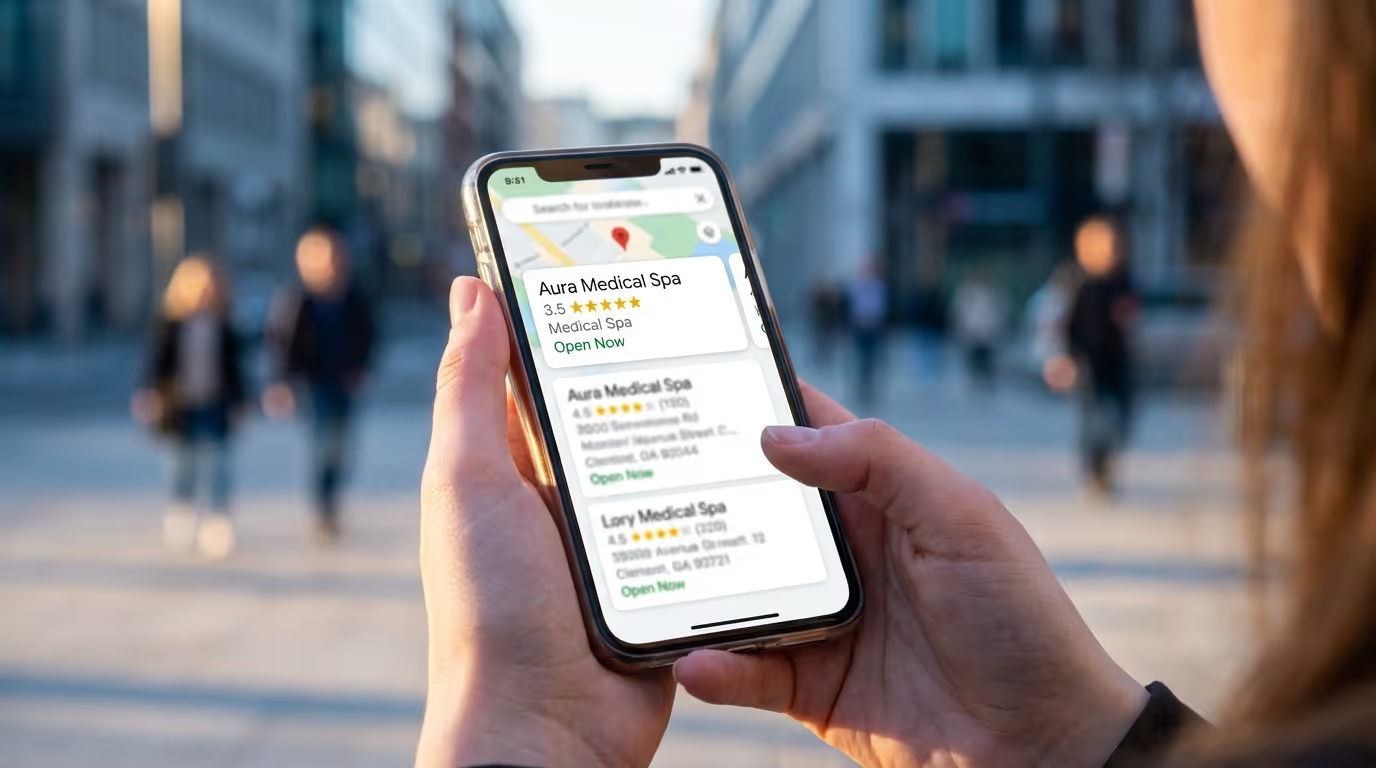
Here is the reality: 46% of all Google searches have local intent. When someone types "Botox near me" or "best med spa in [city]," they are ready to book. If your med spa does not show up in the local 3-pack or the top organic results, that patient is walking into your competitor's door.
Local SEO for med spas is not optional. It is the single highest-ROI channel you can invest in because these searchers convert at 5 to 10 times the rate of general organic traffic. They already want the treatment. They just need to find you first.
This guide covers every element of med spa local SEO from your Google Business Profile to citations, reviews, local content, technical markup, and advanced strategies that separate the practices ranking number one from everyone else. No fluff. Just the playbook we use to get med spas dominating their local markets.
Why Med Spa Local SEO Is the Most Valuable Channel
Before we get tactical, let us establish why local SEO deserves more of your attention and budget than most med spas give it.
The Economics of Local Search
Local search traffic converts at dramatically higher rates than any other channel because of intent. Someone searching "med spa near me" has already decided they want a treatment. They are not browsing. They are choosing where to go.
| Metric | Local Organic | Paid Search | Social Media | General Organic |
|---|---|---|---|---|
| Average conversion rate | 8-15% | 3-7% | 1-3% | 2-5% |
| Cost per lead | $0 (organic) | $25-$75 | $8-$35 | $10-$30 |
| Patient intent level | Very high | High | Low-medium | Medium |
| Lifetime value of acquired patient | $3,200-$5,400 | $2,800-$4,500 | $1,500-$3,000 | $2,500-$4,000 |
| Time to first result | 3-6 months | Immediate | Ongoing | 6-12 months |
The patients who find you through local search are your most valuable patients. They live nearby, they are actively looking for treatments you offer, and they convert at rates that make every other channel look expensive by comparison.
The Compounding Effect
Unlike Google Ads where traffic stops the moment you stop paying, local SEO compounds. Every review you earn, every citation you build, every piece of local content you publish adds to a foundation that keeps working month after month. A med spa that invests consistently in local SEO for 12 months builds a competitive moat that is extremely difficult for new competitors to overcome.
What the Local 3-Pack Is Really Worth
The local 3-pack — those three map listings that appear above organic results for local queries — captures roughly 42% of all clicks on the search results page. If your med spa is in the 3-pack for "Botox near me" in your city, you are getting nearly half of all the clicks for that query. For free. Every single day.
To understand how local SEO fits into your broader med spa marketing strategy, it needs to be the foundation — not an afterthought.
Google My Business Med Spa: Your Most Important Local Asset
Your Google My Business med spa listing (now called Google Business Profile) is the foundation of local SEO for med spas. It directly controls whether you appear in the local 3-pack and it is the single most important ranking factor for local search.
Complete Setup and Verification
Implementation Steps:
- Go to business.google.com and search for your business name
- Claim the listing if it already exists, or create a new one if it does not
- Complete the verification process — Google has been pushing video verification more frequently for medical businesses, so be prepared to do a live walkthrough of your facility
- Fill out every single field in the profile — Google rewards completeness and incomplete profiles get buried
- Set your business hours accurately, including holiday hours and special hours for events
- Add your appointment booking link directly in the profile
- Write a comprehensive business description using your primary keywords naturally (750 characters max)
Verification Options and Timelines:
| Method | Timeline | Availability |
|---|---|---|
| Postcard | 5-7 business days | Most common |
| Phone | Instant | Select businesses |
| 1-3 days | Select businesses | |
| Video | 1-5 days | Increasingly common for medical |
| Instant | Instant | If already verified via Search Console |
Choosing the Right Categories
Your primary category should be Medical Spa. This is non-negotiable. Your primary category carries the most weight in local ranking algorithms and directly determines which searches trigger your listing.
Secondary categories to add (pick all that apply to your actual services):
- Skin Care Clinic
- Laser Hair Removal Service
- Beauty Salon (if you offer aesthetic services beyond injectables)
- Day Spa
- Facial Spa
- Wellness Center
- Cosmetic Surgeon (only if you have a physician performing surgical procedures)
- Weight Loss Service (if you offer semaglutide or similar programs)
Common Mistake: Adding categories that do not match your actual services. Google penalizes category stuffing and it can trigger a suspension review. Only add categories that accurately describe services you actively provide.
Photo Strategy That Actually Moves the Needle
Med spas with 100 or more photos on their GBP get 520% more calls than those with fewer than 10. That is not a typo. Photos are one of the most underutilized ranking and conversion signals in local SEO.
Photo Upload Schedule (Weekly):
| Photo Type | Quantity | Purpose |
|---|---|---|
| Exterior photos | 3-5 total | Confirms location to Google |
| Interior photos | 10-15 total | Shows premium experience |
| Team photos | 5-10 total | Builds trust and personal connection |
| Before-and-after photos | 2-3 per week | Most powerful conversion tool |
| Service-specific photos | Ongoing | Equipment, products, treatment process |
| Video content | 1-2 per month | Walkthroughs, provider introductions |
Implementation Steps:
- Name your image files descriptively before uploading:
botox-treatment-room-[city]-med-spa.jpgnotIMG_4523.jpg— Google reads file names - Add alt text descriptions to every photo using natural language with location keywords
- Upload new photos weekly — recency signals activity to Google
- Remove any low-quality or outdated photos that do not represent your current brand
- Include photos of your actual providers — stock photos destroy trust and Google can detect them
- Always get written consent before uploading any patient photos, including before-and-after images
Google Posts: Weekly Content That Boosts Visibility
Google Posts appear directly on your profile and signal to Google that your business is active. Profiles that post weekly receive 35% more actions (calls, direction requests, website clicks) than those that do not.
Effective Post Types for Med Spas:
| Post Type | Frequency | Example |
|---|---|---|
| Offers | 2-3 per month | "20% off Hydrafacials this month" with booking CTA |
| Updates | Weekly | New treatment announcements, provider spotlights |
| Events | As scheduled | Open house events, VIP nights, seasonal promotions |
| Before-and-after | Weekly | Treatment results with descriptions |
| Educational | 1-2 per month | Quick tips, treatment FAQs, myth busting |
Implementation Steps:
- Create a Google Posts content calendar aligned with your marketing calendar
- Write keyword-rich descriptions of 150 to 300 words per post
- Include a high-quality image with every post — posts without images get significantly less engagement
- Add a CTA button linking to your booking page or relevant landing page
- Post at least once per week — consistency matters more than volume
- Track which post types drive the most actions and double down on what works
Q&A Section Management
Most med spa owners ignore the Q&A section on their Google Business Profile. That is a mistake. Anyone can ask AND answer questions on your profile — including competitors.
Implementation Steps:
- Proactively seed your Q&A with 15 to 20 common questions and answers
- Include keywords naturally in both questions and answers
- Monitor the section weekly for new questions from the public
- Respond to every question within 24 hours
- Upvote your own answers (have team members upvote them as well)
- Report and flag any inappropriate or competitor-planted answers
Questions to Seed:
- "What treatments do you offer?"
- "Do you offer financing?"
- "How much does Botox cost?"
- "Are consultations free?"
- "What are your hours?"
- "Do I need a referral?"
- "What should I expect at my first visit?"
- "Do you accept insurance?"
- "What makes your med spa different?"
- "How do I prepare for [specific treatment]?"
For a deeper dive on profile optimization, see our complete Google My Business guide.
Local Citation Building: NAP Consistency Is Everything
A citation is any online mention of your business Name, Address, and Phone number (NAP). Citations are a core local ranking factor — they help Google verify that your business is legitimate and that the information displayed in search results is accurate.
The NAP Consistency Rule
Your business name, address, and phone number must be identical everywhere. Not similar. Identical.
| Inconsistency Type | Example | Impact |
|---|---|---|
| Name variation | "Glow Med Spa" vs. "Glow Medical Spa" | High — confuses Google about entity |
| Address format | "123 Main St" vs. "123 Main Street" | Medium — can fragment signals |
| Phone format | "(555) 123-4567" vs. "555-123-4567" | Low-medium — less critical but still matters |
| Suite/Unit | "Suite 200" vs. "Ste 200" vs. omitted | Medium — common and easily missed |
Implementation Steps:
- Document your exact business name, address, and phone number in a single reference document
- Choose one format and use it everywhere — down to abbreviations and punctuation
- Share this reference document with every team member who might create listings or profiles
- Audit existing listings quarterly and correct any inconsistencies immediately
- Use a consistent phone number across all citations — do not mix tracking numbers in directory listings
Top Directories for Med Spa Citations
Build citations on these platforms in priority order:
Tier 1 (Build Immediately — Week 1):
- Google Business Profile
- Yelp
- Facebook Business
- Apple Maps (Apple Business Connect)
- Bing Places
- Healthgrades
- RealSelf
- Zocdoc
Tier 2 (Build Within First Month):
- YellowPages
- Better Business Bureau
- Vitals.com
- WebMD
- Wellness.com
- Manta
- Foursquare
Tier 3 (Build Over Months 2-3):
- Chamber of Commerce (local)
- Local business directories
- Industry-specific directories (AmSpa, Medical Spa Society)
- City-specific directories
- State medical board listings
- Niche healthcare directories
Benchmarks:
| Citation Tier | Target Count | Expected Impact on Rankings |
|---|---|---|
| Tier 1 only | 8 listings | Baseline visibility |
| Tier 1 + Tier 2 | 15 listings | Competitive in most markets |
| All three tiers | 25-40 listings | Dominant in most markets |
| With local/niche additions | 50+ listings | Maximum local authority |
Structured vs. Unstructured Citations
Structured citations are formal directory listings with your NAP in a standardized format. These are what you build on Yelp, Healthgrades, and the directories listed above.
Unstructured citations are mentions of your business on blogs, news sites, event pages, or social media. They carry significant weight because they are harder to manufacture and signal real-world relevance.
How to Build Unstructured Citations:
- Get featured in local "Best of" lists and roundup articles
- Sponsor local events — event pages typically include sponsor names and links
- Write guest posts for local health and wellness blogs
- Issue press releases for significant practice milestones
- Participate in community events that generate local news coverage
A mention on your city's "Best Med Spas" roundup article is both an unstructured citation and a backlink. Double value. For more on building links, see our med spa link building guide.
Common Mistakes with Citations:
- Using automated citation tools without reviewing the results — they sometimes create duplicate listings
- Building citations too fast, which can look unnatural to Google
- Forgetting to update citations when you change phone numbers, addresses, or hours
- Ignoring industry-specific directories that carry extra relevance weight for medical businesses
Review Strategy: Your Conversion Engine and Ranking Signal
Reviews are the third most important local ranking factor (behind GBP signals and on-page signals). They also directly impact conversion rates. A med spa with 200 reviews at 4.8 stars will outperform one with 15 reviews at 5.0 stars almost every time.
The Review Math That Matters
| Review Count | Star Rating | Estimated Impact on Click-Through Rate |
|---|---|---|
| 0-10 | Any | -45% vs. competitors with 100+ |
| 10-50 | 4.5+ | Competitive but not dominant |
| 50-100 | 4.5+ | Strong competitive position |
| 100-200 | 4.5+ | Dominant in most markets |
| 200+ | 4.5+ | Category leader |
Google also weighs review recency. A practice with 300 reviews but only 2 in the last month looks stagnant. A practice with 100 reviews and 15 in the last month looks active and relevant.
How to Systematically Generate 5-Star Reviews
Hoping patients leave reviews does not work. You need a system.
Implementation Steps:
- Identify the right moment. The best time to ask is immediately after a positive treatment outcome. For Botox and fillers, that is right after treatment when the patient is excited. For body contouring, it is at their follow-up when they see results.
- Make it frictionless. Create a direct review link (in your GBP dashboard under "Ask for reviews") and deploy it through:
- A follow-up text message (sent automatically via your CRM)
- A follow-up email (same day or next day)
- A QR code displayed at checkout
- A tablet at the front desk
- Train your staff. The actual ask matters. "We would love your feedback on Google" converts better than "Can you leave us a review?" Give staff a script and role-play it during team meetings.
- Set volume targets. Aim for 10 to 20 new reviews per month minimum. That pace builds authority and recency — both ranking factors.
- Automate the ask. Set up automated review request SMS messages that fire 2 to 4 hours after treatment completion. This timing catches patients at peak satisfaction.
- Track and report. Monitor review volume weekly. Track which providers and which treatments generate the most reviews. Adjust your ask timing and messaging based on data.
Benchmarks:
| Metric | Poor | Average | Good | Excellent |
|---|---|---|---|---|
| New reviews per month | 0-3 | 4-8 | 10-20 | 20+ |
| Review response time | Never | 3+ days | 24 hours | Same day |
| Average star rating | Below 4.0 | 4.0-4.4 | 4.5-4.7 | 4.8+ |
| Review response rate | 0% | 25% | 75% | 100% |
For a complete review generation strategy, see our reputation management guide and our guide on getting more Google reviews.
Responding to Every Review
Respond to every single review — positive and negative. Response rate is a ranking signal, and it shows prospective patients that you care.
For Positive Reviews:
- Thank them by name
- Reference something specific about their visit or treatment
- Include a subtle keyword or two naturally ("We love providing premium Botox treatments here in [city]")
- Invite them back
For Negative Reviews:
- Respond within 24 hours. Speed signals you care.
- Stay professional. Never get defensive or argumentative.
- Acknowledge their experience. Even if you disagree.
- Take it offline. "We would like to make this right. Please contact us at [phone/email] so we can discuss this directly."
- Never disclose patient information. HIPAA applies to review responses. Do not confirm they were a patient or reference any treatments.
A thoughtful response to a 1-star review can actually increase trust with prospective patients reading it.
Local Content Strategy: City-Specific Pages and Blog Posts
Content is how you capture long-tail local search traffic. "Botox [city name]" and "best med spa in [city]" are high-intent queries that city-specific pages are built to capture.
City-Specific Landing Pages
If you serve multiple cities or neighborhoods, create a dedicated landing page for each. Not a cookie-cutter template with the city name swapped out — Google sees through that and it can trigger a thin content penalty.
Implementation Steps:
- Identify every city and neighborhood within your service radius (typically 15 to 30 miles for a med spa)
- Prioritize the top 5 to 10 locations by population and search volume
- Create unique pages for each with a minimum of 800 words of original content
- Include city-specific details that cannot be templated — landmarks, neighborhood references, driving directions, local context
- Add an embedded Google Map showing your location relative to that city
- Include local reviews from patients in that specific city or area
- Add location-specific schema markup to each page
- Build internal links from your service pages to your city pages and vice versa
Each City Page Should Include:
| Element | Purpose | Example |
|---|---|---|
| Unique H1 | Primary keyword targeting | "Med Spa Services in [City], [State]" |
| City-specific intro (200+ words) | Unique content signal | Local references, community mentions |
| Services offered | Relevance | List of treatments available |
| Embedded Google Map | Location verification | Your location relative to the city |
| Local reviews | Social proof | Testimonials from patients in that area |
| NAP with schema | Structured data | Full business info with markup |
| Driving directions | Local utility | "Located 10 minutes from [landmark]" |
| Unique imagery | Content depth | Photos of local area if possible |
Local Blog Content Strategy
Write blog posts that target local keywords. These posts build topical authority for your city and provide internal linking opportunities to your service and city pages.
Local Blog Post Ideas:
- "[City] Botox Guide: What to Know Before Your First Treatment"
- "Best CoolSculpting Results in [City]: What to Expect"
- "Why [City] Residents Are Choosing [Your Med Spa] for Laser Hair Removal"
- "[City] Med Spa Events: [Season] Open House Recap"
- "Your Guide to [Neighborhood] Beauty and Wellness"
Implementation Steps:
- Research local keywords using Google Autocomplete, Google Trends, and keyword research tools
- Create a local content strategy that publishes 1 to 2 locally focused posts per month
- Interlink local posts with your city pages and main service pages
- Share local posts on your GBP as Google Posts for additional visibility
- Promote local content through your email marketing and social media channels
For a broader content approach, see our full guide on med spa content strategy.
Local Link Building
Local backlinks are the rocket fuel of local SEO. A single link from your city's newspaper or chamber of commerce carries more local ranking weight than 50 links from generic national directories.
Local Link Opportunities Ranked by Value:
| Opportunity | Difficulty | Link Value | How to Get It |
|---|---|---|---|
| Local news outlets | Medium | Very high | Pitch medical director as source |
| Chamber of Commerce | Easy | High | Membership includes a backlink |
| Local bloggers/influencers | Medium | High | Complimentary treatments for honest reviews |
| Sponsorships | Easy | Medium-high | Local events, charity fundraisers |
| Local business partnerships | Medium | Medium | Cross-promotion with complementary businesses |
| Community events | Easy | Medium | Volunteer, health fairs, speaking engagements |
| Local awards/best of lists | Medium | Very high | Apply to "Best of [City]" lists |
| University/school partnerships | Medium | High | Student discounts, health education talks |
Implementation Steps:
- List every local organization, media outlet, and complementary business in your area
- Prioritize by link value and ease of acquisition
- Outreach to 5 to 10 link prospects per month
- Build genuine relationships before asking for links — sponsor first, link later
- Track acquired links and their impact on rankings monthly
For a broader link building strategy, check out our med spa link building guide and our SEO checklist.
Technical Local SEO: Schema Markup and Beyond
Technical SEO gives Google the structured data it needs to understand your business and display rich results. For local businesses, technical SEO is the difference between showing up with a basic listing and showing up with star ratings, hours, and enhanced information.
Local Business Schema Markup
Add LocalBusiness schema (specifically, the "MedicalBusiness" or "HealthAndBeautyBusiness" subtype) to every page of your site.
Implementation Steps:
- Implement the base MedicalBusiness schema on your homepage
- Add location-specific schema to each city/location page
- Implement Service schema for each treatment page
- Add FAQ schema for any pages with question-and-answer content
- Include AggregateRating schema with your current review count and rating
- Add OpeningHoursSpecification with accurate hours
- Validate all schema using Google's Rich Results Test tool
- Monitor structured data performance in Google Search Console
Minimum Required Schema:
``json { "@context": "https://schema.org", "@type": "MedicalBusiness", "name": "Your Med Spa Name", "image": "https://yourdomain.com/images/med-spa-exterior.jpg", "address": { "@type": "PostalAddress", "streetAddress": "123 Main Street", "addressLocality": "City", "addressRegion": "State", "postalCode": "12345", "addressCountry": "US" }, "telephone": "+15551234567", "url": "https://yourdomain.com", "openingHours": "Mo-Fr 09:00-18:00, Sa 10:00-16:00", "priceRange": "$$-$$$", "geo": { "@type": "GeoCoordinates", "latitude": "XX.XXXXX", "longitude": "-XX.XXXXX" }, "aggregateRating": { "@type": "AggregateRating", "ratingValue": "4.9", "reviewCount": "187" } } ``
For a complete technical SEO walkthrough, see our schema markup guide.
Multi-Location Considerations
If you operate multiple med spa locations, each location needs its own local SEO infrastructure.
Per-Location Requirements:
| Element | Requirement |
|---|---|
| Dedicated page | Unique content, not templated |
| Google Business Profile | Separate profile per location |
| Schema markup | Location-specific structured data |
| Citation set | Independent listings for each location |
| Review strategy | Separate generation campaigns |
| Local content | City-specific blog posts and pages |
| Phone number | Unique trackable number per location |
Implementation Steps:
- Use subdirectories, not subdomains:
yourdomain.com/locations/city-name/— subfolders consolidate domain authority - Create unique content for each location page (minimum 800 words of non-duplicated content)
- Build separate citation profiles for each location
- Implement location-specific review generation workflows
- Create separate Google Business Profiles for each location
- If targeting patients who speak different languages, implement hreflang tags (most common for med spas in Miami, Houston, Los Angeles, Phoenix)
Common Mistakes:
- Using the same phone number for all locations (makes attribution impossible)
- Creating thin location pages with only the address swapped out
- Not building separate citation profiles for each location
- Cannibaling your own rankings by targeting the same keywords across multiple location pages
Core Web Vitals for Local Pages
Google uses page experience signals as ranking factors. Your local pages need to pass Core Web Vitals — and since Google uses mobile-first indexing, these need to be passing on mobile devices.
| Metric | Good | Needs Improvement | Poor |
|---|---|---|---|
| LCP (Largest Contentful Paint) | Under 2.5s | 2.5-4.0s | Over 4.0s |
| INP (Interaction to Next Paint) | Under 200ms | 200-500ms | Over 500ms |
| CLS (Cumulative Layout Shift) | Under 0.1 | 0.1-0.25 | Over 0.25 |
Implementation Steps:
- Test every local page with Google PageSpeed Insights
- Compress all images and serve them in WebP format
- Implement lazy loading for below-the-fold images
- Minimize JavaScript and CSS files
- Set explicit image dimensions to prevent layout shifts
- Use a CDN for faster asset delivery
- Target a mobile PageSpeed score of 80 or higher
- Re-test after every significant page update
For deeper technical optimization, see our website optimization guide and our guide on mobile-first design.
Advanced Med Spa Local SEO Strategies
Once you have the foundations in place, these advanced tactics separate the practices ranking in the top 3 from everyone else.
Google Business Profile Posts as a Ranking Signal
Most med spas post on their GBP sporadically or not at all. Practices that post consistently (3 to 4 times per week) see measurably higher local pack rankings. Google Posts signal business activity and engagement, and they provide additional keyword relevance signals.
Advanced GBP Post Strategy:
- Post 3 to 4 times per week (minimum weekly)
- Rotate between post types: offers, updates, events, educational content
- Include your target keywords naturally in every post
- Use high-quality images with every post — never post text-only
- Track which posts drive the most profile actions
- Align GBP posts with your broader social media calendar
Review Velocity as a Competitive Weapon
Review velocity — the rate at which you acquire new reviews — is a stronger ranking signal than total review count in many local markets. A practice gaining 20 reviews per month will often outrank a competitor with twice as many total reviews but only gaining 2 per month.
How to Maintain High Review Velocity:
- Automate review requests through your CRM — every patient, every visit
- Train staff to make a personal ask at checkout in addition to automated requests
- Run quarterly review campaigns with specific goals (example: 50 reviews in 30 days)
- Monitor velocity weekly and adjust tactics if it drops
- Respond to every review within 24 hours — engagement signals activity
Service Area Pages vs. Location Pages
If you serve patients in cities where you do not have a physical location, you need service area pages — not location pages. Google penalizes businesses that create location pages for areas where they do not have a physical presence.
Service Area Page Best Practices:
- Title format: "[Treatment] for [City] Residents" (not "[Treatment] in [City]")
- Content should reference serving patients from that area, not being located there
- Do not include a fake address or create a GBP for that city
- Include driving directions from that city to your actual location
- Feature testimonials from patients who traveled from that area
Local Competitor Analysis
Understanding what your top-ranking local competitors are doing gives you a roadmap for what to replicate and where to differentiate.
What to Analyze:
| Factor | How to Check | What to Look For |
|---|---|---|
| GBP categories | View their profile | Categories you might be missing |
| Review count and velocity | Count reviews, check dates | Volume and recency patterns |
| Citation profile | Use BrightLocal or Whitespark | Directories where they appear that you do not |
| Local content | Check their blog | City-specific pages and posts |
| Backlink profile | Use Ahrefs or Moz | Local links you could also acquire |
| Schema markup | Google Rich Results Test | Structured data they have implemented |
| GBP posting frequency | Check their profile | How often they post |
Implementation Steps:
- Identify the top 3 to 5 competitors ranking in your local 3-pack
- Audit each competitor across all seven factors above
- Document gaps — places where they have signals you do not
- Prioritize closing the gaps by impact (reviews and citations first, content second)
- Identify opportunities they have missed — local directories, link sources, content topics
- Review competitor positioning quarterly and adjust strategy
For comprehensive competitive analysis, see our guide on med spa marketing strategies.
Local Event and Community SEO
Participating in local events creates multiple SEO benefits simultaneously: unstructured citations, local backlinks, social signals, and brand mentions. This is one of the most underutilized local SEO tactics.
Implementation Steps:
- Identify 12 to 15 local events per year you can sponsor, attend, or host
- Ensure every event listing includes your business name, website, and a link
- Create a recap blog post for each event with photos and local keywords
- Share event content on social media and tag local businesses and organizations
- Build relationships with event organizers for recurring partnership opportunities
Tracking Your Local SEO Performance
You cannot improve what you do not measure. Track these metrics monthly and build them into a dashboard you review regularly.
Essential Local SEO Metrics
| Metric | Tool | Target | Review Frequency |
|---|---|---|---|
| Local 3-pack rankings | BrightLocal, Whitespark | Top 3 for primary keywords | Weekly |
| GBP profile views | GBP Insights | 10% month-over-month growth | Monthly |
| GBP search queries | GBP Insights | Increasing keyword diversity | Monthly |
| GBP actions (calls, directions, clicks) | GBP Insights | 10% month-over-month growth | Monthly |
| Review count and rating | GBP | 10-20 new reviews/month, 4.5+ average | Weekly |
| Citation accuracy score | BrightLocal, Moz Local | 95%+ accuracy | Quarterly |
| Local organic traffic | Google Analytics | 15% quarter-over-quarter growth | Monthly |
| Local page conversion rate | Google Analytics | 5%+ | Monthly |
| Local keyword rankings | Ahrefs, SEMrush | Top 10 for target keywords | Bi-weekly |
| Phone calls from local search | CallRail or similar | Increasing trend | Weekly |
Building Your Local SEO Dashboard
Implementation Steps:
- Set up a Google Looker Studio (formerly Data Studio) dashboard
- Connect Google Analytics, Google Search Console, and your call tracking platform
- Create a weekly automated email report with key metrics
- Add a manual section for metrics that require external tools (GBP insights, citation scores)
- Review the dashboard on the first Monday of every month
- Track trends over time, not snapshots — local SEO is a long game
The 90-Day Local SEO Audit Cycle
Every 90 days, run a comprehensive local SEO audit:
- Citation audit: Check all listings for NAP accuracy, update any that have drifted
- Review audit: Analyze review velocity, rating trends, and response completeness
- GBP audit: Verify all information is current, photos are fresh, and posts are consistent
- Content audit: Assess local content for accuracy, freshness, and keyword targeting
- Competitor audit: Re-analyze the top 3 to 5 competitors for new strategies or gaps
- Technical audit: Re-test Core Web Vitals, schema validity, and mobile usability
- Link audit: Review local backlinks acquired and identify new opportunities
For a comprehensive SEO audit framework, see our med spa SEO checklist.
Common Med Spa Local SEO Mistakes That Kill Rankings
Mistake 1: Inconsistent NAP Information
This is the most common and most damaging local SEO mistake. Every inconsistency in your name, address, or phone number across the web fragments your authority and confuses Google about your business identity. Audit and fix this before doing anything else.
Mistake 2: Ignoring Google Business Profile After Setup
Your GBP is not a "set it and forget it" asset. It requires weekly attention — posts, photos, Q&A management, and review responses. Practices that actively manage their GBP outrank those that do not, even when the inactive profiles have more reviews.
Mistake 3: Buying Reviews or Using Review Gating
Google can detect review patterns that look manufactured. Buying reviews, paying for reviews, or using review gating (only sending review requests to patients you know are happy) violates Google's terms and can result in review removal or profile suspension.
Mistake 4: Duplicate Google Business Profiles
Having multiple GBP listings for the same location splits your signals and confuses Google. Search for your business on Google Maps and merge or remove any duplicates. This is more common than you think, especially if your practice has changed names or locations.
Mistake 5: Neglecting Mobile Optimization
Over 60% of local searches happen on mobile devices. If your website is not optimized for mobile, you are losing the majority of your local search traffic before they even see your content. Mobile page speed and usability are critical local ranking factors.
Mistake 6: No Review Response Strategy
Not responding to reviews — especially negative ones — signals to both Google and potential patients that you do not care. Respond to every review, positive and negative, within 24 hours. See our reputation management guide for response templates.
Mistake 7: Creating Location Pages for Unserved Areas
If you do not have a physical location in a city, do not create a page pretending you do. Google penalizes this aggressively. Use service area pages instead, and focus your effort on ranking in the cities where you actually operate.
The Local SEO Implementation Roadmap
Month 1: Foundation
| Week | Actions |
|---|---|
| Week 1 | Claim and fully optimize GBP, audit existing citations, document NAP |
| Week 2 | Build Tier 1 citations (8 platforms), implement schema markup |
| Week 3 | Set up review generation system, start weekly GBP posts |
| Week 4 | Run baseline audit of rankings, traffic, and competitor positions |
Month 2: Expansion
| Week | Actions |
|---|---|
| Week 1 | Build Tier 2 citations, begin local content creation |
| Week 2 | Create first city-specific landing pages (top 3 cities) |
| Week 3 | Launch local link building outreach (5-10 prospects) |
| Week 4 | First monthly performance review, adjust strategy |
Month 3: Acceleration
| Week | Actions |
|---|---|
| Week 1 | Build Tier 3 citations, publish local blog content |
| Week 2 | Expand city pages to next 5 target locations |
| Week 3 | Increase review velocity efforts, run staff training |
| Week 4 | Full quarterly audit, strategy refinement for months 4-6 |
Months 4-6: Optimization and Scaling
- Analyze 90 days of data to identify what is moving the needle
- Double down on the highest-impact activities
- Expand local content production
- Build advanced schema markup (FAQ, Service, Event)
- Pursue higher-value local link opportunities
- Optimize underperforming city pages or content
- Target new keyword opportunities revealed by ranking data
Months 7-12: Dominance
- Maintain all foundational activities (GBP posts, review generation, citation management)
- Pursue competitive link targets (media placements, partnership links)
- Create advanced local content (video, interactive maps, local guides)
- Optimize conversion rates on local landing pages
- Build content clusters around high-value local keywords
- Prepare for multi-location expansion if applicable
The Bottom Line
Med spa local SEO is not one tactic. It is a system: your Google Business Profile, citations, reviews, local content, technical markup, and link building all working together. Miss one piece and the whole thing underperforms.
The med spas that dominate their local markets are not doing anything revolutionary. They are doing the fundamentals consistently: keeping their GBP updated weekly, generating reviews systematically, publishing city-specific content monthly, and maintaining citation accuracy.
The practices that rank number one in their local market did not get there overnight. They built a system, executed it consistently for 6 to 12 months, and compounded their way to the top. Every review, every citation, every local blog post — each one is a small investment that compounds over time into a marketing asset that drives patients to your door every single day without paying per click.
Start with your Google My Business med spa profile. Get that dialed in. Then build your citations. Then systematize reviews. Then layer in local content and link building. That is the sequence that works.
If you want us to audit your current local SEO performance and show you exactly where you are leaving patients on the table, request your free med spa SEO audit. We will show you the gaps, benchmark you against your local competitors, and build you a 90-day action plan to close the distance. No pitch, no pressure — just the data and a plan.