
You hired an SEO agency. They promised first-page rankings. Six months later, you are paying $3,000 a month for a handful of blog posts about "self-care tips" and a Google Business Profile that still says "Day Spa."
Sound familiar?
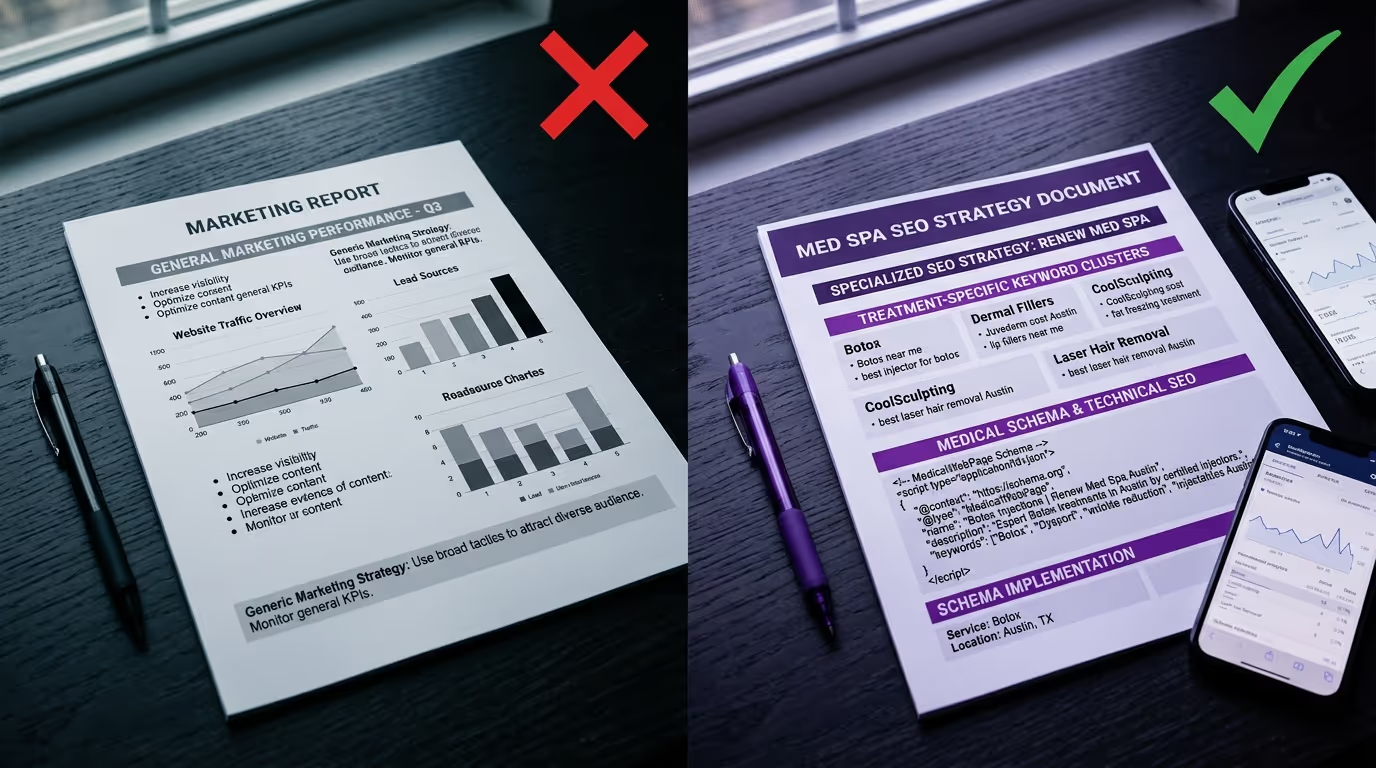
Here is the uncomfortable truth: most marketing agencies have no idea how to approach SEO for medical spas effectively. They apply the same playbook they use for dentists, plumbers, and pizza shops. And it does not work — because med spa SEO operates under an entirely different set of rules.
Your website falls under Google's YMYL (Your Money or Your Life) classification. That means Google holds your content to a higher standard than almost any other local business. Get it wrong, and you do not just miss page one — you get buried.
This is the guide to what actually works for medical spa SEO. No fluff, no generic advice. Just the specialized SEO for med spa approach that ranks medical spas in 2026.
The 7 Ways Generic Agencies Fail Med Spa SEO
Before we build the right strategy, you need to understand exactly why the generic approach fails. This is not theory — these are the specific patterns we see when we audit med spas that have worked with generalist agencies.
1. They Ignore YMYL Signals Entirely
Google's Search Quality Rater Guidelines explicitly classify medical and aesthetic procedures as YMYL content. That means every page on your site about Botox, fillers, laser treatments, or body contouring is held to the same scrutiny as a page about heart surgery or financial advice.
A generic agency does not even know what YMYL means. They will write a 500-word page about CoolSculpting with zero medical credentials cited, no author attribution, and no references to clinical data. Google sees that page and thinks: "Why should I trust this?"
The result: Your treatment pages sit on page 4 while a competitor with proper E-E-A-T signals ranks on page 1 with inferior content.
What it costs you: Every position lost on page 1 of Google reduces click-through rate by approximately 30%. A treatment page ranking #8 instead of #3 gets 80% less traffic — which translates to 80% fewer organic leads for that treatment.
How to Fix This
- Audit every treatment page on your site for medical credential signals.
- Add author attribution with provider name, credentials, and linked bio page.
- Include "Medically reviewed by [Provider Name], [Credentials]" on every clinical content page.
- Reference clinical data, FDA approvals, and published research where applicable.
- Add provider schema markup (Physician type) to provider bio pages.
2. They Skip Medical Schema Markup
Schema markup tells search engines exactly what your content is about in a language they understand natively. For med spas, this means specialized markup that most agencies have never implemented.
What generic agencies do: Add basic LocalBusiness schema and call it done.
What specialized med spa SEO requires:
- MedicalBusiness schema for your practice
- Physician schema for your providers
- MedicalProcedure schema for each treatment
- FAQPage schema for treatment Q&As
- LocalBusiness schema with service areas
- Review and AggregateRating schema for social proof
- Service schema for each treatment with pricing
That is the difference between showing up as "a local business that does stuff" and "a medical practice offering FDA-approved aesthetic treatments performed by board-certified providers."
For implementation details, see our med spa schema markup guide.
Implementation Steps
- Install a schema markup plugin or add JSON-LD to your site header.
- Start with MedicalBusiness schema on your homepage and about page.
- Add MedicalProcedure schema to every treatment page.
- Implement FAQPage schema on any page with Q&A content.
- Add Physician schema to every provider bio page.
- Test all schema with Google's Rich Results Test tool before publishing.
- Monitor Search Console for schema errors monthly.
Schema Impact Benchmarks
| Schema Type | Average Impact on Click-Through Rate |
|---|---|
| FAQPage (rich results) | +15-25% CTR increase |
| AggregateRating (star ratings) | +20-35% CTR increase |
| MedicalProcedure | +10-15% CTR increase |
| Combined medical schema | +30-50% CTR increase vs. no schema |
3. They Build One Page Per Service Category
A generic agency will create a single "Injectables" page and list Botox, Dysport, Juvederm, Restylane, and Sculptra together in 400 words. This is catastrophically wrong for SEO for medical spas.
Each treatment has its own search intent. Someone searching "Botox near me" wants information about Botox — not a generic injectables overview. Someone searching "Sculptra vs Juvederm" wants a comparison — not a services menu.
What top-ranking med spas do instead: They build individual, in-depth pages for every treatment (1,000-1,500 words minimum), plus comparison pages, plus area-specific treatment pages. A single injectable service line might generate 15-20 optimized pages.
Content Architecture for a Single Service Line (Injectables)
| Page Type | Example | Target Keyword |
|---|---|---|
| Category pillar | Complete Guide to Injectables | injectables [city] |
| Individual product | Botox in [City] | botox [city] |
| Individual product | Juvederm in [City] | juvederm [city] |
| Individual product | Sculptra in [City] | sculptra [city] |
| Treatment area | Lip Filler in [City] | lip filler [city] |
| Treatment area | Under-Eye Filler in [City] | under eye filler [city] |
| Treatment area | Jawline Filler in [City] | jawline filler [city] |
| Comparison | Botox vs Dysport | botox vs dysport |
| Comparison | Juvederm vs Restylane | juvederm vs restylane |
| Cost page | How Much Does Botox Cost in [City] | botox cost [city] |
| Cost page | Lip Filler Cost in [City] | lip filler cost [city] |
| FAQ page | Botox FAQ: Everything You Need to Know | how long does botox last |
That is 12+ pages from a single service line. Multiply across injectables, body contouring, laser treatments, skin rejuvenation, and weight loss — and you have a content library that dominates your local market.
Common Mistakes
- Thin content. 300-word treatment pages will not rank against competitors with 1,500-word pages. Depth wins in YMYL verticals.
- Duplicate content across locations. Swapping city names on identical templates is a penalty risk. Each location page needs 200+ words of unique content.
- Missing FAQs. FAQ sections capture "People Also Ask" placements and drive additional impressions. Every treatment page needs 6-10 unique FAQs.
- No internal linking between related pages. Your Botox page should link to your Botox marketing guide, your injectable pillar page, and your lip filler page. Every page should connect to 5-10 related pages.
4. They Produce Generic Content That Builds Zero Authority
"5 Benefits of Getting a Facial" is not med spa content. It is filler. Literally.
Generic agencies churn out surface-level blog posts that could apply to any spa, salon, or wellness center. They do not differentiate between a medical spa performing physician-supervised treatments and a day spa offering cucumber facials.
Med spa content needs to demonstrate clinical expertise. That means discussing mechanism of action, expected outcomes with realistic timelines, contraindications, provider qualifications, and before-and-after documentation. It means content that could only come from a practice that actually performs these procedures.
What Authority-Building Content Looks Like
Generic agency content (won't rank):
"Botox is a popular treatment that can reduce wrinkles. Many people choose Botox because it is quick and effective. Contact us to learn more."
Specialized med spa content (will rank):
"Botox Cosmetic (onabotulinumtoxinA) works by temporarily blocking acetylcholine release at the neuromuscular junction, relaxing targeted facial muscles that cause dynamic wrinkles. Results typically appear within 3-5 days and reach full effect by day 14. At [Practice], our board-certified injectors average 5,000+ Botox treatments annually and use a micro-dosing technique that preserves natural expression while reducing lines in the forehead, glabella, and lateral canthal areas."
The second version demonstrates E-E-A-T (Experience, Expertise, Authoritativeness, Trustworthiness) in every sentence. Google rewards this.
Content Production Benchmarks
| Metric | Generic Agency | Specialized Med Spa SEO |
|---|---|---|
| Blog posts per month | 4 (400-600 words each) | 4-8 (1,500-2,500 words each) |
| Treatment pages | 1 per category | 5-15 per category |
| Content author | "Admin" or no attribution | Named provider with credentials |
| Medical review | None | Every clinical page reviewed |
| Internal links per post | 0-2 | 8-15 |
| Time to ranking results | 6-12 months (if ever) | 3-6 months for long-tail terms |
For content strategy that actually builds authority and drives organic traffic, you need a plan built around treatment-based topic clusters — not a random blog calendar.
5. They Do Not Understand Patient Search Intent
Patient search behavior for aesthetic treatments follows a specific pattern that generic agencies miss completely:
- Awareness stage: "How to get rid of neck lines" (informational)
- Consideration stage: "Botox vs fillers for neck lines" (comparison)
- Decision stage: "Best Botox provider [city]" (transactional)
- Action stage: "Botox near me" or "[practice name] reviews" (navigational)
A generic agency targets the action stage only — "Botox near me" — and ignores the rest of the funnel. They miss 70% of potential patients who are still researching.
Implementation Steps for Full-Funnel Keyword Coverage
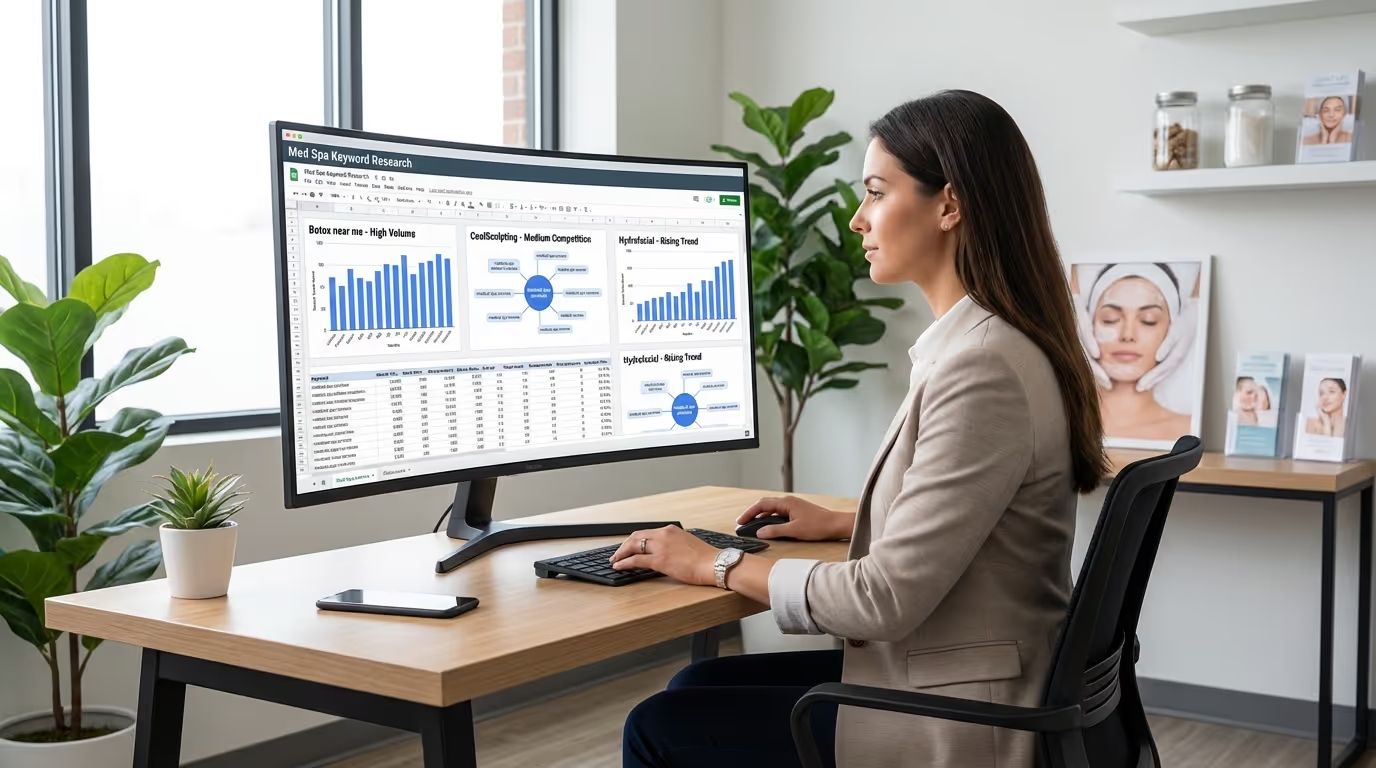
- Map keywords to each stage. Use keyword research tools (Ahrefs, SEMrush) to identify search volume at every stage for each treatment.
- Create content for every stage. Awareness content (blog posts answering questions), consideration content (comparison pages), decision content (treatment pages with social proof), action content (optimized GBP and booking pages).
- Build internal links that guide patients through stages. An awareness blog post should link to a comparison page, which links to a treatment page, which links to booking. This mirrors the natural patient journey.
- Prioritize keywords by commercial intent AND volume. A keyword with 500 monthly searches and high commercial intent (e.g., "CoolSculpting [city]") is worth more than a keyword with 5,000 monthly searches and low intent (e.g., "what is CoolSculpting").
6. They Neglect Local SEO Fundamentals
Generic agencies often treat local SEO as an afterthought — a quick Google Business Profile setup and a handful of directory listings. For med spas, local SEO is the highest-impact opportunity, not an add-on.
Why local SEO matters more for med spas than most businesses:
- 46% of all Google searches have local intent
- Local 3-pack results get 42% of clicks for "near me" searches
- Med spa patients typically travel 15-20 minutes maximum
- Your competition is hyperlocal — you're not competing nationally, you're competing in a 15-mile radius
Implementation Steps for Local SEO
- Optimize your Google Business Profile completely. Every field filled, 100+ photos, weekly Google Posts, proactive Q&A management.
- Build citations on 40+ directories with identical NAP (Name, Address, Phone) data. Tier 1: Google, Yelp, Facebook, Apple Maps, Healthgrades, RealSelf. Tier 2: YellowPages, BBB, Vitals, WebMD.
- Generate reviews systematically. Target 10-20 new Google reviews per month. Automate the ask via SMS 2-4 hours post-appointment.
- Create city and neighborhood landing pages with unique content (not copy-pasted templates with city name swaps).
- Build local backlinks through sponsorships, local press, Chamber of Commerce, community involvement.
- Implement LocalBusiness schema with geo-coordinates, service areas, and aggregate review ratings.
Local SEO Ranking Factors for Med Spas (Weighted)
| Factor | Weight | What It Means |
|---|---|---|
| Google Business Profile signals | 32% | Completeness, categories, reviews, photos, posts |
| On-page signals | 19% | NAP, keywords, content relevance, schema |
| Review signals | 16% | Quantity, velocity, diversity, response rate |
| Link signals | 11% | Domain authority, local link relevance |
| Citation signals | 7% | NAP consistency, citation volume |
| Behavioral signals | 7% | Click-through rate, engagement, dwell time |
| Personalization | 6% | Searcher proximity, search history |
| Social signals | 2% | Social media activity and engagement |
Source: Adapted from Whitespark Local Search Ranking Factors Study, applied to medical aesthetics vertical.
7. They Ignore Technical SEO for YMYL Sites
Generic agencies rarely address the technical SEO requirements specific to medical websites. For YMYL sites, technical foundations must be flawless.
Technical SEO Checklist for Med Spas
- Page speed optimization. Target LCP under 2.5 seconds, INP under 200ms, CLS under 0.1. Compress images, defer JavaScript, use a CDN. See our website optimization guide.
- Mobile-first design. 70%+ of med spa searches happen on mobile. Google uses mobile-first indexing. If your mobile experience is broken, your rankings suffer everywhere.
- SSL/HTTPS. Non-negotiable for any site handling patient data. Also a ranking signal.
- XML sitemap. Include all treatment pages, location pages, blog posts, and provider pages. Submit to Search Console.
- Structured data testing. Run every page through Google's Rich Results Test. Fix all errors and warnings.
- Canonical tags. Prevent duplicate content issues from URL parameters, print versions, or mobile URLs.
- Internal link architecture. Every page should be reachable within 3 clicks from the homepage. Use breadcrumbs for hierarchical navigation.
- 404 error monitoring. Check Search Console weekly for crawl errors. Fix broken links promptly.
The Specialized SEO for Medical Spas Approach That Actually Ranks
Now that you understand why generic SEO fails, here is the framework for SEO for medical spas that actually works. This is the approach we use for every med spa we work with.
Treatment-Specific Content Clusters
The foundation of effective medical spa SEO is the content cluster model, built around each treatment category.
Pillar page: A comprehensive guide (2,000-3,000 words) covering everything about a treatment category. Example: "The Complete Guide to Dermal Fillers in [City]."
Cluster pages: Supporting content that targets specific long-tail keywords and links back to the pillar page:
- Individual filler brand pages (Juvederm, Restylane, Sculptra, RHA, Versa)
- Treatment area pages (lip filler, cheek filler, jawline filler, under-eye filler)
- Comparison pages (Juvederm vs Restylane, filler vs Botox for nasolabial folds)
- FAQ pages (How long does Juvederm last? Does filler hurt?)
- Cost pages (Juvederm cost in [city], how much does lip filler cost?)
One injectable category can generate 20-30 pages of targeted content. Multiply that across all your treatment offerings and you have a content library that dominates your local market.
Implementation Steps for Content Clusters
- List all treatment categories your practice offers (injectables, body contouring, skin rejuvenation, laser treatments, weight loss, etc.).
- For each category, identify the pillar topic and 10-20 supporting subtopics.
- Research keyword volume and difficulty for each subtopic using Ahrefs or SEMrush.
- Prioritize by commercial intent — treatment + city keywords first, then informational keywords.
- Create a publishing calendar — one pillar page per month, 4-8 cluster pages per month.
- Build the internal linking structure — every cluster page links to its pillar, pillar links to all clusters, related clusters cross-link.
- Update pillar pages quarterly with new information, updated data, and links to new cluster content.
Real results: We have seen med spas go from ranking for 12 keywords to ranking for 200+ keywords within 6 months using this model — without building a single backlink. For a detailed case study, see our med spa SEO case study.
Provider Authority Signals (E-E-A-T)
Google's E-E-A-T framework (Experience, Expertise, Authoritativeness, Trustworthiness) is not optional for med spas. It is the single biggest ranking factor for YMYL content.
Provider Pages That Actually Work
Your provider bio pages should not be an afterthought. They are critical SEO assets.
Implementation steps:
- Create individual pages for every provider (not a group staff page).
- Include full biography with credentials, board certifications, and specialized training.
- Use a professional headshot (not a stock photo or casual snapshot).
- Link to published research, speaking engagements, or media appearances.
- Add Physician schema markup with relevant properties.
- List each provider as the author on content they create or supervise.
- Link to external validation (medical board profiles, LinkedIn, publications, hospital affiliations).
Content Attribution That Builds Trust
- Every treatment page should have a named author (the provider who supervises that treatment).
- Medical content should show "Medically reviewed by [Provider Name], [Credentials]" with a date.
- Author pages should link to external credentials for verification.
- Blog posts should be attributed to specific providers, not "Admin" or the practice name.
Practice Authority Signals
- Display accreditations and certifications prominently (not buried in a footer).
- List association memberships (AmSpa, ASLMS, AAFPRS, etc.) with links.
- Highlight awards and recognitions with dates.
- Include years in practice and procedure volume where appropriate ("Over 10,000 injectable treatments performed").
Medical Schema Markup Implementation
Beyond the basics, medical schema gives you a competitive edge that most med spas have not implemented:
``json { "@context": "https://schema.org", "@type": "MedicalProcedure", "name": "Botox Cosmetic Injection", "procedureType": "NoninvasiveProcedure", "body": { "@type": "AnatomicalStructure", "name": "Facial muscles" }, "preparation": "No anesthesia required", "howPerformed": "Injection of botulinum toxin into targeted facial muscles", "status": "FDA-approved", "potentialAction": { "@type": "ReserveAction", "target": "https://yourdomain.com/book-consultation" } } ``
Layer this with FAQPage schema on your treatment pages and you start pulling rich results — those expandable Q&A boxes that dominate the top of search results. We have seen med spa treatment pages capture 3-4 FAQ rich results on a single SERP, pushing organic competitors below the fold.
For the complete schema implementation guide, see our med spa schema markup walkthrough.
HIPAA-Conscious Review Strategy
Reviews are the lifeblood of local SEO. But med spas face a unique challenge: HIPAA compliance.
You cannot publicly acknowledge that someone is a patient. You cannot respond to a negative review by discussing their treatment. You cannot solicit reviews in a way that implies a treatment relationship without consent.
The Compliant Approach
- Use HIPAA-compliant review request workflows. Send review requests through your EHR or CRM with proper authorization language. Never send from a personal email or text.
- Train front desk staff on response protocols. Positive reviews: thank them generally without confirming treatment details. Negative reviews: acknowledge, express concern, invite them to contact you offline. Never, ever reference specifics.
- Leverage consent-based before-and-after content. Patients who consent to sharing results (with signed authorization) become your most powerful SEO asset. Photo galleries with proper alt text and schema markup drive significant image search traffic.
- Build review velocity across platforms. Google, Yelp, RealSelf, and Healthgrades all feed into your authority signals. A steady stream of 8-15 reviews per month beats a one-time push of 50 reviews every time.
- Never incentivize reviews. No discounts, no free treatments, no drawings. It violates Google's terms and puts your practice at risk.
For the complete review management playbook, including response templates and staff training scripts, see our dedicated guide.
Link Building for Medical Aesthetics
Backlinks remain a top-3 ranking factor, but link building for med spas requires a different approach than generic SEO.
High-Value Link Building Strategies
| Strategy | Difficulty | Link Quality | Time Investment |
|---|---|---|---|
| Local press and media mentions | Medium | High | 4-8 hours/month |
| Guest posts on health/wellness sites | Medium | High | 8-12 hours/month |
| Local business partnerships | Low | Medium | 2-4 hours/month |
| Chamber of Commerce membership | Low | Medium | 1-2 hours (one-time) |
| Industry association directories | Low | High | 2-3 hours (one-time) |
| Sponsoring local events | Low | Medium | 2-4 hours/event |
| Provider interviews and podcasts | Medium | High | 4-6 hours/month |
| Original research and surveys | High | Very High | 20-40 hours (one-time) |
Implementation Steps for Link Building
- Join and list on industry directories. AmSpa, RealSelf, Healthgrades, Vitals — these are high-authority, relevant links.
- Pitch your medical director as a source. Local journalists and health publications need expert sources. Services like HARO, Quoted, and Source of Sources connect you with journalists.
- Sponsor local events and charities. Most provide a backlink on their website.
- Create linkable content assets. Original survey data ("We surveyed 500 med spa patients..."), comprehensive treatment guides, or interactive tools (treatment quiz, cost calculator) attract links naturally.
- Build relationships with complementary businesses. Dermatologists, plastic surgeons, fitness studios, and wellness practitioners can create mutual referral links.
For the complete link building strategy, including outreach templates and a monthly action plan, see our dedicated guide.
Before and After: What Specialized Med Spa SEO Produces
Case Study: Single-Location Med Spa, Southeast US
Before (generic agency, 12 months):
- 18 indexed pages
- Ranking for 23 keywords (none in top 3)
- 340 organic visits/month
- 4 online booking requests/month from organic
- Cost per organic lead: $750+ (factoring in monthly SEO retainer)
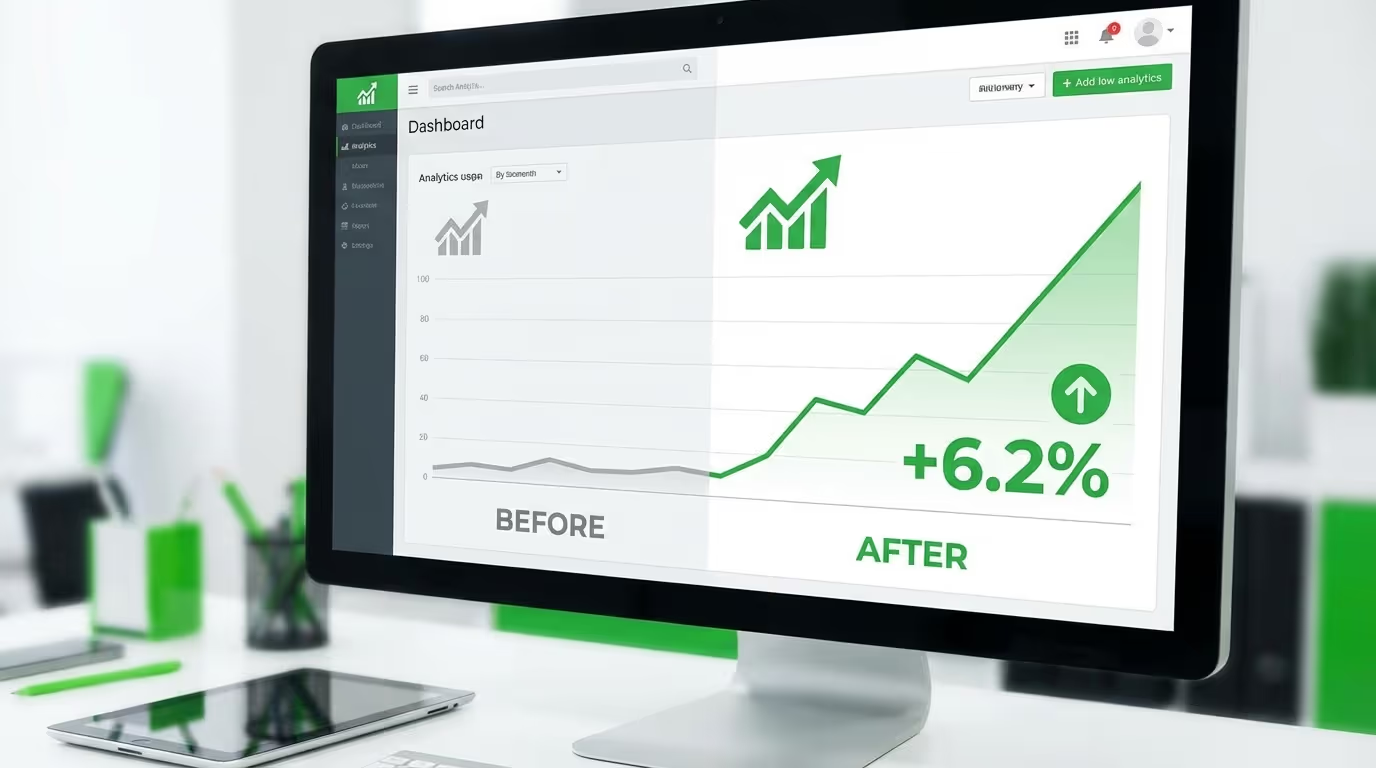
After (specialized approach, 6 months):
- 87 indexed pages
- Ranking for 312 keywords (41 in top 3)
- 2,800 organic visits/month
- 47 online booking requests/month from organic
- Cost per organic lead: $64 (and declining monthly)
The difference was not more content. It was the right content, structured correctly, with proper authority signals and medical schema.
Revenue impact: At a 25% consultation-to-treatment conversion rate and $500 average treatment value, those 47 organic leads generated approximately $5,875/month in new revenue — from a channel that costs nothing per click.
Case Study: Multi-Location Med Spa, 3 Locations
Before (generic agency, 8 months):
- One website serving all locations with a "Locations" dropdown
- 52 total keywords ranked
- Location pages were carbon copies with swapped city names
- Google Business Profiles had inconsistent categories
- Combined organic leads: 12/month
After (specialized approach, 9 months):
- Location-specific content hubs with unique treatment pages per market
- 890 total keywords ranked
- Each location ranking independently for local treatment queries
- Unified review strategy driving 15+ reviews/month per location
- Combined organic leads: 134/month
- Cost per organic lead reduced from $417 to $52
The Complete Med Spa SEO Checklist
Use this as your implementation roadmap. Check off each item as you complete it. For the expanded version with 50+ detailed steps, see our med spa SEO checklist.
Foundation (Month 1)
- [ ] Complete Google Business Profile optimization (guide)
- [ ] Audit and fix all NAP inconsistencies across directories
- [ ] Install Google Analytics 4 and Search Console
- [ ] Run a technical SEO audit (page speed, mobile usability, crawl errors)
- [ ] Implement MedicalBusiness schema on homepage
- [ ] Create XML sitemap and submit to Search Console
- [ ] Set up rank tracking for target keywords
Treatment Pages (Month 2-3)
- [ ] Create individual pages for every treatment (1,000-1,500 words each)
- [ ] Optimize H1, title tag, and meta description for "[Treatment] in [City]"
- [ ] Add FAQPage schema to every treatment page
- [ ] Include before/after photos with descriptive alt text
- [ ] Add provider credentials and treatment-specific experience
- [ ] Build internal links between related treatment pages
Content Clusters (Month 3-6)
- [ ] Build pillar pages for each treatment category (2,000-3,000 words)
- [ ] Create 10-20 supporting cluster pages per category
- [ ] Implement hub-and-spoke internal linking structure
- [ ] Publish 4-8 blog posts per month targeting long-tail keywords
- [ ] Attribute all content to named providers with credentials
Authority Building (Month 4-12)
- [ ] Build citations on 40+ directories
- [ ] Generate 10-20 new Google reviews per month
- [ ] Launch link building campaign (2-5 quality links per month)
- [ ] Create provider authority pages with external validation links
- [ ] Pitch media placements and guest posts
Ongoing Optimization
- [ ] Monitor rankings weekly for target keywords
- [ ] Review Search Console for errors and opportunities monthly
- [ ] Update pillar pages quarterly with fresh content
- [ ] Audit competitor movements monthly
- [ ] Track organic lead volume and conversion rates
The SEO Metrics That Actually Matter for Med Spas
Stop obsessing over vanity metrics. Here is what to track:
| Metric | Why It Matters | Benchmark |
|---|---|---|
| Organic booking requests | Direct revenue attribution | 30-50/month for single location |
| Treatment page rankings | Measures content cluster effectiveness | Top 5 for primary treatment + city |
| Google Business Profile actions | Calls, directions, website clicks | 500+ actions/month |
| Review velocity | Feeds local pack rankings | 8-15 new reviews/month |
| Organic click-through rate | Indicates title/meta optimization | 3-5% average, 8%+ for branded |
| Page speed (Core Web Vitals) | Direct ranking factor | LCP under 2.5s, CLS under 0.1 |
| Keywords in top 10 | Overall SEO progress | 50+ within 6 months |
| Cost per organic lead | Efficiency of SEO investment | $40-$80 (declining over time) |
Common Measurement Mistakes
- Tracking rankings without tracking revenue. Ranking #1 for a keyword that nobody searches is worthless. Connect SEO metrics to actual patient bookings.
- Celebrating traffic without conversion. If organic traffic grows 200% but bookings stay flat, your content is attracting the wrong audience or your conversion path is broken.
- Comparing organic to paid on a monthly basis. SEO is a compounding investment. Compare organic ROI at 12 months, not 30 days.
- Not tracking by treatment. Your Botox pages might rank well while your body contouring pages are invisible. Treatment-level tracking reveals where to invest next.
How to Evaluate Your Current SEO Agency
If you already have an SEO agency and aren't sure whether they're delivering, ask these questions:
- Can you show me which specific keywords we've improved rankings for this quarter? If they can't, they're not tracking properly.
- How many organic leads did we generate last month, and which pages generated them? If they report traffic but not leads, they're hiding bad conversion data.
- What medical schema markup have you implemented on our site? If they say "what's schema markup?" or "we did LocalBusiness," that's a red flag.
- Show me the content calendar for next quarter. If there isn't one, they're winging it.
- How are we building E-E-A-T signals? If they don't know what E-E-A-T means for a medical website, they shouldn't be managing your SEO.
- What is our current cost per organic lead? If they can't calculate this, they don't understand ROI.
- How do you handle HIPAA compliance in our content and review strategy? If this draws a blank stare, walk away.
For an in-depth look at what to expect from a med spa marketing agency, including pricing benchmarks and evaluation criteria, see our honest agency review.
Stop Paying for Generic SEO — Invest in Real SEO for Medical Spas
If your agency cannot explain the difference between YMYL and regular local SEO, they should not be managing your medical spa's search strategy. Period.
SEO for medical spas is not harder than other verticals — it is different. It requires understanding medical content standards, patient search behavior, HIPAA constraints, and the specific trust signals Google looks for in health-related content.
The med spas that dominate their local search results in 2026 are not the ones spending the most on medical spa SEO. They are the ones working with specialists who understand how SEO for med spa practices actually differs from generic local SEO.
Here is a simple test: look at your SEO agency's other clients. If they also serve plumbers, restaurants, and car dealerships, your med spa is getting the plumber playbook with your logo on it.
Ready to see what specialized med spa SEO looks like for your practice? Book a strategy call to see exactly where your current strategy is falling short and what a specialized approach would look like for your market.
We will audit your current rankings, review your content strategy, evaluate your technical SEO, and give you a prioritized action plan — whether you work with us or not.
Related reading:
- Med Spa Local SEO: The Complete Guide to Ranking in Your City
- Med Spa Content Strategy for SEO Growth
- Med Spa Keyword Research: How to Find What Patients Search
- Med Spa Link Building: Strategies That Work
- Med Spa Schema Markup: Technical SEO That Wins
- Med Spa SEO Checklist: 50+ Steps to Rank Higher
- Med Spa Marketing Strategies: The Definitive Guide
- Med Spa Website Design: What Makes a High-Converting Site