
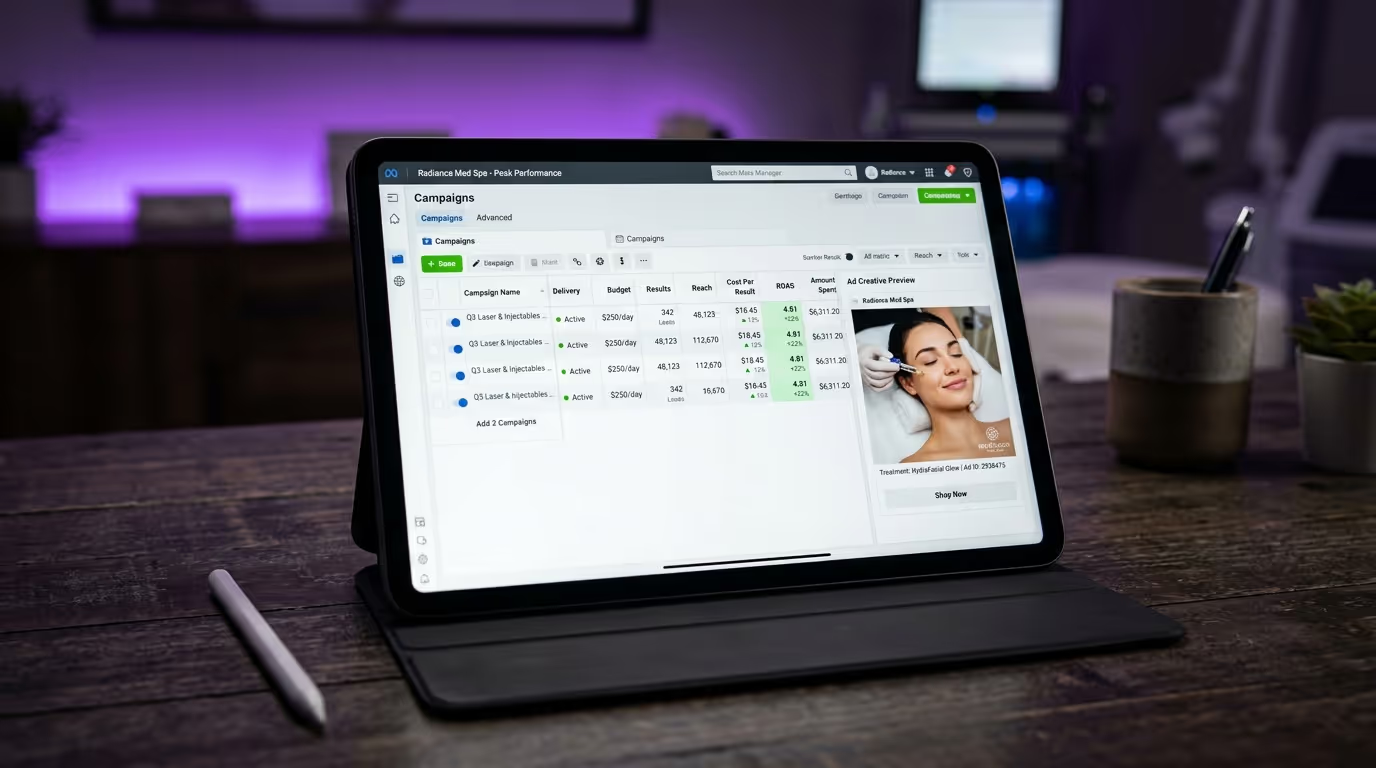
Facebook and Instagram remain the highest-volume patient acquisition channels for med spas in 2026. No other platform lets you put Botox promotions, body contouring results, and membership offers in front of your ideal patient demographic with this level of precision.
But most med spas waste thousands per month on Facebook ads for med spas because they ignore the platform's health advertising restrictions, run flat campaign structures, and send traffic to their homepage instead of dedicated landing pages.
The result: $80-150 cost per lead when it should be $30-50. Leads that never convert because the landing page did not match the ad. And ad accounts that get restricted or banned because nobody bothered to read Meta's health advertising policies.
This guide covers the complete med spa Facebook ads strategy — from navigating Special Ad Categories to building full-funnel campaigns that consistently deliver profitable patient acquisition. Every strategy here has been tested across real med spa ad accounts.
Meta's Special Ad Categories: What Med Spas Need to Know
Here is where most med spa owners get blindsided. Meta classifies certain health and wellness services under Special Ad Categories, which restricts your targeting options. If you run ads promoting medical procedures without understanding these rules, your ad account will get flagged, restricted, or permanently banned.
We have seen med spa owners lose ad accounts they spent years building because they ran one non-compliant before-and-after ad. The account restrictions are real, and recovery is difficult.
What Triggers Special Ad Category Restrictions
Meta's health advertising policies apply when your ads reference specific medical conditions, procedures, or health outcomes. For med spas, this means:
- Ads mentioning specific treatments (Botox, fillers, laser treatments) may trigger elevated review
- Before-and-after imagery is heavily restricted and often automatically rejected
- Claims about health outcomes ("eliminate wrinkles," "cure acne scarring") will get flagged immediately
- Targeting based on health interests is limited compared to standard ad categories
- Weight loss content faces the strictest scrutiny — see our weight loss clinic marketing guide for compliant approaches
How to Navigate the Restrictions
The strategy is not to fight Meta's system — it is to work within it:
- Frame ads around confidence and self-care rather than medical outcomes. "Look and feel your best" performs better than "eliminate fine lines" from a compliance standpoint.
- Use lifestyle imagery showing happy, confident patients rather than clinical before-and-after shots. Authenticity beats clinical every time.
- Avoid mentioning specific medical conditions in ad copy. Focus on the experience and the result emotionally, not clinically.
- Build separate campaigns for content that educates (blog posts, videos) versus content that sells (offers, promotions). Educational content faces fewer restrictions.
- Maintain a strong ad account history. New accounts with aggressive medical claims get shut down fast. Start with softer messaging and scale up gradually.
Compliance Checklist
Before launching any med spa Facebook ad campaign, verify:
| Compliance Item | Status |
|---|---|
| Ads do not make specific medical outcome claims | [ ] |
| No side-by-side before/after images in ad creative | [ ] |
| Ad copy does not reference specific medical conditions | [ ] |
| Landing page is HIPAA-compliant (secure forms, privacy policy) | [ ] |
| Testimonials include "results may vary" disclaimers | [ ] |
| All claims are truthful and substantiable | [ ] |
| Ad account is in good standing with no active violations | [ ] |
| Special Ad Category requirements reviewed for each campaign | [ ] |
| State medical advertising regulations followed | [ ] |
| Provider credentials accurately represented | [ ] |
If your ad account gets restricted, do not create a new one. Appeal the decision and adjust your creative. Creating duplicate accounts is a permanent ban offense.
Understanding the Med Spa Facebook Ads Landscape in 2026
Before building campaigns, understand the current environment. Med spa advertising on Meta has changed significantly in the past two years:
CPMs have increased 25-40%. More med spas are advertising on Meta than ever before, driving up costs. This means creative quality and funnel efficiency matter more than ever.
Video dominates. Across med spa accounts we manage, video ads consistently deliver 40-60% lower cost per lead than static image ads. Reels placement delivers the lowest CPMs.
UGC outperforms polished content. User-generated content — real patients sharing real experiences filmed on phones — outperforms professionally produced content by 2-3x on engagement and cost per lead.
Full-funnel is non-negotiable. Med spas running only bottom-of-funnel conversion campaigns see rising costs and diminishing returns. The practices maintaining $30-50 CPL are running proper three-tier funnels.
Meta Ads Benchmarks for Med Spas (2026)
| Metric | Poor | Average | Good | Excellent |
|---|---|---|---|---|
| Cost Per Lead (CPL) | $80+ | $50-80 | $30-50 | Under $30 |
| Cost Per Acquisition (CPA) | $200+ | $120-200 | $75-120 | Under $75 |
| Click-Through Rate (CTR) | Under 0.8% | 0.8-1.5% | 1.5-2.5% | 2.5%+ |
| Landing Page Conversion | Under 8% | 8-15% | 15-25% | 25%+ |
| Return on Ad Spend (ROAS) | Under 2x | 2-4x | 4-8x | 8x+ |
| Lead-to-Appointment Rate | Under 25% | 25-40% | 40-60% | 60%+ |
If your numbers fall in the "Poor" column, your campaign structure, creative, or funnel has a fundamental problem. This guide will help you identify and fix it.
Audience Targeting for Meta Ads Medspa Campaigns
Even with Special Ad Category limitations, Meta offers powerful targeting for med spas. The key is layering multiple targeting strategies across your funnel.
Interest-Based Targeting (Top of Funnel)
For cold audiences, combine these interest categories:
Demographics:
- Women 28-60 (your core demographic for most treatments)
- Household income top 25-30% (where available)
- Geographic radius: 15-25 miles around your location
Interest layers (combine 2-3 for tighter targeting):
- Skincare and anti-aging
- Wellness and self-care
- Luxury lifestyle and premium brands
- Spa services and beauty
- Specific brands (Allergan, SkinCeuticals, Obagi, La Mer)
- Fitness and health consciousness
Layer interests together rather than using single broad categories. A woman aged 35-55 interested in both "anti-aging skincare" and "luxury spa" is a stronger prospect than someone who only matches one category.
Lookalike Audiences (Scaling)
Lookalike audiences are your best scaling tool. Build them from your highest-value data sources:
| Seed Audience | Lookalike Quality | When to Use |
|---|---|---|
| Existing patient list (email/phone) | Highest | Always — this is your #1 audience |
| Highest-value patients ($5K+ spend) | Very High | When you have 500+ patients in CRM |
| Website visitors who viewed treatment pages | High | When you have 1,000+ monthly visitors |
| Video viewers (75%+ completion) | Medium-High | After running video content for 30+ days |
| Lead form submitters | Medium-High | When you have 100+ form submissions |
| Instagram/Facebook page engagers | Medium | Broad but useful for TOF |
Start with 1% lookalikes for the tightest match, then expand to 2-3% as you scale. A 1% lookalike built from your highest-value patients will outperform a lookalike built from all website visitors every time.
Retargeting Audiences (Bottom of Funnel)
Retargeting is where med spa Facebook ads get profitable. These audiences already know you — they just need a push:
- Website visitors (last 30 days) who did not book — your broadest retargeting audience
- Treatment page visitors (last 14 days) — serve them ads for the specific treatment they viewed
- Video viewers (75%+ completion in last 30 days) — they engaged deeply with your content
- Instagram and Facebook engagers (last 90 days) — they interacted with your brand
- Lead form openers who did not submit (last 14 days) — they started but did not finish
Retargeting audiences are small, so keep budgets proportional. You do not need $50/day on a retargeting audience of 500 people — $10-15/day is sufficient. For a deeper retargeting strategy, see our med spa retargeting guide.
Campaign Structure: The Full-Funnel Framework
Flat campaign structures — one campaign, one audience, one ad — are why most med spa Facebook ads fail. You need a three-tier funnel that moves patients from awareness to conversion.
Top of Funnel (TOF) — Awareness and Education
Objective: Video views, engagement, or traffic Budget allocation: 50-60% of total ad spend Target: Cold interest-based audiences and broad lookalikes
What to run:
- Educational video content (60-90 second treatment explainers)
- Provider introduction videos ("Meet Dr. Smith" — builds trust at scale)
- Clinic tour and atmosphere content (show the premium experience)
- Blog post promotions covering treatment-specific topics — link to posts like our Botox marketing guide or CoolSculpting marketing guide
- Myth-busting content ("5 things you didn't know about Botox")
- Patient journey stories (not before/after — the emotional experience)
The goal here is not leads. It is building a retargeting pool of warm prospects who have engaged with your content. Every dollar spent on TOF feeds your MOF and BOF campaigns. Med spas that skip TOF see their BOF costs climb 40-60% over time as retargeting pools shrink.
Middle of Funnel (MOF) — Consideration
Objective: Traffic to treatment pages or lead generation Budget allocation: 20-25% of total ad spend Target: Video viewers (50%+), website visitors (60 days), Instagram/Facebook engagers
What to run:
- Patient testimonial videos (the single highest-converting ad type for med spas)
- Social proof carousels (results, reviews, awards, provider credentials)
- Treatment comparison content ("Botox vs. Dysport: Which is right for you?")
- "What to expect" content (reduces anxiety, increases booking confidence)
- Educational landing page content with soft CTAs
Bottom of Funnel (BOF) — Conversion
Objective: Conversions (lead form submissions or booking page visits) Budget allocation: 20-25% of total ad spend Target: Website visitors (30 days), treatment page visitors (14 days), engaged leads who have not booked
What to run:
- Limited-time offers ("New Patient Botox Special — $10/unit this month")
- Free consultation offers with specific value propositions
- Membership program promotions
- Seasonal promotions tied to your marketing calendar
- Event-based offers (open house invitations, VIP nights)
- Referral program promotions to existing patient audiences
This is where you drive direct bookings. BOF ads should always go to a dedicated landing page — never your homepage.
Campaign Structure Blueprint
| Campaign | Objective | Budget % | Audience | Creative | KPI |
|---|---|---|---|---|---|
| TOF - Education | Video Views | 30% | Interest-based, broad lookalikes | Provider videos, treatment explainers | Cost per ThruPlay, audience size built |
| TOF - Content | Traffic | 25% | Interest-based, broad lookalikes | Blog posts, educational content | CPC, time on page |
| MOF - Trust | Traffic/Leads | 20% | Video viewers, site visitors, engagers | Testimonials, social proof | CPL, landing page conversion |
| BOF - Convert | Conversions | 25% | Treatment page visitors, warm leads | Offers, consultations, events | CPL, CPA, ROAS |
Ad Creative Best Practices
Video vs. Static Performance
| Creative Type | Avg. CPL | Avg. CTR | Best Placement | Best Funnel Stage |
|---|---|---|---|---|
| UGC-style video (phone-filmed) | $25-40 | 1.8-3.0% | Reels, Stories | TOF, MOF |
| Provider talking-head video | $30-45 | 1.5-2.5% | Feed, Reels | TOF, MOF |
| Patient testimonial video | $28-42 | 1.6-2.8% | Feed, Stories | MOF, BOF |
| Treatment process video | $32-48 | 1.4-2.2% | Feed, Reels | TOF |
| Static carousel (results/offers) | $40-65 | 1.0-1.8% | Feed | MOF, BOF |
| Static single image (offer) | $45-70 | 0.8-1.5% | Feed, Stories | BOF |
Video dominates on Meta in 2026. The data is not close. Invest in video creation — even phone-filmed content outperforms polished production.
What Works in Med Spa Video Ads
Patient testimonial videos (30-60 seconds, filmed on phone, authentic) — the single best-performing format across every med spa account we manage. The formula: patient shares why they came, what the experience was like, and how they feel now. Real emotion beats scripted perfection.
Provider "talking head" videos explaining treatments in simple language. Your injector or medical director on camera for 60-90 seconds demystifying a treatment. No lab coat necessary — approachability wins.
Treatment process videos showing what actually happens during a procedure. These build trust and reduce the anxiety that prevents first-time patients from booking.
Day-in-the-life content from your clinic. Behind the scenes, team interactions, the patient experience from arrival to departure.
Results-focused content showing the transformation experience — not clinical before/after, but the patient's emotional journey. "I feel like myself again" is more powerful than a side-by-side photo.
Before-and-After Content: The Rules
Meta's policies on before-and-after imagery are strict. Violate them and your ads get rejected — or worse, your account gets restricted.
What will get rejected:
- Side-by-side before/after images in ad creative
- Images that imply negative self-perception ("tired of looking old?")
- Close-up body part photos that focus on perceived flaws
- Dramatic transformation imagery
What you can do:
- Show results framed as the patient's experience, not a clinical comparison
- Use user-generated content where patients voluntarily share their results
- Link to your website where you can display full before/after galleries without Meta's restrictions
- Use "results" language focused on confidence and self-expression
Building a UGC Pipeline
User-generated content is the highest-ROI creative format for med spa Facebook ads. Here is how to build a consistent pipeline:
- Ask satisfied patients to record a 30-second video testimonial. Offer a small incentive — $25 off next visit or a complimentary skincare product. Provide simple direction: "Tell us why you came, what the experience was like, and how you feel about your results."
- Partner with local micro-influencers (5K-20K followers) for treatment experiences. Pay for the treatment, get content in return. Cost: $200-500 per content creation session.
- Repurpose organic patient reviews as text overlay ads. Take your best Google and Yelp reviews, overlay them on branded backgrounds.
- Use your staff as content creators. Nurse injectors explaining procedures in their own words outperform polished agency-produced content consistently. See our med spa UGC guide for a complete strategy.
Ad Copy Frameworks That Convert
For TOF (Educational): "Most people think [common misconception about treatment]. Here is what actually happens when you [treatment]..." — hooks with a myth, delivers education, ends with a soft CTA.
For MOF (Social Proof): "'I was nervous about my first [treatment] appointment. But the team at [Spa] made me feel so comfortable, and I am thrilled with my results.' — [Patient Name]. Ready to see what is possible? Book your free consultation." — patient voice drives trust.
For BOF (Conversion): "New Patient Special: [Specific offer with dollar amount]. [Credential that builds trust]. [Urgency element]. Book online or call [number]." — clear, direct, no ambiguity about the offer or next step.
Landing Pages: Where Most Med Spas Lose Money
Sending Facebook ad traffic to your homepage is throwing money away. The data is unambiguous: dedicated landing pages convert at 15-25%, while homepages convert at 2-5% for the same traffic. Every campaign needs a dedicated landing page aligned with the specific offer or treatment.
Landing Page Requirements
| Element | Requirement | Why It Matters |
|---|---|---|
| Headline | Must match the ad promise exactly | Mismatch = immediate bounce |
| CTA | One clear action (book, call, or claim) | Multiple CTAs reduce conversion |
| Social proof | Above the fold (stars, review count) | Builds instant trust |
| Mobile optimization | 90%+ of traffic is mobile | Non-mobile pages waste budget |
| Load speed | Under 3 seconds | Each second over = 20% more bounces |
| Form | Short (name, phone, email max) | Long forms kill conversion |
| HIPAA compliance | Secure form provider required | Legal requirement for health data |
For a complete landing page framework, see our med spa landing page guide. For broader website conversion optimization, check our med spa website optimization guide.
Landing Page Mistakes That Kill Conversion
Navigation menus on landing pages. Remove your standard site navigation. Every link that is not the CTA is an exit opportunity.
Forms that ask for too much. Name, phone, email. That is it for a consultation request. You can collect medical history during the consultation itself.
No mobile optimization. Test your landing page on an actual phone. If the form is hard to fill out or the CTA button is below the fold, you are losing 60%+ of your traffic.
Slow load times. Compress images, minimize scripts, use a fast hosting provider. Run PageSpeed Insights and fix anything scoring below 70 on mobile.
Budget Allocation and Scaling Strategy
Starting Budget: $2,000-3,000/Month
For med spas just getting started with Facebook ads, this is the minimum viable budget to generate meaningful data and results:
| Funnel Stage | Budget % | Monthly Spend | Expected Output |
|---|---|---|---|
| TOF (Awareness) | 55% | $1,100-1,650 | 10,000-30,000 video views, retargeting pool building |
| MOF (Consideration) | 20% | $400-600 | 500-1,500 landing page visits |
| BOF (Conversion) | 25% | $500-750 | 15-30 leads at $25-50 CPL |
At this level, focus on 2-3 core treatments. Do not spread budget across every service you offer. Identify your highest-demand treatments — usually Botox, fillers, and one other service — and concentrate your spend.
Scaling Budget: $3,000-5,000/Month
Once you have identified winning audiences and creative (typically after 60-90 days of testing), scale into this range:
| Funnel Stage | Budget % | Monthly Spend | Expected Output |
|---|---|---|---|
| TOF (Awareness) | 50% | $1,500-2,500 | 25,000-75,000 video views |
| MOF (Consideration) | 25% | $750-1,250 | 1,500-3,500 landing page visits |
| BOF (Conversion) | 25% | $750-1,250 | 25-50 leads at $30-50 CPL |
At $5K/month with optimized campaigns, med spas should expect 80-150 leads per month at $30-50 CPL, depending on market competitiveness and treatment type. For a full breakdown of how this fits into your overall marketing budget, see our budgeting guide.
Mature Budget: $5,000-10,000+/Month
At this level, you should be running campaigns across all major treatment categories, testing new audiences weekly, and maintaining a robust content strategy to feed your TOF campaigns. You should also be running Meta alongside Google Ads for a complete paid media strategy.
Scaling Rules
- Never increase budget more than 20% at a time. Larger jumps reset Meta's learning phase and spike CPL temporarily.
- Scale winning ad sets, not campaigns. Duplicate high-performing ad sets into new campaigns rather than increasing budgets on existing ones.
- Refresh creative every 4-6 weeks. Ad fatigue is real. When frequency exceeds 3.0, performance declines. Have new creative ready before existing creative burns out.
- Scale horizontally before vertically. Add new audiences and creative variations before increasing spend on existing ones.
Key Metrics to Track
Stop looking at vanity metrics. These are the numbers that matter for med spa Facebook ads:
| Metric | What It Tells You | Target Benchmark | Action If Off Target |
|---|---|---|---|
| Cost Per Lead (CPL) | Acquisition efficiency | $25-50 | Improve creative or targeting |
| Cost Per Acquisition (CPA) | Full-funnel conversion | $75-150 | Fix landing page or follow-up |
| Return on Ad Spend (ROAS) | Revenue per dollar spent | 4-8x | Improve conversion rate or AOV |
| Click-Through Rate (CTR) | Ad relevance and quality | 1.5%+ | Refresh creative or improve copy |
| Landing Page Conversion | Page effectiveness | 15-25% | Optimize page design and CTA |
| Lead-to-Appointment Rate | Follow-up quality | 40-60% | Train front desk, speed up follow-up |
| Show Rate | No-show management | 75-85% | Improve confirmation sequences |
| Frequency | Ad fatigue indicator | Under 3.0 | Refresh creative |
The metric that matters most is ROAS. If you are spending $3,000/month and generating $15,000 in booked revenue, your ROAS is 5x. That is a healthy campaign. If your ROAS is below 3x, something in your funnel is broken.
Track the full funnel — if CPL is great but CPA is terrible, the problem is not your ads. It is your front desk follow-up or your booking process. For a complete approach to tracking, see our med spa marketing ROI guide.
A/B Testing Framework
Never stop testing. Here is the testing hierarchy for med spa Facebook ads, in order of impact:
Testing Priority Order
- Audience testing — Test different lookalike seeds, interest stacks, and age ranges. Audience is the biggest lever. A bad audience with great creative still fails.
- Creative format testing — Video vs. static, UGC vs. produced, testimonial vs. educational. Creative format determines whether people stop scrolling.
- Offer testing — $10/unit Botox vs. free consultation vs. membership discount. The offer determines whether people take action.
- Ad copy testing — Headline variations, body copy length, CTA wording. Copy refinement provides incremental gains.
- Landing page testing — Form length, CTA button color/copy, social proof placement. Landing page optimization compounds over time.
Testing Rules
| Rule | Why It Matters |
|---|---|
| Test one variable at a time | Multiple variables = no clear learnings |
| Run tests for 5-7 days minimum | Shorter tests lack statistical significance |
| Need 1,000+ impressions per variation | Below this, data is unreliable |
| Kill losing variations quickly | But not before minimum test duration |
| Document every test and result | Institutional knowledge compounds |
| Test continuously, not in sprints | Ongoing testing prevents performance decay |
What to Test First
If you are just starting with Meta ads for your med spa, test in this order:
Month 1: Audience testing. Run 3-4 different audience segments with the same creative to find your best-performing targeting.
Month 2: Creative format testing. Test video vs. static, and UGC vs. produced content with your winning audience.
Month 3: Offer testing. Test 2-3 different offers (free consultation, dollar-off, percentage off, bundle) with your winning audience and creative.
Month 4+: Continuous optimization. Refine copy, landing pages, and funnel elements. Introduce new creative to prevent fatigue.
Common Mistakes That Waste Budget
Running only BOF campaigns. Without TOF and MOF warming up your audiences, your retargeting pools dry up and CPL skyrockets. We have seen med spas go from $35 CPL to $90 CPL in 30 days after turning off TOF campaigns to "save money."
Ignoring the front desk. The best Facebook ads in the world cannot overcome a front desk team that does not follow up on leads within 5 minutes. Speed to lead is everything. A lead contacted within 5 minutes is 21x more likely to convert than one contacted after 30 minutes. Set up immediate notification systems and response protocols.
Copying competitor ads. What works for a med spa in Miami will not work in Minneapolis. Different markets, different demographics, different competitive landscapes. Test your own creative against your own audience.
Set-it-and-forget-it mentality. Meta's algorithm needs fresh creative every 4-6 weeks. Ad fatigue is real and it kills performance. When frequency exceeds 3.0 and CPL rises 20%+, it is time for new creative — not more budget.
No tracking infrastructure. If you cannot track a lead from ad click to booked appointment to revenue, you cannot optimize. Set up proper UTM parameters, call tracking, and CRM integration before spending a dollar on ads. Track your med spa KPIs religiously.
Broad targeting without creative differentiation. Running the same ad to everyone in a 25-mile radius wastes budget on people who will never book. Use Meta's targeting tools to reach your ideal patient profile.
Neglecting your organic presence. Patients who see your ad will check your Instagram profile before booking. If your last post was 3 weeks ago, that kills trust. Maintain a consistent Instagram marketing presence alongside your paid campaigns.
Seasonal Campaign Planning
Med spa services have predictable demand patterns. Align your Meta ad campaigns with these cycles for maximum efficiency. Build your campaigns using our med spa marketing calendar as a guide.
| Season | Top-Performing Treatments | Budget Adjustment | Creative Focus |
|---|---|---|---|
| Jan-Feb | CoolSculpting, weight loss, skin rejuvenation | +30% above baseline | "New year" transformation messaging |
| Mar-Apr | Botox, fillers (wedding/event prep) | +20% above baseline | Event prep, spring refresh |
| May-Jun | Laser hair removal, body contouring | +25% above baseline | Summer body, outdoor confidence |
| Jul-Aug | Skin treatments, IV therapy | Baseline | Maintenance, summer glow |
| Sep-Oct | Botox, chemical peels, skin rejuvenation | +15% above baseline | Fall refresh, holiday prep |
| Nov-Dec | Gift cards, membership programs, packages | +10% above baseline | Gift giving, self-care, year-end specials |
Plan seasonal campaigns 30-60 days in advance. Creative needs to be produced, tested, and optimized before peak demand hits. For seasonal promotion ideas, see our specials and promotions guide.
The Bottom Line
Med spa Facebook ads work when you respect the platform's rules, build a proper funnel, invest in quality creative, and track the metrics that matter. Start with $2-3K/month, build your retargeting audiences, test relentlessly, and scale what works.
The med spas that win with Facebook ads for med spas and meta ads medspa campaigns are not the ones spending the most — they are the ones with the tightest funnel from ad click to booked appointment. Every element matters: compliant creative, segmented audiences, dedicated landing pages, fast follow-up, and continuous optimization.
Pair your Meta strategy with a strong Google Ads presence to cover both demand capture (Google) and demand creation (Meta). Layer in SEO for organic patient flow that reduces your dependence on paid media over time. The med spas winning in 2026 are running all three channels in tandem, with unified tracking and attribution across the full patient journey.
Ready to see how your current Facebook ads for med spas performance compares to the benchmarks in this guide? Request your free ad account audit — we will analyze your meta ads medspa campaigns, identify the biggest opportunities, and show you exactly where your budget is being wasted.