
97% of people who visit your med spa website leave without booking.
That is not a typo. You are spending thousands on Google Ads, SEO, social media, and content marketing to drive traffic — and 97 out of every 100 visitors disappear. No phone call. No form submission. No booking. Gone.
But not lost. Not if you are running retargeting.
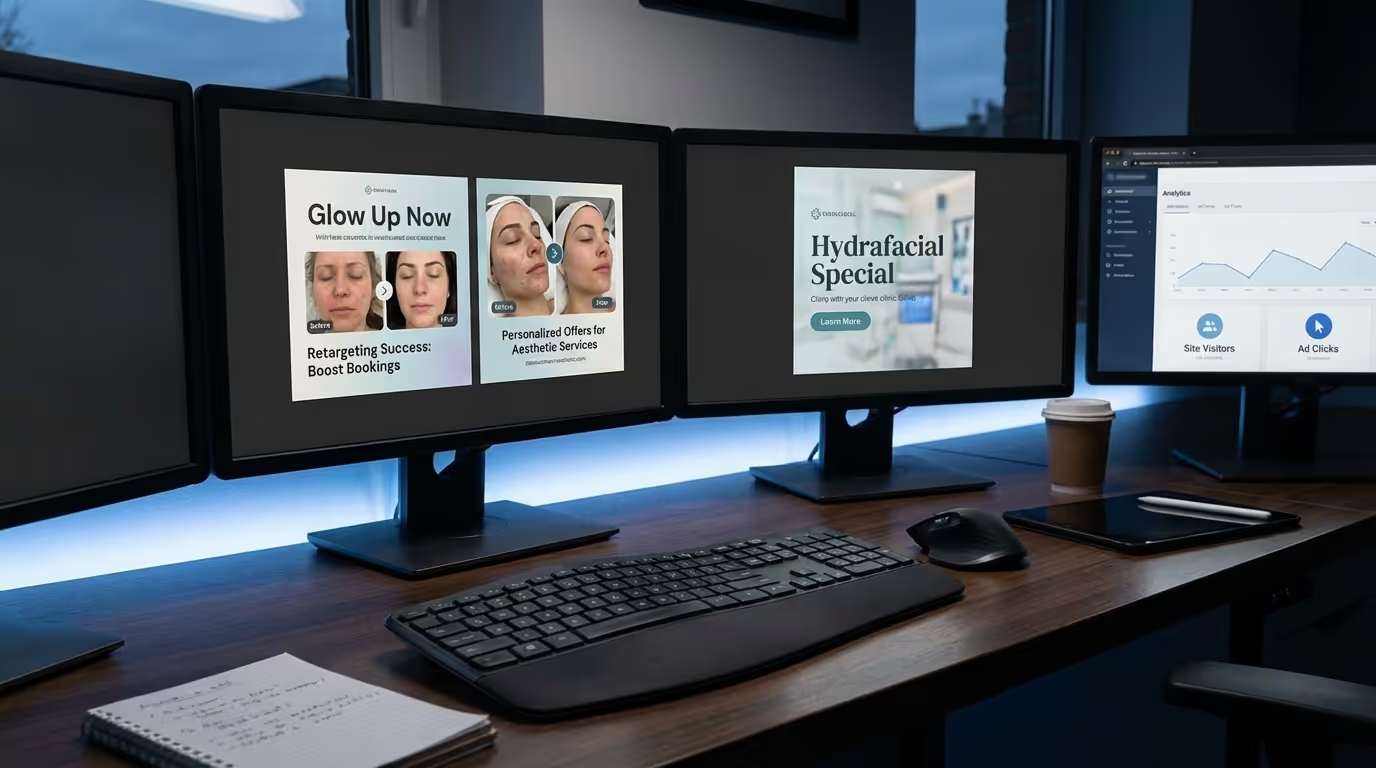
Med spa retargeting puts your practice back in front of those visitors as they scroll Facebook, Instagram, YouTube, Google, and thousands of other websites. It is your second chance — and your third, and fourth — to convert someone who already showed interest in your treatments.
Here is why retargeting is the highest-ROI ad spend in your entire marketing budget: these people already know you. They already visited your website. They already browsed your treatment pages. The trust gap is dramatically smaller than with cold traffic. That is why retargeting converts at 3x to 5x the rate of cold ads and costs a fraction per click.
If you are spending money on any form of digital marketing but not running retargeting for med spas, you are paying to fill a bucket with a hole in the bottom. This guide covers every detail — technical setup, audience segmentation, creative frameworks, platform strategies, budgets, metrics, and the common mistakes that waste your retargeting budget.
How Retargeting Works: The Technical Foundation
Retargeting works by placing a small piece of code (called a pixel or tag) on your website. When someone visits your site, the pixel drops a cookie on their browser. That cookie allows advertising platforms to identify that person later and show them your ads across the internet.
The Platforms You Need
| Platform | Tracking Mechanism | Where Ads Appear | Best For |
|---|---|---|---|
| Meta (Facebook/Instagram) | Meta Pixel | Facebook feed, Instagram feed, Stories, Reels, Audience Network | Visual creative, demographic targeting, highest engagement |
| Google Ads | Google Tag | Google Search (RLSA), Display Network, YouTube, Gmail, Discover | Broadest reach, search intent capture |
| TikTok | TikTok Pixel | TikTok feed, For You page | Patients under 45, video-first creative |
| LinkedIn Insight Tag | LinkedIn feed | B2B (not typical for patient acquisition) | |
| Programmatic (The Trade Desk, etc.) | Third-party pixels | Thousands of premium websites and apps | Advanced practices with large budgets |
For most med spas, Meta and Google cover 90%+ of your retargeting needs. TikTok is increasingly relevant if your TikTok marketing is active and you target patients under 45.
Step-by-Step Technical Setup
Step 1: Install the Meta Pixel (Day 1)
- Go to Meta Events Manager and create a new pixel
- Name it your practice name (e.g., "Your Med Spa — Meta Pixel")
- Copy the base pixel code
- Install it in the
<head>section of every page on your website - Configure standard events: PageView (automatic), ViewContent (treatment pages), InitiateCheckout (booking page), Lead (form submission), Schedule (appointment booked)
- Verify installation using Meta Pixel Helper (free Chrome extension)
Step 2: Install the Google Ads Tag (Day 1)
- In Google Ads, go to Tools > Audience Manager > Your Data Sources
- Set up the Google Ads tag
- Install the global site tag on every page
- Configure conversion actions: form submissions, phone calls, booking completions
- Verify using Google Tag Assistant
Step 3: Configure Server-Side Tracking (Day 2)
With browser-based cookies becoming less reliable due to privacy changes (iOS 14.5+, cookie deprecation), server-side tracking is essential for accurate retargeting.
- Set up Meta Conversions API alongside the browser pixel
- Configure Google Enhanced Conversions
- Use a server-side tag management solution (Google Tag Manager server container or a platform like Stape.io)
| Tracking Method | Data Accuracy | Setup Difficulty | Cost |
|---|---|---|---|
| Browser pixel only | 60-75% (declining) | Easy | Free |
| Browser pixel + server-side | 85-95% | Moderate | $20-50/mo |
| Full server-side | 90-98% | Advanced | $50-200/mo |
Step 4: Build Audience Segments (Day 2-3)
In each ad platform, create the audiences outlined in the next section. Allow 48-72 hours for audiences to populate before launching campaigns.
Step 5: Verify Everything Is Firing (Day 3)
- Visit your website and navigate through treatment pages, booking page, and contact form
- Check Meta Events Manager — verify events are logging
- Check Google Ads Audience Manager — verify audience sizes are growing
- Test a form submission and verify the Lead/conversion event fires
- Check for duplicate tracking (a common error that inflates data)
Common setup mistakes:
- Installing the pixel on the homepage only (it needs to be on every page)
- Not configuring conversion events (just the base PageView is not enough)
- Duplicate pixels from old installations or plugin conflicts
- Missing server-side tracking (loses 25-40% of data on iOS devices)
- Not verifying that events fire correctly after form submissions
Why Retargeting Is Built for Med Spas
Med spa services are not impulse purchases. Nobody sees an ad for CoolSculpting and books a $3,000 treatment package five minutes later. The decision-making process for medical aesthetics involves research, comparison, trust-building, and often multiple website visits before the patient commits.
The Med Spa Patient Decision Timeline
| Treatment Category | Avg. Decision Timeline | Website Visits Before Booking | Price Sensitivity |
|---|---|---|---|
| Botox/Dysport | 3-14 days | 2-4 visits | Low-Medium |
| Dermal fillers | 7-21 days | 3-5 visits | Medium |
| Laser hair removal | 7-14 days | 2-3 visits | Medium-High |
| Body contouring | 14-45 days | 4-8 visits | High |
| Skin rejuvenation | 7-21 days | 3-5 visits | Medium |
| Weight loss programs | 14-30 days | 3-6 visits | Medium-High |
Retargeting is the only advertising strategy that stays with the patient through this entire decision timeline. Without it, you are relying on the patient to remember your practice name and return on their own — competing against every other med spa they visited during their research phase.
The Financial Case for Med Spa Retargeting
| Metric | Cold Traffic Ads | Retargeting Ads | Difference |
|---|---|---|---|
| Average CPC | $8-$35 | $1.50-$8 | 60-80% lower |
| Click-through rate | 0.5-2% | 3-10% | 3-5x higher |
| Conversion rate | 2-5% | 8-18% | 3-5x higher |
| Cost per lead | $25-$75 | $5-$20 | 60-80% lower |
| ROAS | 2:1-5:1 | 5:1-20:1 | 3-5x higher |
| Patient lifetime value capture | Low (one-touch) | High (multi-touch) | Significantly higher |
Retargeting is not incrementally better than cold traffic. It is fundamentally different in efficiency. The audience is warmer, conversion is faster, and cost is lower. For med spa marketing ROI, retargeting consistently delivers the highest returns.
Retargeting Audience Segments: The Key to Performance
Not all website visitors are equal. Someone who spent four minutes on your Botox pricing page and viewed before-and-after photos is a fundamentally different prospect than someone who bounced from your homepage in five seconds.
Treating them the same is the number one mistake practices make. Effective med spa retargeting requires segmented audiences with tailored messaging.
Segment 1: Treatment Page Visitors
Who they are: People who visited a specific treatment page (Botox, fillers, CoolSculpting, laser hair removal, etc.)
What to show them: Ads specific to the treatment they viewed. If they looked at your Botox page, show them Botox-specific creative — before-and-after results, provider expertise, patient testimonials, and a clear CTA to book a Botox consultation.
Implementation steps:
- In Meta Ads Manager, create a Custom Audience > Website > People who visited specific URLs
- Enter the URL path for each treatment page (e.g., /services/botox, /services/fillers)
- Set the retention window to 30-60 days
- Create separate audiences for each major treatment category
- Build corresponding ad sets with treatment-specific creative
Why it works: The messaging matches their exact interest. A patient who browsed your CoolSculpting page does not need to see your general brand story — they need to see CoolSculpting results, pricing context, and a reason to book.
Benchmarks: Treatment-specific retargeting typically achieves 5-12% CTR and 10-18% conversion rate — the highest of any retargeting segment.
Window: 30 to 60 days (most aesthetics patients decide within this timeframe)
Segment 2: Pricing Page Visitors
Who they are: People who visited your pricing page or a treatment cost page. These are high-intent visitors — they are past "Is this for me?" and into "Can I afford this?"
What to show them: Value-focused ads that address the financial hesitation directly:
- Payment plan options ("Starting at $99/month with Cherry or PatientFi")
- Package savings ("Save $500 on our Summer Body Package")
- Introductory offers ("First-Time Botox: $11/unit — normally $14/unit")
- Membership programs ("Members save 15% on every treatment")
Implementation steps:
- Create a Custom Audience for visitors to pricing-related URLs
- Set a shorter retention window: 14 to 30 days (these visitors are close to deciding)
- Build creative that leads with financial value, not treatment education
- Include financing options in ad copy and on your landing pages
Benchmarks: Pricing page retargeting with offer-driven creative achieves 8-15% conversion rates when the ad addresses the price objection.
Window: 14 to 30 days
Segment 3: High-Engagement Visitors
Who they are: People who visited 3+ pages, spent more than 2 minutes on site, or viewed a video. These visitors are seriously researching your practice.
What to show them: Trust-building ads — provider introduction videos, detailed patient testimonials, credentials and certifications, awards and recognition. They are doing due diligence. Help them complete it.
Implementation steps:
- In Meta, create a Custom Audience > Website > People who spent the most time (top 25% by time spent)
- In Google, create an audience based on pages-per-session (3+ pages)
- Build creative focused on credibility: provider videos, Google reviews, certifications
- Include patient testimonial videos (these convert 3x better than static images for this segment)
Why it works: These visitors want reassurance they are choosing the right practice. Your reputation is what closes them.
Window: 30 to 60 days
Segment 4: Form Abandoners
Who they are: People who started filling out a contact or booking form but did not submit it. They were inches from converting.
What to show them: "Still thinking about it?" messaging with a specific next step:
- Complimentary consultation offers
- "Questions? Call us at..." messaging
- Limited availability notices ("Only 3 consultation slots left this week")
- Direct links back to the booking form they abandoned
Implementation steps:
- Set up a custom event that fires when a user begins filling out a form (focus event on first field)
- Create an audience of users who triggered the form-start event but not the form-submission event
- Set a tight window: 7 to 14 days
- Use urgency-driven creative with a clear, single CTA back to booking
- Exclude anyone who has already completed a booking
Benchmarks: Form abandoner retargeting converts at 15-25% — the highest of any segment because these visitors were already at the conversion point.
Window: 7 to 14 days (hottest leads — act fast)
Segment 5: Past Patients (Remarketing)
Who they are: Existing patients uploaded as a Custom Audience from your CRM or email list to Meta or Google.
What to show them: New treatment announcements, seasonal promotions, membership program offers, referral program reminders, and rebooking prompts.
Implementation steps:
- Export your patient list from your CRM (name, email, phone number)
- Upload to Meta as a Custom Audience and Google as a Customer Match list
- Segment by treatment history (Botox patients, filler patients, laser patients)
- Create treatment-specific rebooking ads and cross-sell campaigns
- Update the list monthly for accuracy
Benchmarks: Past patient remarketing achieves 12-20% CTR and 15-30% conversion rates. Selling to an existing patient costs 5x to 7x less than acquiring a new one.
Why it works: These people already trust you. The barrier to the next purchase is minimal. This is the highest-ROI advertising possible for a med spa.
Window: Ongoing (update lists monthly)
Segment 6: Lookalike and Similar Audiences
Who they are: Not retargeting in the traditional sense, but critical for scaling. Upload your patient list or high-intent website visitors, and the platform finds people who match their demographics, interests, and behaviors.
Implementation steps:
- Create a Lookalike Audience in Meta based on your patient Custom Audience (start with 1% lookalike for highest quality)
- Create a Similar Audience in Google based on your Customer Match list
- Layer treatment interest targeting on top for further refinement
- Allocate a separate budget — do not mix lookalike and retargeting budgets
Benchmarks: Lookalike audiences outperform interest-based targeting by 40-60% because they are modeled on your actual patients. CPL is typically 30-50% lower than standard cold campaigns.
Retargeting Ad Creative That Converts
The creative — the actual ad image, video, and copy — is where retargeting succeeds or fails. Showing warm audiences generic creative wastes the advantage. Here is what works, ranked by performance.
Creative Type 1: Before-and-After Results
The most powerful creative format for med spa retargeting. Real results sell better than any copy.
Best practices:
- Use your own patients' results (with signed consent), never stock photos
- Include treatment name and timeframe ("Botox results — 14 days post-treatment")
- Add appropriate disclaimers ("Individual results may vary")
- Use consistent lighting, angles, and framing across all photos
- Show multiple results (carousel format) for maximum engagement
- Include the provider's name for credibility
Common mistakes:
- Using manufacturer stock before-and-afters (patients can tell)
- Poor photo quality or inconsistent lighting
- Missing disclaimers (FTC compliance issue)
- No context about what treatment was performed
- Overly edited photos that look unrealistic
Performance benchmarks: Before-and-after carousel ads achieve 6-12% CTR and 12-20% conversion rate on retargeting audiences.
Your med spa photography directly impacts your retargeting performance. Invest in quality before-and-after documentation.
Creative Type 2: Provider Trust Videos
Short video (15-30 seconds) of your provider introducing themselves, explaining a treatment, or addressing a common concern. Puts a face and voice to the practice.
Production framework:
- Film in your treatment room (authentic environment builds trust)
- Have the provider speak directly to camera
- Script the first 3 seconds to hook attention ("The #1 question I get about Botox...")
- Address one specific concern per video
- End with a clear CTA ("Book your free consultation — link in bio")
- Film in vertical (9:16) for Stories/Reels and square (1:1) for feeds
Why it works for retargeting: The visitor already knows the practice. Now they are meeting the person who will treat them. This bridges the gap between "interested" and "comfortable enough to book."
Performance benchmarks: Provider videos achieve 4-8% CTR and outperform static images by 2-3x on retargeting audiences.
Creative Type 3: Patient Video Testimonials
Video testimonials from real patients convert at 3x the rate of written testimonials. The more specific, the better.
What makes a strong testimonial video:
- Patient states the specific treatment they received
- They describe their initial hesitation ("I was nervous about...")
- They share their experience with the provider
- They describe their results and how it made them feel
- They would recommend the practice (organic, not scripted)
Weak example: "Dr. Smith made me feel so comfortable and my results were incredible."
Strong example: "I was terrified of getting filler for the first time. Dr. Smith spent 20 minutes explaining exactly what she was going to do. Three months later, I still look in the mirror and smile. I've already booked my second appointment."
Creative Type 4: Offer-Driven Ads
For pricing page visitors and form abandoners, lead with an offer:
- "First-Time Patient Special: 20 Units of Botox for $199"
- "Book This Week: Save $200 on Your CoolSculpting Package"
- "Free Consultation — No Obligation, Zero Pressure"
- "Limited: 3 Consultation Slots Left This Week"
Important rules:
- Offers must have deadlines — urgency drives action
- Never discount your core services below cost (see our specials guide for what works)
- "Free consultation" outperforms percentage discounts for new patient acquisition
- Include the regular price as an anchor ("Normally $600 — This Week $449")
Creative Type 5: Social Proof Ads
Show your Google star rating, review count, and selected quotes from reviews. "4.9 stars from 300+ patients" is one of the most compelling retargeting messages possible.
Implementation:
- Screenshot your Google Business Profile showing your star rating
- Overlay a patient review quote
- Add your logo and a CTA
- Update monthly as your review count grows
- Pair with treatment-specific review content for treatment page retargeting
Creative rotation schedule:
| Week | Creative Focus | Segment |
|---|---|---|
| 1-2 | Before-and-after results | Treatment page visitors |
| 3-4 | Provider trust video | High-engagement visitors |
| 5-6 | Patient testimonials | All website visitors |
| 7-8 | Offer-driven ads | Pricing page visitors, form abandoners |
| 9-10 | Social proof | All segments |
| 11-12 | Refresh and rotate top performers | All segments |
Rotate creative every 2-3 weeks to prevent ad fatigue. Monitor CTR — when it drops below 1.5%, swap in new creative.
Platform-Specific Retargeting Strategies
Meta (Facebook + Instagram) Retargeting
Meta is the most versatile retargeting platform for med spas because of its visual format, sophisticated audience tools, and the time patients spend on the platform.
Campaign structure (4 campaigns):
| Campaign | Audience | Window | Creative | Budget Allocation |
|---|---|---|---|---|
| Website visitor retargeting | All visitors | 30 days | Brand + trust creative | 25% of retargeting budget |
| Treatment-specific retargeting | Treatment page visitors | 60 days | Treatment-specific B&A and testimonials | 35% of retargeting budget |
| High-intent retargeting | Pricing + form abandoners | 14 days | Offer-driven + urgency creative | 25% of retargeting budget |
| Patient remarketing | CRM patient list | Ongoing | Rebooking + cross-sell + referral | 15% of retargeting budget |
Ad formats ranked by performance for med spa retargeting:
- Carousel — Multiple before-and-after photos or treatment options (highest engagement)
- Video — 15-30 seconds — Provider intros, patient testimonials (highest conversion for new patients)
- Single image — Clean, professional, with clear copy (reliable workhorse)
- Collection — Treatment catalog format (best for multi-treatment promotion)
Meta-specific tips:
- Use Advantage+ placements but monitor performance by placement (Instagram Stories often outperforms feed)
- Exclude anyone who has converted in the last 30 days from acquisition retargeting
- Use Dynamic Ads for treatment page visitors (automatically shows the treatment they viewed)
- Set frequency caps at 2-3 impressions per day per person
- Test Facebook Ads creative from your cold campaigns in retargeting (warm audiences often respond differently)
Google Retargeting (Display + YouTube + Search)
Google retargeting reaches people across millions of websites, apps, YouTube, and even Google Search — extending your presence far beyond social media.
Display retargeting:
- Create responsive display ads with multiple headlines, descriptions, and images
- Upload high-quality treatment images and your logo
- Target your website visitor audiences
- Use managed placements to exclude low-quality sites (gaming, news aggregators)
- Set frequency caps at 5-7 impressions per week
YouTube retargeting:
- Create 15-30 second skippable in-stream ads (pre-roll)
- Use provider introduction and testimonial content
- Target website visitor audiences
- Include a clear CTA overlay with a link to your booking page
- Set frequency caps at 3-5 impressions per week
Search retargeting (RLSA — Remarketing Lists for Search Ads):
This is one of the most cost-effective and underutilized retargeting strategies. When a previous website visitor searches for relevant terms on Google, your bid is automatically increased, ensuring you appear at the top.
Implementation steps:
- Create an RLSA audience in Google Ads from your website visitors
- Apply this audience to your existing search campaigns with a bid adjustment (+30-50%)
- Create a separate campaign with broader keywords only for retargeting audiences
- This captures searches like "best med spa near me" or "Botox [city]" from people who already visited your site
Benchmark: RLSA campaigns achieve 2-3x higher conversion rates than standard search campaigns at 20-40% lower CPA.
Also optimize your actual Google Ads strategy — retargeting amplifies whatever you are already running. If your cold campaigns are poorly structured, retargeting will not fix the underlying Google Ads cost issues.
TikTok Retargeting
If your practice targets patients under 45 and you are actively running TikTok marketing, retargeting on the platform is increasingly effective.
Implementation:
- Install the TikTok Pixel on all website pages
- Configure Events API for server-side tracking
- Build website visitor audiences (minimum 1,000 users for effective delivery)
- Create short-form vertical video ads native to the platform
- Treatment walkthrough clips and before-and-after transformations perform best
Limitation: Retargeting audiences are typically smaller on TikTok. If your audience is under 1,000 users, combine with interest-based targeting for sufficient reach.
Retargeting Frequency, Duration, and Budget
Frequency Management
The sweet spot: 3-7 impressions per week per person.
Too few impressions and the person forgets about you. Too many and you are annoying (and wasting budget on someone who is clearly not interested).
Platform-specific frequency caps:
| Platform | Recommended Daily Cap | Recommended Weekly Cap | Ad Fatigue Threshold |
|---|---|---|---|
| Meta (Feed) | 2-3 impressions | 10-15 impressions | CTR drops below 1.5% |
| Meta (Stories/Reels) | 1-2 impressions | 7-10 impressions | Completion rate drops below 40% |
| Google Display | 1-2 impressions | 5-7 impressions | CTR drops below 0.5% |
| YouTube | 1 impression | 3-5 impressions | Skip rate exceeds 80% |
| TikTok | 2-3 impressions | 8-12 impressions | CTR drops below 1% |
How to detect ad fatigue:
- Monitor CTR weekly — a consistent decline over 2+ weeks signals fatigue
- Watch frequency metrics — if average frequency exceeds 10 per week, rotate creative
- Check cost per result — rising CPL with stable audience size means fatigue
- Rotate 3-5 creative variations per segment
- Refresh all creative every 2-4 weeks
Duration Windows
| Segment | Window | Rationale | When to Stop |
|---|---|---|---|
| Form abandoners | 7-14 days | Hottest leads, act fast | After 14 days without conversion |
| Pricing page visitors | 14-30 days | High intent, near decision | After 30 days without re-engagement |
| Treatment page visitors | 30-60 days | Active research phase | After 60 days — decision likely made |
| Homepage/general visitors | 14-30 days | Lower intent, shorter value | After 30 days |
| Past patients | Ongoing | Retention and reactivation | Never (update list monthly) |
After the window closes, stop showing ads. If someone visited your Botox page 90 days ago and has not converted, continuing to retarget is inefficient. They went with a competitor or the timing was not right. Reallocate that budget to fresher audiences.
Budget Allocation
For most med spas, retargeting should represent 15-25% of total advertising budget. It is the highest-efficiency segment — you are not spending money finding new people, you are converting people who already found you.
Budget framework by total monthly ad spend:
| Total Monthly Ad Spend | Retargeting Budget | Meta Retargeting | Google Retargeting | RLSA |
|---|---|---|---|---|
| $3,000-$5,000 | $450-$1,000 | 60% | 25% | 15% |
| $5,000-$10,000 | $1,000-$2,000 | 50% | 30% | 20% |
| $10,000-$20,000 | $2,000-$4,000 | 45% | 30% | 25% |
| $20,000+ | $4,000-$6,000 | 40% | 35% | 25% |
Example budget for a practice spending $8,000/month on ads:
| Channel | Budget | Expected CPL | Expected ROAS |
|---|---|---|---|
| Google Ads (cold search) | $3,200 | $40-$70 | 3:1-5:1 |
| Meta Ads (cold prospecting) | $2,400 | $20-$50 | 2:1-4:1 |
| Meta Retargeting | $1,200 | $5-$15 | 8:1-15:1 |
| Google Display + YouTube Retargeting | $600 | $8-$20 | 5:1-12:1 |
| Google RLSA | $600 | $10-$25 | 6:1-12:1 |
The retargeting campaigns produce the lowest CPL and highest ROAS. Most practices under-invest in retargeting because they are fixated on generating new traffic rather than converting existing traffic.
Retargeting + Multi-Channel Integration
Retargeting is most powerful when it works alongside your other follow-up channels. A lead who sees retargeting ads AND receives your email nurture sequence AND gets an SMS check-in is far more likely to convert than one who experiences a single channel.
The Integrated Multi-Channel Sequence
| Day | Retargeting Action | Email/SMS Action | Expected Outcome |
|---|---|---|---|
| Day 0 | Pixel fires, retargeting begins (brand awareness creative) | If partial info captured: automated text in 60 seconds, email in 5 minutes | First touchpoints established |
| Day 1-3 | Treatment-specific results + testimonials | Email nurture: educational content about treatment they viewed | Building familiarity and trust |
| Day 3-5 | Social proof ads (reviews, credentials) | Email: before-and-after photos + patient story | Addressing trust concerns |
| Day 5-7 | Offer or urgency message | SMS check-in: "Any questions about [treatment]?" | Creating action momentum |
| Day 7-14 | Final push with specific deadline | Final email: specific offer with expiration | Converting or closing the loop |
Implementation steps:
- Set up your drip campaign in your CRM (GoHighLevel, Salesforce, etc.)
- Align email/SMS send dates with retargeting creative rotation
- Use consistent messaging themes across channels (same offer, same urgency)
- Track multi-touch attribution to understand which channel combinations convert best
- Create a welcome sequence for leads who convert to nurture them toward becoming patients
The cumulative effect — seeing your practice on Instagram, getting a helpful email, then seeing your ad on YouTube — creates a perception of omnipresence. "I keep seeing this practice everywhere" is exactly the reaction you want.
Measuring Retargeting Performance
The Metrics That Matter
| Metric | Target | What It Tells You | Action if Off Target |
|---|---|---|---|
| Click-through rate (CTR) | 3-8% | Are the ads compelling? | Refresh creative, test new angles |
| Cost per click (CPC) | $1.50-$8 | How efficiently are you driving traffic? | Adjust bids, tighten audience |
| Cost per lead (CPL) | $5-$20 | How much does each retargeted lead cost? | Improve landing page conversion |
| Conversion rate | 8-18% | Are landing pages converting retargeted traffic? | Optimize landing pages |
| Frequency | 3-7/week | Are you hitting the right exposure level? | Adjust caps, expand audience |
| Return on ad spend (ROAS) | 5:1-20:1 | Is the investment generating revenue? | Reallocate budget to top segments |
| View-through conversions | Track | Retargeting often influences without clicks | Include in attribution model |
| Audience saturation | Monitor | Is the audience large enough? | Drive more cold traffic to build audiences |
View-Through Conversions: The Hidden ROI
Many retargeting conversions happen without a direct click. A person sees your retargeting ad on Instagram, does not click it, but later searches your practice name on Google and books. That is a view-through conversion — the ad influenced the action even though there was no click.
Both Meta and Google track view-through conversions (typically within a 1-day view window). Make sure these are included in your reporting.
How to account for view-through conversions:
- In Meta Ads Manager, set your attribution window to "7-day click, 1-day view"
- In Google Ads, check "View-through conversions" column in reporting
- Compare view-through conversions to click-through conversions
- For retargeting specifically, view-through conversions often represent 30-50% of total attributed conversions
Without them, you are undervaluing retargeting by 30-50%.
Monthly Retargeting Report Template
Track these metrics monthly and compare month-over-month:
| Metric | Month 1 | Month 2 | Month 3 | Trend |
|---|---|---|---|---|
| Total retargeting spend | ||||
| Impressions | ||||
| Clicks | ||||
| CTR | ||||
| Leads generated | ||||
| CPL | ||||
| Appointments booked | ||||
| Revenue attributed | ||||
| ROAS | ||||
| View-through conversions | ||||
| Audience size (all segments) |
Track this alongside your overall marketing KPIs to understand retargeting's contribution to your total patient acquisition.
Common Med Spa Retargeting Mistakes
Mistake 1: One Ad for Everyone
The problem: Showing the same generic "Visit Our Med Spa" ad to all website visitors ignores the segmentation that makes retargeting effective.
The fix: Segment audiences by behavior (treatment page, pricing page, form abandoner, past patient) and create tailored creative for each segment. Minimum 4 audience segments with distinct creative.
Impact of fixing: Segmented retargeting outperforms unsegmented by 200-400% in conversion rate.
Mistake 2: Running Retargeting Without Sufficient Traffic
The problem: Retargeting amplifies your other marketing — it does not replace it. If you are not driving new visitors through Google Ads, SEO, social media, or content, your retargeting audiences will be too small for effective delivery.
The fix: You need a minimum of 1,000-2,000 monthly website visitors before retargeting becomes meaningful. For treatment-specific retargeting, you need at least 200-500 visitors per treatment page per month.
If your traffic is too low: Focus 80% of budget on cold traffic acquisition first, with a small retargeting campaign running to capture whatever traffic you do get.
Mistake 3: Ignoring Creative Rotation
The problem: Running the same creative for months. Retargeting audiences are small and see your ads repeatedly. CTR will plummet within 2-3 weeks of the same creative.
The fix: Maintain a library of 3-5 creative variations per segment. Rotate every 2-3 weeks. Track CTR weekly — when it drops below 1.5%, swap creative immediately.
Mistake 4: No Frequency Caps
The problem: Without caps, one person might see your ad 20+ times in a week. That is not marketing — it is harassment, and it wastes budget.
The fix: Set frequency caps on every campaign (see the frequency table above). Monitor frequency in your weekly reporting.
Mistake 5: Not Excluding Converters
The problem: Once someone books an appointment, you keep showing them the acquisition ad that tries to get them to book. This is wasted spend and a poor patient experience.
The fix: Create an exclusion audience of converted leads. Exclude them from acquisition retargeting and move them to a post-booking sequence (appointment confirmations, treatment prep info, patient reactivation campaigns).
Mistake 6: Sending Traffic to the Homepage
The problem: Retargeting ads should never send patients to your homepage. If someone clicked a Botox retargeting ad, they should land on a Botox-specific page with a clear CTA — not your homepage where they have to navigate to find what they already showed interest in.
The fix: Create treatment-specific landing pages for retargeting campaigns. Each ad should link to a page that matches the ad's message and treatment focus.
Mistake 7: No Attribution Model
The problem: Not tracking which retargeting campaigns, segments, and creatives generate actual booked appointments and revenue. You are flying blind.
The fix: Implement end-to-end tracking from ad click to booked appointment to treatment revenue. Use UTM parameters on all retargeting links, track through your CRM, and calculate true ROAS per segment.
Mistake 8: Ignoring Privacy Changes
The problem: Apple's iOS 14.5+ update and browser cookie restrictions have reduced pixel-based tracking accuracy by 25-40%. If you are only using browser pixels, you are missing a significant portion of your audience.
The fix: Implement server-side tracking (Meta Conversions API, Google Enhanced Conversions), first-party data strategies, and customer list-based retargeting alongside pixel-based retargeting.
Advanced Retargeting Strategies
Strategy 1: Sequential Retargeting
Instead of showing all creatives simultaneously, build a narrative sequence:
- Days 1-3: Educational content about the treatment they viewed
- Days 4-7: Before-and-after results from your practice
- Days 8-10: Provider trust video + patient testimonial
- Days 11-14: Specific offer with deadline
Each phase moves the patient closer to booking by addressing a different stage of the decision process.
Strategy 2: Dynamic Product Retargeting
Use Meta's Dynamic Ads to automatically show visitors the exact treatment pages they viewed. Set up your treatment catalog in Meta Commerce Manager, and the platform will dynamically generate ads based on each visitor's browsing behavior. No manual ad creation needed per treatment.
Strategy 3: Cross-Sell Retargeting for Existing Patients
Upload your patient list segmented by treatment history. Then run cross-sell campaigns:
- Botox patients see ads for fillers and skin treatments
- Filler patients see ads for skincare and membership programs
- Body contouring patients see ads for weight loss programs or skin tightening
- All patients see loyalty program and referral program ads
Strategy 4: Seasonal Retargeting Campaigns
Align retargeting creative with seasonal demand:
- January-February: "New Year, New You" body contouring and skin rejuvenation
- March-April: "Spring Refresh" facials and laser treatments
- May-June: "Summer Ready" laser hair removal and body treatments
- September-October: "Fall Reset" skin repair and injectable refresh
- November-December: Gift cards and holiday prep treatments
Build your marketing calendar with retargeting creative rotation baked in.
The Complete Retargeting Launch Timeline
| Timeline | Action | Details |
|---|---|---|
| Day 1 | Install tracking pixels | Meta Pixel, Google Tag, server-side tracking |
| Day 2 | Configure conversion events | Form submissions, calls, bookings |
| Day 3 | Build audience segments | 6 segments as outlined above |
| Day 4-5 | Create ad creative | 3-5 variations per segment |
| Day 6 | Build campaigns | Meta and Google campaign structures |
| Day 7 | Set budgets and frequency caps | 15-25% of total ad budget |
| Week 2 | Launch and monitor daily | Watch CTR, frequency, conversion, CPL |
| Week 3-4 | First optimization pass | Pause underperforming creative, adjust bids |
| Month 2 | Scale and expand | Add YouTube, test sequential retargeting |
| Month 3 | Full optimization | Segment analysis, budget reallocation, creative refresh |
| Ongoing | Monthly optimization | Creative rotation, audience refresh, performance review |
The Bottom Line: You Are Already Paying for These Visitors
Every dollar you spend on Google Ads, SEO, social media, and content marketing drives visitors to your website. Most of those visitors leave without converting.
Retargeting is how you protect that investment.
Without retargeting, 97% of your website traffic — traffic you paid for — is wasted. With retargeting, every visitor becomes an opportunity that persists for 30, 60, or 90 days across every platform they use.
The cost is minimal (15-25% of your ad budget). The ROI is the highest of any advertising channel. The setup takes a week. And the results start within days.
If you are running any form of paid marketing without retargeting, you are leaving the highest-ROI channel on the table. If you are running retargeting without proper segmentation, creative rotation, and multi-channel integration, you are capturing a fraction of its potential.
The practices that dominate their markets do not just run ads. They build systems that convert at every stage of the patient journey. Retargeting is the glue that holds that system together.
Get Your Free Marketing Audit — We will review your current ad setup, audit your retargeting configuration (or identify that you are not running any), analyze your tracking pixels, and show you exactly how much revenue you are leaving on the table from unconverted website visitors. We work with med spas only. No obligation, no fluff — just the data and a clear action plan.