

"How much should I spend on marketing?"
It is the first question every med spa owner asks about their med spa marketing budget. And the answer they usually get is useless: "It depends." Or worse: "What is your budget?" — which is just an agency asking how much they can charge you.
Here is the truth. Your med spa marketing budget is not an arbitrary number you pick based on what feels comfortable. It is a calculated investment based on your revenue, your growth goals, your patient acquisition costs, and the channels that deliver the best return in your market.
We build marketing budgets for med spas every week. Not generic small businesses. Not dentists. Not chiropractors. Med spas. And the math is different in this industry because average treatment values are higher, patient lifetime values are longer, and the competitive dynamics are unlike anything in general healthcare marketing.
This is the budget framework we use. No guesswork. Just the math that separates growing practices from stagnant ones.
The Med Spa Marketing Budget Baseline: What Percentage of Revenue?
The SBA recommends businesses spend 7-8% of revenue on marketing. That is a generic number for generic businesses. Med spas are not generic. The U.S. med spa market hit $27.6 billion in 2025, with over 8,500 practices competing for patients. Here are the real benchmarks by growth stage, based on what we see across dozens of med spa clients.
New Practice (Year 1-2, Under $50K/Month Revenue)
Recommended marketing spend: 15-20% of revenue
This is not a typo. When you are new, nobody knows you exist. You have no Google reviews, no organic rankings, no patient database to market to, and no referral network. You are starting from zero, and zero requires aggressive investment to escape.
If you are doing $30,000 per month in revenue, that means $4,500-$6,000 per month on marketing. It feels like a lot because it is. But the alternative is growing at the speed of word-of-mouth, which in 2026 means watching the med spa down the street — the one spending on marketing — take your patients.
Implementation steps for new practices:
- Calculate your current monthly revenue accurately (include all treatment revenue, product sales, and membership income)
- Multiply by 0.15 to get your minimum marketing budget
- Multiply by 0.20 to get your aggressive growth budget
- Choose a number between those two based on your cash reserves and risk tolerance
- Commit to that number for at least 6 months — marketing budgets need runway to produce results
- Set up tracking before spending a dollar (more on this below)
Where the money goes at this stage:
| Channel | Allocation | Monthly Amount ($30K Revenue) | Purpose |
|---|---|---|---|
| Google Ads | 40% | $1,800-$2,400 | Capture existing demand — people already searching for your treatments |
| Meta Ads | 25% | $1,125-$1,500 | Generate demand — reach people who do not know they want your services yet |
| SEO | 20% | $900-$1,200 | Build the long-term organic asset that compounds every month |
| Email/SMS Setup | 10% | $450-$600 | Activate your database and automate patient communication |
| Creative/Content | 5% | $225-$300 | Photography, ad creative, and content production |
At this stage, every dollar needs to pull double duty. You are not building a brand. You are filling a calendar. Start with the channels that produce the fastest return — Google Ads and email marketing — and layer in everything else as revenue grows.
Common mistakes at this stage:
- Spending the entire budget on social media management instead of paid ads that generate immediate leads
- Splitting the budget across five channels at sub-minimum levels where none can perform
- Not tracking any results, so you have no idea what is working after 90 days
- Cutting the budget after 60 days because "it's not working" when most channels need 90-120 days to optimize
Growth Practice (Year 2-4, $50K-$150K/Month Revenue)
Recommended marketing spend: 10-15% of revenue
You have traction. Reviews are accumulating, organic traffic is growing, and your patient database is large enough to generate retention revenue. Your cost per acquisition should be dropping as brand awareness increases. Now you are investing to scale what works and test new channels.
If you are doing $100,000 per month, that means $10,000-$15,000 on marketing.
Implementation steps for growth practices:
- Audit your current channel performance — which channels are driving the lowest cost per patient acquisition?
- Double down on your top two channels before expanding to new ones
- Shift budget allocation quarterly based on actual performance data, not assumptions
- Begin investing in SEO content that will compound over the next 12-24 months
- Start building your retention marketing engine — this is where ROI multiplies
- Set quarterly budget reviews with your agency or marketing team to reallocate based on data
Where the money goes at this stage:
| Channel | Allocation | Monthly Amount ($100K Revenue) | Purpose |
|---|---|---|---|
| Google Ads | 30% | $3,000-$4,500 | Scale profitable campaigns, add new treatment keywords |
| Meta Ads | 20% | $2,000-$3,000 | Expand audiences, test creative angles, build lookalike audiences |
| SEO | 20% | $2,000-$3,000 | Monthly content production, link building, technical optimization |
| Email/SMS | 10% | $1,000-$1,500 | Automated sequences, monthly newsletters, drip campaigns |
| Social Media | 10% | $1,000-$1,500 | Consistent posting, community management, content creation |
| Creative/Content/PR | 10% | $1,000-$1,500 | Professional photography, video production, media outreach |
Common mistakes at this stage:
- Staying on autopilot with the same budget allocation you had at launch instead of optimizing based on data
- Neglecting retention marketing when your database is large enough to generate 20-30% of revenue from existing patients
- Hiring a cheap social media manager instead of investing in channels that drive measurable revenue
- Not testing new channels (YouTube, TikTok, events) because you are comfortable with what you know
Established Practice ($150K+/Month Revenue)
Recommended marketing spend: 8-12% of revenue
At this level, you should have multiple channels generating patients, strong organic presence, a mature patient database driving 20-30% of revenue through retention, and a referral engine. Your percentage can decrease because your fixed-cost channels (SEO, email) compound without proportionally more spend.
If you are doing $250,000 per month, that means $20,000-$30,000 on marketing.
Implementation steps for established practices:
- Conduct a full marketing audit — identify which channels are delivering the highest ROAS and which are underperforming
- Allocate 70% of budget to proven, high-ROI channels and 10% to testing new opportunities
- Invest in brand-building activities that create long-term competitive moats (thought leadership, PR, community presence)
- Build a membership program if you have not already — this is your recurring revenue engine
- Implement closed-loop attribution tracking that connects ad spend to actual revenue per patient
- Negotiate better rates with vendors and agencies based on your scale and tenure
Where the money goes at this stage:
| Channel | Allocation | Monthly Amount ($250K Revenue) | Purpose |
|---|---|---|---|
| Google Ads | 25% | $5,000-$7,500 | Dominate search in your market across all treatment categories |
| Meta Ads | 15% | $3,000-$4,500 | Awareness campaigns, retargeting, and event promotion |
| SEO/Content | 15% | $3,000-$4,500 | Comprehensive content strategy, link building, technical maintenance |
| Email/SMS/Retention | 15% | $3,000-$4,500 | Full lifecycle marketing — acquisition through retention |
| Social Media/Community | 10% | $2,000-$3,000 | Multi-platform presence, UGC strategy, community engagement |
| Brand/Creative/Video | 10% | $2,000-$3,000 | Professional content production, video marketing, brand campaigns |
| New Channel Testing | 10% | $2,000-$3,000 | TikTok, YouTube, podcast sponsorships, event marketing |
Common mistakes at this stage:
- Becoming complacent because revenue is strong — competitors are always investing
- Not allocating a testing budget for emerging channels and strategies
- Over-relying on paid ads when you should be building organic and referral channels that reduce acquisition costs
- Failing to calculate true patient lifetime value, which means you are undervaluing your marketing investment
Med Spa Marketing Budget by Treatment Revenue Goals
Percentages are useful for understanding how much to spend on med spa marketing, but most owners think in dollar amounts. Here is how to reverse-engineer your budget from your growth goals and account for real medspa marketing costs.
Step 1: Define Your Revenue Goal
How much do you want to grow by? Not "a lot" — a specific number. Example: you want to add $30,000 per month in new revenue.
Step 2: Calculate Your Average Treatment Value
What is your average revenue per patient visit? For most med spas, this falls between $350-$800 depending on your treatment mix. Here is how to calculate yours accurately:
| Treatment Category | Avg Revenue Per Visit | Typical Mix |
|---|---|---|
| Injectables (Botox, fillers) | $400-$600 | 35-45% of revenue |
| Laser treatments | $300-$500 | 15-25% of revenue |
| Body contouring | $800-$2,500 | 10-15% of revenue |
| Skincare/facials | $150-$300 | 10-15% of revenue |
| Wellness (IV, weight loss) | $200-$500 | 5-10% of revenue |
| Blended average | $350-$800 | 100% |
Let us use $500 as the blended average.
Step 3: Determine How Many New Patients You Need
$30,000 in new revenue / $500 average treatment value = 60 new patients per month.
But here is the number most owners miss: those 60 new patients do not each come for just one visit. If your retention rate is healthy (and you should be tracking it with your med spa KPIs), each new patient returns an average of 3-5 times in the first 12 months.
Step 4: Calculate Your Cost Per Acquisition
What does it cost to acquire one new patient through marketing? The med spa industry average is $75-$200, depending on your market and channel mix.
| Market Type | Average CPA | Range |
|---|---|---|
| Small market (< 250K population) | $75-$120 | Lower competition, lower CPCs |
| Medium market (250K-1M) | $100-$150 | Moderate competition |
| Major metro (1M+) | $150-$250 | High competition, higher CPCs |
| Hyper-competitive market (NYC, LA, Miami) | $200-$350 | Top-tier competition across all channels |
Let us use $120 for a medium-market practice.
Step 5: Calculate Your Required Marketing Budget
60 new patients x $120 cost per acquisition = $7,200 per month in marketing spend to add $30,000 in monthly revenue.
That is a 4.2x return on investment in the first month alone. But the real math is even better. Factor in lifetime value: each of those 60 patients returns for an average of $2,500 over the next 12 months. Your $7,200 monthly investment generates $150,000 in annual revenue from that single month's cohort.
Step 6: Validate Against Your Percentage
$7,200 / $30,000 = 24% of the incremental revenue. Feels high? It is — because you are paying to acquire new patients who will generate revenue for years. The percentage of your total revenue dedicated to marketing is what matters:
If your current revenue is $100,000 and you are spending $7,200 on marketing, that is 7.2% of total revenue. Well within the healthy range.
This is how you build a budget. Not with percentages pulled from the internet. With math specific to your practice.
Common mistakes in budget calculation:
- Using first-visit revenue instead of lifetime value to evaluate marketing ROI
- Comparing your CPA to industry averages without accounting for your market's specific competition level
- Setting a budget based on what feels comfortable instead of what the math requires to hit growth targets
- Not factoring in the cost of your team's time for marketing activities (internal labor is not free)
- Expecting the same CPA across all channels — Google Ads CPAs are different from Facebook Ads CPAs
Channel-by-Channel Budget Allocation Guide
Google Ads: The Revenue Engine
Minimum effective budget: $2,000/month Recommended budget: $3,000-$10,000/month Expected CPL: $25-$75 Expected ROAS: 3-8x
Google Ads is where your budget should start because it captures existing demand. Someone searching "Botox in Dallas" is ready to book. You are not convincing them they need Botox — you are convincing them to choose you.
Implementation steps:
- Set up conversion tracking before spending a dollar — track form submissions, phone calls, and chat conversations
- Build separate campaigns for your top 3-5 treatments (do not combine everything into one campaign)
- Create dedicated landing pages for each campaign — generic pages convert 2-3x worse than treatment-specific ones
- Build a negative keyword list of at least 200 terms (jobs, training, DIY, free, cheap, certification)
- Set geographic targeting to a 15-25 mile radius around your practice
- Launch with manual CPC bidding and switch to Smart Bidding after 30+ conversions
- Review search terms weekly for the first 90 days, then biweekly
Budget benchmarks by spend level:
| Monthly Spend | What It Buys | Expected Results |
|---|---|---|
| $2,000 | 1-2 treatment campaigns in one market | 30-50 leads, 12-20 new patients |
| $5,000 | 3-5 treatment campaigns with retargeting | 75-125 leads, 30-50 new patients |
| $7,500 | Full treatment menu with competitor targeting | 100-175 leads, 40-70 new patients |
| $10,000+ | Market domination across all treatments | 150-250 leads, 60-100 new patients |
When to increase: When your ROAS is consistently above 4x, increase budget by 20% per month until you see diminishing returns (usually when you start bidding on lower-intent keywords). Read our full Google Ads cost breakdown for detailed benchmarks.
When to decrease: Never decrease a profitable Google Ads campaign. If ROAS drops below 2x, optimize the campaign — do not cut the budget. The problem is usually ad copy, landing pages, or keyword targeting, not the channel itself.
Common mistakes with Google Ads budgets:
- Running one catch-all campaign instead of procedure-specific campaigns
- Sending all traffic to the homepage instead of optimized landing pages
- Not tracking phone calls (which account for 40-60% of conversions)
- Cutting budget during slow months when CPCs actually drop and you can gain market share
- Setting and forgetting — Google Ads require weekly optimization to maintain performance
Meta Ads: The Demand Generator
Minimum effective budget: $1,500/month Recommended budget: $2,000-$6,000/month Expected CPL: $8-$35 Expected ROAS: 2-6x
Meta Ads (Facebook and Instagram) work differently than Google because you are interrupting someone's scroll, not answering their search. The leads are cheaper but colder. Your follow-up process matters more — practices with strong SMS automation convert Meta leads at 2-3x the rate of those without it.
Implementation steps:
- Install the Meta Pixel on all website pages before running any ads
- Upload your patient email list to create a custom audience (minimum 1,000 emails for effective lookalike modeling)
- Build 1% and 2% lookalike audiences from your best patients (highest spenders, most frequent visitors)
- Create a retargeting campaign for website visitors from the last 30 days
- Launch with one treatment offer and two creative variations to test
- Refresh creative every 3-4 weeks to combat ad fatigue
- Set up automated lead response — Meta leads go cold in minutes, not hours
Budget allocation within Meta Ads:
| Component | % of Meta Budget | Purpose |
|---|---|---|
| Prospecting (cold audiences) | 50-60% | Reach new potential patients |
| Retargeting (warm audiences) | 20-25% | Convert website visitors and engagers |
| Creative production | 15-20% | Photography, video, graphic design |
| Testing (new audiences/creative) | 5-10% | Discover new winning combinations |
Budget tip: Allocate 20% of your Meta budget to creative production. The best targeting in the world cannot save bad creative, and Meta's algorithm heavily rewards ad engagement. Practices with professional photography and video see CPLs 30-50% lower than those using stock images.
Common mistakes with Meta Ads budgets:
- Running the same creative for months until engagement drops to zero
- Not building retargeting audiences, which convert 3-5x better than cold prospecting
- Expecting Meta leads to behave like Google leads — they need more nurture
- Optimizing for leads instead of booked appointments (vanity metrics vs. revenue metrics)
- Not segmenting audiences by treatment interest for targeted ad copy
SEO: The Compounding Asset
Minimum effective budget: $1,500/month Recommended budget: $2,000-$5,000/month Expected CPL (once established): $10-$30 Expected ROI (12-month): 5-15x
SEO is the only marketing channel where your cost per lead decreases over time while your traffic increases. After 6-12 months of consistent investment, your website should rank for dozens of treatment and location keywords, driving free organic leads indefinitely.
The catch: SEO requires patience. Months 1-3 are primarily investment with minimal return. Months 4-6 show early movement. Months 7-12 is where the compounding kicks in. If you cannot commit to 6 months, do not start. Read our full SEO guide for medical spas for the detailed strategy.
Implementation steps:
- Conduct a technical SEO audit — fix speed issues, broken links, mobile problems, and schema markup
- Optimize your Google Business Profile — this is the fastest local SEO win
- Build or optimize dedicated pages for every treatment you offer, targeting "[treatment] + [city]" keywords
- Start a content strategy with 2-4 blog posts per month targeting patient questions
- Build local citations across 40+ directories for NAP consistency
- Begin a link building program through local partnerships, PR, and industry directories
- Track rankings weekly and organic traffic monthly using Google Search Console and Ahrefs
What $2,000-$5,000 per month buys:
| Budget Level | What Is Included |
|---|---|
| $1,500-$2,000 | Technical fixes, GBP optimization, 2 blog posts/month, basic citation building |
| $2,000-$3,500 | Everything above plus 4 blog posts/month, on-page optimization, local link building |
| $3,500-$5,000 | Full-service SEO: technical, content, links, GBP, competitive analysis, monthly reporting |
The SEO compounding curve:
| Timeframe | Typical Results | CPL |
|---|---|---|
| Month 1-3 | Minimal organic traffic improvement | N/A (investment phase) |
| Month 4-6 | Rankings improving, early traffic gains | $100-$200 |
| Month 7-12 | Significant traffic growth, consistent leads | $30-$75 |
| Month 12-24 | Organic becomes a top-3 lead source | $10-$30 |
| Month 24+ | Organic is the lowest-cost channel | Under $15 |
Common mistakes with SEO budgets:
- Expecting results in 30-60 days and cutting the budget before SEO has time to compound
- Hiring a cheap SEO provider who uses outdated tactics (keyword stuffing, low-quality links) that can actually hurt rankings
- Not investing in local SEO, which is the fastest path to visibility for a location-based business
- Creating content without keyword research — blogging for the sake of blogging does not drive traffic
- Ignoring technical SEO (site speed, mobile optimization, structured data) while focusing only on content
Email and SMS Marketing: The Retention Multiplier
Minimum effective budget: $500/month (platform costs + content creation) Recommended budget: $1,000-$2,500/month Expected ROI: 10-30x
This is the highest-ROI channel in med spa marketing and the one that gets the least budget. You are marketing to people who already know, like, and trust you. The cost is essentially your email platform fee plus the time to create content and manage automations.
Implementation steps:
- Choose a CRM platform that integrates email, SMS, and automation (we recommend GoHighLevel for med spas)
- Clean your database — remove duplicates, update contact info, segment by treatment type, last visit date, and total spend
- Build your core automated sequences: welcome sequence, post-treatment follow-up, appointment reminders, birthday automation, and lapsed patient reactivation
- Create a monthly newsletter template and commit to sending it consistently
- Set up SMS marketing with proper opt-in compliance (TCPA)
- Build drip campaigns for specific treatment interests
- Track open rates, click rates, and most importantly, revenue attributed to email/SMS
What $1,000-$2,500 per month buys:
| Component | Monthly Cost | Revenue Impact |
|---|---|---|
| CRM platform (GHL, Mailchimp, etc.) | $100-$300 | Foundation for all email/SMS |
| Content creation (newsletters, sequences) | $500-$1,000 | 5-15% of monthly revenue from database |
| Automation management | $200-$500 | 20-40% reduction in no-shows |
| SMS marketing credits | $100-$300 | Highest open rates (98%) of any channel |
| Campaign strategy and optimization | $200-$500 | Continuous improvement in conversion |
If you do not have at least basic email automation running, that is where your next dollar should go. It is the fastest path to revenue with the least spend.
Common mistakes with email/SMS budgets:
- Not allocating any budget because "we already have patient emails" — having emails and marketing to them are different things
- Sending the same blast to the entire list instead of segmenting by treatment interest and behavior
- Not investing in automation setup, which is a one-time cost that generates returns indefinitely
- Ignoring SMS marketing, which has 98% open rates versus 25-35% for email
- Not tracking revenue attribution — if you cannot measure the ROI, you cannot justify increasing the investment
Social Media Management: The Trust Builder
Minimum effective budget: $1,000/month Recommended budget: $1,500-$3,500/month Expected ROI: Indirect (supports all other channels)
Organic social media does not drive bookings directly for most practices. It builds trust, creates social proof, and increases conversion rates across every other channel. A patient who Googles you, clicks your ad, and then checks your Instagram will book at a higher rate if your content is professional and consistent.
Implementation steps:
- Audit your current social presence — are you on the right platforms for your audience?
- Build a social media calendar with 12-16 posts per month across your primary platforms
- Invest in a content ideas framework so you never run out of topics
- Decide on your content production model: in-house, freelance creator, or agency-managed
- Set up community management — respond to every comment and DM within 2 hours
- Track engagement metrics monthly and adjust content mix based on what performs
- Integrate social content with your broader marketing calendar for consistent messaging
What $1,500-$3,500 per month buys:
| Budget Level | What Is Included |
|---|---|
| $1,000-$1,500 | 8-12 posts/month on one platform, basic content creation, hashtag strategy |
| $1,500-$2,500 | 12-16 posts/month across two platforms, professional photography/video, community management |
| $2,500-$3,500 | 16+ posts/month across three platforms, UGC coordination, influencer partnerships, TikTok strategy |
Common mistakes with social media budgets:
- Spending $3,000/month on social media management while spending $0 on Google Ads — social supports revenue, ads create it
- Measuring success by followers and likes instead of profile visits, link clicks, and DMs that convert to consultations
- Posting only promotional content instead of educational, behind-the-scenes, and trust-building content
- Not investing in short-form video, which gets 2-3x the reach of static posts on every platform
- Using the same content across all platforms without adapting format and tone for each audience
Med Spa Marketing Budget Mistakes That Destroy ROI
Mistake 1: Starting With Social Media Instead of Ads
Every week we talk to a med spa owner who spent their first $3,000 on an Instagram management company. They got beautiful posts, a few hundred followers, and zero bookings. Social media supports revenue. It does not create it — at least not at the beginning.
The fix: Start with Google Ads (captures demand) and email marketing (activates your database). Once those are profitable, add Meta Ads, then SEO, then social.
The data: Practices that start with paid search generate their first marketing-attributed patients within 30 days. Practices that start with organic social typically wait 6-12 months for any measurable patient acquisition.
Mistake 2: Allocating Budget Equally Across All Channels
Spending $1,500 on five channels means you are below the minimum effective budget for all of them. You are spreading too thin to generate meaningful results anywhere.
The fix: Concentrate budget on your top two revenue channels. Get them to 4x+ ROI. Then expand. A focused $5,000/month on Google Ads alone will outperform $1,000 each on Google, Meta, SEO, social, and email.
The data: Practices that concentrate 60-70% of their budget on their top-performing channel see 40-60% higher overall ROAS than those that spread evenly.
Mistake 3: Cutting Budget During Slow Months
January is slow. Summer dips. The instinct is to cut marketing spend during these periods. This is exactly wrong. Slow months are when your competitors pull back, which means ad costs drop and your share of voice increases. Maintaining or increasing spend during slow periods is how you steal market share.
The fix: Set your annual budget in advance and stick to it. Adjust channel allocation seasonally (shift more to pre-summer body contouring campaigns in Q1, holiday promotions in Q4), but do not cut total spend.
The data: Google Ads CPCs in the med spa vertical drop 15-25% during traditionally slow months (January, July). The practices that maintain spend during these windows acquire patients at a lower cost per acquisition than any other time of year.
Mistake 4: No Budget for Creative Production
You can have a $10,000 ad budget and get crushed by a competitor spending $3,000 with better creative. In Meta Ads especially, your creative is your targeting. The algorithm shows your ads to people who engage with similar content — so better creative literally reaches better audiences.
The fix: Allocate 10-15% of your total marketing budget to creative production. Professional photography quarterly. Monthly video content. Fresh ad creative every 3-4 weeks.
The data: Practices that refresh ad creative monthly see 25-35% lower CPLs on Meta Ads compared to those running the same creative for 3+ months. Creative fatigue is the number one performance killer on social platforms.
Mistake 5: Ignoring Retention Marketing
Every dollar you spend on acquiring a new patient only pays off if that patient comes back. The average med spa spends 90% of budget on acquisition and 10% on retention. The math says it should be closer to 70/30 — especially once you have 500+ patients in your database.
The fix: Build retention marketing into your budget from day one. Email sequences, SMS campaigns, membership programs, and loyalty rewards are not "nice to haves." They are the multiplier that makes your acquisition spend profitable.
The data: A 5% increase in patient retention produces a 25-95% increase in profit (depending on your treatment mix and average transaction value). The practices with the highest revenue per marketing dollar are the ones that invest in keeping patients, not just finding new ones.
Mistake 6: Not Budgeting for Technology and Tracking
Your marketing budget should include the tools that make everything else work: CRM, call tracking, analytics, scheduling software, and automation platforms. These are not optional extras. They are the infrastructure that allows you to measure, optimize, and scale.
The fix: Allocate 3-5% of your marketing budget to technology and tracking tools.
Recommended tech stack and costs:
| Tool | Monthly Cost | What It Does |
|---|---|---|
| CRM (GHL, HubSpot) | $100-$500 | Contact management, pipeline tracking, automation |
| Call tracking (CallRail) | $50-$150 | Attribute phone calls to marketing channels |
| Analytics (GA4 + GSC) | Free | Website traffic and search performance data |
| SEO tool (Ahrefs, SEMrush) | $100-$250 | Keyword tracking, competitor analysis, site audits |
| Scheduling (Calendly, GHL) | $0-$50 | Online booking integration |
| Email/SMS platform | $50-$300 | Campaign management, automation, deliverability |
Mistake 7: Hiring Based on Price, Not Expertise
A $500/month SEO provider will not deliver the same results as a $3,000/month agency that specializes in med spas. A $1,000/month Google Ads freelancer managing 50 accounts will not give your campaigns the attention they need. Cheap marketing is the most expensive mistake you can make because it wastes time — and time is the one resource you cannot get back.
The fix: Hire specialists who understand the med spa industry. Ask for case studies, references from practices your size, and transparent reporting. The right agency at the right price pays for itself in 90 days. The wrong agency at any price costs you six months of lost growth.
The $5,000/Month Budget (Starter)
If you have $5,000 per month to invest in marketing, here is exactly where it should go:
| Channel | Monthly Budget | Expected Output |
|---|---|---|
| Google Ads | $2,500 | 35-50 leads, 15-20 new patients |
| Email/SMS Marketing | $750 | 15-25% of revenue from existing patients |
| SEO (foundational) | $1,250 | Rankings improvement by month 4-6 |
| Creative/Content | $500 | Photography, ad creative, email content |
| Total | $5,000 | $15,000-$25,000 in attributed revenue |
This is a starter allocation focused on the highest-ROI activities. No social media management yet — post on your own using your phone and social media post ideas. No Meta Ads yet — Google captures higher-intent traffic. Every dollar goes to channels with measurable, short-term revenue impact.
What success looks like at $5,000/month after 90 days:
- 45-60 new patient leads per month from Google Ads
- 15-25 new patients booked per month
- Cost per new patient: $200-$330
- Revenue per marketing dollar: $3-$5
- Database marketing generating 15-25% of monthly revenue
- SEO showing early ranking improvements for primary keywords
The $10,000/Month Budget (Growth)
| Channel | Monthly Budget | Expected Output |
|---|---|---|
| Google Ads | $3,500 | 50-80 leads, 25-35 new patients |
| Meta Ads | $2,000 | 60-100 leads, 20-30 new patients |
| SEO and Content | $2,500 | Organic traffic growth, 20-40 organic leads by month 6 |
| Email/SMS Marketing | $1,000 | Retention revenue increase of 15-25% |
| Creative Production | $1,000 | Monthly photo/video, fresh ad creative |
| Total | $10,000 | $35,000-$60,000 in attributed revenue |
At this level, you have two paid channels running, SEO building long-term equity, and retention marketing compounding your patient base. You should also have robust conversion tracking and a monthly reporting dashboard.
What success looks like at $10,000/month after 90 days:
- 110-180 total leads per month across all channels
- 45-65 new patients booked per month
- Cost per new patient: $155-$220
- Revenue per marketing dollar: $3.50-$6
- Organic traffic growing 10-15% month-over-month
- Meta Ads producing a separate pipeline of demand-generated leads
- Database marketing contributing 20-30% of monthly revenue
The $20,000/Month Budget (Scale)
| Channel | Monthly Budget | Expected Output |
|---|---|---|
| Google Ads | $5,000 | 80-120 leads, 35-50 new patients |
| Meta Ads | $4,000 | 120-200 leads, 40-60 new patients |
| SEO and Content | $4,000 | 50-100+ organic leads/month by month 9 |
| Email/SMS/Retention | $2,000 | 20-30% of revenue from database |
| Social Media Management | $2,500 | 16+ posts/month, community management |
| Creative and Video | $1,500 | Professional content, UGC coordination |
| Testing Budget | $1,000 | New channels, offers, audiences |
| Total | $20,000 | $80,000-$150,000 in attributed revenue |
At $20,000 per month, you should be running a full-ecosystem marketing operation with every major channel active, a content engine producing weekly assets, and a testing budget to discover your next growth lever.
What success looks like at $20,000/month after 90 days:
- 250-420 total leads per month
- 75-110 new patients booked per month
- Cost per new patient: $180-$265
- Revenue per marketing dollar: $4-$7.50
- Organic search as a top-3 lead source
- Social media building brand presence and supporting conversion across channels
- Membership program growing with 15-20% of active patients enrolled
- Clear data on which channels and treatments produce the highest ROAS
The $50,000+/Month Budget (Domination)
For multi-location practices or high-revenue single-location med spas, here is the enterprise budget framework:
| Channel | Monthly Budget | Expected Output |
|---|---|---|
| Google Ads | $12,000 | 200-350 leads, 80-140 new patients |
| Meta Ads | $8,000 | 250-400 leads, 75-120 new patients |
| SEO/Content/PR | $8,000 | 150+ organic leads/month, media coverage |
| Email/SMS/Retention | $4,000 | 25-35% of revenue from database |
| Social Media (Multi-Platform) | $5,000 | Full presence on Instagram, TikTok, YouTube |
| Creative/Video Production | $4,000 | Professional content monthly, video series |
| Brand/Events/Sponsorships | $3,000 | Community presence, brand awareness |
| Technology/Tools | $2,000 | Full tech stack, advanced analytics |
| Testing/Innovation | $4,000 | Emerging channels, partnership opportunities |
| Total | $50,000 | $200,000-$400,000+ in attributed revenue |
At this level, you are not just running marketing campaigns. You are building a brand. The practices operating at $50K+/month in marketing spend are the ones that dominate their markets so thoroughly that competitors cannot close the gap.
How to Know If Your Med Spa Marketing Budget Is Working
Track these seven numbers monthly. If the trend lines are going in the right direction, your budget is working. If they are flat or declining for two consecutive months, something needs to change.
The Essential Marketing Dashboard
| Metric | What It Tells You | Target | Red Flag |
|---|---|---|---|
| Cost per lead by channel | Efficiency of each channel | Stable or declining | Rising 20%+ without quality improvement |
| Lead-to-patient conversion rate | Quality of leads and follow-up process | 30%+ Google, 20%+ Meta | Below 20% Google, below 12% Meta |
| New patient count | Overall marketing effectiveness | Growing month over month | Flat or declining for 2+ months |
| Revenue per marketing dollar | Overall ROI | 3x minimum, improving over time | Below 2x for 2+ consecutive months |
| Patient retention rate | Whether you are keeping acquired patients | 40%+ rebook within 90 days | Below 30% (leaking bucket) |
| Cost per acquisition | True cost to gain a paying patient | $75-$200 (market dependent) | Above $300 consistently |
| Channel-level ROAS | Which channels are earning their keep | 3x+ per channel | Any channel below 2x for 90+ days |
Implementation steps for tracking:
- Set up a Google Data Studio (Looker Studio) dashboard that pulls from Google Ads, GA4, and your CRM
- Implement call tracking with unique numbers for each marketing channel
- Require source tagging for every new patient in your CRM — "How did you hear about us?" with specific options
- Review the dashboard weekly in a 15-minute marketing standup (you, your marketing lead, and your agency)
- Conduct a full budget review quarterly — reallocate from underperforming channels to overperforming ones
- Calculate lifetime value per channel annually to understand true long-term ROI
- Compare your metrics to the benchmarks in this guide to know where you stand relative to industry standards
When to increase your total budget:
- When your overall ROAS is above 4x for 3+ consecutive months
- When you have exhausted optimization opportunities on current channels (diminishing returns on existing spend)
- When you are opening a new location or adding a major new service line
- When a competitor enters your market aggressively and you need to defend your position
When to reallocate (not cut) your budget:
- When one channel's ROAS drops below 2x while others are above 4x
- When seasonal demand shifts require different channel emphasis
- When you launch a new treatment that requires targeted awareness campaigns
- When your patient database reaches a size (2,000+) where retention marketing deserves more investment
When to cut a channel entirely:
- When a channel has been below 2x ROAS for 6+ months despite optimization efforts
- When the channel fundamentally does not fit your patient demographic
- When the management overhead (time + cost) exceeds the incremental revenue it generates
Budget Planning by Quarter: The Annual Marketing Calendar
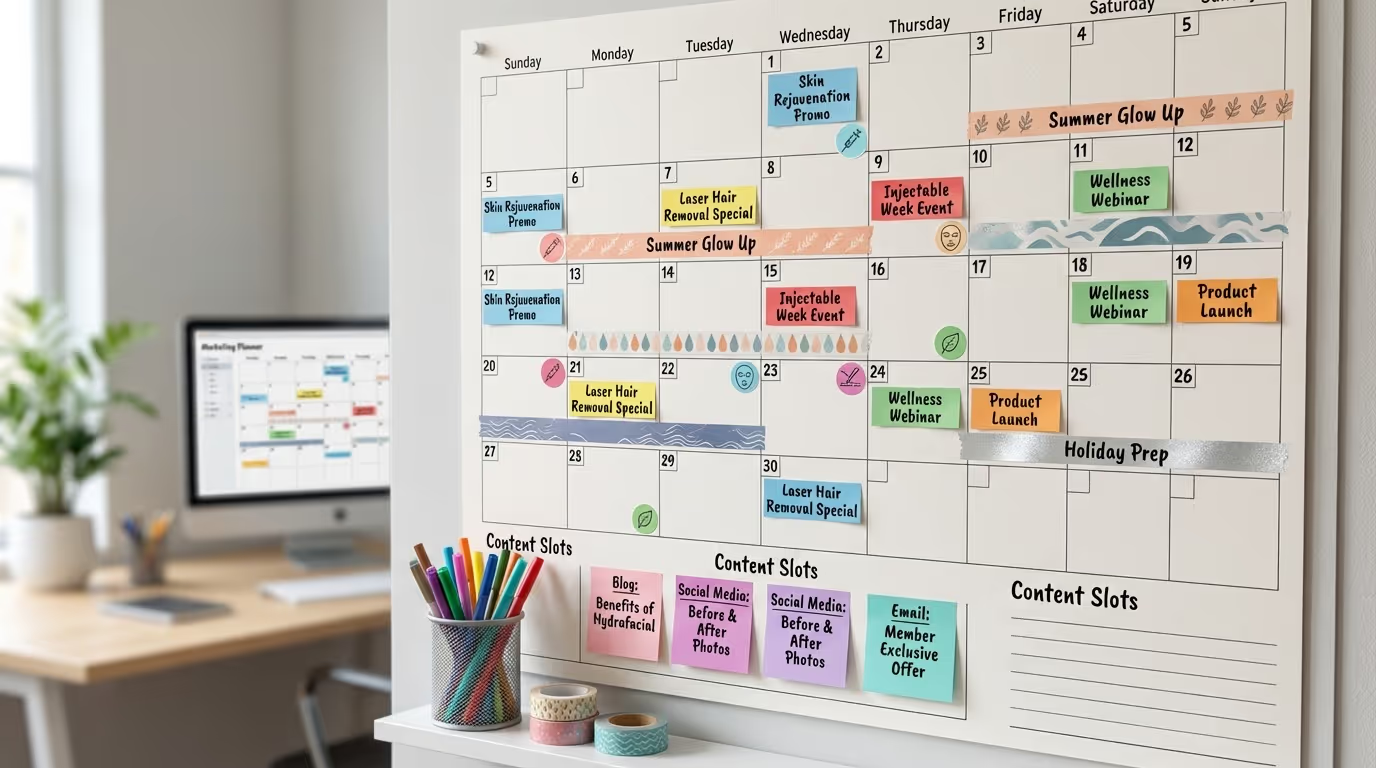
Your marketing budget should not be the same every month. While total annual spend stays consistent, allocation should shift based on seasonal demand, planned campaigns, and strategic priorities.
Q1 (January-March): Rebuild + Pre-Summer Push
| Focus Area | Budget Shift | Why |
|---|---|---|
| Google Ads for body contouring | Increase 15-20% | Patients start planning summer bodies |
| Weight loss marketing | Increase 10-15% | New Year resolution surge |
| Semaglutide campaigns | Increase 10% | Peak demand period |
| Email reactivation | Increase 20% | Re-engage lapsed patients from holidays |
| SEO content | Maintain | Consistent investment compounds |
Q2 (April-June): Peak Season Acceleration
| Focus Area | Budget Shift | Why |
|---|---|---|
| Google Ads (all treatments) | Increase 10-15% | Peak demand season for injectables and laser |
| Meta Ads creative refresh | Increase 15% | Summer-focused creative performs best |
| Social media | Increase 10% | Peak engagement season |
| SEO content | Maintain | Continue building organic authority |
| Events/community | Increase | Pre-summer events drive bookings |
Q3 (July-September): Strategic Maintenance
| Focus Area | Budget Shift | Why |
|---|---|---|
| Google Ads | Maintain | Consistent presence through summer |
| Meta Ads | Decrease 10% | Slightly lower engagement in late summer |
| Laser hair removal campaigns | Increase 15% | Last-chance summer messaging |
| Membership marketing | Increase 20% | Fall enrollment push |
| SEO content | Increase 10% | Build authority before Q4 competition |
Q4 (October-December): Holiday + Year-End Push
| Focus Area | Budget Shift | Why |
|---|---|---|
| Google Ads (Botox, injectables) | Increase 15% | Holiday event season drives injectable demand |
| Specials and promotions | Increase 20% | Gift card campaigns, holiday packages |
| Email marketing | Increase 25% | Black Friday, holiday promotions, year-end campaigns |
| Retargeting | Increase 15% | Capture holiday shoppers who browsed but did not book |
| Budget planning for next year | Allocate time | Use Q4 data to set next year's strategy |
Build Your Med Spa Marketing Budget Around Reality, Not Hope
The right marketing budget for your med spa is not what feels comfortable. Whether you are setting your med spa advertising budget for the first time or restructuring an existing one, it is what the math says you need to invest to hit your growth targets at an acceptable cost per acquisition.
If you are doing $80,000 per month and want to grow to $120,000, you can calculate exactly how many new patients that requires, what it costs to acquire them, and what marketing budget makes that possible. That is a business decision, not a gut feeling.
The med spas that grow consistently do not have bigger aesthetic practice marketing budgets than their competitors. They have smarter budgets — allocated to the right channels, measured with the right metrics, and adjusted based on real performance data.
The framework in this guide gives you everything you need to build, allocate, and optimize your marketing budget. But frameworks are only useful if you execute them. The practices we see grow the fastest are the ones that commit to a number, commit to the channels, and commit to measuring everything — then adjust based on what the data tells them, not what their gut says.
Your marketing budget is not an expense. It is the investment that determines whether your practice grows, stagnates, or slowly loses ground to competitors who understood this first.
Not sure if your current marketing budget is working hard enough? Get Your Free Marketing Audit and we will analyze your spend, benchmark it against practices your size, and identify exactly where your budget is underperforming. No cost. No obligation. Just a clear picture of what your marketing dollars should be doing — and what they are actually doing.