
Here's a number that should bother you: the average med spa converts less than 30% of its leads into booked appointments.
That means for every 10 people who raise their hand and say "I'm interested," 7 of them never become patients. You paid to generate those leads. You paid for the ads, the website, the social media presence, the SEO — all of it. And 70% of that investment walks away.
The problem isn't lead generation. It's the entire system around it.
Most med spa owners think about lead generation for healthcare as a top-of-funnel problem: "I need more leads." But the practices that grow fastest aren't the ones with the most leads — they're the ones with the best systems for converting and closing the leads they already have.
This guide covers both sides of patient lead generation. We will show you how to generate more leads for your med spa through proven medical practice lead generation channels, and more importantly, how to stop losing the ones you are already paying for. Every channel, every conversion tactic, every follow-up sequence — with the implementation steps, benchmarks, and mistakes to avoid.
The Healthcare Lead Generation Math That Changes Everything
Before tactics, you need to understand the economics. Most practice owners don't, and it costs them tens of thousands of dollars per year.
Know Your Numbers
| Metric | What It Means | Poor | Average | Good | Great |
|---|---|---|---|---|---|
| Cost Per Lead (CPL) | What you pay per inquiry | $100+ | $50-$100 | $25-$50 | Under $25 |
| Lead-to-Appointment Rate | % of leads that book | Under 15% | 20-30% | 30-40% | 40%+ |
| Show Rate | % of booked that show up | Under 70% | 75-80% | 80-90% | 90%+ |
| Consultation Close Rate | % of consults that buy | Under 50% | 55-65% | 65-80% | 80%+ |
| Average Transaction Value | Revenue per patient visit | Under $250 | $300-$600 | $600-$1,000 | $1,000+ |
| Patient Lifetime Value | Total revenue per patient | Under $1,500 | $2,000-$5,000 | $5,000-$10,000 | $10,000+ |
The Math That Separates Winners From Losers
Let's run the numbers on two real scenarios to show why system optimization matters more than lead volume.
Practice A — Volume-focused, broken system:
| Stage | Number | Rate |
|---|---|---|
| Monthly ad spend | $5,000 | — |
| Leads generated | 100 | $50 CPL |
| Appointments booked | 20 | 20% lead-to-appointment |
| Patients who show up | 15 | 75% show rate |
| Patients who buy | 9 | 60% close rate |
| Revenue per patient | $450 | — |
| Monthly revenue from ads | $4,050 | 0.81:1 ROAS |
Practice A is underwater. They're spending $5,000 to generate $4,050. They think they need more leads. They don't. They need a better system.
Practice B — System-focused, same lead volume:
| Stage | Number | Rate |
|---|---|---|
| Monthly ad spend | $5,000 | — |
| Leads generated | 100 | $50 CPL |
| Appointments booked | 40 | 40% lead-to-appointment |
| Patients who show up | 34 | 85% show rate |
| Patients who buy | 26 | 75% close rate |
| Revenue per patient | $650 | — |
| Monthly revenue from ads | $16,900 | 3.38:1 ROAS |
Same leads. Same ad spend. Practice B generates 4x the revenue because every stage of their system converts better. This is why healthcare lead generation strategy must address the entire pipeline — not just the top of the funnel.
When you factor in patient lifetime value, the gap widens dramatically. If Practice B retains those 26 patients at an average LTV of $5,000, that single month of ad spend generates $130,000 in lifetime revenue.
Lead Generation Channels: Where Med Spa Leads Come From
Google Search Ads (Highest Intent)
When someone types "Botox near me" or "med spa in [your city]," they are actively looking for a provider. Google Ads put your practice at the top of those results immediately.
Why this channel matters: Intent. The person has already decided they want a treatment. You're competing for who they book with, not whether they book at all.
Implementation steps:
- Build separate campaigns for each treatment category (injectables, body contouring, skin treatments, weight loss, laser hair removal)
- Use exact match and phrase match keywords — broad match bleeds budget on irrelevant searches
- Send traffic to treatment-specific landing pages, never your homepage
- Implement call tracking with unique numbers per campaign (60%+ of med spa conversions happen on the phone)
- Set up conversion tracking that distinguishes between leads and booked appointments
- Geo-target your service radius (15-20 miles for most markets, tighter in dense metros)
- Build a negative keyword list from day one (jobs, training, DIY, side effects, free)
- Create treatment-specific ad copy that speaks to each audience's specific concerns
Performance benchmarks by treatment:
| Treatment | Avg. CPC | Expected CPL | Lead-to-Appt Rate | Patient Value |
|---|---|---|---|---|
| Botox/Injectables | $4-$8 | $30-$60 | 35-50% | $400-$800 |
| Body Contouring | $6-$12 | $50-$90 | 25-40% | $2,000-$5,000 |
| Laser Hair Removal | $3-$7 | $25-$50 | 30-45% | $1,500-$3,000 |
| Weight Loss/GLP-1 | $8-$20 | $60-$120 | 30-45% | $3,000-$12,000 |
| Skin Treatments | $3-$7 | $25-$50 | 30-45% | $300-$1,500 |
| IV Therapy | $2-$5 | $15-$35 | 35-50% | $150-$350 |
For a complete breakdown of costs, see our med spa Google Ads cost guide.
Google Local Service Ads (Pay Per Lead)
Local Service Ads (LSAs) appear at the very top of Google — above regular search ads. You pay per lead (phone call or message), not per click. For med spas that qualify, LSAs are one of the most cost-effective lead generation channels available.
Key advantages:
- Google Guaranteed badge builds instant trust
- Pay only for actual leads, not clicks
- Appear above traditional paid ads
- Mobile-dominant format matches how patients search
Implementation steps:
- Apply for Google Local Service Ads (requires background checks and license verification)
- Complete the setup process (2-4 weeks for verification)
- Set your weekly budget and service area
- Respond to every lead within minutes — Google tracks response time and rewards fast responders with better placement
- Dispute invalid leads through the dashboard (you'll get refunded)
Meta Ads (Demand Generation)
Facebook and Instagram ads don't capture existing demand — they create new demand. Someone scrolling through their feed isn't searching for Botox, but your ad stops them and plants the seed.
Implementation steps:
- Install the Meta Pixel on every page of your website
- Upload your patient database as a Custom Audience
- Build Lookalike audiences from your patient list (40-60% better than interest targeting)
- Create separate campaigns: prospecting (cold audiences), retargeting (website visitors), and remarketing (existing patients)
- Produce video creative — 15-30 second videos outperform static images by 2-3x
- Test lead form ads (higher volume, lower quality) versus landing page ads (lower volume, higher quality)
- Build a nurture sequence to handle the longer conversion cycle (2-4 weeks from lead to booking)
Performance benchmarks:
| Ad Type | CPL Range | Lead Quality | Conversion Timeline |
|---|---|---|---|
| Lead form ads | $15-$35 | Medium | 2-4 weeks |
| Landing page ads | $35-$65 | High | 1-2 weeks |
| Retargeting | $8-$20 | Very High | 3-7 days |
| Video ads (cold) | $20-$45 | Medium-High | 2-3 weeks |
Organic Search (SEO)
Organic search is the long-term play. It takes 6 to 12 months to build, but once your content ranks, it generates leads at near-zero marginal cost. Our SEO for medical spas guide covers the complete strategy.
Priority content for lead generation:
| Content Type | Target Keywords | Conversion Potential |
|---|---|---|
| Treatment cost pages | "how much does [treatment] cost in [city]" | Very High |
| Location treatment pages | "[treatment] near me," "[treatment] [city]" | Very High |
| Comparison content | "Botox vs. Dysport," "CoolSculpting vs. Emsculpt" | High |
| What to expect guides | "what to expect during [treatment]" | Medium-High |
| FAQ pages | Long-tail questions about treatments | Medium |
A med spa with strong local SEO can generate 50 to 200 organic leads per month without spending a dollar on ads. For a step-by-step approach, see our med spa SEO checklist.
Implementation steps:
- Conduct keyword research for every treatment
- Build treatment cost pages for your top 5-8 services
- Create location-specific treatment pages if you serve multiple cities
- Optimize your Google Business Profile for map pack visibility
- Publish a content strategy of 8+ pieces per month
- Implement schema markup for business, services, and reviews
- Build internal linking architecture between all related pages
Social Media (Organic)
Organic social media generates leads through trust, not direct response. The path is: someone follows your account, engages with your content over weeks or months, builds trust in your expertise, and eventually books.
The ROI is real but difficult to attribute directly. Think of organic social as a trust multiplier that makes every other channel more effective. A patient who sees your Google Ad AND follows you on Instagram is more likely to book than one who only sees the ad.
For social content strategy, see our social media posts guide, content ideas, and hashtag strategy.
Referral Programs
Existing patient referrals are the highest-quality leads you'll ever get. They convert at 50% to 70% (versus 25% to 40% for paid leads), they have higher average transaction values, and they cost a fraction of paid acquisition. See our med spa referral program guide for the complete system.
Implementation steps:
- Design a two-sided incentive ($50-$100 credit for both referrer and new patient)
- Build tracking into your CRM (not on sticky notes)
- Promote at every patient touchpoint: checkout, post-treatment emails, welcome sequence, reception signage
- Send quarterly referral reminders to active patients
- Run referral contests for top referrers
Database Reactivation
Your existing database — past patients, unconverted leads, lapsed inquiries — is a lead generation channel. These people already know you. They already showed interest. Reactivating them is dramatically cheaper than acquiring someone new.
Implementation steps:
- Segment by last visit date and treatment type
- Build personalized email + SMS sequences with a specific offer and deadline
- Follow up by phone for high-value segments (patients who previously spent $1,000+)
- Run reactivation campaigns quarterly on your marketing calendar
A single database reactivation campaign can generate $10,000 to $50,000 in revenue within 30 days. Most practices never run one.
The Lead Capture System: Where Most Practices Lose
Generating traffic and attention is worthless if your lead capture system has holes. And most do.
Your Website Is Leaking Leads
The average med spa website converts 2% to 3% of visitors. That means 97% to 98% of people who visit your site leave without doing anything.
Website lead capture fixes — implementation steps:
- Make your phone number visible and clickable on every page. This sounds basic. Over 40% of the med spa websites we audit bury the phone number in the footer or make it non-clickable on mobile devices.
- Add a chat or text widget. Many patients prefer texting to calling. A chat widget that routes to your front desk via SMS captures leads you'd otherwise lose. This alone recovers 5-10% of otherwise-lost visitors.
- Place a form on every treatment page. Not just a "contact us" page. Every treatment page should have a consultation request form directly on it.
- Implement exit-intent popups. When a visitor moves to leave your site, trigger a popup with an offer: free consultation, treatment guide download, or special pricing. Exit-intent popups recover 5% to 10% of abandoning visitors.
- Add online booking. If a patient can book online without calling, you capture leads outside business hours — when 40% of searches happen.
- Add a sticky CTA. A floating "Book Now" or "Call" button on mobile that stays visible as the user scrolls.
- Install website optimization improvements: page speed under 3 seconds, mobile-first design, clear visual hierarchy.
Landing Pages vs. Your Website
This distinction matters. Your website serves multiple audiences and purposes. A landing page serves one audience with one purpose: convert a specific visitor into a specific lead.
Landing page requirements:
| Element | Requirement | Impact on Conversion |
|---|---|---|
| Treatment focus | One treatment per page | +40-60% vs. multi-topic pages |
| Headline match | Matches the search query or ad copy | +20-30% conversion lift |
| Above-fold CTA | Form, phone, or booking visible without scroll | +25-35% conversion lift |
| Social proof | Reviews, ratings, before-and-afters | +15-25% conversion lift |
| Provider credentials | Name, photo, qualifications | +10-20% conversion lift |
| No navigation | Remove menu and footer links | +10-15% conversion lift |
| Mobile-first | Designed for phone screens first | +20-30% conversion on mobile |
| Page speed | Under 3 seconds | Every extra second costs 7% |
Benchmark: 8% to 12% conversion rate. If you're below 5%, test the headline first, then the CTA, then the page speed.
For homepage design and service page design best practices, see our dedicated guides.
Forms That Convert
Most med spa contact forms are terrible. They ask for too much information, they're buried at the bottom of the page, and they don't set expectations about what happens next.
Form optimization checklist:
- [ ] Fields limited to: Name, phone, email, treatment interest (4 fields max)
- [ ] Placed above the fold on landing pages
- [ ] Placed mid-page and bottom-page on treatment pages
- [ ] Submission message sets clear expectations ("We'll call within 2 hours")
- [ ] Mobile-optimized with large tap targets
- [ ] Treatment selection uses dropdown (not free text)
- [ ] Phone field triggers numeric keyboard on mobile
- [ ] Form submission fires conversion tracking event
Every additional field beyond 4 reduces conversion by 5% to 10%. If you're asking for address, date of birth, insurance information, or anything else on a lead capture form — stop. Collect that during the appointment booking call.
The Lead Follow-Up System: Where the Money Is
This is where most healthcare lead generation strategies fail completely. The leads come in. Nobody follows up fast enough (or at all). And the lead books with a competitor who responded first.
The 5-Minute Rule
Responding to a new lead within 5 minutes makes you 21 times more likely to qualify that lead compared to waiting 30 minutes. After 1 hour, the lead is effectively cold. After 24 hours, you might as well not have generated it at all.
Most med spas we audit have an average lead response time of 4 to 8 hours. Some don't respond to inquiries at all.
The response system — implementation steps:
| Timeframe | Action | Who | Channel |
|---|---|---|---|
| 0-60 seconds | Automated text acknowledging inquiry | CRM automation | SMS |
| 0-60 seconds | Automated email confirmation | CRM automation | |
| 1-5 minutes | Live phone call | Front desk / sales team | Phone |
| 5-10 minutes | Escalation to manager if no call made | CRM alert | Internal |
| After hours | Automated text + email + offer online booking or callback slot | CRM automation | SMS + Email |
| Next morning | First call of the day to all after-hours leads | Front desk | Phone |
The Nurture Sequence
Not every lead is ready to book on the first contact. Some need time, information, and multiple touchpoints. A lead nurture sequence does that work automatically. For the complete system, see our med spa drip campaign guide.
Email + SMS nurture sequence for med spa leads:
| Day | Channel | Content | Goal |
|---|---|---|---|
| 0 | SMS + Email | Instant confirmation + "what to expect" | Set expectations |
| 1 | Treatment education (how it works, results, FAQ) | Build knowledge | |
| 3 | Social proof (before-and-afters, testimonial, reviews) | Build trust | |
| 5 | SMS | Check-in ("Any questions about [treatment]?") | Personal touch |
| 7 | Offer (intro pricing, free consult, limited availability) | Drive booking | |
| 10 | Email + SMS | Final follow-up ("Want us to hold a spot this week?") | Urgency |
| 14+ | Email (monthly) | Long-term nurture with education + seasonal offers | Stay top of mind |
Performance benchmarks: A well-built nurture sequence recovers 15% to 25% of leads that didn't book on first contact. At a $50 CPL, that's recovering $7.50 to $12.50 worth of ad spend per recovered lead — and generating $300 to $1,500 in treatment revenue.
Phone Skills Matter
The best lead generation system in the world is useless if your front desk can't convert a phone call into a booked appointment.
Common phone conversion killers:
| Mistake | Impact | Fix |
|---|---|---|
| Putting callers on hold | 25% hang up, never call back | Dedicated phone line, no hold policy |
| Answering questions without booking | Lead gets info, books elsewhere | "Let me get you on the calendar to discuss in person" |
| Not asking for the appointment | Lead hangs up with no next step | Always offer specific dates and times |
| Not following up on missed calls | Lost leads | Return every call within 15 minutes + instant text |
| Using voicemail | Most patients won't leave one | Always have a live answer, plus auto-text for missed calls |
Phone training priorities:
- Warm greeting including practice name
- Qualifying questions (treatment interest, timeline, budget range)
- Overcoming objections (price, fear, timing)
- Closing to a specific appointment ("We have Tuesday at 2 PM or Thursday at 10 AM — which works better?")
- Missed call protocol (return within 15 minutes, text immediately)
Lead Scoring: Not All Leads Are Equal
A lead who visited your Botox pricing page, watched a treatment video, and submitted a form is not the same as someone who clicked a Facebook ad and filled out a 2-field form without looking at your website. They both count as "leads," but they require very different levels of effort to convert.
Lead scoring model for med spas:
| Behavior | Points | Rationale |
|---|---|---|
| Submitted contact form | +10 | Active intent to connect |
| Called the practice | +15 | Highest-intent action |
| Visited pricing page | +10 | Price research = near decision |
| Viewed 3+ pages | +5 | Active research |
| Watched a video | +5 | Engaged with content |
| Opened nurture email | +3 | Responsive to communication |
| Clicked link in email | +5 | Actively engaging |
| Returned to website | +10 | Coming back = high interest |
| High-value treatment inquiry | +10 | Body contouring, weight loss |
| Inquired about low-value service | +3 | Still a lead, lower urgency |
| Referred by existing patient | +15 | Highest-quality lead source |
Lead tiers and response protocol:
| Tier | Score | Response Protocol | Expected Conversion |
|---|---|---|---|
| Hot | 30+ | Call within 5 minutes, personal follow-up | 50-70% |
| Warm | 15-29 | Call within 1 hour, accelerated nurture | 25-40% |
| Cool | 1-14 | Standard nurture sequence, email follow-up | 10-20% |
Lead scoring lets your team prioritize their time on the leads most likely to convert, instead of treating every inquiry the same.
Reducing No-Shows: Protecting Your Lead Generation Investment
A no-show isn't just a missed appointment — it's a wasted lead. You paid to generate it, you paid your team to follow up, and you blocked a time slot that could have served another patient.
The average no-show rate for med spas is 15% to 25%. Getting that to under 10% has the same revenue impact as generating 15% more leads.
No-show reduction system — implementation steps:
| Touchpoint | Timing | Channel | Content |
|---|---|---|---|
| Confirmation | At booking | SMS + Email | Details, directions, what to expect |
| Reminder 1 | 48 hours before | SMS | "Reply YES to confirm" |
| Reminder 2 | 2 hours before | SMS | Final reminder with location |
| Deposit | At booking | Payment system | $25-$50 deposit applied to treatment |
| Waitlist | Upon cancellation | CRM automation | Auto-offer slot to waitlist patients |
Impact by tactic:
| Tactic | No-Show Reduction |
|---|---|
| Confirmation SMS at booking | -10% |
| 48-hour reminder with confirmation request | -15-20% |
| 2-hour reminder | -5-10% |
| Deposit/credit card on file | -30-40% |
| Waitlist system | Recovers 30-50% of cancellations |
For appointment reminder templates, see our dedicated guide.
Tracking and Attribution: Know What Works
You can't optimize what you can't measure. Every healthcare lead generation strategy needs clear attribution — you need to know which channel produced which leads, which leads became patients, and what those patients spent.
Tracking infrastructure — implementation steps:
- Call tracking. Unique phone numbers for each campaign/channel. Tools like CallRail or WhatConverts track every call to its source.
- UTM parameters. Every link in every ad, email, and social post should have UTM tags so GA4 can attribute website visits to their source.
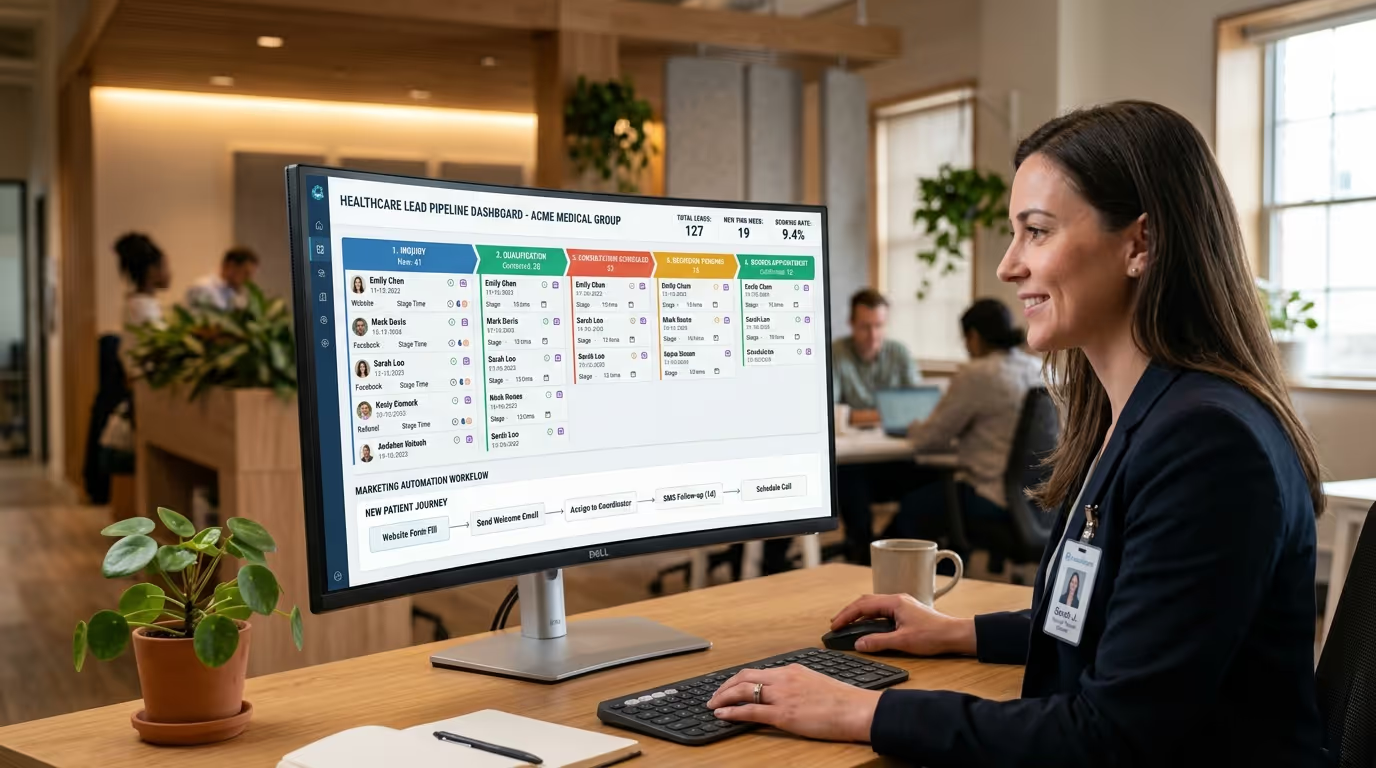
- CRM pipeline tracking. Every lead should have a source tag. Track: inquiry → contacted → appointment booked → showed → converted → revenue.
- Offline conversion import. Upload your CRM conversion data back to Google Ads and Meta so the algorithms can optimize for patients, not just leads.
- Monthly reporting dashboard. Build or implement a dashboard that connects marketing spend to patient revenue by channel.
The attribution dashboard you need:
| Metric | Google Ads | Meta Ads | SEO | Referral | Email/SMS | LSAs |
|---|---|---|---|---|---|---|
| Leads generated | Track | Track | Track | Track | Track | Track |
| Cost per lead | Calculate | Calculate | Calculate | Calculate | Calculate | Calculate |
| Lead-to-appt rate | Track | Track | Track | Track | Track | Track |
| Show rate | Track | Track | Track | Track | Track | Track |
| Revenue generated | Track | Track | Track | Track | Track | Track |
| ROAS / ROI | Calculate | Calculate | Calculate | — | Calculate | Calculate |
Build this dashboard. Review it weekly. Kill channels that underperform. Double down on channels that overperform. This is how you turn healthcare lead generation from a cost center into a profit engine.
For more on marketing ROI tracking, see our measurement guide. And for a list of the KPIs every med spa owner should track, see our KPI guide.
Advanced Healthcare Lead Generation Tactics
Once your foundational system is running, these advanced tactics can accelerate growth significantly.
Tactic 1: Treatment Bundles as Lead Magnets
Instead of offering a generic "free consultation," offer a specific treatment bundle or package as the hook.
Example offers that outperform "free consultation":
| Offer Type | Example | Expected CPL vs. Generic |
|---|---|---|
| Package deal | "Summer Body Prep: CoolSculpting + Skin Tightening — Save $500" | -30% CPL |
| First-time special | "New Patient Botox: $10/unit (regularly $13)" | -25% CPL |
| Assessment | "Free Body Contouring Assessment with 3D Scan" | -20% CPL |
| Bundle | "Anti-Aging Package: Botox + Filler + Chemical Peel — $200 Off" | -35% CPL |
These offers generate more qualified leads because they pre-qualify for interest in a specific treatment and communicate concrete value. For more promotion ideas that actually drive bookings, see our guide.
Tactic 2: Quiz Funnels
"What's the Right Treatment for You?" quizzes generate leads by providing personalized recommendations. The patient answers 5 to 7 questions about their goals, and the quiz recommends treatments and asks for their contact info to send detailed results.
Quiz funnel performance:
| Metric | Standard Landing Page | Quiz Funnel | Improvement |
|---|---|---|---|
| Conversion rate | 8-12% | 30-50% | 3-5x |
| Lead quality | High | Medium-High | Slightly lower |
| Cost per lead | $40-$80 | $15-$35 | 50-60% lower |
| Engagement time | 30-60 sec | 2-4 min | 3-4x longer |
Quiz funnels work because they're interactive and the patient feels like they're getting value before giving information. For practices with diverse treatment menus, this is one of the highest-converting lead generation tools available.
Tactic 3: Webinar and Virtual Event Funnels
Host a monthly virtual event: "Ask the Injector" live Q&A, "Understanding Non-Surgical Body Contouring," or "Everything You Need to Know About Semaglutide Weight Loss." Registration is your lead capture. Attendees are pre-qualified and warm. Post-event follow-up converts 20% to 30% of attendees into consultations.
Implementation steps:
- Choose a topic aligned with your highest-value treatment
- Create a registration page (this is your lead capture form)
- Promote across email, social media, and paid ads
- Host the 30-45 minute event with live Q&A
- Record and repurpose as YouTube content and social clips
- Follow up within 24 hours with a consultation offer to all registrants
Tactic 4: Competitor Targeting
Run Google Ads campaigns targeting your competitors' brand names. When someone searches "[Competitor Name] Botox" or "[Competitor Name] reviews," your ad shows up offering a comparison or a complimentary consultation.
This is legal, effective, and costs less than generic keywords because competition on branded terms is lower. You can't use competitor brand names in your ad copy, but you can bid on them as keywords and position yourself as the better alternative.
Tactic 5: Retargeting the Unconverted
97% of website visitors leave without converting. Retargeting follows them across the internet with your ads for the next 30 to 90 days. Retargeting typically delivers 3x to 5x higher conversion rates than cold traffic at $2 to $10 CPCs.
Segment your retargeting by page visited. Someone who looked at your pricing page gets a different message than someone who read a blog post.
Tactic 6: Strategic Partnerships for Lead Flow
Build referral relationships with complementary businesses — dermatologists, plastic surgeons, fitness studios, and high-end salons. These partnerships generate leads with zero ad spend and extremely high conversion rates. See our post on patient acquisition strategies for the full partnership playbook.
The Healthcare Lead Generation System: Putting It All Together
Individual channels generate individual leads. A system generates predictable patient flow.
Here's what the complete system looks like when all the pieces are connected:
Stage 1: Traffic Generation
- Google Ads capture high-intent search demand
- Meta Ads create new demand through visual storytelling
- SEO content builds compounding organic traffic
- Social media builds trust and brand awareness
- Referral programs leverage existing patient relationships
Stage 2: Lead Capture
- Treatment-specific landing pages convert traffic at 8-12%
- Website optimization ensures no friction in the conversion path
- Chat widgets and online booking capture after-hours leads
Stage 3: Lead Conversion
- Speed-to-lead automation responds within 60 seconds via text
- Phone follow-up within 5 minutes during business hours
- Lead scoring prioritizes high-value inquiries
- Nurture sequences follow up with leads who don't book immediately
Stage 4: Appointment Protection
- Appointment reminders reduce no-shows to under 10%
- Deposits protect against casual bookings
- Waitlist fills cancellation gaps
Stage 5: Revenue Maximization
- Consultation process converts consults to purchases at 70%+
- Membership programs create recurring revenue
- Post-treatment follow-up generates reviews and rebookings
Stage 6: Measurement
- Attribution tracking connects every dollar spent to every dollar earned
- Weekly dashboard review optimizes channel allocation
- Quarterly strategy refresh based on performance data
When this system runs properly, your cost per acquired patient drops, your calendar fills predictably, and your revenue grows month over month. Not because you're spending more, but because you're losing less.
Common Healthcare Lead Generation Mistakes
Mistake 1: Chasing Volume Over Quality
More leads is not always better. 200 leads at a 15% close rate (30 patients) costs the same as 100 leads at a 30% close rate (30 patients) — but your team spends half the time on follow-up. Focus on lead quality by channel and optimize for patients, not leads.
Mistake 2: No Speed-to-Lead Process
If your average lead response time is over 30 minutes, you're losing 50%+ of your leads before they ever hear from you. This is the single highest-impact fix in healthcare lead generation.
Mistake 3: Ignoring the Middle of the Funnel
Most practices invest in generating leads (top) and treating patients (bottom) but ignore the middle — the follow-up, nurture, and conversion steps that turn a lead into a booked appointment. The middle of the funnel is where the money is.
Mistake 4: Flying Blind Without Attribution
If you can't tell which channel produced which patients, every budget decision is a guess. Implement attribution tracking before you increase spend on any channel.
Mistake 5: Treating All Leads the Same
A lead who called your office after reading 5 pages on your website is fundamentally different from someone who filled out a 2-field Facebook form. Score your leads and allocate follow-up effort accordingly.
Mistake 6: Neglecting Your Existing Database
Your CRM is a lead generation channel. Reactivation campaigns targeting lapsed patients generate $10K-$50K in revenue with zero ad spend. Most practices never run one.
Stop Generating Leads You Can't Convert
The biggest waste in healthcare lead generation isn't spending too little — it's losing the leads you've already paid for.
Before you increase your ad budget, fix your response time. Before you launch another campaign, optimize your landing pages. Before you chase new channels, reactivate your existing database.
The leads are there. The system to convert them probably isn't. And every week you operate with a broken system, you're burning money on leads that never become patients.
The practices that dominate their markets haven't found a secret lead source. They've built a system that loses fewer leads at every stage. That's the competitive advantage. That's what separates a $50K/month practice from a $300K/month practice.
Book a Strategy Call — We'll map your entire lead generation system, identify where you're losing patients, and build a plan to increase your conversion rate before you spend another dollar on ads. This is what we do. Med spas only. Results only.