
No-shows are not a scheduling problem. They are a revenue problem — and med spa appointment reminders are the fastest fix.
The average med spa has a no-show rate between 12% and 20%. For a practice booking 40 appointments per week at $300 average treatment value, a 15% no-show rate means 6 lost appointments per week. That is $1,800 per week. $7,200 per month. $93,600 per year — gone. Not because patients decided to go somewhere else. Because they forgot, got busy, chickened out, or simply did not feel enough commitment to show up.
Automated med spa appointment reminders are the simplest, fastest way to recover that revenue. A properly timed reminder sequence reduces no-shows by 40 to 60%. That same practice cutting its no-show rate from 15% to 5% recovers $62,400 per year. From text messages that cost pennies to send.
This guide gives you the exact med spa appointment reminders templates — SMS and email — that you can copy, customize, and deploy today. Plus the timing strategy, the psychology behind why appointment reminder SMS med spa sequences work, the automation setup in your CRM, and the advanced med spa text reminders tactics that separate good reminder systems from great ones.
The Financial Case for Med Spa Appointment Reminders
Before diving into templates, understand what no-shows actually cost. Most practice owners underestimate this number by 50% or more because they only count the missed appointment — not the downstream revenue loss (rebooking delays, retail sales, referrals).
No-Show Cost Calculator
| Practice Size | Appts/Week | No-Show Rate | Avg Treatment | Weekly Loss | Monthly Loss | Annual Loss |
|---|---|---|---|---|---|---|
| Small (1-2 providers) | 30 | 15% | $250 | $1,125 | $4,500 | $58,500 |
| Medium (3-5 providers) | 80 | 15% | $300 | $3,600 | $14,400 | $187,200 |
| Large (6+ providers) | 150 | 15% | $350 | $7,875 | $31,500 | $409,500 |
After implementing a proper reminder system (reducing no-shows from 15% to 5%):
| Practice Size | No-Show Rate | Weekly Loss | Monthly Loss | Annual Loss | Annual Recovery |
|---|---|---|---|---|---|
| Small | 5% | $375 | $1,500 | $19,500 | $39,000 |
| Medium | 5% | $1,200 | $4,800 | $62,400 | $124,800 |
| Large | 5% | $2,625 | $10,500 | $136,500 | $273,000 |
Those recovery numbers are not theoretical. They represent real revenue from patients who would have no-showed but instead showed up because of a well-timed text message.
Your reminder system — built into your CRM at no additional cost if using GoHighLevel, or $50 to $200/month for a dedicated tool — pays for itself many times over. This is the highest-ROI automation you can implement in your practice.
The Psychology Behind Effective Med Spa Appointment Reminders
Understanding why patients no-show helps you write med spa appointment reminders that actually prevent it. No-shows break down into five categories, each requiring a different intervention.
The Five Types of No-Shows
| Type | Why They No-Show | % of No-Shows | Intervention |
|---|---|---|---|
| Forgetters | Life got busy, genuinely forgot | 35-40% | Multi-touch reminders with confirmation |
| Anxious | Nervous about the procedure, avoid dealing with it | 20-25% | Reassurance messaging, "what to expect" content |
| Low-commitment | Booked impulsively, interest faded | 15-20% | Deposit collection, excitement-building sequence |
| Logistical | Schedule conflict arose, did not bother to cancel | 10-15% | Easy reschedule options in every reminder |
| Price-sensitive | Got sticker shock between booking and appointment | 5-10% | Value reinforcement, financing mentions |
A great reminder system addresses all five types. Simple "do not forget your appointment" messages only catch the Forgetters. The templates in this guide address every category.
Med Spa Appointment Reminders Timing Framework
The timing of your med spa appointment reminders matters as much as the content. Send too early, and patients forget again by appointment time. Send too late, and they cannot reschedule if they need to. Here is the framework that works.
The 4-Touch Reminder Sequence
Touch 1: Immediate Confirmation (0 minutes after booking)
The moment someone books, they should receive a confirmation. This is not technically a "reminder" — it is a receipt. But it sets expectations, provides details, and creates the first commitment anchor. Psychologically, receiving a confirmation makes the appointment feel real and creates a sense of obligation.
Touch 2: Pre-Appointment Prep (48 hours before)
This reminder serves a dual purpose — it reminds them of the appointment and prepares them for it. Include pre-treatment instructions, what to bring, and what to expect. This positions you as professional and thorough, and it addresses the "anxious" no-show type by reducing uncertainty.
Touch 3: Day-Before Reminder (24 hours before)
This is the most important reminder. It is close enough to the appointment that the patient will not forget, and far enough out that they can reschedule if something came up. Always include a confirmation mechanism (reply to confirm) — patients who actively confirm are 90% less likely to no-show.
Touch 4: Same-Day Nudge (2 hours before)
The final touch. Short, simple, and action-oriented. Address, time, and a warm welcome. This catches the logistical no-shows who may need a final push and reassures the anxious types.
Timing Adjustments by Booking Lead Time
Not every appointment needs all four touches. Adjust based on how far in advance the patient booked:
| Booking Lead Time | Touches to Send | Rationale |
|---|---|---|
| Same-day booking | Touch 1 + Touch 4 only | No time for prep reminders |
| Next-day booking | Touch 1 + Touch 3 + Touch 4 | Skip 48-hour, send day-before and day-of |
| 2-3 days out | Touch 1 + Touch 3 + Touch 4 | Skip 48-hour if booking is 2 days out |
| 4-7 days out | All 4 touches | Full sequence |
| 8-14 days out | All 4 touches + additional mid-point | Add a Touch 1.5 at the midpoint to maintain engagement |
| 15+ days out | All 4 touches + 2 mid-point touches | Long booking windows have highest no-show rates — add extra touchpoints |
Implementation step: Configure your booking software or CRM automation to detect the booking lead time and automatically select the appropriate reminder sequence. This prevents over-messaging same-day bookings and under-messaging far-out bookings.
SMS Templates
SMS is your primary reminder channel. 95-98% of text messages are read, most within 3 minutes of receipt. Every template below has been tested across med spa environments and can be customized with your practice name, treatment, and details.
Touch 1: Booking Confirmation (Immediate)
Template A — Simple:
Confirmed! Your [treatment] appointment at [Practice Name] is set for [Day], [Date] at [Time]. Questions? Reply to this text. We look forward to seeing you!
Template B — With Pre-Instructions:
Your [treatment] appointment is booked! [Day], [Date] at [Time] at [Practice Name]. Quick prep note: [pre-treatment instruction, e.g., "avoid blood thinners 48 hours before your appointment"]. Reply with any questions.
Template C — New Patient:
Welcome to [Practice Name]! Your [treatment] consultation is confirmed for [Day], [Date] at [Time]. Here is what to expect: [link to appointment prep page]. Need to reschedule? Reply R anytime.
Template D — High-Value Treatment (deposit collected):
Your [treatment] is confirmed for [Day], [Date] at [Time] at [Practice Name]. Your $[amount] deposit has been applied. We are excited for your appointment! Full details: [link]. Questions? Reply here.
Implementation steps for booking confirmations:
- Set up the SMS trigger to fire within 60 seconds of booking
- Use dynamic fields for [treatment], [Date], [Time], and [First Name]
- Include a reply path so patients can text back with questions
- For new patients, include a link to your intake forms — patients who complete forms pre-appointment are 35% less likely to no-show
Touch 2: Pre-Appointment Prep (48 Hours Before)
Template A — Standard:
Hi [First Name], quick reminder that your [treatment] appointment is in 2 days — [Day], [Date] at [Time]. A few things to remember: [1-2 pre-treatment instructions]. See you soon!
Template B — Injectable-Specific:
Reminder: Your injectable appointment is [Day] at [Time]. To get the best results, please avoid alcohol, aspirin, and ibuprofen for 24 hours before your visit. If you have any questions, text us here.
Template C — Laser-Specific:
Your laser treatment is in 2 days! Reminder: Avoid direct sun exposure and self-tanners before your appointment. Come with clean skin (no makeup or lotions on the treatment area). See you [Day] at [Time].
Template D — New Patient:
Hi [First Name], looking forward to meeting you on [Day] at [Time]. Please complete your intake forms before arriving: [Link]. Parking is [instructions]. Allow [X] extra minutes for check-in. Questions? Reply here.
Template E — Body Contouring:
Your [CoolSculpting/body contouring] appointment is in 2 days! Wear comfortable, loose clothing. Treatment takes approximately [X] minutes per area. You can return to normal activities immediately after. See you [Day] at [Time]!
Template F — High-Anxiety Treatment (surgical consultation):
Hi [First Name], your consultation with [Provider Name] is in 2 days ([Day] at [Time]). We know this is a big step, and we want you to feel completely comfortable. Here is a video of what to expect: [link]. Any questions before your visit? Text us anytime.
Touch 3: Day-Before Reminder (24 Hours Before)
Template A — With Confirmation Request:
Hi [First Name], just a reminder about your [treatment] appointment tomorrow at [Time] at [Practice Name]. Reply C to confirm or R to reschedule. See you soon!
Template B — With Directions:
See you tomorrow! Your [treatment] appointment is at [Time]. We are located at [Address]. [Parking note]. Reply C to confirm.
Template C — Premium Experience:
Tomorrow is the day! Your [treatment] appointment is at [Time] with [Provider Name]. Everything is set for you — just arrive 5 minutes early and we will take care of the rest. Reply C to confirm.
Template D — First-Time Visitor Reassurance:
Hi [First Name], looking forward to your first visit tomorrow at [Time]. Here is what to expect: you will arrive, check in at our front desk, and be welcomed into a private room. The entire process takes about [X] minutes. No pressure, no rush. Reply C to confirm.
Touch 4: Same-Day Nudge (2 Hours Before)
Template A — Short and Warm:
See you in 2 hours! [Practice Name], [Address]. Text us if you need anything.
Template B — With Provider Name:
2 hours to go! [Provider Name] is looking forward to your [treatment] today. [Address]. See you soon.
Template C — First-Timer Reassurance:
Almost time for your first [treatment]! Just a reminder — the process is quick, comfortable, and our team will walk you through everything. See you at [Time] at [Address].
Template D — Weather/Traffic Aware:
See you at [Time]! Quick note: [traffic/weather note if applicable, e.g., "construction on Main St — take Oak Ave instead"]. [Practice Name], [Address]. Text us if you are running late — no stress!
Email Templates
Email provides the space for detailed information that SMS cannot. Use email for confirmations and pre-appointment prep where you need to communicate instructions, directions, forms, and expectations. Your email marketing system should handle these automatically.
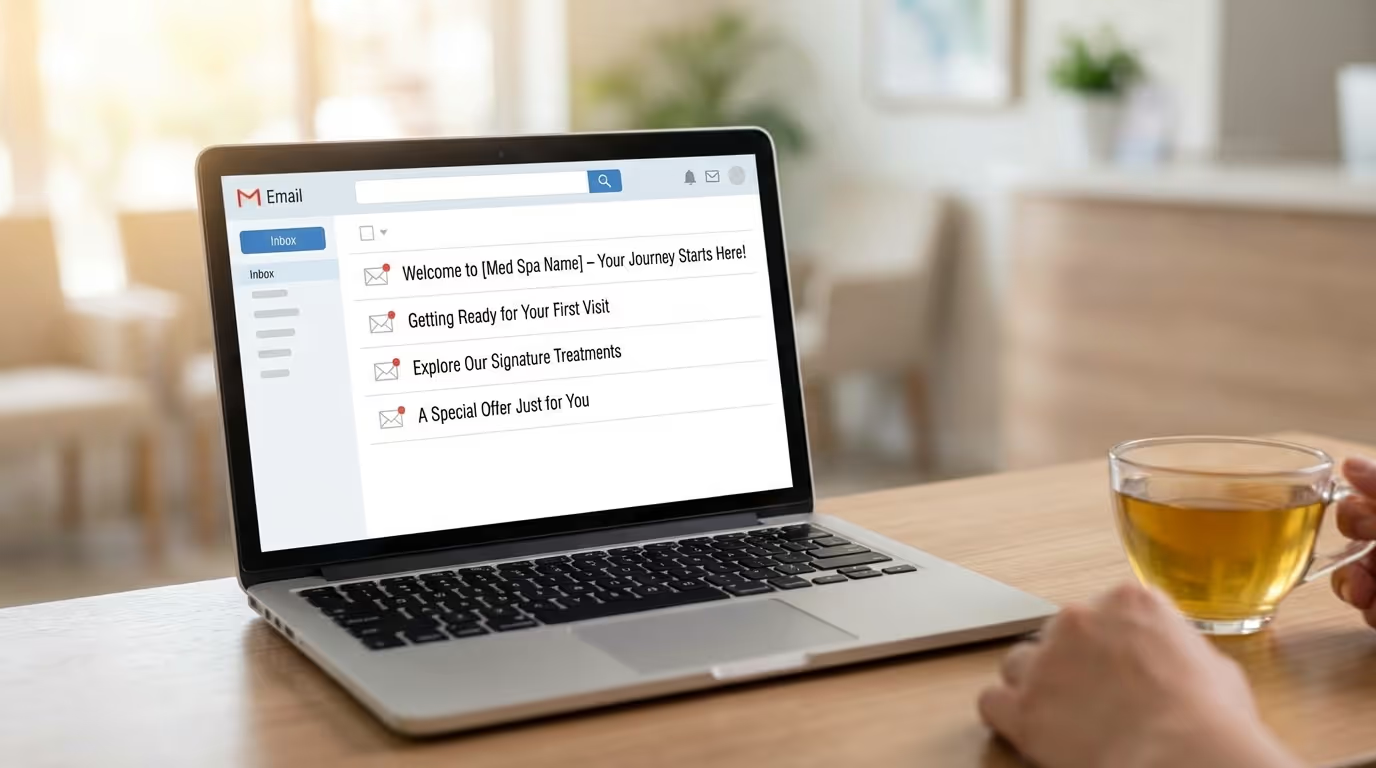
Touch 1: Booking Confirmation Email
Subject line: Your appointment at [Practice Name] is confirmed
Body:
Hi [First Name], Great news — your appointment is confirmed. Here are the details: Treatment: [Treatment Name] Date: [Day, Month Date, Year] Time: [Time] Provider: [Provider Name] Location: [Full Address] Before your appointment: - [Pre-treatment instruction 1] - [Pre-treatment instruction 2] - [Pre-treatment instruction 3] What to bring: - Photo ID - Completed intake forms ([link] — completing these online saves you 15 minutes at check-in) - List of current medications and supplements Parking: [Parking instructions] Need to reschedule? Reply to this email or call us at [phone number]. We ask for at least 24 hours notice for any changes. We look forward to seeing you. [Practice Name] [Phone] | [Email] | [Website]
Touch 2: Pre-Appointment Prep Email (48 Hours Before)
Subject line: Getting ready for your [treatment] appointment
Body:
Hi [First Name], Your [treatment] appointment is coming up on [Day] at [Time], and we want to make sure you get the best possible experience and results. Your provider: [Provider Name] — [1-2 sentence bio, e.g., "a board-certified nurse practitioner with 8 years of experience in medical aesthetics and over 5,000 injectable treatments performed."] Pre-treatment reminders: - [Treatment-specific instruction 1] - [Treatment-specific instruction 2] - [Treatment-specific instruction 3] What to expect: [2-3 sentences about the treatment process, duration, and what happens during the appointment. Set expectations so they arrive calm and informed.] Your total investment: [Include price range or specific amount if known. Addressing price before arrival reduces sticker shock and price-related no-shows.] Financing available: If you are interested in spreading the cost over monthly payments, we offer [financing option]. Ask your provider during your visit or [link to financing info]. Questions before your visit? Just reply to this email or text us at [phone number]. See you [Day]! [Practice Name]
Touch 3: Day-Before Reminder Email (24 Hours Before)
Subject line: Tomorrow at [Time] — your [treatment] appointment
Body:
Hi [First Name], Just a friendly reminder that your [treatment] appointment is tomorrow. When: [Day, Date] at [Time] Where: [Practice Name], [Address] With: [Provider Name] Final reminders: - Arrive 5 minutes early - [Any last-minute pre-treatment instructions] Cancel or reschedule? Please let us know as soon as possible at [phone number] or by replying to this email. [Include cancellation policy if applicable.] We look forward to seeing you tomorrow. [Practice Name]
Post-Appointment Email: Review Request (24-48 Hours After)
Include this as part of your reminder workflow to complete the patient loop:
Subject line: How was your visit at [Practice Name]?
Body:
Hi [First Name], Thank you for visiting [Practice Name] yesterday for your [treatment]. We hope you are feeling great! We would love to hear about your experience. A quick review helps other patients find us and helps us continue providing the best care possible. Leave a Google Review: [Direct link to your Google review page] It only takes 60 seconds and means the world to our team. Questions about aftercare? Reply to this email or text us at [phone number]. We are here for you. Thank you, [Practice Name]
For a complete review collection strategy, see our guide on how to get more Google reviews and reputation management.
Advanced Reminder Strategies
Strategy 1: Confirmation-Based Escalation
Do not just send reminders and hope for the best. Use confirmation responses to segment and escalate. This is the single most effective no-show reduction tactic after basic reminders.
Workflow:
- Send 24-hour reminder with "Reply C to confirm"
- If confirmed: Send same-day nudge only. No further action needed. Tag patient as "confirmed" in your CRM.
- If no confirmation within 4 hours: Send a second SMS: "We want to make sure we hold your spot. Can you confirm your appointment tomorrow at [Time]? Reply C or call [phone]."
- If still no confirmation after 2 hours: Alert front desk to call the patient directly. Warm, friendly call — not scolding.
- If unreachable: Tag as "high no-show risk" and have front desk attempt outreach the morning of. Simultaneously, notify your waitlist in case the slot opens.
Confirmation escalation benchmarks:
| Step | Expected Response Rate | Cumulative Confirmation Rate |
|---|---|---|
| First SMS (24-hour reminder) | 50-65% confirm | 50-65% |
| Escalation SMS (4 hours later) | 30-40% of remaining confirm | 70-80% |
| Phone call (if no SMS response) | 40-50% reached and confirm | 80-90% |
| Morning-of outreach | 20-30% reached | 85-92% |
This escalation catches potential no-shows before they happen and gives you time to fill the slot from your waitlist.
Strategy 2: Deposit Collection
For high-value treatments or repeat no-show offenders, collect a deposit at booking. This changes the psychology entirely — a patient who has $50 on the line is dramatically more likely to show up or properly cancel.
Implementation steps:
- Configure your booking software to require deposits for treatments over $500 (body contouring, filler packages, laser series)
- Flag patients with a history of no-shows in your CRM and require deposits for all future bookings
- Communicate the deposit policy clearly at booking: "A $50 deposit is required to hold your appointment. This is applied to your treatment cost."
- Apply the deposit to the treatment if they show up — it is not an extra charge, it is a commitment mechanism
- Define a clear cancellation policy: "Cancellation with 24+ hours notice: full deposit refunded. Cancellation with less than 24 hours or no-show: deposit forfeited."
Deposit benchmarks:
| Deposit Approach | No-Show Rate Impact | Patient Satisfaction Impact |
|---|---|---|
| No deposit | 12-20% no-show rate | No friction, but high revenue loss |
| $25 deposit | 8-12% no-show rate | Minimal friction |
| $50 deposit | 5-8% no-show rate | Some patients push back initially |
| $100+ deposit | 3-5% no-show rate | Appropriate only for high-value treatments |
| Full prepayment | 1-3% no-show rate | Works for packages and memberships |
Common concern: "Will requiring deposits scare away patients?" Data says no. Practices that implement deposits see a 2-5% decrease in initial bookings but a 30-50% decrease in no-shows. The net result is more completed appointments and more revenue.
Strategy 3: Waitlist Filling
When a patient cancels or no-shows, your system should automatically notify patients on the waitlist. This turns cancellations from lost revenue into recovered revenue.
Workflow:
- Cancellation detected (patient cancels or appointment marked as no-show)
- System checks waitlist for patients who requested the same provider, treatment, or time slot
- Instant SMS to waitlist patients: "Good news! A [treatment] appointment just opened up on [Day] at [Time] with [Provider]. Want it? Reply YES to claim it."
- First to respond gets the slot (auto-booked)
- If no waitlist response within 2 hours, expand the notification to patients due for that treatment (from your treatment reminder list)
Waitlist recovery benchmarks:
| Response Time | Fill Rate |
|---|---|
| Within 30 minutes | 40-50% of slots filled |
| Within 2 hours | 50-65% of slots filled |
| Within 4 hours | 55-70% of slots filled |
| Same-day (morning notification) | 30-40% of afternoon slots filled |
This system recovers 30 to 50% of cancellations without any front desk effort.
Strategy 4: No-Show Follow-Up
When a patient does no-show, the worst thing you can do is nothing. The second worst is send an angry message. Strike the right balance — concerned, not condescending.
No-show follow-up sequence:
30 minutes after missed appointment (SMS):
Hi [First Name], we missed you at your [treatment] appointment today. Everything okay? If you would like to reschedule, here is our calendar: [Booking Link]
24 hours later (Email): Subject: We missed you — let's reschedule
Body: No guilt, no passive aggression. Simply: "We noticed you were unable to make your appointment yesterday. Life happens — we would love to reschedule at a time that works better for you. [Booking Link]"
72 hours later (SMS — if no response):
Hi [First Name], just following up one more time about rescheduling your [treatment]. We have openings this week if you would like to grab a spot: [Booking Link]. No pressure — we are here when you are ready.
If this is a repeat no-show (2+): Flag in your CRM, add to "deposit required" segment for future bookings, and have the front desk call personally to understand if there is an underlying issue.
If this is a 3+ repeat no-show: Consider a personal call from the practice manager or provider. Sometimes chronic no-shows have transportation issues, anxiety, or financial concerns that a personal conversation can resolve. If the pattern continues, implement a mandatory deposit or prepayment policy for that patient.
No-show recovery benchmarks:
| Follow-Up Step | Rescheduling Rate |
|---|---|
| 30-minute SMS | 15-25% rebook |
| 24-hour email | 8-12% rebook |
| 72-hour SMS | 5-8% rebook |
| Phone call (repeat no-shows) | 20-30% rebook or resolve |
| Total recovery rate | 35-50% |
Strategy 5: Treatment-Specific Instructions
Generic reminders are functional. Treatment-specific reminders are professional. Customize your reminder content based on the treatment type. This addresses the "anxious" no-show type by providing clear expectations and making the patient feel cared for.
Injectable reminders should include:
- Avoid blood thinners (aspirin, ibuprofen, fish oil) for 24 to 48 hours
- Avoid alcohol for 24 hours
- Come with a clean face (no makeup)
- Expect the treatment to take [X] minutes
- Bruising is possible but manageable — plan accordingly for social events
Laser treatment reminders should include:
- Avoid sun exposure for [X] days before
- No self-tanners or tanning beds
- Shave the treatment area [X] days before (for laser hair removal)
- Come with clean skin, no lotions or products on the treatment area
- Wear comfortable clothing that allows easy access to the treatment area
Body contouring reminders should include:
- Wear comfortable, loose clothing
- Treatment takes [X] minutes per area
- You can return to normal activities immediately after
- What results timeline to expect (e.g., "visible changes in 4-8 weeks, full results in 12 weeks")
- Hydrate well before and after treatment
Chemical peel / facial reminders should include:
- Discontinue retinol [X] days before treatment
- Avoid sun exposure for [X] days before
- Come with clean skin
- Plan for possible redness/peeling for [X] days after
New patient consultation reminders should include:
- Complete intake forms before arriving (link)
- Bring photo ID and insurance card if applicable
- List of current medications and supplements
- Photos of areas of concern (if doing a virtual or in-person consultation)
- Plan for 30-45 minutes for the full consultation
Implementation step: Create treatment-specific reminder templates in your CRM and map them to each service type in your scheduling system. When a patient books "Botox," they automatically receive the injectable-specific reminders. When they book "laser hair removal," they get the laser-specific templates. This requires setup time upfront but runs automatically forever after.
Strategy 6: Personalization Beyond [First Name]
Basic personalization (using the patient's first name) is table stakes. Advanced personalization drives significantly higher engagement and show rates.
Personalization elements to include:
| Element | Example | Impact |
|---|---|---|
| Provider name | "with Sarah, your injector" | Increases connection and commitment |
| Treatment-specific prep | "avoid sun exposure" vs. "avoid aspirin" | Shows expertise and care |
| Previous visit reference | "We loved seeing you last month!" | Reinforces relationship |
| Booking history | "Your 4th Botox refresh!" | Celebrates loyalty |
| Appointment value | Investment amount for high-value treatments | Reduces price-related no-shows |
The Numbers: Reminder Impact by Channel
Not all reminder channels perform equally. Here is what the data shows across med spas, based on aggregate performance from practices we have analyzed.
Channel Performance Comparison
| Channel | Open/Read Rate | Response Rate | No-Show Reduction | Best For |
|---|---|---|---|---|
| SMS | 95-98% | 40-60% confirmation | 35-50% reduction | Primary reminder channel |
| 40-55% | 10-20% click rate | 15-25% reduction | Detailed prep information | |
| Phone call | 15-25% answer | Varies | 10-15% reduction | High-value appointments, escalation |
| Push notification (app) | 60-70% | 20-30% | 20-30% reduction | Practices with patient app |
| WhatsApp (where applicable) | 85-95% | 50-65% | 30-45% reduction | International practices |
Best practice: Use all available channels in a coordinated sequence. SMS is your workhorse. Email provides detail and preparation. Phone calls are reserved for high-value appointments or no-confirmation escalation.
SMS vs. Email: When to Use Which
| Situation | SMS | Both | |
|---|---|---|---|
| Booking confirmation | Primary | Backup with full details | Recommended |
| 48-hour prep reminder | Short version | Full version with instructions | Recommended |
| 24-hour reminder | Primary (with confirm request) | Optional | SMS is sufficient |
| 2-hour nudge | Primary | Not needed | SMS only |
| No-show follow-up | First touchpoint | Second touchpoint (24 hours later) | Recommended |
| Post-appointment review request | Can work | Better for detailed ask | Either or both |
Setting Up Reminders in Your CRM
GoHighLevel Setup
If you are using GoHighLevel, here is how to set up the complete reminder sequence:
Confirmation + Reminder Workflow:
- Navigate to Automations → Create Workflow
- Trigger: "Appointment scheduled" (calendar event created)
- Action 1: Send SMS — Booking confirmation template (immediate)
- Action 2: Send Email — Booking confirmation email (immediate)
- Wait: Until 48 hours before appointment
- Action 3: Send Email — Pre-appointment prep email
- Wait: Until 24 hours before appointment
- Action 4: Send SMS — Day-before reminder with confirmation request
- Wait: 4 hours
- Condition: Did they reply "C"?
- Yes: Wait until 2 hours before → Send same-day nudge SMS
- No: Send escalation SMS ("Want to confirm your appointment?") → Notify front desk via internal notification
- Wait: Until 2 hours before appointment
- Action 5: Send SMS — Same-day nudge
No-Show Follow-Up Workflow (separate automation):
- Trigger: "Appointment status changed to No Show"
- Wait: 30 minutes
- Action 1: Send SMS — "We missed you" template
- Wait: 24 hours
- Condition: Did they rebook?
- Yes: End workflow
- No: Send Email — "Let's reschedule" template
- Wait: 48 hours
- Condition: Did they rebook?
- Yes: End workflow
- No: Send SMS — Final follow-up template
- Action: Add tag "no-show-[date]" for tracking
Waitlist Workflow (separate automation):
- Trigger: "Appointment cancelled" or "Appointment status changed to No Show"
- Condition: Is there a waitlist contact for this time slot / provider / treatment?
- Yes: Send SMS to waitlist contact — "Slot opened up" template
- No: Check for patients due for that treatment type (from treatment reminder segment)
- Wait: 2 hours
- Condition: Did the waitlist contact book?
- Yes: Send confirmation, end workflow
- No: Send to next waitlist contact or expand to treatment-due segment
Other CRM Platforms
Most med spa management software and EMR systems support some level of reminder automation. Here is what to configure in each:
| Platform | Reminder Capability | Setup Complexity | SMS Included |
|---|---|---|---|
| GoHighLevel | Full automation with branching logic | Medium | Yes |
| AestheticsPro | Basic reminders, limited branching | Low | Yes (additional cost) |
| Boulevard | Automated reminders with customization | Low-Medium | Yes |
| Vagaro | Basic automated reminders | Low | Limited |
| Mangomint | Strong automation with two-way texting | Medium | Yes |
| Zenoti | Enterprise-grade automation | High | Yes |
If your current system has limited reminder capabilities: Set up a dedicated reminder automation in GoHighLevel or a tool like Twilio + Zapier, and connect it to your scheduling system via API or webhook. The investment in proper reminder infrastructure pays for itself within the first month.
Common Reminder Mistakes
Mistake 1: Sending Reminders Only by Email
Email open rates for appointment reminders are 40 to 55%. That means 45 to 60% of your patients never see the reminder. SMS has a 95%+ open rate. If you are only using email, you are reminding barely half your patients.
Fix: SMS is your primary channel. Email supplements with detailed information. Never rely on email alone.
Mistake 2: Generic Messages for Every Treatment
"You have an appointment tomorrow at 2 PM" is functional but uninspiring. Treatment-specific reminders that include relevant preparation instructions show professionalism, reduce patient anxiety, and improve the treatment experience. Practices with treatment-specific reminders report 15-20% lower no-show rates than those with generic reminders.
Fix: Create templates for every treatment category (injectables, laser, body contouring, facials, consultations) and map them in your CRM.
Mistake 3: Not Asking for Confirmation
Reminders without a confirmation mechanism are one-directional. When you ask patients to confirm, you create a micro-commitment that increases show rates. You also identify patients who do not confirm — your highest no-show risk — so you can take proactive action.
Fix: Every 24-hour reminder should include "Reply C to confirm" and trigger escalation if no response.
Mistake 4: Too Many Reminders for Short-Notice Bookings
If a patient books a same-day or next-day appointment, they do not need four reminders. Over-messaging feels spammy and undermines your professional image.
Fix: Configure your system to adjust the sequence based on lead time:
- Same-day bookings: confirmation + one reminder
- Next-day bookings: confirmation + two reminders
- 2+ days out: full sequence
Mistake 5: Ignoring Time Zones and Send Times
Do not send reminder texts at 6 AM or 11 PM. This seems obvious, but automated systems do not always account for time zones.
Fix: Configure your system to respect business hours and time zones. The ideal send window for SMS reminders is 9 AM to 7 PM in the patient's local time zone. Schedule the 2-hour nudge based on actual appointment time, not a fixed clock.
Mistake 6: No Follow-Up After No-Shows
Most practices mark a no-show in their system and move on. They never reach out to the patient, never understand why they missed, and never attempt to rebook. That is leaving 35-50% of recoverable revenue on the table.
Fix: Implement the no-show follow-up sequence described above. Automated SMS at 30 minutes, email at 24 hours, final SMS at 72 hours.
Mistake 7: Forgetting to Update Templates Seasonally
Holiday hours, construction detours, weather alerts, and seasonal promotions all affect your reminder content. Sending a reminder with the wrong hours or outdated information damages credibility.
Fix: Review and update all reminder templates quarterly. Add a seasonal note when relevant: "Note: We have extended holiday hours — open until 7 PM this week!"
Mistake 8: Not Tracking Reminder Performance
If you do not know your no-show rate before and after implementing reminders, you cannot prove ROI or optimize the system. Yet most practices never measure reminder effectiveness.
Fix: Track these metrics monthly:
| Metric | How to Track | Target |
|---|---|---|
| No-show rate (overall) | Appointments marked no-show / total appointments | Under 5% |
| Confirmation rate | Patients who reply C / patients sent reminder | Above 65% |
| No-show rate by confirmation status | No-shows among confirmed vs. unconfirmed | Confirmed: under 2%. Unconfirmed: under 15% |
| Waitlist fill rate | Cancelled slots filled from waitlist / total cancellations | Above 30% |
| No-show recovery rate | No-shows who rebook from follow-up / total no-shows | Above 35% |
Integrating Med Spa Appointment Reminders With Your Full Communication System
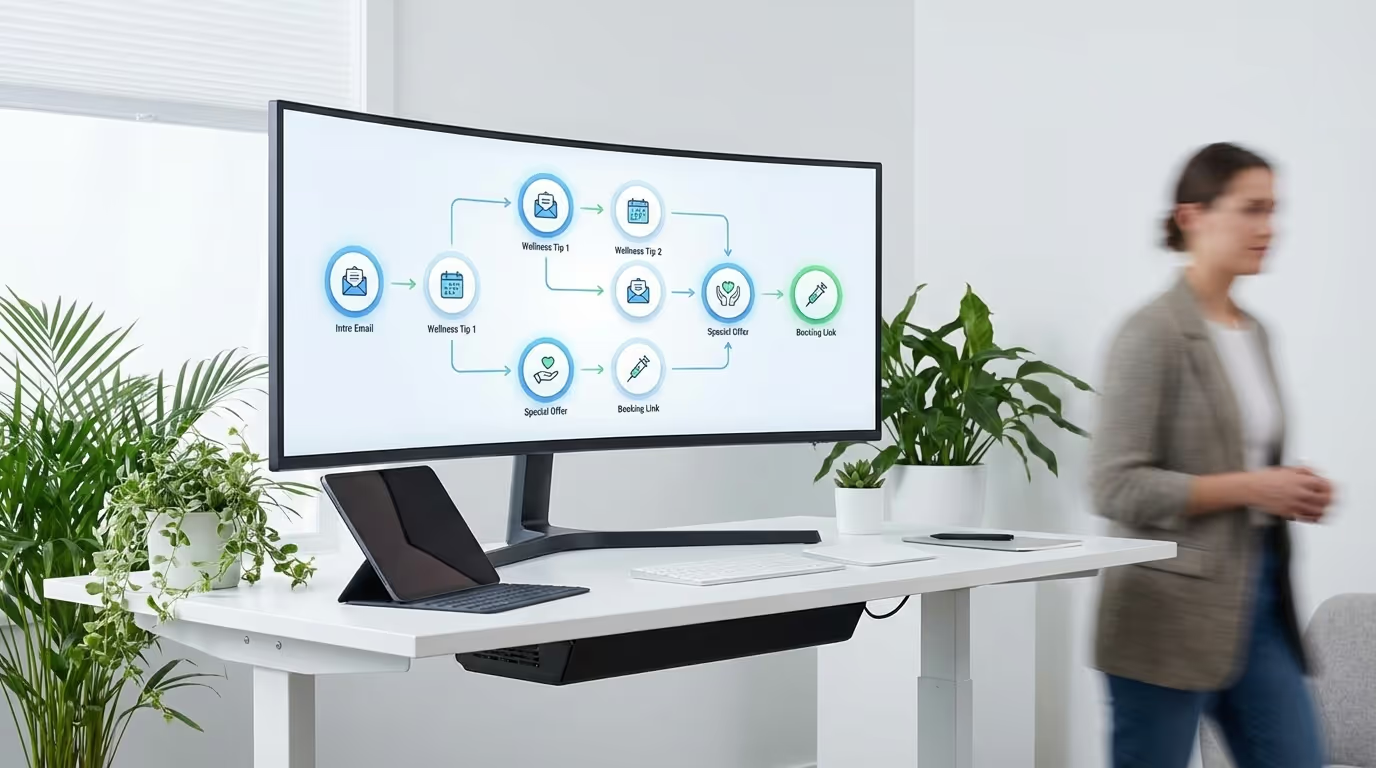
Med spa appointment reminders do not exist in isolation. They are one part of your complete patient communication system that includes welcome sequences, drip campaigns, newsletters, SMS marketing, and reactivation campaigns.
The Complete Communication Timeline
| Touchpoint | Channel | Timing | Purpose |
|---|---|---|---|
| Lead capture | SMS + Email | Immediate | Speed to lead response |
| Consultation booking | SMS + Email | At booking | Confirm and prepare |
| Pre-consultation reminders | SMS + Email | 48h and 24h before | Reduce consultation no-shows |
| Post-consultation follow-up | SMS + Email | Same day + day 1, 3, 7 | Convert consultation to treatment |
| Treatment booking confirmation | SMS + Email | At booking | Confirm and prepare |
| Treatment reminders | SMS + Email | 48h, 24h, 2h before | Reduce treatment no-shows |
| Post-treatment follow-up | SMS + Email | 24-48h after | Aftercare + review request |
| Treatment refresh reminder | Email + SMS | Based on treatment cycle | Rebook before results fade |
| Monthly newsletter | Monthly | Stay top of mind | |
| Reactivation campaign | Email + SMS | 90-120 days since last visit | Win back lapsed patients |
Each touchpoint should be automated in your CRM. Once configured, this system runs continuously, generating revenue from every patient relationship without manual effort.
Measuring ROI: Before and After Implementation
How to Measure
Step 1: Record your baseline no-show rate for 30 days before implementing the reminder system. Track total appointments scheduled, total no-shows, and no-show rate by provider, treatment type, and day of week.
Step 2: Implement the full reminder system (all 4 touches + confirmation escalation + no-show follow-up).
Step 3: After 30 days, measure the same metrics. Calculate the difference.
Step 4: Multiply the recovered appointments by your average treatment value. That is your monthly ROI.
Expected ROI Timeline
| Week | What Happens |
|---|---|
| Week 1 | System configured, templates loaded, automations activated |
| Week 2 | First patients receive full reminder sequence |
| Week 3 | No-show rate begins declining. Front desk notices fewer empty slots. |
| Week 4 | Measure first full month. Typical result: 30-50% no-show reduction. |
| Month 2 | Optimize based on data. Adjust timing, add treatment-specific templates. |
| Month 3 | System fully optimized. No-show rate stabilized at 3-7%. Waitlist filling cancellations. |
Start Today
You do not need a perfect system to start reducing no-shows. If you do nothing else, set up two automated SMS reminders — one at 24 hours and one at 2 hours — and you will see an immediate impact.
Then build from there. Add the confirmation workflow. Add treatment-specific instructions. Add the no-show follow-up. Add the waitlist filler. Add deposit collection for high-value treatments.
Each layer you add compounds the impact. The full med spa appointment reminders system described in this guide — 4-touch reminders, confirmation escalation, no-show follow-up, waitlist management, and deposit collection — can reduce your no-show rate from 15% to under 5%. For most med spas, that means recovering $40,000 to $270,000 per year in revenue that was walking out the door.
The investment is minimal: the cost of your CRM platform and 4-8 hours of initial setup time. The return is immediate and permanent.
If you want us to review your current reminder system, identify the gaps, and show you exactly how much revenue you are leaving on the table — we do that for free.