
Most dermatology practices run ads the same way: they hand their budget to an agency, wait for "leads," and hope the phone rings. Three months later, they have spent $15,000 and cannot point to a single new patient they can attribute to advertising.
This is not an advertising problem. It is a system problem. And it is fixable.
Effective dermatology advertising is specific. It targets the right patients, on the right platforms, with the right message, at the right time. It sends them to pages designed to convert. It tracks every lead from click to consultation to treatment. And it optimizes relentlessly based on what actually generates revenue — not what generates clicks.
This guide covers exactly how to build that system for a dermatology practice — from campaign architecture through ad copy, landing pages, follow-up systems, and ROI tracking. Every recommendation comes from campaigns we have built for practices in the medical aesthetics and dermatology space.
Understanding the Dermatology Advertising Landscape
Dermatology advertising is unique because you are marketing two fundamentally different service lines to two different audiences. Understanding this split is the foundation of every decision you make about campaigns, budgets, and messaging.
Medical dermatology — acne, eczema, psoriasis, skin cancer screening — serves patients with medical needs. These patients often find you through insurance networks and referrals, but increasingly through Google search. CPCs are lower ($5-$15), but so are margins (insurance reimbursement rates).
Cosmetic dermatology — Botox, fillers, laser treatments, chemical peels, microneedling — serves patients making elective, cash-pay decisions. These patients are fully driven by marketing. CPCs are higher ($15-$40), but margins are significantly better (no insurance discounting).
Your advertising strategy should weight heavily toward cosmetic services. Not because medical patients do not matter, but because cosmetic patients are the ones whose acquisition is entirely marketing-dependent. Medical patients come through insurance networks, referrals, and inertia. Cosmetic patients choose you because your marketing convinced them to.
| Factor | Medical Dermatology Ads | Cosmetic Dermatology Ads |
|---|---|---|
| Budget allocation | 20-30% of ad spend | 70-80% of ad spend |
| Average CPC | $5-$15 | $15-$40 |
| Target CPL | $30-$80 | $80-$200 |
| Patient value (first visit) | $150-$300 (insurance) | $400-$1,200 (cash) |
| Decision timeline | Days to 2 weeks | 2 weeks to 3 months |
| Landing page focus | Insurance, availability, conditions treated | Results, credentials, pricing, before/after |
| Primary KPI | Appointments booked | Revenue per lead |
Google Ads for Dermatology: The Primary Channel
Google Ads captures patients who are actively searching for a dermatologist or a specific treatment. This is the highest-intent traffic you can buy. No other advertising channel delivers leads that are this close to booking.
Campaign Architecture
Build your Google Ads account with clear separation between medical and cosmetic campaigns. This allows different budget allocation, different bidding strategies, and different performance targets.
Medical Dermatology Campaigns:
Campaign: General Dermatology
- Ad Group: dermatologist near me / dermatologist [city]
- Ad Group: dermatologist [insurance name] [city]
- Ad Group: skin doctor near me
- Ad Group: board certified dermatologist [city]
Campaign: Condition-Specific
- Ad Group: acne treatment [city]
- Ad Group: eczema specialist [city]
- Ad Group: psoriasis treatment [city]
- Ad Group: skin cancer screening [city]
- Ad Group: rosacea treatment [city]
- Ad Group: mole check [city]
Cosmetic Dermatology Campaigns (Priority):
Campaign: Injectables
- Ad Group: Botox [city]
- Ad Group: dermal fillers [city]
- Ad Group: lip fillers [city]
- Ad Group: Botox dermatologist [city]
- Ad Group: Dysport [city]
Campaign: Laser Treatments
- Ad Group: laser skin resurfacing [city]
- Ad Group: IPL treatment [city]
- Ad Group: laser hair removal [city]
- Ad Group: laser skin tightening [city]
- Ad Group: Fraxel laser [city]
Campaign: Skin Rejuvenation
- Ad Group: chemical peel [city]
- Ad Group: microneedling [city]
- Ad Group: PRP facial [city]
- Ad Group: hydrafacial [city]
- Ad Group: photofacial [city]
Campaign: Brand
- Ad Group: [practice name]
- Ad Group: Dr. [name] dermatologist
Campaign: Competitor
- Ad Group: [competitor practice names]
- Ad Group: [competitor doctor names]
Implementation Steps: Building Dermatology Google Ads
- Run keyword research. Use Google Keyword Planner, Ahrefs, or SEMrush to identify keywords with commercial intent. Prioritize keywords with monthly search volume above 50 and CPC under your target CPL / target conversion rate. See our keyword research guide.
- Map keywords to ad groups. Each ad group contains 5-15 semantically related keywords. One ad group = one intent = one landing page.
- Build landing pages before launching ads. Every campaign needs a dedicated landing page. Do not launch ads without them — sending traffic to your homepage wastes 40-60% of your budget.
- Write responsive search ads with 15 headlines and 4 descriptions per ad group. Test credential-focused, consultation-focused, and social proof-focused messaging.
- Configure all ad extensions: sitelinks (4-6), callout extensions (4-6), structured snippets, call extension, location extension, and promotion extensions when running specials.
- Install conversion tracking for every conversion action: form submissions (Google Ads tag), phone calls (call tracking with CallRail or CTM), chat initiations, and online bookings.
- Set up a negative keyword list. Add the pre-built list below. Review search terms daily for 14 days, then weekly.
- Launch with manual CPC. Set a daily budget of $75-$150 and bid conservatively on your top keywords.
- Transition to Smart Bidding after accumulating 30+ conversions (usually 30-60 days). Start with Maximize Conversions, then switch to Target CPA once you know your sustainable CPL.
- Implement offline conversion tracking by month 3. Upload appointment attendance and treatment completion data back into Google Ads. This trains the algorithm to find people who become patients, not just people who fill out forms.
Ad Copy That Converts
For dermatology advertising, ad copy must be specific to the treatment or condition, emphasize credentials, and drive to a clear CTA.
Medical dermatology ad copy framework:
Headline 1: Board-Certified Dermatologist Headline 2: [Condition] Treatment in [City] Headline 3: Accepting [Insurance] Patients Description: Expert [condition] treatment from Dr. [Name], board-certified dermatologist in [City]. Accepting most major insurance plans. Same-week appointments available. Call or book online.
Cosmetic dermatology ad copy framework:
Headline 1: [Treatment] by a Dermatologist Headline 2: Board-Certified Expert in [City] Headline 3: Natural Results — See Our Work Description: Get [treatment] from a board-certified dermatologist, not a med spa. Dr. [Name] has performed [X]+ treatments with personalized, natural-looking results. Book your consultation today.
The "not a med spa" angle works because it differentiates dermatologists from the growing number of non-physician providers offering the same treatments. Patients who value expertise respond to this positioning.
Words that help ads perform:
- "Board-certified dermatologist"
- "Expert" or "specialist"
- "Personalized treatment plan"
- "Natural results" or "natural-looking"
- "Same-week appointments"
- "See our patient results"
- "No obligation consultation"
Words that hurt ads or get them disapproved:
- "Best" (without substantiation)
- "Guaranteed results"
- "Painless" or "risk-free"
- "Transform" or "dramatic change"
- Pricing claims without context
- Outcome-specific promises
Ad copy testing schedule:
| Week | Action |
|---|---|
| Week 1-2 | Launch 3 ad variations per ad group (credential, consultation, social proof) |
| Week 3-4 | Review click-through rates; pause lowest performer |
| Week 5-6 | Write replacement ad with new angle (urgency, differentiation, specificity) |
| Week 7-8 | Review conversion rates (not just CTR); pause lowest converter |
| Ongoing | Replace bottom performer monthly; keep at least 2 active ads per group |
Landing Pages for Dermatology Ads
Every ad group needs a corresponding landing page. Sending all traffic to your homepage is the single most common — and most expensive — advertising mistake in dermatology. It is also the easiest to fix.
Medical dermatology landing page elements:
- Headline: "[Condition] Treatment in [City] — Board-Certified Dermatologist"
- Insurance accepted (list major plans with logos)
- Provider credentials and experience (photo, board certification, years of experience)
- Treatment approach overview (what patients can expect)
- Patient testimonials specific to the condition
- Same-day or same-week appointment availability
- Simple booking form or click-to-call button
- FAQ section (3-5 questions about the condition and treatment)
Cosmetic dermatology landing page elements:
- Headline: "Expert [Treatment] in [City]"
- Before/after gallery (treatment-specific, real patients, professional photography)
- Provider credentials emphasizing dermatology board certification
- Treatment details (what to expect, session length, recovery, results timeline)
- Cost range and financing options — see our pricing strategy guide
- Video: provider explaining the treatment or patient testimonial
- Consultation booking form (name, phone, email, treatment interest — 4 fields maximum)
- Trust badges: board certification, review count, years in practice, procedure count
Conversion rate benchmarks for dermatology landing pages:
| Performance Level | Conversion Rate | Monthly Leads (at $5K spend) |
|---|---|---|
| Below average | Under 3% | Under 15 |
| Average | 3-5% | 15-25 |
| Good | 5-8% | 25-40 |
| Excellent | 8-12%+ | 40-60+ |
Landing page optimization tests (run one at a time):
| Element | Test A | Test B | Expected Impact |
|---|---|---|---|
| Headline | Treatment-focused | Provider-focused | 10-25% conversion difference |
| Form length | 3 fields | 5 fields | 15-30% fewer completions with more fields |
| CTA button text | "Book Consultation" | "Check Availability" | 5-15% difference |
| Social proof placement | Above fold | Below fold | 10-20% higher with above fold |
| Video | Present | Absent | 20-40% higher with video |
| Phone number | Prominent | Subdued | 15-25% more calls with prominent |
| Before/after gallery | 3 examples | 8 examples | Diminishing returns after 6 |
Bidding and Budget Strategy
Starting bids:
- Medical dermatology keywords: Start at $8-$12 CPC
- Cosmetic dermatology keywords: Start at $15-$25 CPC
- Brand keywords: Start at $2-$5 CPC (these should be cheap)
Bidding strategy progression:
| Phase | Timeline | Strategy | Requirement |
|---|---|---|---|
| Learning | Month 1-2 | Manual CPC | Maintain control while gathering data |
| Transition | Month 3-4 | Maximize Conversions | 30+ tracked conversions accumulated |
| Optimization | Month 5+ | Target CPA | Know your sustainable cost per lead |
| Advanced | Month 8+ | Target ROAS (for cosmetic) | Offline conversion data feeding into Google |
Budget allocation example ($5,000/month):
| Campaign | Monthly Budget | % | Rationale |
|---|---|---|---|
| Cosmetic treatments | $2,500 | 50% | Highest ROI procedures |
| Medical conditions | $1,000 | 20% | Steady patient flow |
| General dermatology | $750 | 15% | Captures broad searches |
| Brand defense | $250 | 5% | Protects against competitors |
| Competitor targeting | $500 | 10% | Captures competitor searches |
Negative Keywords You Need Day One
Add these as negative keywords across all campaigns before spending a dollar:
- "free," "cheap," "discount," "coupon"
- "home remedy," "DIY," "natural cure," "essential oil"
- "side effects," "dangers," "gone wrong," "lawsuit"
- "school," "training," "degree," "salary," "jobs," "hiring"
- "for dogs," "for cats," "veterinary," "pet"
- "definition," "Wikipedia," "what is"
- "Reddit," "Quora," "forum"
- Competitor-specific negatives (if you do not run competitor campaigns)
- Irrelevant conditions you do not treat
- "[treatment] at home," "[treatment] DIY"
Review your search terms report weekly for the first 60 days, then biweekly. Every irrelevant click at $15-$40 is money directly out of your revenue. A single month of unmonitored search terms can waste $1,000-$3,000.
Common Google Ads Mistakes in Dermatology
Mistake 1: One campaign for everything. Mixing "dermatologist near me" with "Botox [city]" with "acne treatment" in one campaign makes optimization impossible. These keywords have different intents, different CPCs, different conversion rates, and different patient values. Separate them.
Mistake 2: No landing page strategy. Sending cosmetic treatment clicks to your general "services" page instead of a treatment-specific landing page cuts your conversion rate by 40-60%. Every $40 click that does not convert because of a generic landing page is $40 wasted.
Mistake 3: Set-it-and-forget-it management. Google Ads requires active management. At minimum: weekly search term review, monthly ad copy testing, monthly bid adjustments, and quarterly campaign restructuring. If your agency sends you a report and does not touch the account between reports, you are paying for neglect.
Mistake 4: Chasing volume over quality. A campaign that generates 100 leads at $30 each sounds better than one generating 30 leads at $80 each — until you realize the first campaign converts 10% to patients and the second converts 40%. Cost per lead is a vanity metric. Cost per patient acquired is the only number that matters.
Mistake 5: No call tracking. In dermatology, 50-70% of conversions happen via phone call, not form submission. If you are only tracking form submissions, you are missing the majority of your conversions — and you cannot optimize what you cannot measure.
Meta Ads for Dermatology
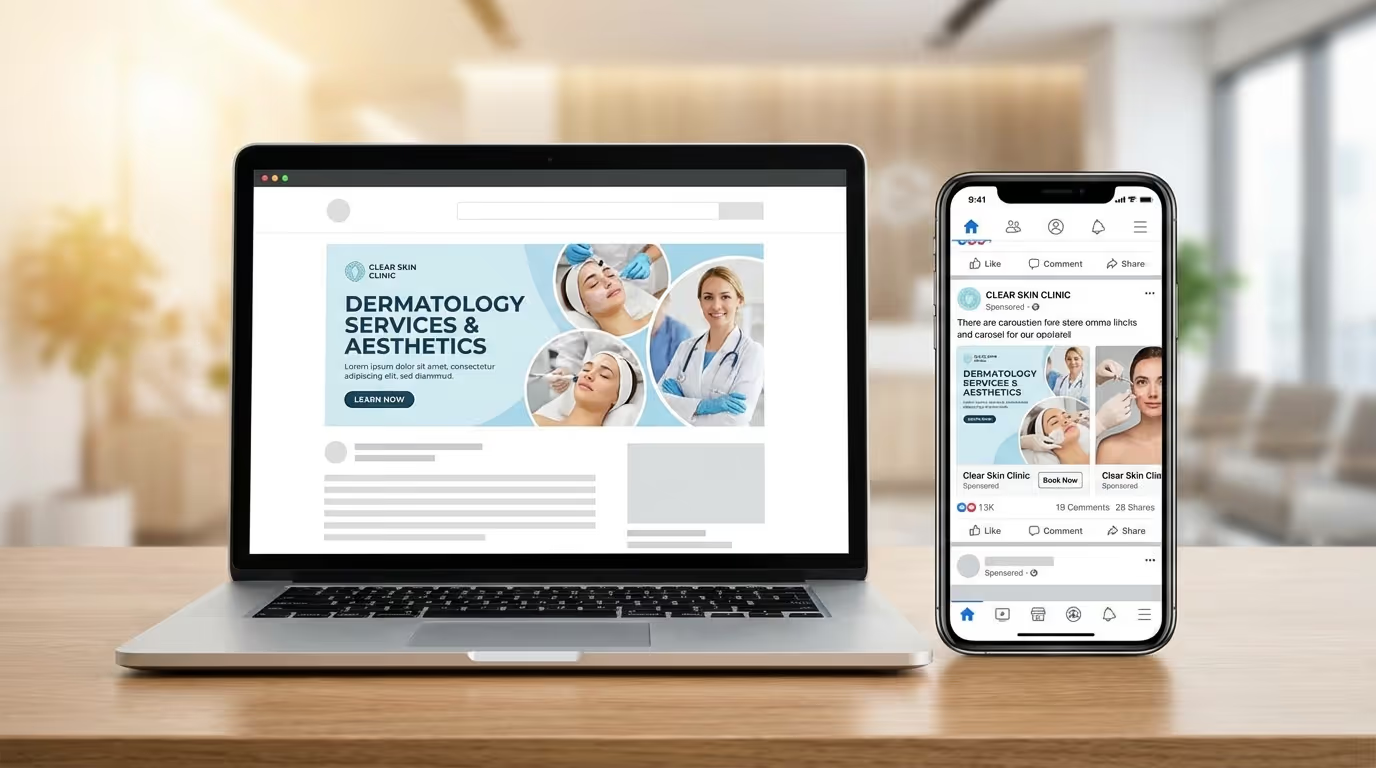
Meta (Facebook/Instagram) Ads work differently for dermatology than Google Ads. Google captures demand. Meta creates awareness and nurtures consideration. Understanding this difference is critical to setting realistic expectations and measuring performance correctly.
When Meta Ads Make Sense for Dermatology
Meta Ads are most effective for:
- Cosmetic dermatology promotions (Botox events, laser treatment specials)
- Building brand awareness in your local market
- Retargeting website visitors who did not convert
- Promoting educational content that establishes your authority
- New treatment announcements
- Event promotion (vendor events, open houses)
Meta Ads are less effective for:
- Medical dermatology patient acquisition (too low-intent for insurance-driven patients)
- Direct-response lead generation for first-time visitors (low conversion rate without prior awareness)
- Reaching patients with immediate medical needs (they search Google, not scroll Facebook)
Campaign Types
Educational Content Campaigns (Top of Funnel — 40% of Meta budget)
Create short video content that educates and positions your dermatologist as the local expert:
- "A dermatologist's guide to choosing the right sunscreen"
- "The difference between Botox and fillers — explained"
- "3 signs you should see a dermatologist about that mole"
- "What a dermatologist actually does during a skin check"
- "The truth about [popular skincare product]"
These build audience and credibility. Run them as awareness or video view campaigns targeting adults 25-65 within 30 miles of your practice.
Implementation steps for educational campaigns:
- Film 5-10 short videos (30-90 seconds each) with your dermatologist on camera. Use a smartphone with a ring light — production value matters less than authenticity and expertise.
- Upload as native video to Meta (not YouTube links — native video gets 10x more reach).
- Target broadly: adults 25-65, within 30 miles, interest in skincare/beauty/health. Let the algorithm optimize.
- Set a daily budget of $10-$30 per video.
- Monitor cost per ThruPlay (target under $0.10) and engagement rate.
- Build a custom audience of people who watched 50%+ of any video — this becomes your warm audience for conversion campaigns.
Promotion Campaigns (Middle of Funnel — 30% of Meta budget)
Promote specific cosmetic treatments with a time-limited offer:
- "First-time Botox patients: complimentary consultation this month"
- "Laser skin resurfacing event — limited spots available"
- "New patient chemical peel special — book by [date]"
Use carousel or single image ads with clear offer and CTA. Target interests related to skincare, beauty, anti-aging, and wellness, plus your warm video viewer audiences.
Retargeting Campaigns (Bottom of Funnel — 30% of Meta budget)
Show ads to users who visited your website but did not book:
- Testimonial video from a patient who had the treatment they viewed
- Reminder ad: "Still considering [treatment]? Book your complimentary consultation"
- Social proof ad: "[X] patients chose us for [treatment] this month — here's why"
- Review highlight ad featuring your Google rating and review count
Retargeting is the highest-ROI Meta campaign type because you are reaching people who already know you. These people are 8-10x more likely to convert than cold audiences.
Implementation steps for retargeting:
- Install the Meta Pixel on every page of your website. Configure standard events for ViewContent (treatment pages), Lead (form submissions), and Schedule (booking confirmations).
- Create a custom audience of website visitors in the last 30 days who did not convert.
- Create treatment-specific retargeting audiences (visited Botox page but did not book, visited laser page but did not book).
- Build 3-5 retargeting ad variations (testimonial, reminder, social proof, educational).
- Set a daily budget of $15-$30 for retargeting.
- Set frequency caps to avoid showing the same ad more than 3x per week to the same person.
Ad Creative Guidelines
What works:
- Dermatologist on camera explaining a treatment or condition
- Patient testimonials (focus on experience, not physical outcomes)
- Skin care tip videos (educational, not salesy)
- Clean, professional imagery of your practice
- Carousel of different treatments available
- "Day in the life at the practice" content
What gets flagged or rejected by Meta:
- Before/after photos (especially close-ups of skin conditions)
- Body-focused imagery
- Claims about appearance change or weight loss
- Ad copy referencing age, skin color, or physical attributes
- Price-focused copy without substantiation
- Implied body dissatisfaction ("tired of your skin?")
Compliant ad copy formula: "Considering [treatment]? Dr. [Name] is a board-certified dermatologist in [City] specializing in [treatment category]. Book a consultation to discuss your personalized treatment plan. [Offer if applicable]. Financing available."
Meta Budget and Expectations
| Monthly Budget | Expected CPL | Expected Leads | Best Use Case |
|---|---|---|---|
| $1,000-$2,000 | $30-$60 | 15-40 | Retargeting + 1 promo campaign |
| $2,000-$4,000 | $25-$50 | 40-80 | Full funnel (awareness + retargeting) |
| $4,000-$8,000 | $20-$40 | 80-200 | Scaled awareness + conversion + events |
Remember: Meta leads typically convert to appointments at a lower rate (25-40%) than Google leads (40-60%). Factor this into your cost per acquired patient calculation. A $40 Meta lead that converts at 30% has an effective cost per patient of $133. A $120 Google lead that converts at 50% has an effective cost per patient of $240. The Meta lead is actually cheaper per patient — but only if you have a strong follow-up system to nurture them.
Common Meta Ads Mistakes for Dermatology
Mistake 1: Expecting Google-like intent from Meta. Meta users are not searching for a dermatologist. They are scrolling through photos of their friends' kids. Your ads need to interrupt that scroll with something valuable (education, entertainment, credibility) before asking for a booking.
Mistake 2: Skipping the awareness phase. Launching conversion campaigns to cold audiences on Meta produces expensive, low-quality leads. Spend 4-6 weeks building awareness and warm audiences before pushing for conversions.
Mistake 3: Using the same creative for months. Meta ads fatigue within 2-3 weeks. If your cost per lead is climbing, the first thing to check is creative freshness. Rotate new images and videos every 2-3 weeks.
Mistake 4: Not separating retargeting from prospecting budgets. Retargeting and prospecting have completely different economics. Combine them in one campaign and the algorithm will spend all your budget on retargeting (because it converts better), starving your top-of-funnel pipeline.
The Follow-Up System That Makes Advertising Work
Here is the truth about dermatology advertising: your campaigns can be perfect — right keywords, right ad copy, right landing pages — and still fail if your follow-up is broken. The follow-up system is where advertising ROI is actually determined.
The data is clear:
| Response Time | Booking Probability | Comparison |
|---|---|---|
| Under 5 minutes | 10x more likely | Baseline best practice |
| 5-30 minutes | 4x more likely | Acceptable |
| 30-60 minutes | 2x more likely | Below average |
| 1-4 hours | 1x (baseline) | Industry average |
| 4-24 hours | 0.5x | Losing half your leads |
| 24+ hours | 0.2x | Losing 80% of leads |
Additional data:
- 50% of practices take more than 24 hours to respond to leads
- The average practice attempts 1.5 follow-up contacts before giving up (you need 5-7)
- The first practice to respond wins 78% of the time when a patient contacts multiple providers
The 5-Minute Follow-Up System
Implementation steps:
- Minute 0-1 (Automated): Text message: "Thanks for contacting [Practice Name]! We received your inquiry about [treatment]. Our team will call you shortly to schedule your consultation."
- Minute 1-5 (Human): Live phone call from your dedicated lead coordinator (not the front desk receptionist who is also checking in patients). Build this role using our med spa hiring guide.
- If no answer at minute 5:
- Leave a voicemail (keep it under 30 seconds, warm and specific)
- Send a second text: "Hi [Name], this is [Coordinator] from [Practice]. I just tried calling about your [treatment] inquiry. What is the best time to reach you today?"
- Hour 2: Email with practice information, provider credentials, and online scheduling link.
- Day 1 (end of day): Second call attempt.
- Day 2: Third call attempt + text message.
- Day 3: Final attempt + text: "Hi [Name], we've tried reaching you a few times about your [treatment] inquiry. If you'd like to schedule a consultation, you can book online here: [link]. We'd love to help!"
- Days 7, 14, 30: Automated nurture emails with relevant content and booking links.
This follow-up sequence should be automated in your CRM. The only manual step is the phone call. GoHighLevel can automate the entire text and email sequence with the phone call triggered as an internal task notification.
The Consultation Conversion Process
Getting the lead on the phone is step one. Converting them to a booked consultation is step two. Our med spa consultation guide covers the complete process, but here are the essentials:
- Keep the booking call to 3-5 minutes. The goal is to schedule, not to educate.
- Qualify briefly: "Have you had [treatment] before?"
- Build excitement: "Our Dr. [Name] is exceptional with [treatment]. You're going to love the experience."
- Offer two time slots: "We have openings on [day] at [time] or [day] at [time] — which works?"
- Confirm and set expectations: Date, time, location, what to bring, pre-consultation instructions.
- Send immediate confirmation via text and email.
- Send appointment reminders at 48 hours, 24 hours, and 2 hours before.
Tracking and Optimizing Dermatology Ad Performance
Setting Up Proper Tracking
Before spending a dollar on ads, set up this tracking stack. Every component is non-negotiable:
| Component | Tool | What It Tracks |
|---|---|---|
| Ad conversion tracking | Google Ads tag, Meta Pixel | Form submissions on landing pages |
| Call tracking | CallRail or CallTrackingMetrics | Phone calls by source with dynamic number insertion |
| Website analytics | Google Analytics 4 | User behavior, conversion paths, traffic sources |
| CRM | GHL or HubSpot | Lead source attribution, pipeline stage, revenue |
| Offline conversions | Google Ads API, Meta CAPI | Feed appointment and treatment outcomes back into ad platforms |
Implementation steps for tracking:
- Install Google Ads conversion tracking tags on all landing page thank-you pages.
- Set up CallRail with dynamic number insertion — every marketing channel displays a unique tracking number.
- Configure GA4 with conversion events for: form_submission, phone_call, chat_initiated, booking_confirmed.
- Connect your CRM to all lead sources so every lead has source/medium/campaign attribution.
- By month 3, set up offline conversion imports: upload appointment attendance data to Google Ads weekly and treatment completion data to both Google and Meta monthly.
- Build a monthly reporting dashboard that shows: spend by channel, leads by channel, CPL, consultation bookings, patients acquired, revenue attributed, and ROAS.
Monthly Optimization Checklist
Follow this checklist every month to keep campaigns performing:
Week 1: Search Terms and Keywords
- [ ] Review search terms report — add negative keywords, find new keyword opportunities
- [ ] Check quality scores — improve ad copy and landing pages for keywords with scores below 6
- [ ] Identify top-performing keywords and ensure they have sufficient budget
Week 2: Ads and Creative
- [ ] Evaluate ad copy performance — pause lowest CTR ad in each group, write replacement
- [ ] Check Meta ad creative frequency — refresh any ads shown 4+ times to same audience
- [ ] Review Meta audience performance — scale winners, pause losers
Week 3: Landing Pages and Conversion
- [ ] Analyze conversion rates by landing page — identify underperformers
- [ ] Run one A/B test (headline, form length, CTA text, or social proof placement)
- [ ] Check page speed — ensure all landing pages load under 3 seconds on mobile
Week 4: Performance and Strategy
- [ ] Calculate cost per patient acquired (not just cost per lead) by campaign
- [ ] Review device performance — adjust bids for mobile vs. desktop if conversion rates differ
- [ ] Review geographic performance — increase bids in high-converting areas
- [ ] Feed offline conversion data back into ad platforms
- [ ] Update monthly report and identify action items for next month
When to Fire Your Ad Agency
Advertising agencies should produce measurable results within 90 days. If any of these are true after 90 days, it is time for a change:
- They cannot tell you your cost per patient acquired (not just cost per lead)
- They send monthly reports focused on impressions and clicks rather than leads and revenue
- They do not have conversion tracking properly installed
- Your campaigns use broad match keywords without negative keyword management
- They are sending paid traffic to your homepage
- They cannot explain why specific campaigns are underperforming
- They do not ask about lead quality or conversion rates
- Your ad account is owned by the agency (you should always own your accounts)
- They also work with restaurants, law firms, and plumbers (generalists learning on your dime)
- They have never asked about your follow-up process or speed-to-lead time
Our guide to choosing a marketing company covers the full evaluation framework.
Building a Sustainable Advertising Strategy
The First 90 Days
Days 1-14: Foundation and Setup
- Audit current website — speed, mobile optimization, conversion paths. See our website optimization guide.
- Install all tracking: GA4, Google Tag Manager, call tracking, CRM.
- Build landing pages for top 3-5 treatments.
- Set up speed-to-lead follow-up automation in your CRM.
- Document lead follow-up process and assign ownership.
Days 15-30: Launch Google Ads
- Launch Google Ads with 3-5 campaigns targeting your highest-revenue treatments.
- Set conservative daily budgets ($75-$150 total).
- Monitor search terms daily.
- Set up Meta Pixel and begin building website visitor audiences.
- Start filming video content for Meta campaigns.
Days 31-60: Expand and Optimize
- Optimize Google Ads based on first 30 days of data — pause underperforming keywords, scale winners.
- Add negative keywords based on search term analysis.
- Test landing page variations (one element at a time).
- Launch brand campaign on Google.
- Launch Meta retargeting campaigns for website visitors.
- Begin Meta awareness campaigns with video content.
Days 61-90: Scale and Measure
- Expand Google Ads to additional treatment campaigns.
- Scale budget on campaigns with proven ROAS above 5:1.
- Launch Meta conversion campaigns to warm audiences.
- Implement offline conversion tracking.
- Calculate first meaningful ROAS data by campaign and procedure.
- Set targets and plan for the next quarter.
Scaling Beyond 90 Days
Once you have 90 days of data:
- Calculate ROAS by campaign and procedure. This is the number that determines everything.
- Shift budget aggressively to highest-ROAS campaigns. Stop spreading budget evenly — concentrate on what works.
- Test new channels: YouTube for awareness, display retargeting for brand reinforcement.
- Launch seasonal campaigns for peak periods (January new year, spring pre-summer, September pre-holiday). See our marketing calendar guide.
- Build lookalike audiences on Meta from your best patients (highest LTV, best review writers, most referrals).
- Invest in SEO to reduce long-term dependence on paid advertising.
Long-Term Budget Progression
| Stage | Timeline | Monthly Ad Spend | Focus |
|---|---|---|---|
| Launch | Months 1-3 | $2,000-$4,000 | Google Ads — top procedures |
| Growth | Months 4-6 | $4,000-$8,000 | + Meta retargeting, expanded Google |
| Scale | Months 7-12 | $6,000-$15,000 | + YouTube, display, full Meta funnel |
| Optimize | Month 12+ | Based on ROAS | Shift to highest performers, test new angles |
The Complete Dermatology Ad System: How It All Connects
Here is how every component works together:
- SEO and content build organic visibility and feed blog content for Meta awareness campaigns.
- Google Ads capture high-intent search traffic and drive it to conversion-optimized landing pages.
- Meta awareness campaigns build brand recognition with educational video content.
- Meta retargeting re-engages website visitors who did not convert on Google Ads.
- Email nurture sequences stay in touch with leads who are not ready to book.
- Appointment reminders reduce no-shows and protect your booked revenue.
- Post-treatment email sequences drive reviews, referrals, and rebookings.
- Review generation improves your Google Business Profile, which improves your local SEO and Map Pack ranking, which generates more organic leads, which reduces your dependence on paid ads.
This is a system, not a collection of tactics. Each component feeds the others. The practices that build this system generate 3-5x more revenue per advertising dollar than practices running isolated campaigns.
The Bottom Line
Dermatology advertising is not about spending more. It is about spending smarter. The practices generating 8:1 ROAS from their ad campaigns are not outspending their competitors — they are out-executing them.
They have better campaign structures, better ad copy, better landing pages, better follow-up systems, and better tracking. And they are making data-driven decisions every month based on what actually produces revenue — not what produces clicks.
If your current advertising feels like a black hole where money goes in and "hopefully" patients come out, the fix is not more budget. The fix is a system.
Not sure if your dermatology ads are working as hard as they should be? We will audit your current campaigns, benchmark against industry standards, and show you exactly where you are losing money — and where the opportunity is. Free, no obligation.
Get Your Free Marketing Audit{: .cta-button}