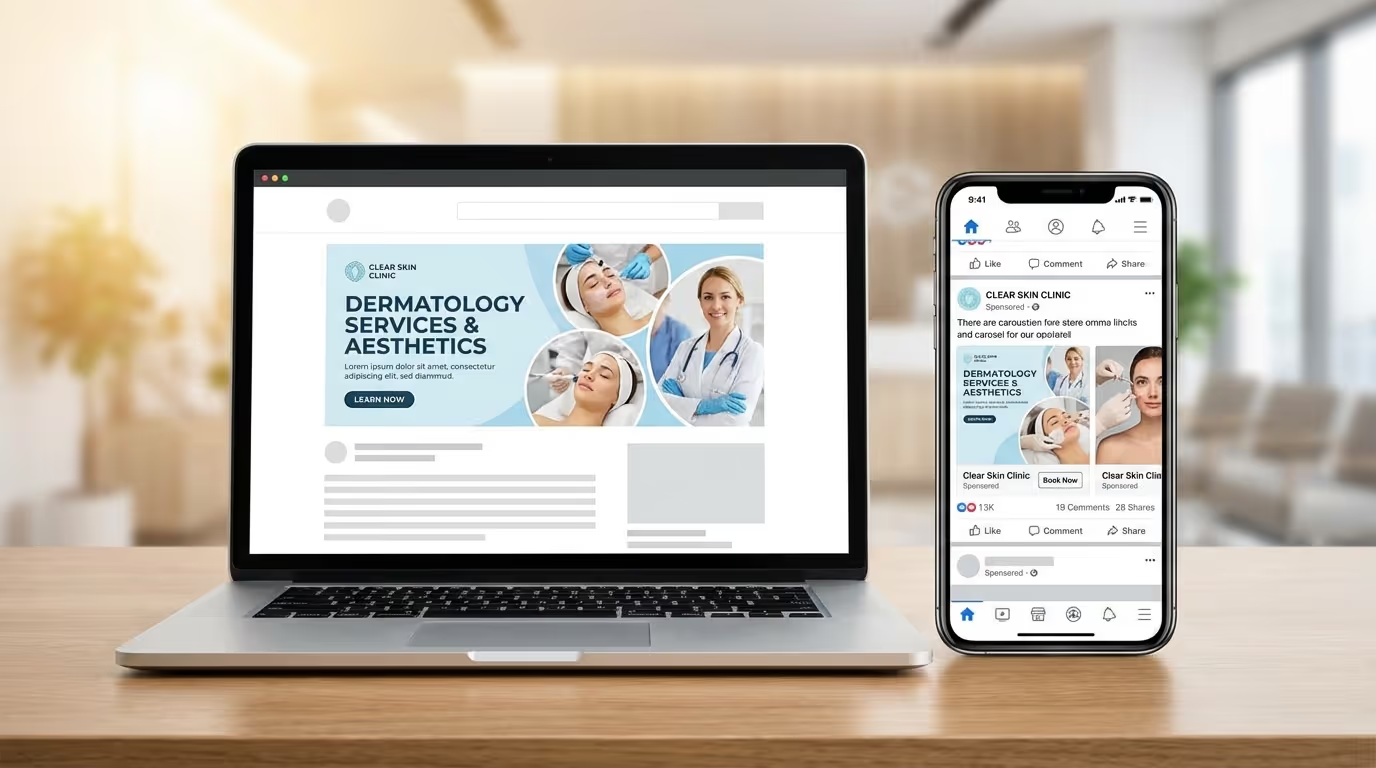

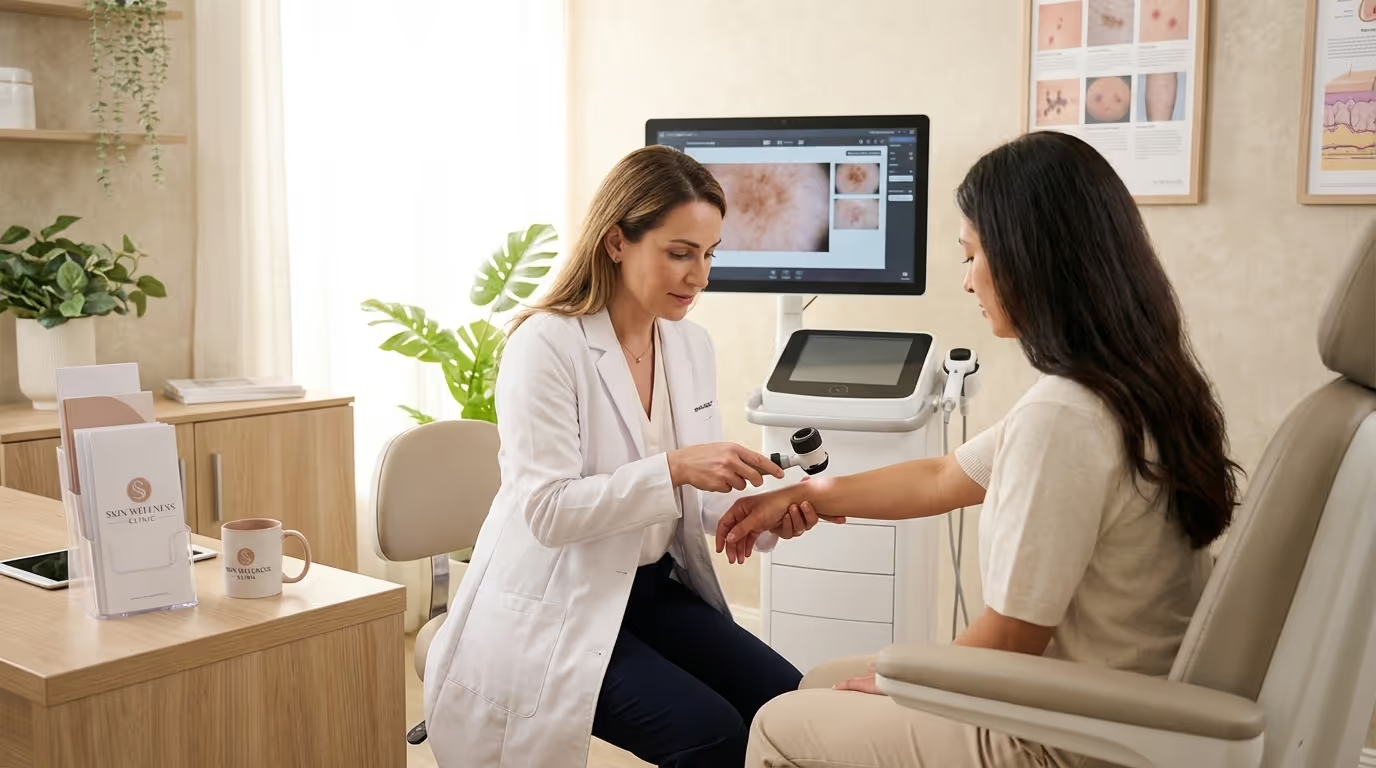
You did not spend a decade in medical training to worry about marketing. But here you are — a board-certified dermatologist, possibly fellowship-trained, with more clinical expertise than any med spa within 50 miles — watching less-qualified providers fill their calendars with the cosmetic patients you should be treating.
The reason is not your skills. It is not your outcomes. It is your marketing for dermatologists — or more accurately, the lack of effective dermatologist marketing strategies.
The med spa down the street with the nurse practitioner doing Botox has 400 Google reviews, a polished Instagram account, and ads running on Google and Facebook. You have 37 reviews, a website that was built in 2019, and a vague feeling that you should probably "do something about social media."
This is fixable. And you do not need to become a marketing expert to fix it. You need to understand which strategies actually move the needle for dermatologists, invest in the right ones, and build systems that work without requiring your personal attention every day.
This dermatologist marketing guide is comprehensive, actionable, and based on what we see working for dermatology and medical aesthetics practices in 2026.
Why Most Dermatologists Struggle With Dermatologist Marketing
Before we get into what works, let us address why marketing feels so hard for dermatologists specifically. Understanding these root causes prevents you from repeating the same patterns.
The Training Gap
Medical school and residency teach you to diagnose and treat. They do not teach you to run a business, manage a brand, or acquire patients through digital channels. Most dermatologists enter practice ownership with zero formal business or marketing education.
This means you are either figuring it out yourself (slowly, with expensive mistakes) or outsourcing it to agencies that may or may not understand your specialty. Neither path is efficient, and both cost more than they should.
The fix is not getting a marketing degree. It is understanding the fundamentals well enough to make smart decisions about where to invest and how to evaluate whether it is working.
The Authority Paradox
You are a medical doctor. You have more training, more knowledge, and more clinical authority than the estheticians and nurse practitioners competing for the same cosmetic patients. But online, authority does not come from a medical degree — it comes from visibility. Reviews, content, search rankings, social media presence.
A med spa with 500 reviews and a slick website looks more authoritative to a patient searching Google than a dermatologist with 30 reviews and a dated website, regardless of actual qualifications.
| Factor | Your Actual Authority | Your Perceived Authority (Online) |
|---|---|---|
| Medical training | 12+ years | Invisible unless displayed |
| Board certification | ABMS verified | Only matters if prominently shown |
| Procedure experience | Thousands of procedures | Invisible without before/after gallery |
| Patient outcomes | Excellent | Invisible without reviews |
| Clinical knowledge | Deepest in the market | Invisible without content |
This is the paradox: you have the authority but are not communicating it effectively online. The practices that are communicating it effectively may have less actual expertise but more marketing sophistication. Your job is not to out-market them at their game — it is to translate your genuine authority into online visibility.
The Medical-Cosmetic Split
Your practice likely serves both medical (insurance) and cosmetic (cash-pay) patients. Marketing these two service lines requires different strategies, different messaging, and different channels. Many dermatologists try to do both with a single generic approach and end up doing neither well.
We covered this split in detail in our dermatology advertising guide, but the core issue is this: medical patients find you through insurance directories and referrals. Cosmetic patients find you through marketing. If you market both the same way, you waste money on medical patient acquisition (they would have found you anyway) and under-invest in cosmetic patient acquisition (where every patient is marketing-dependent).
The "Build It and They Will Come" Mindset
Many dermatologists — especially those who came up in an era when referrals and insurance panels were sufficient to fill a calendar — believe that being a good doctor should be enough. It is not. Not in 2026. Not when patients have 40+ options and choose based on what they find online.
The market has changed. Patient behavior has changed. Your marketing needs to match.
The 5 Marketing Systems Every Dermatologist Needs
Stop thinking about marketing as a collection of random tactics. Think about it as five interconnected systems that work together. Each system has a specific purpose, specific metrics, and specific implementation steps.
System 1: Online Visibility (How Patients Find You)
If patients cannot find you online, nothing else matters. This system ensures you appear when patients search for dermatologists or treatments in your area.
Google Business Profile — The #1 Priority
This is the single most important piece of your online presence. When patients search "dermatologist near me," Google shows a map with three practices. Being in that map pack — with a high rating, lots of reviews, and complete information — is the difference between getting 50+ calls per month and getting 5.
Implementation steps for Google Business Profile:
- Claim your listing at business.google.com if you have not already.
- Select "Dermatologist" as your primary category. Add secondary categories: "Cosmetic Dermatologist," "Skin Care Clinic," "Medical Spa" (if applicable).
- Complete every field: business name, address, phone, hours, website, appointment link, description (750 characters — keyword-rich but natural).
- Add all services individually with descriptions (Botox, fillers, acne treatment, skin cancer screening, etc.).
- Upload 50+ photos: office exterior, waiting room, treatment rooms, equipment, team photos, provider headshots, results (with consent).
- Post weekly: treatment spotlights, skin care tips, seasonal content, practice news, specials announcements.
- Seed your Q&A section with 15-20 common patient questions and answers.
- Respond to every review within 24 hours — positive and negative.
- Set up a systematic review generation process (covered in System 2).
Read our complete Google Business Profile optimization guide for the full playbook.
SEO (Search Engine Optimization)
SEO for dermatology is the long game. It takes 4-8 months to see significant results, but once you rank on page one, every click is free and the traffic compounds over time. SEO is the only marketing channel that gets cheaper as you invest more time.
Implementation steps for dermatology SEO:
- Run a technical audit: site speed (target under 3 seconds), mobile responsiveness, crawl errors, broken links, duplicate content, schema markup. Our website optimization guide covers this step by step.
- Build or rewrite 10-15 treatment and condition pages (1,500-2,500 words each): one page per major treatment (Botox, fillers, chemical peels, laser treatments, microneedling) and one per major condition (acne, eczema, psoriasis, rosacea, skin cancer).
- Launch a blog publishing 2-4 posts per month targeting informational keywords. Our content strategy guide covers topic selection.
- Build local citations (consistent NAP across 50+ directories): Healthgrades, Vitals, Zocdoc, RealSelf, Yelp, and industry-specific directories.
- Implement schema markup for LocalBusiness, MedicalBusiness, Physician, and FAQ.
- Begin link building: medical PR, guest posts on health publications, local chamber of commerce, medical association memberships.
| SEO Phase | Timeline | What Happens |
|---|---|---|
| Foundation | Months 1-3 | Technical fixes, content creation, citation building |
| Growth | Months 4-6 | Long-tail keywords rank, traffic up 20-40% |
| Acceleration | Months 7-12 | Money keywords hit page 1, organic leads consistent |
| Compounding | Month 12+ | Organic becomes highest-ROI channel |
Investment: $3,000-$7,000/month for a comprehensive SEO program. ROI becomes positive around months 8-12 and compounds from there.
Google Ads
While SEO builds over time, Google Ads generates leads immediately. When a patient searches "Botox dermatologist [city]," your ad can appear at the top of the page today.
Implementation steps for Google Ads:
- Start with 3-5 campaigns targeting your highest-revenue cosmetic treatments. See our Google Ads cost guide for budget benchmarks.
- Build dedicated landing pages for each campaign — never send paid traffic to your homepage.
- Write compliant ad copy emphasizing board certification, experience, and results.
- Set up conversion tracking for forms, calls, and chat before spending a dollar.
- Budget: $2,000-$8,000/month in ad spend depending on market size and competition.
- Monitor and optimize monthly based on cost per patient acquired (not cost per click).
System 2: Reputation (How Patients Choose You)
Visibility gets patients to your digital doorstep. Reputation gets them through the door. In dermatology, reputation is primarily built through reviews, credentials display, and social proof.
Review Generation — The Revenue Multiplier
Reviews are the number one factor patients use when choosing a dermatologist. Not your medical school. Not your board certification (though both matter). Reviews.
The math is simple: a practice with 300 reviews and a 4.9 rating beats a practice with 30 reviews and a 5.0 rating every time. Volume signals trust. Recency signals relevance. Our review generation guide covers the complete system.
Implementation steps for systematic review generation:
- Identify the moment of peak satisfaction for each patient type:
- Medical patients: when symptoms resolve or a good diagnosis is given
- Cosmetic patients: when they see their results (often 2-14 days post-treatment)
- Train staff to recognize and act on satisfaction signals: "I'm so glad I came in" or "This looks amazing" = immediate review request moment.
- Set up an automated review request sequence:
- 2 hours after appointment: SMS with direct Google review link
- 48 hours later (if no review): second SMS: "We'd love to hear about your visit. It takes 30 seconds: [link]"
- 7 days later (if no review): email review request with practice photo and personal note
- Make it frictionless — one tap to your Google review page. No login required, no account creation.
- Respond to every review — positive and negative — within 24 hours, personally and specifically. Generic "Thank you for your feedback" responses look automated and lazy.
- Handle negative reviews professionally: acknowledge the concern, take the conversation offline ("Please call us directly at [number] so we can resolve this"), never argue publicly.
| Current Reviews | Monthly Target | Strategy |
|---|---|---|
| 0-50 | 25-30/month | Aggressive ask of every patient + staff incentive for review volume |
| 50-150 | 20-25/month | Automated post-visit sequences + in-office reminders |
| 150-300 | 15-20/month | Maintain automated system + focus on responding to all reviews |
| 300+ | 10-15/month | Maintenance mode + shift focus to review quality and responses |
Target: 20-30 new reviews per month. Within a year, you will have 250+ reviews and be untouchable in local search.
Credentials and Social Proof Display
Your website, social media, and ads should prominently display:
- Board certification (ABMS/AAD) with logos
- Fellowship training (if applicable)
- Years of experience and total procedures performed
- Professional affiliations (AAD, ASDS, ASLMS)
- Media appearances and publications
- Awards and recognition
- Patient satisfaction scores
This is not bragging. This is providing the information patients need to trust you with their skin. The practices that hide credentials in a footnote lose to the practices that lead with them.
RealSelf, Healthgrades, and Directory Profiles
Claim and optimize your profiles on RealSelf, Healthgrades, Vitals, Zocdoc, and WebMD. Many patients use these platforms specifically to research and choose providers.
Implementation steps:
- Claim profiles on all major platforms (Healthgrades, Vitals, Zocdoc, RealSelf, WebMD, Google, Yelp).
- Complete every field on every platform: photos, services, insurance, conditions treated, bio.
- Upload before/after photos to RealSelf (it ranks highly for procedure-specific searches).
- Answer patient questions on RealSelf and Healthgrades (this builds visibility and authority on those platforms).
- Monitor and respond to reviews on all platforms monthly.
- Ensure NAP consistency across all platforms (exact same name, address, phone number).
System 3: Conversion (How Patients Become Appointments)
Attracting attention and building reputation mean nothing if patients cannot easily book an appointment. Your conversion system turns interested visitors into scheduled patients.
Website Optimization
Your website is not a brochure — it is a conversion machine. Every page should have a clear path to booking.
Essential website elements (audit against this checklist):
| Element | Status Check | Impact if Missing |
|---|---|---|
| Prominent phone number (click-to-call) | Is it visible on every page? | Losing 30%+ of potential callers |
| Online scheduling (24/7) | Can patients book at midnight? | Losing 40% of after-hours visitors |
| Consultation forms on treatment pages | Every treatment page has a form? | Losing page-specific leads |
| Live chat or chatbot | Available on key pages? | Missing patients who have quick questions |
| Cost information (cosmetic) | Price ranges visible? | Attracting unqualified consultations |
| Before/after galleries | Updated and organized by treatment? | Missing the #1 viewed content |
| Provider bios with photos | Professional and trust-building? | Losing to competitors with better bios |
| Mobile-first design | Forms easy on a phone? | Losing 70%+ of traffic |
| Page speed under 3 seconds | Tested on mobile? | Losing 7% per additional second |
Conversion rate target: 5-10% of website visitors should become leads.
Implementation steps for website optimization:
- Test your website on mobile right now. Can you book an appointment with one thumb in under 60 seconds? If not, fix this first. See our mobile design guide.
- Add a phone number and "Book Online" button to the top of every page (sticky header on mobile).
- Add a booking widget to every treatment page — embedded, not a redirect to another site.
- Add a short form (name, phone, email, treatment interest) to every treatment page.
- Build or update before/after galleries for every cosmetic treatment. Use professional photography with consistent lighting and angles.
- Add pricing ranges for cosmetic treatments. Patients who see pricing self-qualify — reducing wasted consultation time. See our pricing strategy guide.
- Rewrite provider bios to lead with credentials and patient outcomes, not education history and personal hobbies.
- Test page speed using Google PageSpeed Insights and fix anything scoring below 80.
Speed-to-Lead Follow-Up
When a lead comes in — from any source — the clock starts. This is the single most impactful system in your entire marketing operation.
Implementation steps for speed-to-lead:
- Set up automated confirmation text within 60 seconds of any form submission, using your CRM.
- Assign a dedicated lead coordinator (not the front desk). This person's only job during business hours is responding to leads. Compensate with base + bonus tied to conversion rate. See our hiring guide.
- Build a follow-up sequence: call within 5 minutes, text + email if no answer, three additional attempts over 48 hours.
- Build a 30-day nurture sequence for leads who are not ready to book.
- Track speed-to-lead weekly. If average response time exceeds 15 minutes, you have a process problem.
Multiple Conversion Paths
Different patients prefer different booking methods:
| Booking Method | Patient Preference | Your System |
|---|---|---|
| Phone call | 45+ demographics, complex questions | Tracked number, answered in 3 rings |
| Online scheduling | 25-45 demographics, convenience seekers | 24/7 booking widget |
| Text message | All ages, quick follow-ups | Two-way SMS via CRM |
| Chat | Information seekers, after-hours | Website chatbot + live chat during hours |
| Contact form | Email preferrers, detailed inquiries | Auto-response + 5-min follow-up call |
Offer all of these. Every missing option is a missing patient.
System 4: Content (How You Build Authority and Trust)
Content marketing serves two purposes: SEO (ranking for more keywords) and authority building (positioning you as the go-to dermatologist in your market).
Content Types That Work for Dermatologists
- Treatment/condition pages (high priority, one-time creation)
- Comprehensive pages for every treatment and major condition
- Target: "[treatment/condition] [city]" keywords
- These are your money pages — they generate consultations directly
- Length: 1,500-2,500 words with FAQ section, provider credentials, and booking CTA
- Blog posts (ongoing, 2-4 per month)
- Educational content targeting informational keywords
- Examples: "How Long Does Botox Last? A Dermatologist Explains"
- Examples: "Chemical Peel vs Microneedling: Which Is Right for You?"
- Every post links to relevant treatment pages
- See our content strategy guide for topic selection
- Video content (high impact, ongoing)
- Treatment explainers (embed on treatment pages + YouTube)
- Patient testimonials (with consent)
- Skin care tips (social media + YouTube)
- "Dermatologist reacts" content (TikTok/Instagram)
- Film 2-4 videos per month; repurpose across all channels
- Social media content (ongoing, 3-5 posts per week)
- Educational posts and carousels
- Behind-the-scenes of the practice
- Treatment process videos
- Skin care tips and myth-busting
- Team introductions and culture content
- Use a social media calendar for consistency
Implementation steps for content marketing:
- Audit existing content: what treatment pages do you have? Are they comprehensive? Do they rank?
- Prioritize: create or rewrite treatment pages for your top 10 revenue-generating services first.
- Build a 3-month content calendar with 2-4 blog posts per month.
- Assign content creation: who writes, who reviews, who publishes?
- Set up a video filming schedule: dedicate 2 hours per month for provider on-camera content.
- Repurpose everything: blog post becomes social posts, video clips, email content, and ad creative.
Content Strategy by Patient Type
| Patient Type | Content Topics | Distribution Channels |
|---|---|---|
| Medical patients | Condition education, when to see a dermatologist, treatment comparisons | Blog, YouTube, Google (SEO) |
| Cosmetic patients | Before/after showcases, treatment comparisons, cost guides, recovery timelines | Instagram, TikTok, Facebook, blog |
| Both | Provider expertise, practice culture, patient stories, seasonal skin tips | Email, social media, blog |
System 5: Retention (How You Keep Patients Coming Back)
Acquiring a new patient costs 5-7x more than keeping an existing one. Your retention system maximizes the lifetime value of every patient you acquire.
Email Marketing
Your patient database is your most valuable marketing asset. Email these people regularly:
Implementation steps for email marketing:
- Choose a HIPAA-capable email platform: GoHighLevel, ActiveCampaign, or Mailchimp (paid plan with BAA). See our healthcare email marketing guide.
- Import your patient email list with proper opt-in.
- Set up basic segments: active patients, lapsed patients (6+ months), cosmetic interest, medical only, VIP (top 20% by revenue).
- Create a monthly newsletter template: skin health tips + treatment spotlight + practice news + booking CTA.
- Build a reactivation campaign targeting lapsed patients (3 emails over 3 weeks).
- Set up a welcome sequence for new patients (5 emails over 21 days).
- Create birthday emails with a special offer.
- Track monthly: open rate (target 25-35%), click rate (target 3-5%), revenue attributed to email.
Expected ROI: $30-$45 per dollar spent on email marketing. This is not a typo — email marketing to your existing database is the highest-ROI channel you have.
Loyalty and Membership Programs
For cosmetic dermatology patients, a membership program or loyalty program creates recurring revenue and increases lifetime value.
Implementation steps for a membership program:
- Design a membership tier: monthly fee ($149-$299) including a treatment credit, percentage off additional treatments, priority scheduling, and member-only events.
- Set minimum commitment at 6 months.
- Build the membership into your CRM for automated billing and tracking.
- Train your team to present membership during consultations for cosmetic patients.
- Promote membership via email, in-office signage, and post-treatment conversations.
- Track: enrollment rate, retention rate, average revenue per member vs. non-member.
A well-structured membership program can increase patient retention by 30-50% and create predictable monthly revenue.
Rebooking at Time of Service
The easiest time to book the next appointment is at the current appointment. Train your team to rebook:
- Medical patients: schedule their next check-up before they leave
- Botox/filler patients: schedule their next session based on treatment timeline
- Laser patients: book the next session in their treatment series
- All patients: schedule their annual skin check
Implementation: add rebooking to your checkout workflow. Make it a standard step, not an afterthought. Track rebooking rate by provider — the providers who rebook consistently generate 30-50% more revenue per patient than those who do not.
Marketing Budget for Dermatologists
How Much Should You Spend?
The standard guideline is 5-10% of revenue on marketing. For dermatology practices focused on growth — especially growing the cosmetic side — we recommend 8-12%.
| Annual Revenue | Marketing Budget (10%) | Monthly Budget |
|---|---|---|
| $500,000 | $50,000 | $4,167 |
| $1,000,000 | $100,000 | $8,333 |
| $2,000,000 | $200,000 | $16,667 |
| $3,000,000 | $300,000 | $25,000 |
Our marketing budget guide covers allocation in detail for every revenue level.
Where to Allocate
For a dermatologist spending $8,000/month on marketing:
| Investment | Monthly | Purpose | Expected Monthly Return |
|---|---|---|---|
| Google Ads (ad spend) | $3,000 | Immediate patient acquisition | $15,000-$30,000 |
| SEO + content | $2,500 | Long-term organic growth | $0-$5,000 (months 1-6), $20,000+ (month 12+) |
| Social media management | $1,000 | Credibility and brand building | Supports conversion rates |
| Email/SMS marketing | $300 | Patient retention | $3,000-$10,000 |
| Review generation tools | $200 | Reputation building | Improves conversion rates across all channels |
| Retargeting ads | $500 | Convert website visitors | $2,500-$5,000 |
| Photography/video | $500 | Content creation | Supports all channels |
Prioritization When Budget Is Limited
If you can only afford $3,000/month:
| Priority | Action | Monthly Cost |
|---|---|---|
| 1 | Optimize Google Business Profile + launch review generation | $0-$200 |
| 2 | Launch Google Ads for top 3 cosmetic treatments | $2,000 |
| 3 | Basic SEO (technical fixes + GBP optimization) | $800 |
| 4 | DIY social media (3 posts/week by staff) | $0 (time only) |
| 5 | Monthly email to patient database | $0-$100 |
This prioritized approach generates results within 30 days. As revenue grows, reinvest into expanding channels.
Common Marketing Mistakes Dermatologists Make
Mistake 1: Hiring a Nephew, Friend, or "Social Media Person"
You would not let someone without proper training perform a skin biopsy. Do not let someone without proper expertise manage your marketing. The "affordable" option of hiring a friend's kid to manage your Instagram or a local generalist to run your ads costs you far more in lost opportunity than a qualified specialist charges.
A generalist agency learning dermatology on your dime makes mistakes you pay for: non-compliant ad copy gets disapproved, poor landing pages waste ad budget, wrong keywords burn cash, and bad follow-up systems lose leads. A specialist agency has already made and learned from those mistakes.
Mistake 2: Spending Everything on Acquisition, Nothing on Retention
If you are spending $8,000/month acquiring new patients and $0/month marketing to your existing database of 3,000 patients, your priorities are backwards. A single email campaign to your existing database can generate $5,000-$15,000 in revenue for under $200.
The fix: dedicate 15-20% of your marketing budget and effort to retention — email, SMS, loyalty, membership, and reactivation programs.
Mistake 3: Ignoring Cosmetic Marketing Because "Referrals Are Fine"
Your medical side may thrive on referrals and insurance. Your cosmetic side will not. Every cosmetic patient is a marketing-driven acquisition. If you are not actively marketing cosmetic services, you are leaving the highest-margin revenue on the table — and handing it to the med spa down the street.
Mistake 4: No Tracking, No Attribution
"I think we're getting more calls" is not a marketing metric. If you cannot track the source of every lead, measure cost per acquisition by channel, and calculate ROI by campaign, you are guessing. And guessing with a $5,000+/month budget is expensive.
Minimum tracking requirements:
- Google Analytics 4 with conversion events
- Call tracking with dynamic number insertion (CallRail or CTM)
- CRM with source attribution on every lead
- Monthly reporting connecting spend to revenue by channel
Mistake 5: Inconsistency
Marketing works through consistency and compounding. Publishing 10 blog posts in January and nothing for the rest of the year does not build SEO. Posting on social media for two weeks and then going silent for three months does not build a following. Running ads for 60 days and then pausing "to save money" resets all the algorithm learning.
Commit to a sustainable cadence and maintain it for at least 12 months before evaluating whether to change strategy. A consistent $5,000/month over 12 months beats $20,000/month for 3 months every time.
Mistake 6: Not Measuring What Matters
Your marketing dashboard should show these KPIs:
| KPI | Target | Why It Matters |
|---|---|---|
| Cost per lead (by channel) | Decreasing over time | Efficiency |
| Cost per patient acquired | Below LTV/5 | Profitability |
| Lead-to-patient conversion rate | 30-50% | System effectiveness |
| Speed to lead (avg response time) | Under 5 minutes | Follow-up quality |
| Patient retention rate (12-month) | 60-75% | Lifetime value |
| Review generation rate | 20+/month | Reputation growth |
| Organic traffic growth | 15-25% MoM | SEO performance |
| Email revenue per month | $3,000-$10,000+ | Retention ROI |
If your agency reports impressions, reach, and followers but not cost per patient and revenue attribution, they are hiding behind vanity metrics.
How to Choose the Right Marketing Partner
If you are going to hire outside help — and most dermatologists should, because your time is better spent treating patients — here is what to look for.
Must-Haves
- Healthcare or aesthetics specialization. They should understand medical advertising compliance, HIPAA, patient psychology, and the medical/cosmetic split without you explaining it.
- Transparent reporting. Monthly reports showing leads, cost per lead, cost per patient acquired, and revenue attribution. Not impressions and "keyword visibility."
- You own your accounts. Your Google Ads account, your analytics, your social media pages — all owned by you with the agency having access, not the other way around. If you leave, your data comes with you.
- Realistic expectations. SEO takes 6-12 months. Google Ads takes 60-90 days to optimize. Anyone promising results in 30 days is either lying or using tactics that will not last.
- Case studies or references. Talk to other dermatologists they have worked with. Ask about results, communication, and whether they would hire them again.
Red Flags
| Red Flag | What It Means |
|---|---|
| Long-term contracts (12+ months) before proving results | They know you will want to leave |
| "Proprietary" methods they cannot explain | Either no real method or hiding something |
| Reports focused on vanity metrics | They cannot prove ROI |
| No access to your ad accounts or analytics | They own your data — not you |
| They also work with restaurants, lawyers, and plumbers | Generalists learning on your dime |
| Guaranteed rankings or guaranteed patient volume | Impossible to guarantee — this is dishonest |
| No questions about your follow-up process | They do not understand conversion |
| No interest in your patient lifetime value | They optimize for leads, not patients |
Our guide to choosing a marketing company covers the complete evaluation framework.
The Complete Dermatologist Marketing Action Plan
Here is what to do, in order, starting today. This plan is designed for a dermatologist who wants to build a marketing system from scratch or reset a broken one.
This week (days 1-7):
- Claim and fully optimize your Google Business Profile
- Set up a review generation system (automated text after appointments via your CRM or booking system)
- Audit your website — can a patient book in under 60 seconds on mobile?
- Document your lead follow-up process (who responds, how fast, what happens)
This month (days 8-30):
- Set up Google Analytics 4, Google Search Console, and call tracking
- Launch Google Ads for your top 3 cosmetic treatments
- Build dedicated landing pages for each ad campaign
- Create a content calendar for 3 months of social media and blog posts
- Set up your email marketing platform and import your patient list
Next 90 days (days 31-120):
- Begin SEO work (technical audit, treatment page creation)
- Launch email marketing (monthly newsletter + reactivation campaign for lapsed patients)
- Start consistent social media posting (3-5x/week)
- Add Meta retargeting for website visitors
- Optimize Google Ads based on first 60 days of data
- Launch a patient reactivation campaign
- Review performance data and set targets for next quarter
Ongoing monthly cadence:
- Generate 20+ reviews per month
- Publish 2-4 blog posts per month
- Post 3-5 times per week on social media
- Optimize ad campaigns monthly based on data
- Send monthly newsletter to existing patients
- Track cost per patient acquired across all channels
- Review KPIs monthly against targets
- Meet with marketing team or agency monthly for strategy review
The practices that follow this playbook do not wonder where their next patient is coming from. They know. And within 6-12 months, they have a marketing system that generates patients predictably, efficiently, and without requiring the dermatologist to personally manage any of it.
Ready to build a marketing system that fills your dermatology calendar? Let's talk. We work exclusively with medical aesthetics and dermatology practices, and we will show you exactly what your practice needs to grow. No generic agency pitch — just a specific plan built for your market.
Book a Strategy Call{: .cta-button}