
You are spending thousands of dollars per month generating leads. Google Ads, Meta Ads, SEO, social media — all working to get prospective patients to raise their hand and say "I'm interested." Your med spa consultation process is where all of that investment either pays off or falls apart.
And then what happens?
In most med spas, one of two things. Either the lead sits in an inbox for hours (or days) before someone calls them back. Or the lead does get a quick response, shows up for a consultation, and leaves saying "I'll think about it" — and is never heard from again.
Both scenarios are conversion failures. And they are costing you more than your ad budget ever will.
Here is the reality: the average med spa consultation converts 25-35% of leads to treatments. The top-performing med spas — the ones with full calendars and waiting lists — convert 50-70%. The difference is not the quality of their leads. It is the quality of their med spa consultation process.
This guide covers how to build a consultation process that turns leads into patients — from the first moment of contact through the booking of their first treatment. Including the scripts, the systems, the follow-up sequences, the objection handling frameworks, and the metrics you need to track to optimize continuously.
Why the Med Spa Consultation Is Your Most Important Business Activity
Every other marketing activity — ads, SEO, social media, email — exists to generate consultations. The consultation is where revenue happens. Everything before it is a cost. Everything after it is profit (or loss).
The Math That Changes Everything
If you generate 100 leads per month and convert 30% through your consultation process:
- 100 leads x 60% show rate = 60 consultations
- 60 consultations x 30% conversion = 18 new patients
- 18 patients x $800 average first treatment = $14,400/month
Now improve the consultation conversion rate from 30% to 55%:
- 100 leads x 60% show rate = 60 consultations
- 60 consultations x 55% conversion = 33 new patients
- 33 patients x $800 average first treatment = $26,400/month
Same leads. Same ad budget. $12,000 more per month — $144,000 more per year — just from improving your med spa consultation process.
And that is first-treatment revenue only. Factor in lifetime value (repeat treatments, referrals, product purchases) and the impact of a better consultation process is measured in millions over time.
The Lifetime Value Multiplier
| Consultation Conversion Rate | New Patients/Year | First-Year Revenue | 3-Year Lifetime Revenue |
|---|---|---|---|
| 25% (below average) | 180 | $144,000 | $432,000 |
| 35% (average) | 252 | $201,600 | $604,800 |
| 50% (good) | 360 | $288,000 | $864,000 |
| 65% (top performer) | 468 | $374,400 | $1,123,200 |
The difference between a 25% and 65% consultation conversion rate is $691,200 in 3-year revenue from the same 100 leads per month. Your consultation process is not a nice-to-have. It is your highest-leverage revenue growth tool.
The Three Conversion Points
Your consultation process actually has three conversion points, not one:
- Lead to Scheduled Consultation — Can you get the lead to book and show up?
- Consultation to Treatment Decision — Can you get the patient to say yes during the consultation?
- Treatment Decision to Completed Booking — Can you secure payment and scheduling before they leave?
Each point has its own failure modes and its own optimization strategies. Most med spas focus only on the second point (the consultation itself) and ignore the first and third — which is where the majority of leads are lost.
Where leads are actually lost:
| Conversion Point | Average Drop-off | Where Revenue Dies |
|---|---|---|
| Lead → Scheduled consultation | 40-60% of leads never book | Slow response, poor phone skills |
| Scheduled → Actually shows up | 15-30% no-show rate | No reminders, too long between booking and appointment |
| Consultation → Treatment decision | 30-50% leave undecided | Poor consultation structure, no ask |
| Decision → Completed booking | 10-20% do not schedule | No payment collection, no available times |
Fix all four leak points and you can double or triple your effective conversion rate without spending a single additional dollar on marketing.
Stage 1: Lead to Scheduled Consultation
The moment a lead comes in — whether from a form submission, phone call, DM, or chat message — the clock starts. Your goal is to convert that lead into a scheduled consultation. Here is how.
Speed to Lead: The 5-Minute Rule
This is the single most impactful change you can make to your consultation process. Respond to every lead within 5 minutes.
The data is unambiguous:
| Response Time | Contact Rate | Qualification Rate | Relative Conversion |
|---|---|---|---|
| Under 5 minutes | 90%+ | 10x baseline | 400% improvement |
| 5-30 minutes | 60-70% | 4x baseline | 200% improvement |
| 30-60 minutes | 40-50% | 2x baseline | 100% improvement |
| 1-4 hours | 20-30% | Baseline | Baseline |
| 4+ hours | 10-15% | 0.5x baseline | 50% worse than baseline |
| Next day | 5-10% | Near zero | Effectively lost |
The average med spa responds to leads in 4+ hours. Many do not respond until the next business day. By that time, the patient has already contacted 2-3 other practices and booked with whoever responded first.
The 5-Minute Response System:
Minute 0-1 (Automated): Configure your CRM to trigger an automated text message immediately upon lead submission:
"Hi [First Name]! Thanks for reaching out to [Practice Name] about [treatment]. Our consultation coordinator will be calling you shortly. In the meantime, here is a little more about what to expect: [link to treatment page]. Looking forward to connecting! — [Practice Name]"
This confirms their inquiry was received, reinforces their interest, and buys you a few minutes to make the personal call.
Minute 1-5 (Human): Your consultation coordinator (not the front desk receptionist, not an answering machine, not voicemail) calls the lead personally.
If the coordinator is on another call, the lead goes to the top of their callback queue — not behind the six patients waiting to check in.
If no answer:
- Leave a brief, warm voicemail (30 seconds max)
- Send a text: "Hey [First Name], I just tried calling about your [treatment] inquiry. What is the best time to reach you today? — [Name] at [Practice Name]"
- Schedule automatic follow-up attempts at 2 hours, 24 hours, and 48 hours
- Add to email drip campaign for longer-term nurture
Implementation steps:
- Set up automated SMS in your CRM triggered by every form submission, chat message, and missed call
- Designate a lead response owner for every hour your practice is open
- Create an after-hours auto-response that captures information and promises a callback at opening
- Track and report response time daily for the first 30 days, then weekly
- Set a maximum response time SLA of 5 minutes during business hours
The Booking Call: What to Say
The booking call has one objective: schedule the consultation. It is not the time for a full treatment discussion, price negotiation, or detailed Q&A session.
The Framework (2-3 minutes total):
Step 1: Warm introduction (15 seconds) "Hi [First Name], this is [Name] from [Practice Name]. I saw you reached out about [treatment] — I'd love to help you get started."
Step 2: Qualify briefly (30 seconds) "Have you had [treatment] before, or is this your first time exploring it?" (This tells you whether they are a new or experienced patient — adjusts your approach)
Step 3: Build excitement (30 seconds) "That is great — [treatment] is one of our most popular treatments, and our [provider name] is incredible with [specific thing about the treatment]. You are going to love the results."
Step 4: Schedule (30 seconds) "The best next step is to come in for a consultation with [provider]. This is a one-on-one session where they will assess your [area/concern], create a personalized plan, and walk you through exactly what to expect. We have openings on [day] at [time] or [day] at [time] — which works better for you?"
Step 5: Confirm and set expectations (30 seconds) "Perfect — you are all set for [day] at [time] with [provider]. You will get a confirmation text with our address and a quick intake form to fill out beforehand. The consultation takes about 30-45 minutes. Any questions before then?"
Total call time: 2-3 minutes. That is all it takes.
What NOT to do on the booking call:
- Discuss pricing in detail ("Pricing depends on your custom treatment plan — that is what the consultation covers")
- Give a full treatment education ("Your provider will walk you through everything during your consultation")
- Oversell or pressure ("This is a no-obligation consultation to see if [treatment] is right for you")
- Spend 15 minutes chatting (you have other leads to contact)
- Be vague about what happens at the consultation (uncertainty drives no-shows)
The Price Question: How to Handle It on the Phone
This comes up on nearly every booking call. Patients want to know the cost before committing to a consultation. Handle it wrong and you either scare them away or set false expectations.
Script for handling the price question:
"Great question — I want to make sure you have a realistic sense of the investment. [Treatment] typically ranges from [$X to $Y] depending on the area being treated and the amount of product used. The consultation is where [provider] will assess your specific needs and create a personalized plan with exact pricing. There's no obligation — you can take the plan home and think about it. And we do offer financing options if that's helpful. Want to go ahead and get that consultation on the calendar?"
Why this works:
- Gives a range (not a specific price that may not apply to their case)
- Connects the price to a personalized plan (value framing)
- Mentions no obligation (reduces risk)
- Mentions financing (addresses budget concerns proactively)
- Ends with a scheduling prompt (redirects to the booking)
Reducing No-Shows Before the Consultation
Scheduling the consultation is only half the battle. Getting the patient to actually show up is the other half. Consultation no-show rates in med spas average 20-30%. Here is how to cut that to under 10%.
Confirmation and reminder sequence:
- Immediately after booking: Automated text + email with appointment details, address, parking info, and intake form link
- 48 hours before: Text reminder with preparation information
- 24 hours before: "Reply YES to confirm or call us to reschedule" (patients who confirm are 90% less likely to no-show)
- 2 hours before: Final text: "See you soon! We are at [address]. Free parking in [location]."
For complete reminder templates and strategies, see our appointment reminders guide.
Additional no-show reduction tactics:
| Tactic | No-Show Reduction | Implementation Effort |
|---|---|---|
| Confirmation SMS with reply request | 30-40% reduction | Low — CRM automation |
| Credit card on file ($50-100 no-show fee) | 50-60% reduction | Medium — policy change |
| Pre-consultation video from provider | 15-25% reduction | Medium — one-time recording |
| Booking-to-appointment gap under 7 days | 20-30% reduction | Low — scheduling practice |
| Virtual consultation option | 25-35% reduction in overall no-shows | Medium — telehealth setup |
| Intake forms sent pre-appointment | 15-20% reduction (commitment effect) | Low — automated email |
Stage 2: The Med Spa Consultation Itself
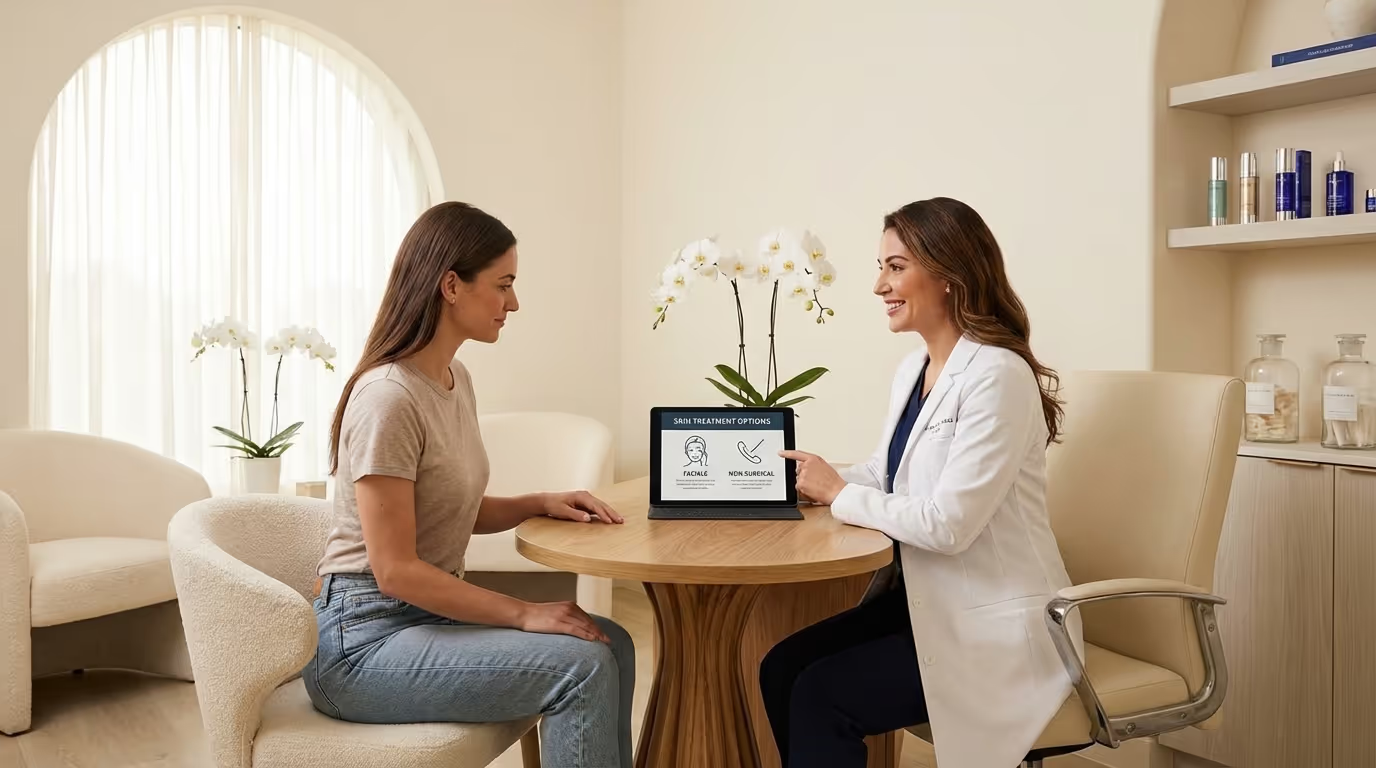
The patient is in your office. This is where revenue is generated or lost. A great med spa consultation is not a sales pitch — it is a structured conversation that understands the patient's goals, builds trust, presents a solution, and makes it easy to say yes. The following med spa consultation tips will help you structure every conversation for maximum conversion.
The Consultation Framework: BUILD
B — Bond (5 minutes)
Start with rapport. Not "so what brings you in today?" but genuine human connection.
- Welcome them by name at the front desk
- Offer water, coffee, or tea
- Walk them to the consultation room personally (not "the room is down the hall on the left")
- Make a personal observation or open warmly
- Ask an open question: "Tell me a little about yourself and what's been on your mind about [treatment area]"
The goal is to make them feel seen, comfortable, and heard. A patient who feels comfortable shares more about their goals, which gives you more to work with in the recommendation phase.
U — Understand (10 minutes)
Deeply understand their goals, concerns, and expectations. This is the diagnostic phase — and the most important part of the entire consultation.
Questions to ask (in order):
- "What specifically about [area/concern] bothers you most?"
- "How long have you been thinking about this?"
- "Have you tried anything before? What was that experience like?"
- "If we could achieve your ideal outcome, what would that look like?"
- "Is there anything you are nervous or uncertain about?"
- "What does your timeline look like — are you hoping to do this soon or still exploring?"
- "Have you researched [treatment] already, or would it be helpful if I walked you through how it works?"
Listen more than you talk. Take notes. Repeat back what you heard: "So if I'm hearing you right, you've been bothered by [concern] for [time], you tried [thing] and it didn't work, and ideally you'd like to see [outcome]. Is that right?"
This active listening builds enormous trust and demonstrates that you care about their specific situation — not just making a sale. It also gives you the exact language to use when presenting your recommendation — mirroring their words back to them is one of the most powerful persuasion techniques in existence.
Understanding what they DON'T say: Watch for non-verbal cues:
- Looking at a specific area in the mirror = primary concern even if they mention something else verbally
- Mentioning a friend or family member's results = they want similar results but may not want to admit they are comparing
- "I'm just exploring" = they are interested but anxious about commitment
- Asking detailed questions about the procedure = they are further along in their decision than they let on
I — Inform (10 minutes)
Now that you understand their goals, educate them on the solution. This is where your clinical expertise shines.
Structure your education like this:
- Name the solution: "Based on what you've told me, I would recommend [treatment]. Here's why it is the best fit for your goals..."
- Show proof: Display before/after photos of similar patients (with consent). "This patient had a very similar concern to yours — here is what we achieved."
- Walk through the process: What happens during treatment, recovery expectations, timeline to results
- Address their specific concerns: Reference the worries they expressed during the Understand phase
- Be honest about limitations: "This will significantly improve [concern], but I want to set realistic expectations about [limitation]"
Use visual aids: Before/after photos, treatment diagrams, a mirror to point to specific areas on their face/body. Patients retain 65% of information when it is paired with visuals versus 10% with words alone.
Educational resources to have ready:
- Before/after photo portfolio organized by treatment and concern
- Treatment explanation videos on a tablet
- FAQ sheets for each treatment type
- Photography showing consistent, high-quality results
L — Layout the Plan (5 minutes)
Present a specific, personalized treatment plan. Not options — a recommendation.
"Based on everything you've told me, here is what I recommend. We would start with [treatment], which addresses your primary concern of [concern]. This would take [time] and you would see results within [timeline]. Then in [timeframe], we would follow up with [maintenance treatment] to maintain and build on those results."
Then present the investment: "The investment for this treatment plan is [price]. We also offer [financing option] that breaks it into [monthly payment] per month."
Key principles:
- Present ONE recommendation, not a menu of options (too many choices leads to no choice)
- Use the word "investment," not "cost" or "price"
- Include the full plan (multiple sessions if applicable), not just the first treatment
- Mention financing proactively — do not wait for them to ask about price
- Give them a printed or digital treatment plan summary to take home
Treatment plan presentation template:
| Element | What to Include |
|---|---|
| Recommended treatment(s) | Name, brief description |
| Number of sessions | If applicable |
| Treatment timeline | When each session happens |
| Expected results | Realistic outcomes with timeline |
| Investment | Total cost + per-session cost |
| Financing | Monthly payment option |
| Maintenance | What is needed to maintain results |
| Provider | Who will perform the treatment |
| Next step | "Book your first session today" |
D — Decide (5 minutes)
Guide them to a decision. This is not about pressure — it is about helping them take the next step they already want to take.
"So what are you thinking — does this feel like the right path forward?"
Then stop talking. Let them respond.
If they say yes: "Wonderful. Let me get you scheduled for your first treatment. We have openings on [day] and [day] — which works better?"
If they hesitate: Address the specific concern (see objection handling below).
If they say no: Respect it. "I completely understand. I want you to feel 100% confident. Here is my card — when you are ready, just call and we will get you right in." Then tag them for follow-up in your CRM.
Objection Handling: The 7 Most Common Objections
Every objection is a buying signal in disguise. If a patient did not care, they would just leave. The fact that they are voicing a concern means they want you to resolve it so they can say yes.
Objection 1: "I need to think about it."
This usually means one of two things: they are not convinced of the value, or they have a specific concern they have not voiced.
"Absolutely — this is an important decision and I want you to feel completely confident. Can I ask — is there something specific you'd like to think through? Sometimes I can help clarify things right now so you don't leave with unanswered questions."
If they name a specific concern, address it. If they truly want to think, respect it — but set a follow-up and give them materials to review at home.
Objection 2: "It's more than I expected."
"I understand — it's an investment. Let me break this down. This plan covers [X sessions/treatments] over [timeline], which works out to [per-session cost]. And we do offer [financing option] that brings it to about [monthly amount] per month. Would that make it more comfortable?"
If they still resist on price: "We could also start with [smaller scope] and build from there. The most important thing is getting started — we can always expand the plan as we go."
See our pricing strategy guide for more on presenting investment confidently.
Objection 3: "I want to compare with other providers."
"That makes total sense — you should feel confident in your choice. I'd just encourage you to consider a few things when comparing: provider credentials, the number of procedures performed, and the before/after results. We're happy to share all of that with you."
Do not bash competitors. Do highlight your differentiators.
Objection 4: "I'm worried about pain/downtime/side effects."
"That's a completely valid concern. Here's what most patients experience: [honest description]. On a scale of 1-10, most patients rate the discomfort at a [X]. We also [describe comfort measures]. And in terms of downtime, you can expect [honest timeline]."
Show patient testimonials that specifically address the concern.
Objection 5: "My spouse/partner needs to agree."
"I completely understand — it's great that you make decisions together. Would it be helpful if I put together a summary of what we discussed today that you can share with them? I can also include the before/after photos and the treatment plan details."
Set a follow-up: "How about I check in with you on [day] to see if you have any additional questions?"
Objection 6: "I've heard bad things about [treatment]."
"I appreciate you being upfront about that. Can I ask what you've heard? [Listen.] I understand that concern. Here's the clinical reality: [address the specific concern with facts]. [Show data, studies, or clinical evidence]. What matters most is having an experienced provider and the right treatment plan — which is exactly what we've built for you."
Objection 7: "Can I get a discount?"
"I appreciate you asking. We price our treatments to reflect the quality of our products, the expertise of our providers, and the results we deliver. What I can offer is [financing option / membership program / new patient offer if available]. [If applicable:] We also have a membership program that gives you ongoing savings of 15-25% on every treatment."
Never discount from the presented price during the consultation. It undermines the value you just spent 30 minutes building. Instead, redirect to financing, membership programs, or promotions that have legitimate structure.
Consultation Conversion Benchmarks by Treatment Type
Not all consultations convert at the same rate. Set benchmarks by treatment category:
| Treatment Category | Average Conversion | Top Performer | Target |
|---|---|---|---|
| Botox / neurotoxins | 65-75% | 85%+ | 75% |
| Dermal fillers | 55-65% | 75%+ | 65% |
| Laser treatments | 45-55% | 65%+ | 55% |
| Body contouring | 40-50% | 60%+ | 50% |
| Skin rejuvenation (facials, peels) | 60-70% | 80%+ | 70% |
| Medical weight loss | 50-60% | 70%+ | 60% |
| Surgical consultations | 30-45% | 55%+ | 45% |
Lower-commitment treatments (Botox, facials) should convert at higher rates. If they are not, the problem is likely in the consultation structure, not the patient quality.
Stage 3: Post-Consultation Conversion
The consultation ends and the patient walks out. If they did not book during the consultation, you have a 48-hour window to convert them. After that, the probability of conversion drops dramatically — from 40-50% in the first 48 hours to under 10% after 7 days.
The Post-Consultation Follow-Up Sequence
Same day (2-3 hours after consultation): Text message:
"Hi [First Name], it was so great meeting you today! I wanted to send you a quick recap of what we discussed. [Brief summary of treatment plan]. If you have any questions at all, don't hesitate to text me directly at this number. — [Provider/Coordinator Name]"
Day 1 (next morning): Email with:
- Treatment plan summary (formatted professionally)
- Before/after photos of similar patients
- Link to relevant treatment information on your website
- Financing options if price was a concern
- Direct booking link
- Provider's personal message
Day 3: Text:
"Hi [First Name]! Just checking in — did you have any questions about the treatment plan we discussed? Happy to chat anytime."
Day 7: Phone call from the consultation coordinator:
"Hey [First Name], this is [Name] from [Practice]. I wanted to follow up on your consultation with [Provider]. How are you feeling about everything?"
If they are ready: book immediately. If they have concerns: address them. If they are not ready: tag for continued nurture.
Day 14: Email with a patient success story relevant to their treatment interest. Show them someone who was in the same position and got great results.
Day 30: Final personal touchpoint:
"Hi [First Name], it's been a month since your consultation and I wanted to reach out one more time. If [treatment] is still something you're interested in, we'd love to help you get started. [Any current promotion if applicable]. Here's your direct link to book: [link]."
After day 30, move them to your general email marketing list for ongoing nurturing. They may convert months later when the timing is right.
Post-consultation follow-up conversion benchmarks:
| Touchpoint | Expected Booking Rate |
|---|---|
| Same-day text | 5-10% of undecided patients book |
| Day 1 email | 8-12% book |
| Day 3 text | 5-8% book |
| Day 7 phone call | 10-15% book |
| Day 14 email | 3-5% book |
| Day 30 final touch | 2-4% book |
| Total follow-up recovery rate | 25-40% of undecided patients |
That means for every 10 patients who leave your consultation undecided, a proper follow-up sequence recovers 2.5-4 of them. At $800 average treatment value, that is $2,000-$3,200 per 10 consultations — or $20,000-$32,000 per year for a practice doing 100 consultations per year.
For Patients Who Book During the Consultation
If the patient says yes and books during the consultation, your work is not done:
- Collect payment — for a deposit or full prepayment (reduces cancellations by 50%+)
- Schedule the treatment — specific date and time, not "we'll call you to schedule"
- Send confirmation — immediately, with date, time, pre-treatment instructions, and what to expect
- Pre-treatment communication — 48 hours before: reminder + pre-treatment instructions
- Day-of experience — exceed expectations at every touchpoint
- Post-treatment follow-up — check-in, review request, next appointment scheduling
Building the Med Spa Consultation Team
The Consultation Coordinator Role
The most successful med spas have a dedicated consultation coordinator — someone whose only job is managing leads and converting consultations. This is not the front desk receptionist. This is not the office manager. This is a revenue-generating role that should be compensated accordingly.
Responsibilities:
- Respond to all leads within 5 minutes
- Book consultations via phone, text, and email
- Manage the confirmation and no-show reduction sequence
- Conduct pre-consultation prep (review patient info, prepare before/after photos)
- Follow up with all post-consultation non-converters
- Track conversion metrics and report weekly
- Manage the CRM pipeline
Compensation model:
- Base salary: $40,000-$55,000
- Performance bonus: based on consultation conversion rate and revenue generated
- Top consultation coordinators generate $200,000-$500,000+ per year in treatment bookings
ROI of the role: If a consultation coordinator costs $55,000/year (base + bonus) and increases your consultation conversion rate from 30% to 50%, and you do 60 consultations per month at $800 average treatment value, the coordinator generates an additional $144,000/year in revenue. The ROI is 2.6:1 on salary alone — before accounting for lifetime value.
Provider Consultation Training
Your providers (injectors, aestheticians, laser techs) also need consultation training. Clinical expertise alone does not convert patients — consultations that combine clinical authority with patient-centric communication do.
Training should cover:
- The BUILD framework (or your chosen consultation framework)
- Active listening techniques
- Objection handling scripts and practice
- Pricing presentation (how to present investment confidently)
- Body language and non-verbal communication
- Time management (consultations should be 30-45 minutes, not 15 or 90)
Training implementation:
- Role-play consultations monthly (provider plays patient, coordinator plays provider, then swap)
- Record consultations (with patient consent) and review as a team quarterly
- Shadow top-converting providers — identify what they do differently
- Create a consultation playbook with scripts, objection responses, and best practices
- Track conversion rates by provider and identify coaching opportunities
The practices with the highest conversion rates treat the consultation as a skill that is practiced and refined, not a natural talent that some providers have and some do not.
Measuring and Optimizing Your Med Spa Consultation Process
Med spa patient conversion depends on tracking the right metrics. Here are the numbers that matter for every med spa consultation.
The Metrics That Matter
| Metric | Target | How to Track |
|---|---|---|
| Speed to lead (average response time) | Under 5 minutes | CRM automation timestamps |
| Lead-to-consultation booking rate | 50-70% | CRM pipeline tracking |
| Consultation show rate | 85-95% | Scheduling system |
| Consultation conversion rate | 50-70% | CRM + POS system |
| Average treatment plan value | Increasing over time | POS system |
| Same-day booking rate | 60-80% | POS system |
| Post-consultation follow-up conversion rate | 25-40% | CRM |
| Overall lead-to-patient conversion rate | 30-50% | CRM end-to-end |
| Revenue per consultation | $400-600+ | Total revenue / total consultations |
| Cost per consultation | Decreasing over time | Total marketing spend / total consultations |
Weekly Review Process
Every week, review with your team:
- How many leads came in? (Total and by source: Google Ads, organic, social, referral)
- How fast were they contacted? (Average and distribution)
- How many consultations were booked?
- How many showed up?
- How many converted?
- What was the average treatment plan value?
- Which provider had the highest/lowest conversion rate?
- What were the most common objections?
- How many post-consultation follow-ups converted?
- What is the trend over the last 4 weeks?
This weekly review turns your consultation process from a static procedure into a continuously improving system.
The Consultation Scorecard
Create a scorecard for every consultation to identify patterns:
| Element | Score (1-5) | Notes |
|---|---|---|
| Speed to lead | ___ | Time from inquiry to first contact |
| Booking call quality | ___ | Did coordinator follow the script? |
| Show rate | ___ | Did the patient arrive? |
| Bond phase | ___ | Did the provider build rapport? |
| Understand phase | ___ | Were the patient's goals fully explored? |
| Inform phase | ___ | Was the education clear and visual? |
| Plan presentation | ___ | Was ONE clear recommendation made? |
| Investment presentation | ___ | Was price presented confidently with financing? |
| Decision phase | ___ | Was the patient asked to book? |
| Follow-up (if not booked) | ___ | Was the follow-up sequence triggered? |
Scoring consultations systematically reveals where your process is strong and where it leaks revenue.
Common Conversion Killers
Killer 1: The front desk bottleneck. When leads go to the front desk voicemail or inbox and compete with check-ins, insurance calls, and scheduling requests, response time suffers. Solution: Dedicated consultation coordinator.
Killer 2: The information dump consultation. The provider spends 30 minutes educating the patient on every possible treatment option, overwhelming them with information. The patient leaves "needing to think about it." Solution: Recommend ONE plan, not a menu. Save the additional options for future visits.
Killer 3: The missing ask. The consultation goes well, the patient seems interested, but nobody asks them to book. The consultation ends with "let us know if you have questions" instead of "let me get you scheduled." Solution: Always close with a specific ask. "Which day works better for you — Tuesday or Thursday?"
Killer 4: The pricing avoidance. The provider or coordinator avoids discussing price until the patient asks. This creates anxiety and signals that the price is something to be uncomfortable about. Solution: Present the investment proactively and confidently as part of the treatment plan. Own the number.
Killer 5: No follow-up system. Patients who do not book during the consultation are never contacted again. They are lost. Solution: Automated follow-up sequence with personal touches at days 0, 1, 3, 7, 14, and 30.
Killer 6: The environment. The consultation happens in a cold, clinical exam room with a paper gown and fluorescent lights. The patient feels like a patient, not a valued guest. Solution: Invest in consultation room design — private office setting, comfortable chairs, good lighting, before/after display.
The Consultation Experience: Small Details, Big Impact
The consultation is not just a conversion event — it is the patient's first real experience with your practice. The details matter because they communicate your brand before you say a word.
Before They Arrive
- Clean, welcoming reception area with premium design
- Offer beverage upon arrival (glass, not paper cup)
- Minimal wait time (under 5 minutes — if you are running late, acknowledge it personally)
- Branded intake materials (digital preferred via booking software)
During the Consultation
- Private consultation room (not the reception area, not a treatment room)
- Provider introduces themselves personally
- Mirror available for visual discussions
- Before/after portfolio ready and relevant to their concern
- Treatment plan documentation (give them something tangible to take home)
- Comfortable seating at eye level (not patient on exam table, provider standing)
After the Consultation
- Walk them to the front desk personally (do not point and say "check out is over there")
- Warm handoff to the scheduling coordinator by name
- Thank them for their time regardless of decision
- Follow-up within hours, not days
These details do not show up on a conversion metrics dashboard, but they create the experience that makes patients say yes — and makes them refer their friends. For every patient you convert, you also plant the seed for a referral.
Virtual Consultations: Extending Your Reach
Virtual consultations have become standard in med spa practice. They reduce barriers to first contact, serve out-of-area patients, and can increase your total consultation volume by 20-30%.
When to Offer Virtual vs. In-Person
| Situation | Recommended Format |
|---|---|
| New patient, local, high-value treatment | In-person |
| New patient, local, moderate treatment (Botox, facials) | Either (patient preference) |
| New patient, out-of-area | Virtual first, in-person for treatment |
| Returning patient, new treatment | Virtual (they already know the practice) |
| Surgical consultations | In-person (virtual for initial screening) |
| Follow-up consultations | Virtual |
Virtual Consultation Best Practices
- Use a HIPAA-compliant video platform (not regular Zoom or FaceTime)
- Ensure good lighting and a professional background
- Ask the patient to be in good lighting so you can assess their concerns
- Share your screen to show before/after photos
- Email the treatment plan immediately after the virtual consultation
- Offer to schedule the treatment during the virtual call
- Follow the same BUILD framework as in-person consultations
The Bottom Line
Your med spa consultation process is the most leveraged point in your entire business. Improving med spa patient conversion from a 30% to a 55% rate does not require more leads, more ad budget, or more marketing channels. It requires a better system at the point where leads become patients.
Build the system. Train the team. Track the metrics. Apply these med spa consultation tips consistently and optimize continuously.
The med spas with waiting lists did not get there by spending more on ads. They got there by improving med spa patient conversion — converting a higher percentage of the leads they already had. Every improvement to your med spa consultation compounds — more patients means more reviews, more referrals, more rebookings, more lifetime value, and more growth.
Ready to build a med spa consultation process that converts? Let's talk about your current med spa patient conversion rates, where leads are dropping off, and exactly what to fix. We work exclusively with med spas and medical aesthetics practices — this is what we do.