
Here is the pattern we see in almost every med spa that hires us. They are running ads. They are getting clicks. They might even be getting leads. But the leads do not convert. Or they convert once and never come back. Or the phone rings but nobody books.
The problem is not traffic. It is not even leads. The problem is that there is no med spa funnel — no deliberate, engineered path that takes a stranger from "I'm curious about Botox" to "I'm a loyal patient who rebooks every quarter and refers her friends."
Most med spas have a website and some ads. That is not a med spa lead funnel. That is a brochure with a phone number.
A real med spa sales funnel is a system that captures attention, builds trust, removes objections, converts interest into appointments, and turns first-time patients into lifetime revenue. Every stage is designed. Every transition is optimized. Nothing is left to chance.
This guide gives you the complete framework — every stage of the funnel, the exact sequences to build, benchmarks to measure against, implementation steps you can execute this week, and the mistakes that are leaking revenue from your practice right now.
Why the Med Spa Patient Journey Requires a Different Funnel
Med spa services are not impulse purchases. A $600 Botox appointment or a $3,000 laser treatment package involves research, trust-building, anxiety management, and often multiple touchpoints before a buying decision.
The typical med spa patient journey looks like this:
- Trigger event — They notice something (aging, skin concern, friend's results, social media post) that creates awareness of a desire
- Research phase — They Google, read reviews, check Instagram, ask friends, compare options. This phase lasts anywhere from 2 days to 6 months
- Consideration — They narrow their options to 2-3 practices and start evaluating based on trust signals (reviews, before/after photos, credentials, website quality)
- Decision — They choose a practice and take action (call, fill out a form, book online)
- Experience — They have the consultation and/or treatment
- Post-treatment — Their experience determines whether they become a one-time customer or a lifetime patient
Most med spa marketing addresses step 1 (awareness via ads) and step 4 (book now). Steps 2, 3, 5, and 6 are completely unmanaged. That is where most of your revenue is leaking.
The Revenue Leak Quantified
| Funnel Gap | Revenue Impact | How It Leaks |
|---|---|---|
| No lead capture beyond "Call Us" | 70-85% of website visitors leave without converting | Interested visitors with lower commitment are lost |
| No nurture sequence | 80% of leads require 5-12 touches to convert | Leads go cold after 1-2 contact attempts |
| No consultation framework | 25-40% of consultations fail to convert | Providers present options without guiding decisions |
| No post-treatment follow-up | 60-70% of first-time patients never return | Nobody reminds them or gives them a reason to come back |
| No referral system | 85% of satisfied patients never refer | Referrals happen by accident instead of by design |
A med spa doing $1.5M in annual revenue with these gaps is typically leaving $600K-$900K on the table. A funnel does not create new demand — it captures the demand you are already generating but currently wasting.
The Med Spa Funnel Architecture
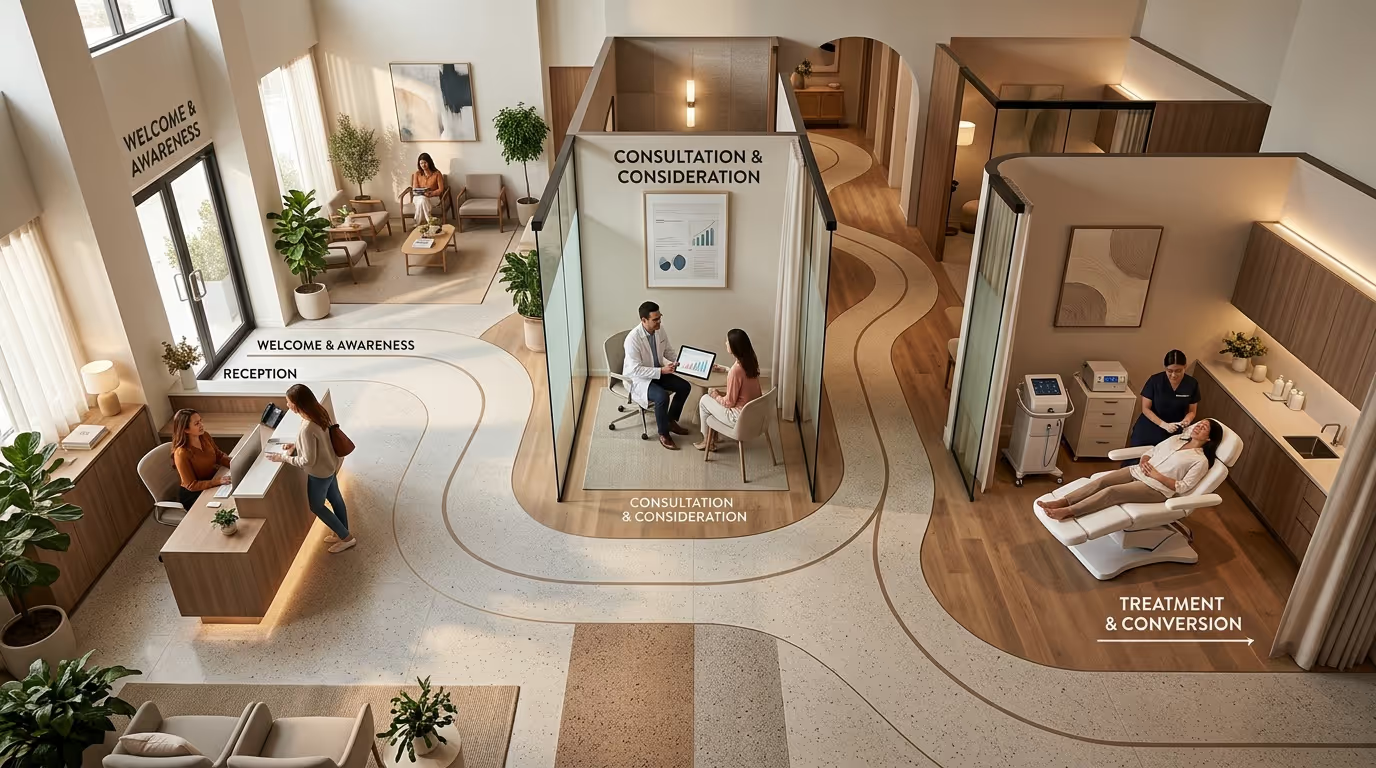
Your funnel has five distinct stages. Each stage has a specific goal, specific content, specific channels, and specific metrics.
Stage 1: Awareness — Getting on Their Radar
Goal: Make your ideal patient aware that your practice exists and that you can solve their problem.
The mistake most med spas make: Running ads that say "20% off Botox" to cold audiences. This attracts price shoppers who have zero loyalty. You are buying a one-time transaction, not a patient.
What works instead:
Educational Content Ads
Run Facebook and Instagram ads that deliver genuine value without asking for the sale:
- "5 Things Your Injector Should Tell You Before Your First Botox Appointment" (carousel post)
- "The Difference Between Filler and Botox — Explained in 60 Seconds" (video)
- "What Nobody Tells You About Laser Skin Resurfacing" (article promotion)
These ads build awareness AND trust simultaneously. They position your practice as the expert, not just the cheapest option.
Google Search Ads for High-Intent Keywords
When someone searches "best med spa near me" or "Botox [your city]," they are in active research mode. Your Google Ads should capture this intent with landing pages — not just send them to your homepage.
| Keyword Type | Search Intent | Funnel Stage | Example |
|---|---|---|---|
| Branded | Know your practice | Decision | "[Your Practice Name] reviews" |
| Treatment + location | Active research | Consideration | "Botox near me," "CoolSculpting Dallas" |
| Informational | Early research | Awareness | "How much does Botox cost," "Is microneedling worth it" |
| Competitor | Comparison shopping | Consideration | "[Competitor name] reviews," "alternative to [Competitor]" |
For detailed cost benchmarks and budget guidance, see our med spa Google Ads cost guide.
Local SEO Presence
Your Google Business Profile is often the first thing a potential patient sees. It needs to be fully optimized with current photos, accurate services, hundreds of reviews, and regular posts. This is passive awareness that compounds over time.
Implementation steps for GBP optimization:
- Claim and verify your Google Business Profile
- Add all service categories (primary: Medical Spa, secondary: all applicable treatment categories)
- Upload 50+ high-quality photos (facility, team, treatments, results)
- Write a keyword-rich business description
- Add all treatments as services with descriptions and pricing
- Post weekly updates (offers, tips, events)
- Respond to every review within 24 hours
- Enable messaging and booking features
Social Proof Content
Before/after photos (with consent), patient testimonials, and behind-the-scenes content on Instagram and TikTok build familiarity and trust without any ad spend. Use proper hashtag strategies to extend reach to local audiences.
Awareness Stage Benchmarks:
| Metric | Target | What It Tells You |
|---|---|---|
| Impressions/reach (monthly) | Growing 10%+ month-over-month | Is your brand visibility increasing? |
| Website traffic | 2,000+ monthly visitors | Are awareness efforts driving exploration? |
| Social profile visits | 500+/month | Is social content generating interest? |
| GBP views | 1,000-5,000+/month | Is your local presence visible? |
| Brand search volume | Increasing trend | Are more people searching for you by name? |
Stage 2: Capture — Converting Attention into Leads
Goal: Get the interested person's contact information so you can continue the conversation.
The mistake most med spas make: The only conversion path on their website is "Call Us" or "Book Now." Both require high commitment. A first-time visitor who is still researching will not call you. They will leave your site and probably not come back.
What works instead:
Lead Magnets
Offer something genuinely valuable in exchange for an email address and/or phone number:
| Lead Magnet | Conversion Rate | Best For |
|---|---|---|
| Treatment price guide | 15-25% | High-intent visitors who want cost transparency |
| Skin assessment quiz | 10-20% | Interactive engagement, segmentation |
| "What to Expect" treatment guide | 8-15% | First-timer anxiety reduction |
| Before/after lookbook | 8-12% | Visual learners comparing results |
| Free consultation offer | 20-30% | High-intent visitors ready to take action |
The price guide is the highest-converting lead magnet in medical aesthetics. People want to know what things cost before they call. Give them that information in exchange for their contact details, and you now have permission to follow up.
Landing Pages, Not Homepages
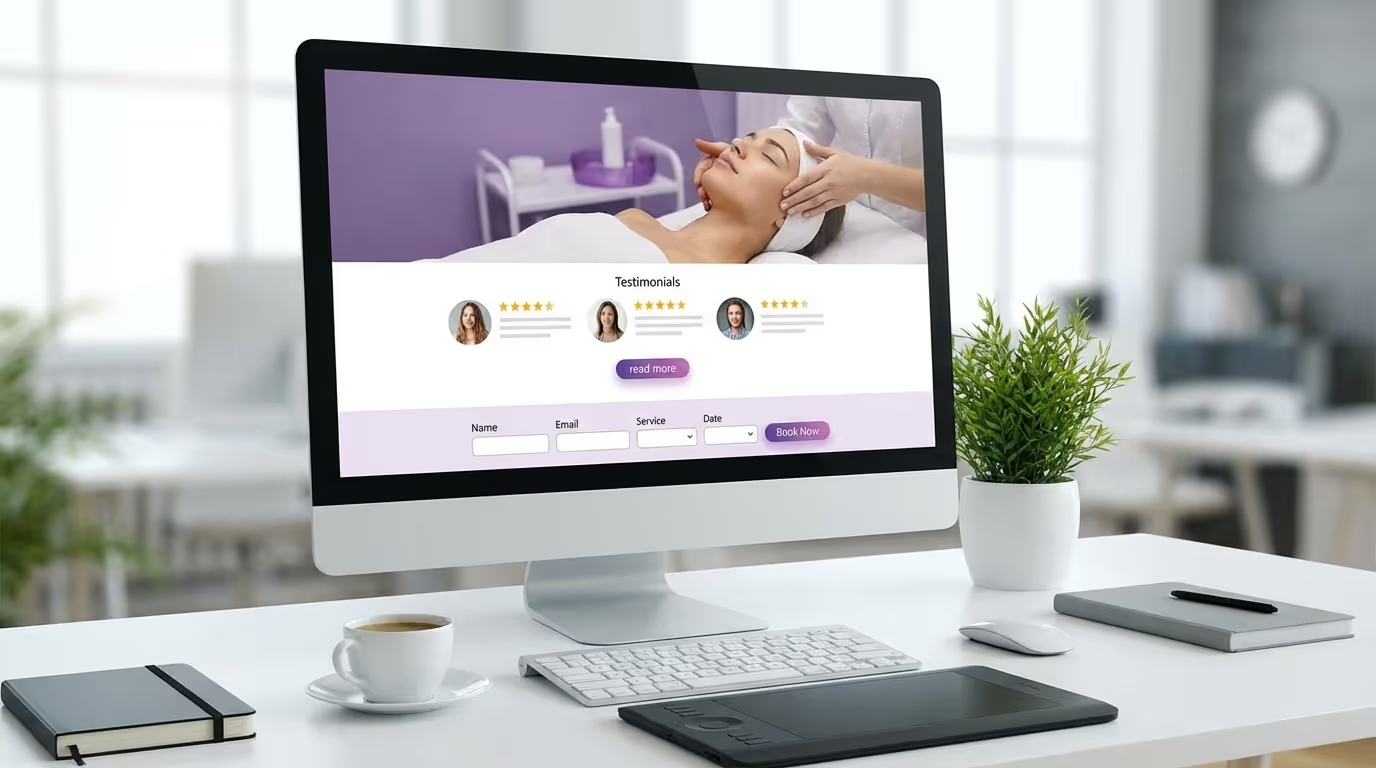
Every ad should send traffic to a dedicated landing page — not your homepage. A landing page has one purpose: convert the visitor into a lead. It has no navigation menu, no distractions, and a single clear call to action.
Landing page anatomy for med spas:
| Section | Purpose | Key Element |
|---|---|---|
| Headline | Speaks directly to the visitor's desire or pain point | Match the ad copy that brought them here |
| Subheadline | Adds specificity (treatment, location, offer) | Differentiator or proof point |
| Hero image or video | Shows the outcome they want (not your building) | Before/after or treatment in progress |
| Social proof bar | Review count, rating, "as featured in" logos | Credibility at first glance |
| Benefits (3-5 bullets) | What they get, not what you do | Outcome-focused language |
| Before/after gallery | 4-6 relevant results | Matched to the treatment being promoted |
| The offer | Free consultation, price guide, quiz, or special | Clear value proposition |
| Form | Name, phone, email — nothing more | Fewer fields = higher conversion |
| Trust signals | Provider credentials, certifications, years in business | Anxiety reduction |
| FAQ | 3-5 common objections answered | Objection handling |
| Urgency element | Limited availability, seasonal offer | Motivation to act now |
A well-built landing page converts 15-25% of visitors into leads. A homepage converts 2-5%. This is the single biggest leverage point in your funnel, and most med spas do not have a single dedicated landing page.
Chat and Messaging
Add a chat widget to your website (live chat during business hours, chatbot after hours). Many prospective patients will ask a quick question via chat who would never pick up the phone. Capture their information during the conversation.
Implementation steps for the capture stage:
- Build your first lead magnet (start with the treatment price guide — it converts highest)
- Create a dedicated landing page for your highest-revenue treatment
- Install a chat widget on your website with after-hours chatbot functionality
- Set up form submission notifications so leads trigger immediate alerts
- Create UTM tracking templates for every ad campaign
- Implement call tracking to attribute phone leads to specific campaigns
- Set up a lead scoring system in your CRM to prioritize follow-up
Capture Stage Benchmarks:
| Metric | Target | Action If Below Target |
|---|---|---|
| Landing page conversion rate | 15-25% | Test headline, offer, or form length |
| Cost per lead | $15-$75 (varies by channel and market) | Optimize ad targeting or landing page |
| Lead magnet download rate | 10-20% of page visitors | Improve offer value or placement |
| Chat engagement rate | 5-10% of visitors | Test chat prompts and timing |
| Total leads per month | Depends on budget — target 50-150 | Increase traffic or improve conversion |
Stage 3: Nurture — Building Trust Before the Appointment
Goal: Move the lead from "interested" to "ready to book" by systematically building trust and removing objections.
The mistake most med spas make: Lead comes in. Front desk calls once or twice. If they do not answer, the lead dies. There is no automated follow-up, no nurture sequence, no systematic approach to warming cold leads.
The data is clear: 80% of sales require 5-12 follow-up touchpoints. Med spas that follow up once or twice are abandoning 80% of their potential revenue.
Speed to Lead: The 5-Minute Rule
When a lead comes in, they should receive a response within 5 minutes. This can be automated: an SMS saying "Thanks for reaching out to [Practice Name]! We received your inquiry and a patient coordinator will call you within the next few minutes. In the meantime, here's a link to see our before/after results: [link]."
| Response Time | Conversion Rate Multiplier |
|---|---|
| Under 1 minute | 10x baseline |
| Under 5 minutes | 8x baseline |
| 5-30 minutes | 3x baseline |
| 30-60 minutes | 1x baseline |
| Over 1 hour | 0.5x baseline |
| Over 24 hours | 0.1x baseline |
Speed to lead is not a nice-to-have. Set up an automation in your CRM that texts immediately and alerts your front desk to call within 5 minutes during business hours.
The 14-Day Nurture Sequence
After the initial contact, every lead should enter an automated nurture sequence. Here is the framework with exact timing and content types:
Day 0 (immediate): Welcome SMS + email with the resource they requested (price guide, quiz results, etc.)
Day 1: Email — "Why Patients Choose [Practice Name]." Include your top differentiators, provider credentials, and 2-3 patient testimonials. No hard sell.
Day 3: SMS — "Hi [Name], just checking in. Did you have a chance to look at the information we sent? Happy to answer any questions. — [Coordinator Name]"
Day 5: Email — Educational content related to their stated interest. If they inquired about Botox, send "What to Expect at Your First Botox Appointment." Personalization matters. For content ideas by treatment, see our content strategy guide.
Day 7: Email — Before/after gallery. "Here are some recent results from our patients." Show 4-6 relevant transformations. This is the single most persuasive content in medical aesthetics.
Day 9: SMS — Soft close. "Hey [Name], we have a few consultation openings this week. Would you like me to hold one for you? No pressure — just want to make sure you can get in when it works for you."
Day 11: Email — Social proof. A detailed patient story or video testimonial. The more specific, the better.
Day 14: Email — Final outreach. "We want to make sure you have everything you need to make a decision. Here's a direct link to book a free consultation: [link]. If now isn't the right time, no worries — we're here whenever you're ready."
Post-sequence: Leads who do not convert after 14 days move to a long-term nurture list. They receive 1-2 emails per month with educational content, seasonal promotions, and practice updates via your newsletter. Many will convert weeks or months later. For more on building these drip campaigns, see our automation guide.
The Phone Call Strategy
Automation supports but does not replace human follow-up. Your front desk should call every new lead within 5 minutes of submission.
Phone call script framework:
| Step | Script Element | Example |
|---|---|---|
| Opening | Lead with value, not sales | "Hi [Name], this is [Coordinator] from [Practice]. I saw you were interested in [treatment] — I wanted to personally make sure you had all the information you needed." |
| Discovery | Ask what prompted their inquiry | "What's got you thinking about [treatment] right now?" |
| Education | Share relevant information | "Great question — here's what most of our patients experience..." |
| Soft close | Offer next step naturally | "Would you like to come in for a quick consultation? It takes about 15 minutes and there's no obligation." |
| Objection handling | Address common concerns | "I completely understand — let me send you some before/after photos so you can see real results from patients similar to you." |
If they do not answer, call again the next day. Then shift to the automated sequence while attempting calls on days 3 and 7.
Common Mistake: Treating All Leads the Same
A lead who downloaded your price guide is different from a lead who requested a specific consultation. Segment your leads by intent level and treatment interest, then personalize the nurture sequence accordingly. Your CRM should automate this segmentation.
Nurture Stage Benchmarks:
| Metric | Target | Action If Below Target |
|---|---|---|
| Speed to lead (avg first response) | Under 5 minutes | Automate SMS response, add alerts |
| Email open rates | 35%+ | Improve subject lines, test send times |
| SMS response rates | 40%+ | Shorten messages, add personalization |
| Consultation booking rate from nurtured leads | 25-40% | Improve sequence content, train front desk |
| Average touchpoints before conversion | 5-8 | Ensure your sequence has enough touches |
Stage 4: Conversion — Turning Consultations into Treatments
Goal: Convert the booked consultation into a paid treatment.
The mistake most med spas make: They treat the consultation as purely clinical. The provider assesses the patient, recommends a treatment plan, quotes a price, and waits for the patient to decide. There is no sales framework, no objection handling, and no systematic close.
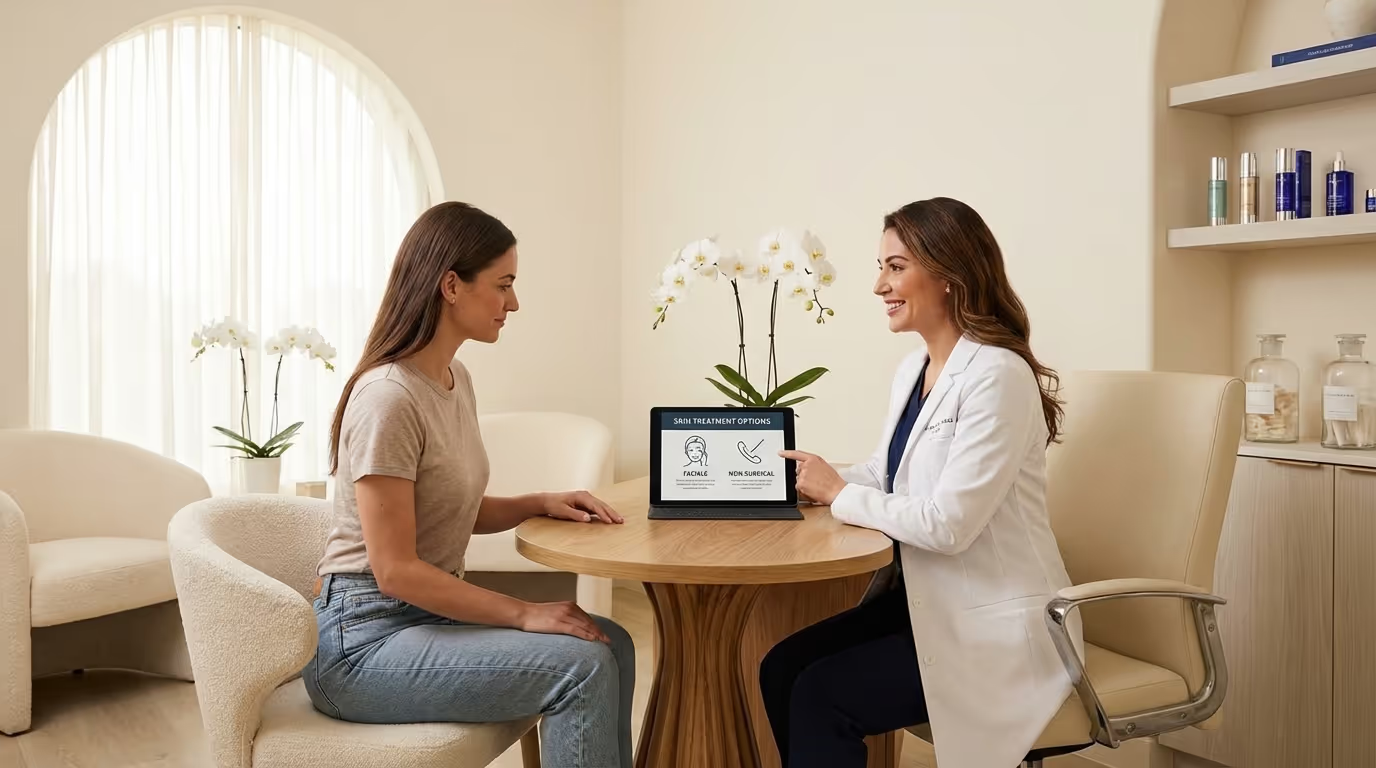
The consultation is a sales conversation. It happens to take place in a medical environment, but it follows the same principles as any consultative sale.
Pre-Consultation Experience
The conversion process starts before the patient walks in the door.
Implementation steps:
- Confirmation sequence: SMS reminder the day before and morning of the appointment, including parking instructions, what to expect, and a note about what to bring
- Intake forms: Send digital intake forms 24 hours before the appointment so the patient arrives prepared and the provider has context
- Environment: The physical space should be immaculate (see our interior design guide), the greeting should be warm and personal, and the wait should be under 5 minutes
- Pre-consultation education: Send a short video or guide about the treatment they are considering — this primes the conversation and reduces anxiety
The 5-Step Consultation Framework
| Step | Duration | Goal | Key Technique |
|---|---|---|---|
| 1. Discovery | 5-10 min | Understand their goals and concerns | Open-ended questions: "What brought you in today?" |
| 2. Assessment | 5-10 min | Examine the area of concern | Use a mirror, connect findings to their stated concerns |
| 3. Recommendation | 5 min | Present a clear treatment plan | Be specific: treatments, sessions, results timeline, cost |
| 4. Address concerns | 5-10 min | Handle objections | Pain, results, cost, natural look — address all four |
| 5. Close | 2-3 min | Ask for the commitment | "Would you like to go ahead and schedule your first treatment?" |
The four objections you must address:
| Objection | Response Framework |
|---|---|
| Pain | "Most patients describe it as a slight pinch. We use [numbing method] to ensure you're comfortable." |
| Results | "Here's a patient with a very similar starting point — and here are their results at 2 weeks." |
| Cost | "The total investment for this plan is $X. We do offer financing through [provider] if you'd prefer to spread that out." Reference your pricing strategy for packaging options. |
| Looking unnatural | "I completely understand that concern. My approach is always conservative — you want to look refreshed, not different." |
Post-Consultation Follow-Up
If the patient does not book during the consultation, they enter a post-consultation nurture sequence:
| Day | Channel | Content |
|---|---|---|
| Same day | SMS | Thank them for coming in, summary of recommended plan |
| Day 2 | Before/after photos relevant to their treatment plan | |
| Day 5 | SMS | "Any questions about the plan we discussed?" |
| Day 7 | Time-sensitive incentive (if applicable) | |
| Day 14 | Phone call | Personal follow-up from coordinator |
Conversion Stage Benchmarks:
| Metric | Target | Action If Below Target |
|---|---|---|
| Consultation show rate | 85%+ | Improve confirmation sequence, add deposits |
| Consultation-to-treatment conversion | 60-75% | Train providers on consultation framework |
| Average treatment value at first visit | Track and increase quarterly | Present comprehensive plans, not single treatments |
| Same-day booking rate | 40-60% | Improve close technique, offer same-day incentive |
Stage 5: Retention — Turning One-Time Patients into Lifetime Value
Goal: Maximize patient lifetime value through rebooking, upselling complementary treatments, and generating referrals.
The math that changes everything: Acquiring a new patient costs $150-$400 depending on your market and channels. Retaining an existing patient costs nearly nothing. A patient who stays for 3 years with quarterly treatments at $500 average is worth $6,000 in lifetime revenue from a single acquisition cost.
But here is the number that matters most: the average med spa loses 60-70% of first-time patients within 12 months. They come once, have a good experience, and simply do not come back. Not because they were unhappy. Because nobody reminded them, followed up, or gave them a reason to return.
This is the biggest revenue leak in the med spa industry, and it is completely fixable with the right systems.
The Post-Treatment Sequence
| Timing | Channel | Content | Purpose |
|---|---|---|---|
| Immediately after | In-person | Verbal aftercare + printed/digital aftercare card | Set expectations |
| 2 hours post | SMS | "Hi [Name], hope you're feeling great! Here's your aftercare reminder: [link]" | Support and care |
| 24 hours post | SMS | "How are you feeling today? Any questions? We're here for you." | Check-in |
| 48-72 hours post | Review request with Google review link | Build reviews | |
| 2 weeks post | "Your results are still developing — here's what to expect." | Education and engagement | |
| Rebook window | SMS/Email | Treatment-specific rebooking reminder | Retention |
Rebook timing by treatment type:
| Treatment | Rebook Reminder Timing | Message Framework |
|---|---|---|
| Botox/Dysport | 10-12 weeks post-treatment | "It's been [X weeks] — most patients refresh around now." |
| Dermal fillers | 6-9 months post-treatment | "Your filler results may be starting to soften." |
| Chemical peels | 4-6 weeks post-treatment | "Ready for your next peel? Consistent treatments compound results." |
| Laser hair removal | Per series schedule (4-6 weeks) | "Session [X] of [Y] — let's keep your momentum going." |
| Microneedling | 4-6 weeks post-treatment | "Your collagen is still building — the next session amplifies results." |
| Body contouring | Per treatment plan | "Time for your follow-up assessment and next session." |
Membership and Package Programs
The most powerful retention tool in medical aesthetics is a membership program. Here is the framework:
Monthly membership ($150-$300/month):
| Included | Benefit to Patient | Benefit to Practice |
|---|---|---|
| One core treatment per month | Consistent care at lower per-treatment cost | Recurring revenue baseline |
| 10-20% off all other services | Savings on additional treatments | Increased treatment frequency |
| Exclusive member pricing on retail | Product savings | Higher retail revenue |
| Priority booking | Convenience | Schedule predictability |
Why memberships work: They create a recurring revenue baseline, increase visit frequency, build habit, and create switching costs (patients lose benefits if they leave). Target 20-30% of active patients enrolled within 12 months.
Treatment packages (bundles of 3, 6, or 12):
Pre-paid packages at a 10-15% discount versus individual pricing. Creates commitment and guarantees future visits. Track completion rates — if patients are not completing packages, your rebooking process needs work.
Referral Program
Your best patients should be your best marketers. Create a structured referral program:
Implementation steps:
- Design the incentive structure ($50-$100 credit for referrer, $50 off for referred patient)
- Create personalized referral links or codes in your CRM
- Make it easy — give patients a referral link they can text to friends
- Automate tracking and reward fulfillment
- Send quarterly referral program reminders
- Celebrate top referrers ("You've referred 3 friends this year — here's a bonus treatment on us")
Retention Stage Benchmarks:
| Metric | Target | Action If Below Target |
|---|---|---|
| 90-day rebook rate | 50-65% | Implement automated rebooking reminders |
| 12-month patient retention | 40-50% | Launch loyalty program, improve post-treatment experience |
| Membership enrollment rate | 20-30% of active patients | Train staff on membership benefits, offer signup incentive |
| Package completion rate | 85%+ | Improve rebooking process, add completion reminders |
| Referral rate | 15-20% of patients refer 1+ friend | Launch structured referral program |
| Net Promoter Score | 50+ | Survey every patient, address detractor feedback |
| Patient lifetime value | $2,000-$5,000+ | Improve retention, increase average visit value |
Building Your Med Spa Conversion Funnel: The Implementation Roadmap
You do not need to build everything at once. Here is the priority order based on revenue impact.
Phase 1: Fix the Leaks (Week 1-2)
| Priority | Action | Expected Impact |
|---|---|---|
| 1 | Set up speed-to-lead automation (immediate SMS to all new inquiries) | 2-3x lead conversion improvement |
| 2 | Build your first dedicated landing page for your highest-revenue treatment | 2-5x conversion vs. homepage traffic |
| 3 | Implement automated appointment reminders | Reduce no-shows by 30-50% |
| 4 | Create a post-treatment review request sequence | Build review pipeline from day one |
These four automations will impact your revenue within the first month.
Phase 2: Build the Nurture Engine (Week 3-4)
- Write and activate the 14-day lead nurture sequence
- Create your first lead magnet (start with the price guide)
- Train your front desk on the phone call framework
- Set up a long-term email nurture list for unconverted leads
Phase 3: Optimize Conversion (Month 2)
- Train providers on the 5-step consultation framework
- Build pre-consultation and post-consultation sequences
- Create treatment-specific follow-up sequences for SMS and email
- Implement rebooking reminders for all major treatment categories
Phase 4: Scale Retention (Month 3)
- Design and launch a membership program
- Create treatment packages with clear pricing
- Launch a referral program
- Build a VIP or loyalty tier for top patients
Phase 5: Measure and Refine (Ongoing)
- Track funnel metrics weekly using your KPI dashboard
- A/B test landing pages, email subject lines, and SMS copy
- Review conversion rates at each stage monthly
- Identify and fix the biggest drop-off point every quarter
Common Mistake: Building Everything Before Launching Anything
Perfection is the enemy of revenue. Launch Phase 1 immediately with whatever tools you have. A basic speed-to-lead text and a simple landing page will outperform no funnel at all. You can optimize and expand as you go.
Funnel Metrics Dashboard
Track these numbers weekly. They tell you exactly where your funnel is working and where it is broken.
| Metric | Target | What It Tells You | Fix If Below Target |
|---|---|---|---|
| Website visitors (monthly) | Growing MoM | Is your awareness stage working? | Increase ad spend or SEO investment |
| Landing page conversion rate | 15-25% | Is your capture stage working? | Test headline, offer, form length |
| Cost per lead | $15-$75 varies by channel | Are you acquiring leads efficiently? | Optimize targeting, improve Quality Score |
| Speed to lead | Under 5 minutes | Are you responding fast enough? | Automate, add staff alerts |
| Lead-to-consultation rate | 25-40% | Is your nurture stage working? | Improve sequence, train front desk |
| Consultation show rate | 85%+ | Is your confirmation process working? | Add deposits, improve reminders |
| Consultation-to-treatment rate | 60-75% | Is your conversion stage working? | Train providers on consultation framework |
| Average first-visit value | Track by service mix | Are you presenting comprehensive plans? | Improve treatment planning process |
| 90-day rebook rate | 50-65% | Is your retention stage working? | Implement rebooking automation |
| 12-month patient retention | 40-50% | Are patients staying? | Launch membership/loyalty programs |
| Patient lifetime value | $2,000-$5,000+ | Is the whole funnel working? | Improve retention + increase visit value |
| Referral rate | 15-20% | Are patients advocating for you? | Launch referral program |
When a metric is below target, it tells you exactly which stage of your funnel needs attention. You do not need to guess — you diagnose.
The Technology Stack for Your Med Spa Funnel
You need the right tools to run a funnel at this level. Here is the minimum viable tech stack with cost benchmarks:
| Purpose | Recommended Tools | Monthly Cost | Role in Funnel |
|---|---|---|---|
| CRM + automation | GoHighLevel, HubSpot | $97-$497/mo | Central nervous system — leads, sequences, pipeline |
| Landing pages | Built into CRM, or Unbounce/Leadpages | $0-$200/mo | Capture stage conversion |
| Scheduling | Jane, Boulevard, Calendly | $50-$300/mo | Booking integration |
| SMS platform | Built into CRM, or Twilio | $0-$100/mo | Two-way patient communication |
| Review management | BirdEye, Podium, or built-in CRM | $0-$300/mo | Post-treatment review requests |
| Analytics | GA4, UTM tracking, CRM reporting | $0 | Full-journey attribution |
| EMR system | PatientNow, Nextech, AestheticsPro | $200-$500/mo | Clinical documentation + patient data |
| Call tracking | CallRail, CallTrackingMetrics | $50-$200/mo | Phone lead attribution |
For a full comparison of platforms, see our med spa management software guide and best med spa software comparison.
Integration is critical. Your CRM should connect to your scheduling system, your EMR, your review platform, and your ad accounts. If systems do not talk to each other, leads fall through the cracks. GoHighLevel is the most common all-in-one platform for med spas because it handles CRM, automation, landing pages, SMS, and review management in a single system.
Advanced Funnel Strategies
Once your core funnel is running, these advanced tactics can multiply results.
Retargeting Funnel
Set up retargeting campaigns for website visitors who did not convert:
| Retargeting Audience | Ad Content | Goal |
|---|---|---|
| Visited treatment page but didn't convert | Before/after photos + specific offer | Drive landing page conversion |
| Started form but didn't submit | "Still thinking about [treatment]?" + testimonial | Recapture abandoned leads |
| Downloaded price guide but didn't book | Patient story + consultation CTA | Move from research to action |
| Past patients (6+ months inactive) | "We miss you" + reactivation offer | Win back lapsed patients |
Retargeting audiences convert 3-5x better than cold audiences because they already know your brand.
Seasonal Funnel Variations
Your funnel messaging should shift with seasons to match patient demand:
| Season | Primary Treatments | Funnel Messaging Angle |
|---|---|---|
| January-March | Body contouring, weight loss, laser | "New year, new you" + summer prep |
| April-June | Injectables, peels, laser hair removal | Wedding season + vacation prep |
| July-September | Facials, IV therapy, maintenance | Summer recovery + fall prep |
| October-December | Injectables, specials, gift cards | Holiday promotions + treat yourself |
Build seasonal landing pages and update your marketing calendar to align funnel messaging with demand patterns.
Service-Stacking Funnel
Design patient journeys that naturally progress from entry-level to premium treatments:
| Entry Treatment | Upsell Opportunity | Timeline |
|---|---|---|
| HydraFacial ($200) | Chemical peel series, then microneedling | Month 1 → Month 3 → Month 6 |
| Botox ($300-600) | Filler, then combination plans | Visit 1 → Visit 2 → Ongoing |
| Laser hair removal ($150-300) | Body contouring, skin treatments | During series → Post-series |
| Free consultation | Comprehensive treatment plan | Same day |
Each treatment in the sequence is presented as the natural next step based on their results and goals — not as a random upsell.
Common Med Spa Funnel Mistakes That Cost Revenue
Mistake 1: Building a Funnel Without Data
Do not build sequences based on assumptions. Start with data: What are your current conversion rates? Where do leads drop off? What does your booking software show about no-show patterns? Build the funnel to fix actual problems, not theoretical ones.
Mistake 2: Over-Automating and Losing the Human Touch
Automation handles the system. Humans handle the relationship. The best funnel combines automated sequences with personal touchpoints (phone calls, personalized texts, in-person interactions). Never let automation replace genuine human connection.
Mistake 3: Ignoring the Post-Treatment Experience
Most med spas invest 90% of their marketing budget in acquisition and 10% in retention. Flip it. Improving retention by 10% costs a fraction of acquiring the equivalent number of new patients.
Mistake 4: No Attribution Tracking
If you cannot trace a patient back to the marketing channel that brought them in, you cannot optimize your funnel. Implement UTM tracking, call tracking, and "how did you hear about us" fields in your intake form. Attribution is not optional — it is the foundation of intelligent marketing spend.
Mistake 5: Same Funnel for Every Treatment
A Botox patient and a weight loss patient have completely different objections, timelines, and decision processes. Build treatment-specific landing pages, nurture sequences, and consultation frameworks. One-size-fits-all funnels underperform treatment-specific funnels by 30-50%.
The Bottom Line
A med spa without a med spa sales funnel is leaving 40-60% of its potential revenue on the table. Leads come in and die. Patients come once and disappear. Referrals happen by accident instead of by design.
Building a med spa conversion funnel is not complicated. It is a sequence of deliberate steps: capture attention, earn trust, convert interest through a dedicated med spa landing page, deliver an exceptional experience, and systematize retention.
The med spas that build this system properly do not worry about where their next patient is coming from. They worry about having enough capacity to serve the demand.
That is the position you should be in.
The difference between a struggling med spa and a thriving one is rarely the quality of treatments. It is the quality of the med spa lead funnel system that surrounds those treatments. Your med spa funnel is that system.
Ready to build a med spa funnel that fills your calendar with high-value patients? Book a Strategy Call and we will map your med spa patient journey from first click to lifetime loyalty. We build funnels exclusively for med spas — and we know which frameworks, sequences, and offers convert in this industry because it is the only industry we work in.