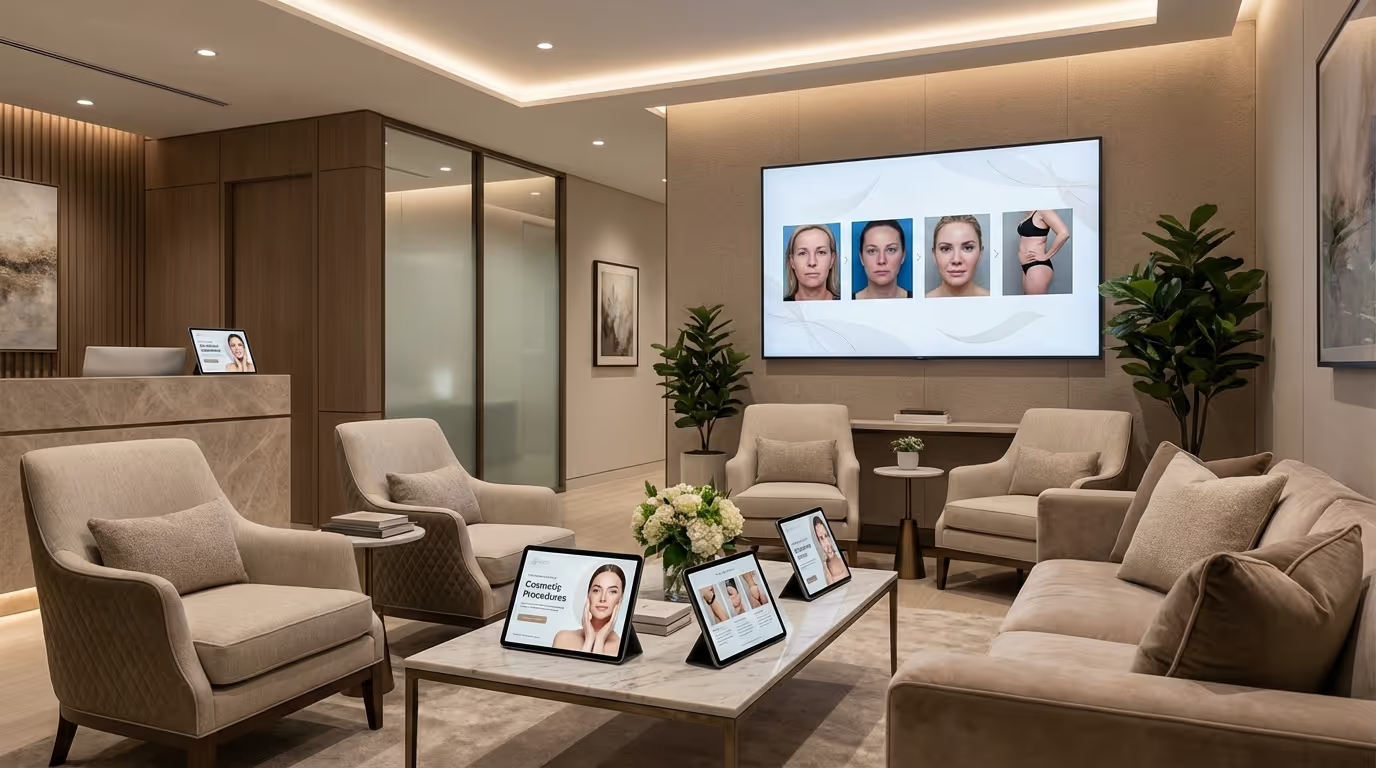


Cosmetic surgery is an elective, cash-pay business. Nobody needs a rhinoplasty. Nobody needs breast augmentation. Every single patient walks through your door because they chose to — and they chose you over every other surgeon in your market.
That choice is shaped by marketing. Whether you like that word or not.
The surgeons who accept this reality and invest accordingly are the ones with waitlists. The ones who still believe their work should "speak for itself" are the ones wondering why the practice down the street — the one with the Instagram Reels and the Google Ads — is booked six weeks out while they have openings next Tuesday.
This is the complete guide to cosmetic surgery marketing. Not a surface-level overview. Not a list of tactics without context. A comprehensive playbook covering strategy, channels, budgets, funnels, and the exact metrics you need to know whether your marketing is working or wasting money.
Why Cosmetic Surgery Marketing Is Different
Marketing a cosmetic surgery practice is not like marketing a restaurant, a retail store, or even a general medical practice. The economics, the patient psychology, and the competitive dynamics are fundamentally different.
The Unique Characteristics of Cosmetic Surgery Marketing
| Characteristic | Implication | Marketing Response |
|---|---|---|
| High-ticket ($3K to $20K+) | Long consideration cycle, multiple touchpoints needed | Multi-channel nurture system, not single-touch campaigns |
| Cash-pay, elective | Competing with discretionary spending (vacations, renovations) | Value framing and ROI messaging, not just feature lists |
| Trust threshold is extreme | Patients trust you with permanent physical changes | Video content, credentials, reviews, before/after galleries |
| Competition is intensifying | More practices, higher ad costs (up 25 to 40% since 2023) | Sophisticated targeting, strong differentiation, SEO investment |
| Non-surgical alternatives expanding | Med spas targeting same patients with lower-cost options | Clear positioning on when surgery is the right choice |
| Decision influenced by emotion | Self-image, confidence, life transitions drive decisions | Storytelling, patient journeys, transformation narratives |
The Patient Psychology Factor
Understanding why patients choose cosmetic surgery — and what stops them — is the foundation of effective marketing.
Decision triggers (what prompts the search):
- Life transitions: divorce, milestone birthday, post-pregnancy, significant weight loss
- Social comparison: seeing results on social media, peers who have had procedures
- Long-held desire reaching a tipping point: "I have wanted this for years"
- GLP-1 medication weight loss creating need for body refinement
Decision barriers (what stops them from booking):
- Fear of a bad outcome
- Cost and financing concerns
- Not knowing which surgeon to trust
- Uncertainty about recovery and downtime
- Social stigma or concern about others' reactions
Your marketing must address both sides: amplify the triggers while systematically removing the barriers. Every channel, every piece of content, every touchpoint should serve one of these two purposes.
Common mistake: Marketing only to patients who are ready to book. That is 10 to 15 percent of your potential audience. The other 85 percent are in research, evaluation, or early consideration stages. If you are not reaching them, your competitors are.
The Cosmetic Surgery Marketing Stack: 13 Layers
A "marketing stack" is the combination of channels, tools, and systems that work together to acquire, convert, and retain patients. Here is the complete stack that works for cosmetic surgery in 2026.
Layer 1: High-Converting Website
Your website is the hub of everything. Every ad, every social post, every Google search result, every referral — they all lead back to your website. If it does not convert, nothing else matters.
What a high-converting cosmetic surgery website requires:
| Element | Standard | Impact on Conversion |
|---|---|---|
| Procedure pages | 1,500 to 3,000 words each, with galleries, costs, FAQs, forms | Fundamental — no procedure page = no ranking, no conversion |
| Surgeon bio | Professional photo, credentials, story, specialties, video introduction | +25 to 35% trust building |
| Before/after gallery | Organized by procedure, consistent photography, case details | Highest-converting page type on the site |
| Mobile-first design | 70%+ traffic is mobile; fast, thumb-friendly, easy navigation | -7% conversion per second of load time above 3 seconds |
| Speed | Under 3 seconds load time | Ranking factor + conversion factor |
| Multiple conversion paths | Phone, form, chat, self-scheduling | Each path captures a different patient preference |
| Video content | Provider intros, procedure explainers, patient testimonials | +20 to 30% engagement and time on site |
Target conversion rate: 5 to 10 percent of visitors should become leads.
For design principles that apply across aesthetic practices, see our guides on med spa website design, best med spa websites, and med spa homepage design.
Implementation steps:
- Audit your current website with Google PageSpeed Insights (speed), Google Search Console (indexation), and Hotjar or Microsoft Clarity (user behavior).
- Create or rebuild every procedure page to the 1,500 to 3,000-word standard with all required elements.
- Rebuild your before/after gallery with standardized photography, filtering by procedure, and case details.
- Film a 2 to 3-minute surgeon introduction video and embed it on the homepage and bio page.
- Implement online booking or consultation scheduling that works on mobile.
- Add live chat during business hours and after-hours SMS capture.
Layer 2: Google Business Profile + Local SEO
When patients search "[procedure] near me" or "cosmetic surgeon in [city]," Google shows a map with three practices. If you are not one of those three, you are invisible for the most valuable searches.
Implementation steps:
- Complete every field in Google Business Profile.
- Set primary category to "Cosmetic Surgeon" or "Plastic Surgeon."
- Generate 5 to 10 new Google reviews per month (automated via SMS after consultations and post-procedure).
- Post weekly Google Updates (before/after results, procedure spotlights, practice news).
- Maintain consistent NAP across all directories.
- Build location-specific content for each city or neighborhood you serve.
- List on RealSelf (critical for cosmetic surgery), Healthgrades, Vitals, Zocdoc.
The same local SEO fundamentals that drive med spa local SEO success apply to cosmetic surgery — but the competitive stakes are higher.
Layer 3: Conversion Tracking Infrastructure
Before you spend a dollar on advertising, your tracking must be airtight.
Required tracking setup:
| What to Track | Tool | Why It Matters |
|---|---|---|
| Form submissions by source | GA4 + Google Tag Manager | Know which channels generate leads |
| Phone calls by source | CallRail or CallTrackingMetrics | 40 to 60% of cosmetic surgery conversions are phone calls |
| Chat/text inquiries by source | CRM or chat platform analytics | Growing channel, often untracked |
| Consultation bookings by source | CRM with source attribution | Bridge the gap between lead and patient |
| Procedures booked by source | CRM + POS | The metric that actually matters: revenue |
| Revenue by marketing channel | Manual calculation from CRM + POS data | Determines ROAS and budget allocation |
Without this infrastructure, you are flying blind with thousands of dollars per month. This is identical to the tracking requirements for med spa marketing ROI measurement.
Layer 4: Google Ads (PPC)
The most direct path from "patient searching" to "patient booking." Google Ads for cosmetic surgery captures demand at the moment of highest intent.
Campaign structure:
| Campaign Type | Budget Allocation | Keywords | Expected CPC |
|---|---|---|---|
| Branded | 5 to 10% | Your practice name, surgeon name | $1 to $3 |
| Procedure-specific | 40 to 50% | "[procedure] [city]," "[procedure] surgeon near me" | $8 to $30 |
| Competitor conquest | 10 to 15% | Competitor practice and surgeon names | $5 to $15 |
| General/near-me | 15 to 20% | "cosmetic surgeon [city]," "plastic surgery near me" | $10 to $25 |
| Remarketing | 15 to 20% | Display and YouTube to past website visitors | $1 to $5 |
Implementation steps:
- Build one campaign per procedure category with tight keyword groups.
- Create dedicated landing pages for each procedure campaign (never send to homepage).
- Add comprehensive negative keywords (educational, job-related, DIY terms).
- Enable call tracking on all campaigns — 40 to 60 percent of cosmetic surgery conversions are phone calls.
- Start with manual bidding; switch to Smart Bidding at 30-plus conversions per month.
- Set location targeting at 20 to 30-mile radius (cosmetic surgery patients travel farther than med spa patients).
- Monitor and optimize weekly for the first 90 days, then biweekly.
Budget: $5,000 to $15,000 per month for a single location. Scale based on ROAS data. See med spa Google Ads cost for related benchmarks.
Layer 5: SEO + Content Marketing
The long game that compounds. Every blog post, every procedure page, every location page you create is a permanent asset that drives traffic without ongoing ad spend.
Content priorities for cosmetic surgery:
| Priority | Content Type | Examples | Timeline |
|---|---|---|---|
| 1 | Procedure pages | Comprehensive pages for every procedure offered | Months 1 to 2 |
| 2 | Cost content | "[Procedure] cost in [city]: what to expect" | Months 2 to 4 |
| 3 | Comparison content | "[Procedure A] vs [Procedure B]" | Months 3 to 5 |
| 4 | Recovery guides | "[Procedure] recovery: week by week" | Months 4 to 6 |
| 5 | Candidate qualification | "Am I a good candidate for [procedure]?" | Months 5 to 7 |
| 6 | Surgeon selection | "How to choose a cosmetic surgeon in [city]" | Months 6 to 8 |
Publish 2 to 4 pieces per month. Each post should be 1,500 to 2,500 words, SEO-optimized, and include internal links to your procedure pages.
Timeline: 6 to 12 months for significant organic traffic. But once it compounds, organic becomes your lowest-cost acquisition channel. For content strategy frameworks, see our med spa content strategy guide.
Layer 6: Meta Ads (Facebook + Instagram)
Lower intent than Google (patients are not searching, they are scrolling), but powerful for awareness, retargeting, and social proof.
Best-performing ad types for cosmetic surgery:
| Ad Type | Performance | Best Use Case |
|---|---|---|
| Before/after carousel | Highest engagement | Retargeting website visitors |
| Video testimonials | Highest conversion | Warm audiences, consultation push |
| Educational Reels (repurposed) | Best reach | Cold audiences, brand awareness |
| Event promotions | Good for local | Open houses, webinars, consultations |
| Surgeon Q&A clips | Strong trust building | Mid-funnel consideration |
Budget: $2,000 to $5,000 per month as a complement to Google Ads. See our med spa Facebook ads guide for creative best practices.
Layer 7: Video Content + YouTube
Video is the most powerful trust-building medium available. Patients want to see the surgeon talk, explain, and demonstrate expertise before they commit to a consultation.
Content formats:
| Format | Length | Publishing Frequency | Platform |
|---|---|---|---|
| Procedure explainers | 3 to 8 minutes | 2 per month | YouTube, website |
| Patient journey videos | 5 to 15 minutes | 1 per month | YouTube |
| Recovery vlogs | 3 to 8 minutes | 1 per month | YouTube |
| Myth-busting | 2 to 5 minutes | 2 per month | YouTube, Reels, TikTok |
| Surgeon Q&A | 3 to 10 minutes | 2 per month | YouTube, clips for social |
| Day-in-the-life | 1 to 3 minutes | Weekly | Instagram, TikTok |
Repurpose long-form content into 15 to 60-second clips for Instagram Reels, TikTok, and YouTube Shorts.
Layer 8: Social Media (Instagram + TikTok)
Implementation steps:
- The surgeon's personal account outperforms the practice account 3:1 — invest in building the surgeon's personal brand.
- Post 4 to 5 times per week on the feed, daily Stories, and active engagement with comments and DMs.
- Mix content: 40 percent educational/procedure, 30 percent results/before-after, 20 percent personal/behind-scenes, 10 percent promotional.
- Use med spa hashtags research to identify optimal tags for each post.
- Engage with every comment and DM within 4 hours during business hours.
Layer 9: Reputation Management
Reviews are the social proof layer that determines whether a patient who finds you actually trusts you.
The system:
- Automated review requests via SMS 24 to 48 hours after consultation.
- Post-procedure review requests 2 to 3 weeks after surgery (when results are visible).
- Response to every review within 24 hours — positive and negative.
- Review monitoring across Google, RealSelf, Healthgrades, and Yelp.
- Video testimonial collection from willing patients.
Target: 5 to 10 new Google reviews per month. 4.5-plus star average. For the complete framework, see our med spa reputation management guide.
Layer 10: PR and Media
Third-party validation is worth more than any ad. A feature in a local magazine, a quote in a national publication, or a segment on local news creates credibility that money cannot buy.
Implementation steps:
- Respond to HARO queries and journalist databases within 1 hour of publication.
- Pitch local media on trending topics (new techniques, seasonal trends, celebrity procedures).
- Write contributed articles for lifestyle and health publications.
- Build a media kit on your website (headshots, bio, areas of expertise, prior coverage).
- Announce practice milestones via press releases.
- Target: 2 to 4 media placements per quarter.
Layer 11: Email + SMS Nurture
The average cosmetic surgery patient takes 3 to 12 months to decide. If you are not nurturing them throughout that period, you are losing patients to the surgeon who is.
Essential sequences:
| Sequence | Trigger | Emails | Duration | Purpose |
|---|---|---|---|---|
| Speed-to-lead | New inquiry | SMS + email within 5 min | Immediate | Capture while interest is hot |
| Consultation nurture | Lead not booked | 5 to 7 emails | 21 days | Convert lead to consultation |
| Post-consultation | Consulted, not booked | 5 to 8 emails | 30 days | Convert consultation to procedure |
| Procedure-specific drip | Based on procedure interest | 6 to 10 emails | 45 to 60 days | Educate and build confidence |
| Re-engagement | Cold leads (90+ days) | 3 emails | 10 days | Reactivate dormant leads |
| Post-procedure retention | After surgery | Ongoing | 12+ months | Upsell maintenance, referrals |
For email frameworks, see our med spa email marketing, drip campaign, and welcome sequence guides.
Layer 12: Patient Referral Program
Referrals are the highest-converting, lowest-cost patient acquisition channel.
Implementation steps:
- Create a formal program: $250 to $500 credit toward future treatments for successful referrals.
- Provide easy-to-share referral links or cards.
- Promote in post-op communications, on your website, and at checkout.
- Track referrals in your CRM for attribution.
- Send thank-you messages when referrals result in bookings.
Benchmark: A structured referral program generates 15 to 25 percent of new patient volume at a fraction of paid acquisition cost.
Layer 13: Patient Loyalty and Retention
A surgical patient who is happy with their rhinoplasty is a candidate for injectable maintenance, skin treatments, and future procedures. The lifetime value of a cosmetic surgery patient extends far beyond the first procedure.
Implementation steps:
- Membership programs for non-surgical maintenance (monthly fee for discounted injectables, skin treatments).
- Annual check-in communications (birthday offers, anniversary of procedure).
- VIP events for existing patients (new technology previews, exclusive specials).
- Loyalty rewards for repeat treatments.
- Patient reactivation campaigns for lapsed patients.
Budget Framework: How Much to Spend
Budget by Practice Profile
| Practice Type | Revenue | Monthly Marketing Budget | % of Revenue |
|---|---|---|---|
| Solo surgeon, established | $1M to $3M | $8,000 to $15,000 | 8 to 12% |
| Multi-surgeon practice | $3M to $7M | $20,000 to $40,000 | 7 to 10% |
| Multi-location group | $7M+ | $50,000 to $100,000+ | 7 to 12% |
Channel Allocation for a $15,000/Month Budget
| Channel | Allocation | Monthly Spend | Primary Goal |
|---|---|---|---|
| Google Ads | 35 to 40% | $5,250 to $6,000 | High-intent patient capture |
| SEO + content | 15 to 18% | $2,250 to $2,700 | Long-term organic growth |
| Meta Ads | 12 to 15% | $1,800 to $2,250 | Awareness + retargeting |
| Social media management | 10 to 12% | $1,500 to $1,800 | Brand building + trust |
| Video production | 5 to 10% | $750 to $1,500 | Content for all channels |
| Website CRO | 5 to 8% | $750 to $1,200 | Conversion optimization |
| Tools + tracking | 3 to 5% | $450 to $750 | Infrastructure |
The Cosmetic Surgery Patient Funnel
Understanding the patient journey is not optional. It is the foundation of every marketing decision you make.
The 7-Stage Funnel
| Stage | Patient Action | Marketing Role | Key Channel | Metric |
|---|---|---|---|---|
| 1. Trigger | Life event prompts consideration | Be present (brand awareness) | Social media, display ads, PR | Brand impressions |
| 2. Research | Gathering information | Educational content | Blog, YouTube, website | Traffic, time on site |
| 3. Evaluation | Comparing surgeons | Trust signals, social proof | Website, reviews, gallery | Page views, review reads |
| 4. Conversion | Ready to book | Reduce friction | Forms, phone, chat, scheduling | Lead volume, CPL |
| 5. Consultation | Meeting the surgeon | Deliver qualified, educated lead | In-person or virtual | Consultation-to-booking rate |
| 6. Procedure + post-op | Surgery and recovery | Review requests, referral enrollment | SMS, email automation | Reviews generated |
| 7. Advocacy | Sharing experience | Make it easy to share | Review links, social sharing | Referral rate, UGC |
Common mistake: Optimizing only for Stage 4 (lead generation) while neglecting Stages 2 and 3 (research and evaluation). If patients do not trust you during evaluation, no amount of lead volume will fill your schedule.
Tracking and Attribution: Know What Works
What to Track
| Metric | Definition | Target | Tracking Tool |
|---|---|---|---|
| Cost per lead | Ad spend divided by leads | $50 to $200 | Ad platforms |
| Cost per consultation | Ad spend divided by booked consultations | $150 to $500 | CRM |
| Cost per acquisition | Ad spend divided by booked procedures | $800 to $2,000 | CRM + POS |
| Lead-to-consultation rate | Consultations divided by leads | 30 to 50% | CRM |
| Consultation-to-procedure rate | Procedures divided by consultations | 40 to 60% | CRM |
| ROAS | Revenue from procedures divided by ad spend | 5:1 to 15:1 | Manual |
| Patient acquisition cost percent | Marketing spend divided by new patient revenue | 8 to 15% | Manual |
| Organic traffic growth | Month-over-month increase | 10 to 15% | GA4 |
| Review velocity | New reviews per month | 5 to 10 | Google, RealSelf |
For tracking frameworks, see our med spa KPIs guide.
Common Mistakes in Cosmetic Surgery Marketing
Mistake 1: Spending Without Tracking
If you cannot attribute a booked procedure to a marketing channel, you do not know what is working. Fix your tracking before you increase your budget.
Mistake 2: Chasing Followers Instead of Patients
10,000 Instagram followers means nothing if they are not in your city and not potential patients. Focus on local reach and conversion, not vanity metrics.
Mistake 3: Neglecting Speed to Lead
A lead that waits 4 hours for a callback has already moved on. Automate initial responses within 5 minutes via SMS and email. Call back within 15 minutes during business hours.
Speed-to-lead benchmarks:
| Response Time | Consultation Booking Rate |
|---|---|
| Under 5 minutes | 35 to 50% |
| 5 to 30 minutes | 20 to 35% |
| 30 minutes to 1 hour | 15 to 25% |
| 1 to 4 hours | 10 to 15% |
| Over 4 hours | Under 10% |
Mistake 4: Inconsistent Execution
Starting and stopping campaigns, posting inconsistently on social media, and publishing one blog post every three months is worse than doing nothing. It wastes money and resets your momentum.
Mistake 5: Ignoring Non-Surgical Revenue
Non-surgical treatments (injectables, skin rejuvenation, body contouring) have lower margins per treatment but higher frequency and serve as an entry point to surgical services. Marketing non-surgical services fills the schedule, generates cash flow, and builds a surgical pipeline.
Mistake 6: Hiring a Generalist Agency
An agency that markets restaurants, law firms, and cosmetic surgeons does not understand your patient psychology, your compliance requirements, or your margin structure. Specialists outperform generalists in every metric that matters. See our guide on best med spa marketing companies for how to evaluate agencies.
The Compounding Effect: What to Expect Over 12 Months
| Timeline | What Happens | Expected Results |
|---|---|---|
| Month 1 to 3 | Building infrastructure, testing channels, collecting data | Modest — learning phase |
| Month 3 to 6 | Google Ads optimized, SEO content ranking, social growing | Consultations at measurable, predictable rate |
| Month 6 to 12 | Organic traffic compounds, brand recognition reduces CPC, referrals increase | Every channel feeds the others |
| Month 12+ | Marketing becomes a profit center, CPA drops as organic matures, LTV increases | Compounding returns on investment |
The practices that win are the ones that commit to the system and let it compound. The ones that lose are the ones that spend 3 months, see moderate results, panic, and start over with a different agency or strategy.
Stop Marketing Like It Is 2020
The cosmetic surgery landscape in 2026 demands more than a decent website and some Google Ads. It demands a system — channels working together, data driving decisions, trust built at every touchpoint, and patients nurtured from first click to referral.
You do not need to do everything at once. But you need to start building the system now.
Book a Strategy Call — we work exclusively with cosmetic surgery and med spa practices. No dentists. No chiropractors. No restaurants. One vertical, one obsession. We will audit your current marketing, identify the highest-impact opportunities, and map the system that fills your schedule. No cost for the call. No obligation.
Related reading:
- Cosmetic Surgery SEO: Rank Higher, Book More Patients
- Cosmetic Surgery Advertising: Strategies That Convert
- Marketing for Plastic Surgeons: What Works in 2026
- Plastic Surgery Marketing Ideas That Fill Your Schedule
- Plastic Surgery Advertising: Compliance-First Strategies
- Plastic Surgery PPC: Google Ads Strategy for Surgeons
- Plastic Surgery Website Design: What Converts Patients
- Best Med Spa Marketing Companies: Honest Review
- Med Spa Marketing Strategies: The Definitive Guide
- Med Spa Google Ads: Strategy & Best Practices
- Med Spa Facebook Ads: The Complete Guide
- Med Spa Website Design: What Makes a High-Converting Site
- Med Spa Content Strategy for SEO Growth
- Med Spa Email Marketing: Campaigns That Rebook Patients
- Med Spa Reputation Management: Getting & Managing Reviews
- Med Spa KPIs: The Metrics Every Owner Should Track
- Medical Aesthetics Marketing: Complete Industry Guide