
Most plastic surgery marketing advice reads like it was written by someone who has never set foot inside an operating room. "Post more on Instagram." "Start a TikTok." "Run some Google Ads." As if a board-certified surgeon needs a social media intern's advice on growing a practice.
Here is the reality: plastic surgery is a high-consideration, high-ticket service. A patient deciding on a rhinoplasty or a mommy makeover is not impulse-buying off a social post. They are researching for weeks, sometimes months. They are comparing three to five surgeons. They are reading reviews, watching videos, checking credentials, and looking for any reason to trust — or not trust — you.
Your plastic surgeon advertising and marketing needs to meet patients at every stage of that decision journey. Not just the top of the funnel. Not just brand awareness. The entire journey, from "I am thinking about it" to "I just booked my pre-op appointment." Effective plastic surgery patient acquisition requires a system that addresses every touchpoint.
These are 17 plastic surgery marketing ideas that actually work — each one with implementation steps, expected outcomes, benchmarks, and the common mistakes that undermine execution. Every idea here is proven to drive consultations and fill surgical calendars. Not theory. Not trends. Ideas backed by data and real practice growth.
Whether you are a solo surgeon building a practice or a multi-surgeon group expanding, the strategies here are the same ones driving results for practices across the country. For the comprehensive framework, start with our marketing for plastic surgeons guide.
1. Build Procedure-Specific Google Ads Campaigns
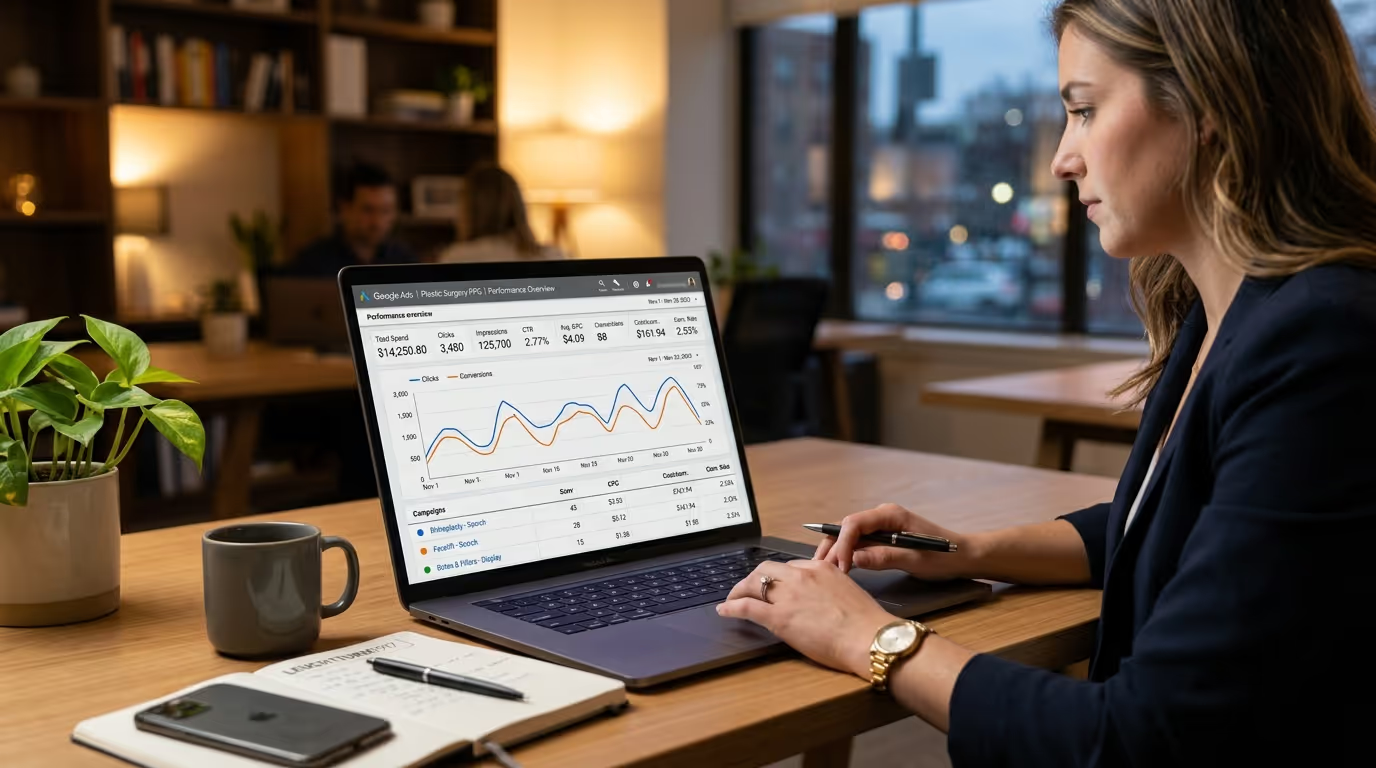
Google Ads is the single highest-intent channel for plastic surgery. When someone searches "rhinoplasty surgeon in Dallas" or "breast augmentation near me," they are actively looking for a provider. No other channel captures this level of intent.
Implementation steps:
- Build separate campaigns for each major procedure (rhinoplasty, breast augmentation, facelift, body contouring, non-surgical)
- Create dedicated landing pages for each procedure — never send traffic to your homepage
- Set up call tracking to capture phone conversions (40-60% of plastic surgery leads call)
- Start with Exact and Phrase match keywords with comprehensive negative keyword lists
- Write compliant ad copy focused on credentials, consultations, and results — not outcome promises
- Enable all ad extensions: call, location, sitelinks, callouts, structured snippets
- Configure offline conversion tracking so you can feed booked consultation and surgery data back to Google
- Set geographic targeting based on your draw radius — typically 15-50 miles for surgical procedures, wider for specialized operations
- Establish a negative keyword list immediately: jobs, salary, school, free, DIY, gone wrong, botched, malpractice, insurance
Expected outcomes:
| Metric | Target | Red Flag |
|---|---|---|
| Cost per click | $8-$25 | Above $35 |
| Conversion rate (landing page) | 8-15% | Below 5% |
| Cost per consultation lead | $100-$300 | Above $500 |
| ROAS (after 90 days optimization) | 5:1-15:1 | Below 3:1 |
| Quality Score (average) | 7+ | Below 5 |
| Call-to-consultation rate | 40-60% | Below 30% |
Common mistakes:
| Mistake | Impact | Fix |
|---|---|---|
| Running one generic campaign with broad keywords | Wastes 30-40% of budget on irrelevant clicks | Tight keyword themes with procedure-specific landing pages |
| Sending all traffic to the homepage | 50-70% lower conversion vs. dedicated landing pages | Build a dedicated landing page per procedure |
| No call tracking | Missing 40-60% of your conversions | Install dynamic number insertion and call recording |
| Optimizing for cost per click instead of cost per surgery | Cheap clicks that never convert | Track full funnel: click to lead to consultation to surgery |
| No negative keywords | Budget wasted on informational and irrelevant searches | Review search terms weekly for the first 90 days |
For the complete PPC strategy, read our dedicated guide. For Google Ads cost benchmarks, see our pricing analysis.
2. Create Before-and-After Galleries That Actually Convert
Every plastic surgeon has before-and-after photos. Few use them strategically. The difference between a gallery that converts and one that does not is organization, context, and presentation.
Implementation steps:
- Organize by procedure AND by patient profile: "Rhinoplasty — Dorsal Hump Correction," "Breast Augmentation — Athletic Build," "Facelift — Age 50-60"
- Include case details with every set: procedure performed, patient goals, recovery timeline, implant specs (where relevant)
- Add a CTA on every gallery page: "See what is possible for you. Book your consultation."
- Use consistent lighting, angles, and backgrounds for every photo pair (inconsistency looks unprofessional)
- Get proper HIPAA-compliant marketing authorization (not just a general photo release) for every image
- Add new cases monthly to keep the gallery fresh and growing
- Tag and organize for search: patients should be able to filter by procedure, body area, and patient demographics
- Include patient age range and brief narrative — prospective patients look for results on someone who looks like them
- Implement image alt text with procedure and keyword targeting for SEO value
Expected outcomes:
| Metric | Benchmark |
|---|---|
| Gallery page time on site | 3-5x longer than other pages |
| Conversion rate on pages with B/A | 40-60% higher than pages without |
| Google Image Search traffic | 5-15% of total organic traffic from well-optimized galleries |
| Returning visitor rate on gallery pages | 25-40% (patients come back to compare) |
Common mistakes:
| Mistake | Impact | Fix |
|---|---|---|
| Gallery as a dumping ground for every case | Dilutes quality, overwhelms visitors | Curate for quality — 5 exceptional results beat 50 mediocre ones |
| No case context or patient details | Photos without narrative are less persuasive | Include patient goals, procedure details, and recovery timeline |
| Inconsistent photography quality | Undermines professional credibility | Standardize your B/A photography setup and protocol |
| No CTA on gallery pages | High engagement, zero conversions | Add booking CTA after every 3-4 case sets |
| Missing HIPAA marketing consent | Legal liability | Use HIPAA-specific marketing authorization, not a general photo release |
For photography best practices, see our med spa photography guide.
3. Dominate Google Maps With Local SEO
When a potential patient searches "plastic surgeon near me," the Google Maps 3-pack appears above organic results. That placement is more valuable than any ad because it combines location, reviews, and credibility into a single result.
Implementation steps:
- Complete every field on your Google Business Profile — leaving any field blank is leaving ranking potential on the table
- Set up a review generation system (automated SMS 24-48 hours after consultation)
- Build NAP consistency across 50+ directories (Healthgrades, RealSelf, Vitals, Yelp, Apple Maps, Bing Places)
- Create location-specific pages: "[Procedure] in [City]" and "[Procedure] in [Neighborhood]"
- Publish Google Posts weekly with case highlights, practice news, and educational content
- Add new photos to your GBP monthly (Google rewards active profiles)
- Respond to every review within 24 hours — positive and negative
- Build local citations systematically using BrightLocal or Whitespark
- Add FAQ schema and LocalBusiness schema markup to your website
Expected outcomes:
| Metric | Target | Timeline |
|---|---|---|
| Map pack visibility | Top 3 for primary procedures | 4-8 months |
| Website visits from GBP | 35-50% increase | 3-6 months |
| Review count | 100+ reviews | 6-12 months |
| Review velocity | 10-20 new reviews/month | Ongoing |
| Local lead cost | $15-$40 per lead | Once established |
Common mistakes:
| Mistake | Impact | Fix |
|---|---|---|
| Setting up GBP and forgetting it | Rankings decay without activity | Weekly posts, monthly photos, consistent review generation |
| Inconsistent NAP across directories | Confuses Google, hurts local rankings | Audit and correct all citations quarterly |
| Not responding to negative reviews | Looks like you do not care | Respond professionally within 24 hours — never argue |
| Missing Google Posts | Loses engagement signals | Publish 1-2 posts per week with photos |
| Wrong primary category | Ranking for wrong terms | Select "Plastic Surgeon" or "Cosmetic Surgeon" as primary category |
For the complete local SEO strategy, read our guide. For reputation management frameworks, see our dedicated resource.
4. Build a Consultation Funnel, Not Just a Contact Form
A contact form on your website is not a funnel. It is a dead end with a submit button. The practices filling their surgical calendars have built multi-step systems that capture, qualify, nurture, and convert leads over the entire decision timeline.
Implementation steps:
- Build procedure-specific landing pages with targeted messaging and social proof
- Create a qualification form (4-6 questions): procedure interest, timeline, budget range, previous consultations, preferred contact method
- Build a confirmation page with next steps and a scheduling link
- Create a 5-email automated nurture sequence over 7-10 days:
- Email 1 (Day 0): Confirmation + what to expect at your consultation
- Email 2 (Day 2): Surgeon credentials + procedure-specific B/A results
- Email 3 (Day 4): Patient testimonial video focused on the experience
- Email 4 (Day 7): Financing options + FAQ addressing top concerns
- Email 5 (Day 10): Direct booking CTA + limited-time consultation incentive
- Set up automated SMS follow-up within 5 minutes of form submission with a link to self-schedule
- Track funnel metrics: submission rate, nurture open rate, consultation booking rate
- Build a parallel retargeting campaign for visitors who viewed procedure pages but did not submit the form
- Configure your CRM to score leads based on engagement — prioritize high-intent leads for personal outreach
Expected outcomes:
| Metric | With Funnel | Without Funnel | Improvement |
|---|---|---|---|
| Lead-to-consultation rate | 40-60% | 15-25% | +100-200% |
| Speed-to-contact | Under 5 minutes (automated) | 4-24 hours (manual) | Dramatically faster |
| Nurture conversion (cold leads over 30 days) | 10-15% | 2-5% | +200-500% |
| Overall consultation bookings/month | 50-80 | 20-35 | +100-150% |
Common mistakes:
| Mistake | Impact | Fix |
|---|---|---|
| No follow-up system | 70-80% of leads go cold within 48 hours | Automated SMS + email nurture from minute one |
| Generic nurture content | Low engagement, no differentiation | Procedure-specific sequences with relevant B/A and testimonials |
| Too many form fields | Each extra field reduces submissions 4-7% | Keep initial form to 4-6 essential questions |
| No qualification step | Wastes consultation time on unqualified leads | Include timeline and budget questions to filter leads |
| Manual-only follow-up | Inconsistent, slow, dependent on staff | Automate the first 3 touchpoints, then add personal follow-up |
For nurture sequence strategies, see our med spa welcome sequence guide and drip campaign framework.
5. Launch a YouTube Channel With Procedure Education
YouTube is the second-largest search engine and where prospective plastic surgery patients spend hours researching. It is the most underleveraged marketing channel for surgeons because most practices never start — or start and stop after a few videos.
Implementation steps:
- Set up a branded YouTube channel with professional banner and complete about section
- Record 1-2 videos per week covering:
- Procedure explainers ("What to Expect During Rhinoplasty Recovery")
- Case walkthroughs (narrate from consultation to result with patient consent)
- Myth-busting ("5 Things Your Surgeon Will Not Tell You About Breast Augmentation")
- Q&A sessions (answer common consultation questions)
- Day-in-the-life (humanize the surgeon)
- Optimize every video: keywords in title, description, and tags
- Include consultation booking link in every video description
- Create YouTube Shorts from full-length content for additional reach
- Embed videos on relevant procedure pages on your website for SEO and engagement value
- Pin a comment on every video with a direct booking link
- Create playlists organized by procedure — patients binge-watch when researching
- Repurpose video content for social media, TikTok, and Instagram Reels
Expected outcomes:
| Metric | Target After 6 Months | Target After 12 Months |
|---|---|---|
| Monthly views | 2,000-5,000 | 10,000-30,000 |
| Subscribers | 200-500 | 1,000-3,000 |
| Monthly leads from YouTube | 5-15 | 15-40 |
| Video CTR | 4-7% | 5-8% |
| Average view duration | 40-60% of video length | 50-65% of video length |
Common mistakes:
| Mistake | Impact | Fix |
|---|---|---|
| Waiting for "perfect" production quality | Never launches — competitors build audience first | Start with good lighting, decent mic, and authenticity |
| No consistency | Algorithm penalizes irregular posting | Commit to 1-2 videos per week minimum |
| No CTAs in videos | High views, zero conversions | Mention consultation booking in every video + link in description |
| Ignoring YouTube SEO | Videos do not appear in search | Research keywords, optimize titles, write full descriptions |
| Not repurposing content | One video serves one platform | Cut Shorts, Reels, TikToks, and blog transcripts from each video |
6. Implement Patient Review Automation
Reviews are currency in plastic surgery. A practice with 200+ Google reviews at a 4.8-star average will outperform a practice with 30 reviews in every measurable way — local SEO rankings, website conversion rates, consultation booking rates, and patient trust.
Implementation steps:
- Select a review management platform or configure your CRM with automated review flows
- Set up automated review request flow:
- Post-consultation: SMS 24-48 hours after with satisfaction screening
- Post-procedure: Email 2-3 weeks post-op (when satisfaction is highest)
- Milestone appointments: Review request at major checkpoints
- Route unhappy patients to a private feedback form (not public review)
- Respond to every review within 24 hours — your responses are marketing content for future patients reading reviews
- Track review velocity monthly — Google's algorithm favors steady, recent reviews
- Request reviews on Google first, then direct satisfied patients to RealSelf and Healthgrades
- Train your front desk to mention reviews naturally: "We would love to hear about your experience"
- Feature top reviews on your website, social media, and landing pages
Expected outcomes:
| Metric | Target | Timeline |
|---|---|---|
| New reviews per month | 10-25 | Immediate with automation |
| Average rating maintained | 4.7+ stars | Ongoing |
| Local SEO ranking improvement | 2-3 positions for map pack | 2-3 months of consistent velocity |
| Website conversion lift from displayed reviews | +15-25% | Immediate when reviews are shown on-site |
| Patient trust score improvement | 270% higher conversion with 100+ reviews | 6-12 months |
For detailed review strategies, see our review generation guide and reputation management framework.
7. Run RealSelf Advertising Strategically
RealSelf is where plastic surgery patients go to research procedures and compare surgeons. Having a presence is non-negotiable. Paying for premium placement is a strategic decision that depends on your market, budget, and current lead volume.
Implementation steps:
- Create a complete RealSelf profile: photos, bio, credentials, Q&A answers
- Build your gallery with your best 20-30 B/A cases — quality over quantity
- Answer 10-15 patient questions weekly (positions you as an expert and drives profile visibility)
- Evaluate paid advertising only after building a strong organic profile
- If you invest in paid placement, track cost per consultation attributed to RealSelf specifically
- Ask new patients "Did you find us on RealSelf?" to capture untracked attribution
- Cross-promote your RealSelf profile on your website and in your email marketing
Expected outcomes:
| RealSelf Investment | Monthly Consultations | Cost Per Consultation | Lead Quality |
|---|---|---|---|
| Organic only (free) | 5-15 | $0 (time investment) | Very high |
| Basic paid ($500-$1,500/mo) | 10-25 | $60-$150 | High |
| Premium paid ($2,000-$5,000/mo) | 20-50 | $100-$250 | High |
Common mistakes:
| Mistake | Impact | Fix |
|---|---|---|
| Paying for premium on a thin profile | Wasted spend — patients see an empty profile | Build the profile fully before investing in paid placement |
| Not answering community questions | Missing free exposure to researching patients | Block 30 minutes daily for Q&A responses |
| Not tracking RealSelf attribution | Cannot calculate ROI | Add RealSelf as a lead source in your CRM |
| Ignoring RealSelf reviews | Missing critical social proof platform | Actively request RealSelf reviews from satisfied surgical patients |
8. Create a Financing Content Strategy
Cost is the number one objection in plastic surgery. Turn financing into a marketing asset instead of a footnote buried in your website footer.
Implementation steps:
- Create a dedicated financing page with monthly payment examples for popular procedures
- Include financing information on every procedure page — not as an afterthought, but as a primary content section
- Write blog content targeting cost keywords: "How Much Does a Tummy Tuck Cost in [City]?"
- Feature financing in ad copy: "As low as $149/month" drives higher CTR than "Schedule a consultation"
- Train your consultation team to present financing proactively (not as an afterthought when the patient flinches at the price)
- Partner with multiple financing providers to offer options for different credit profiles
- Create comparison tables showing total cost vs. monthly payment for each major procedure
- Address the "Is financing worth it?" question directly in your content — transparency builds trust
Expected outcomes:
| Metric | Benchmark |
|---|---|
| Cost-keyword content organic traffic | High search volume, moderate competition — ranks within 4-6 months |
| CTR improvement with financing in ads | +15-25% vs. ads without financing language |
| Consultation conversion with proactive financing | +20-30% vs. practices that wait for the patient to ask |
| Average procedure value with financing | Often 15-20% higher — patients choose more comprehensive procedures when payments are manageable |
Common mistakes:
| Mistake | Impact | Fix |
|---|---|---|
| Hiding financing in a footer link | Patients with cost concerns never find it | Feature financing prominently on every procedure page |
| Only one financing partner | Patients with lower credit scores are turned away | Offer 2-3 financing options for different credit profiles |
| Not training the consultation team | Staff uncomfortable discussing money | Role-play financing conversations until they are natural |
| No cost content on the website | Competitors rank for "[procedure] cost" searches | Publish cost guides for every major procedure |
For pricing strategy principles, see our med spa pricing strategy guide. For marketing budget allocation, read our framework.
9. Build a Surgeon Personal Brand on Instagram
Your practice Instagram account is fine. But the surgeon's personal account is where the real growth happens. Patients choose surgeons, not practices. A surgeon who shows up authentically on Instagram builds trust at scale in a way no ad campaign can replicate.
Implementation steps:
- Create a professional Instagram profile for the surgeon (separate from practice account)
- Post 4-5 times per week:
- Behind-the-scenes content (prep, marking patients, reviewing cases — with consent)
- Educational Reels (30-60 second technique explanations, recovery tips)
- Patient testimonials (video >> written)
- Personal content (family, hobbies, travel — humanizes the surgeon)
- Go Live monthly for Q&A sessions
- Use Instagram Stories daily for real-time behind-the-scenes
- Respond to every comment within 2 hours and every DM within 4 hours
- Use location tags and relevant hashtags consistently
- Collaborate with local influencers and complementary businesses
- Cross-post Reels to TikTok and YouTube Shorts for maximum reach
- Track DM inquiries as a lead source in your CRM
Expected outcomes:
| Metric | Month 3 | Month 6 | Month 12 |
|---|---|---|---|
| Followers (local market) | 500-1,500 | 2,000-5,000 | 5,000-15,000 |
| Engagement rate | 3-5% | 4-6% | 5-8% |
| Monthly DM inquiries | 5-15 | 15-30 | 30-60 |
| Instagram-attributed consults | 2-5 | 5-12 | 10-25 |
Common mistakes:
| Mistake | Impact | Fix |
|---|---|---|
| Posting only polished clinical content | Algorithm rewards authenticity and engagement | Mix professional content with personal moments |
| Inconsistent posting | Algorithm deprioritizes inactive accounts | Batch-create content weekly for consistent daily posting |
| Ignoring DMs | Missing high-intent leads | Set up DM response SOP — respond within 4 hours during business hours |
| No Reels or video content | Missing 3x engagement of video vs. static | Commit to 3-4 Reels per week minimum |
| Not using Stories | Missing the most-viewed Instagram feature | Post 3-5 Stories daily — low production, high engagement |
For social media strategy, see our med spa Instagram guide, UGC strategy, and social media calendar.
10. Develop a Patient Referral Program
Referrals are the highest-converting lead source in plastic surgery — referred patients come with built-in trust and convert to surgery at 50-70%, compared to 20-40% for cold leads.
Implementation steps:
- Choose an incentive structure: $250-$500 credit toward future treatments for successful referrals
- Create digital referral cards/links patients can share via text — make it effortless
- Build tracking in your CRM to attribute referrals to the referring patient
- Mention the program at every checkout and in post-op follow-up emails
- Feature the program on your website with a dedicated referral page
- Track referral volume monthly — target 15-25% of new patients from referrals
- Thank referrers personally (handwritten note or personal call from the surgeon)
- Create a tiered program: $250 for first referral, $350 for second, $500 for third — gamification drives volume
Expected outcomes:
| Metric | Benchmark |
|---|---|
| Referral patient conversion rate | 50-70% (vs. 20-40% for cold leads) |
| Cost per acquisition from referrals | 60-70% lower than paid advertising |
| Referral patient lifetime value | 30% higher than non-referred patients |
| Target referral contribution | 15-25% of new patient volume |
| Referral program ROI | 8-15x return on incentive costs |
For referral program frameworks, see our med spa referral program guide and loyalty program strategies.
11. Invest in Professional Photography and Videography
Your visual assets determine the quality of every other marketing channel. A surgeon with exceptional photography and video content will outperform a competitor in every channel — website conversions, social media engagement, ad performance, and patient trust.
Implementation steps:
- Schedule quarterly photo/video production days
- Create a standardized B/A photography setup: consistent lighting, angles, backgrounds, distance
- Shoot professional office and facility photography
- Record 3-5 patient testimonial videos per quarter (focus on the experience, not just the result)
- Create 5-10 procedure education videos per quarter
- Build a content library organized by procedure, content type, and usage rights
- Invest in a professional medical photographer who understands clinical documentation standards
- Plan your content calendar around production days — batch-create 3-6 months of content per shoot
Expected outcomes:
| Investment | Impact | ROI Timeline |
|---|---|---|
| Professional imagery | +20-40% website conversion rates | Immediate upon deployment |
| Video content | 3x more engagement than static images across all channels | 30-60 days |
| Quarterly production | 3-6 months of content per shoot across all channels | Ongoing compound value |
| Consistent B/A documentation | Strongest conversion asset for consultations | Ongoing |
Common mistake: Using stock photos instead of real patient and practice photography. Patients can tell the difference. Authentic imagery builds trust; stock imagery undermines it. For the complete photography framework, read our med spa photography guide.
12. Create a Virtual Consultation Offering
Virtual consultations lower the barrier to entry and expand your geographic reach. For plastic surgery specifically, virtual consults capture out-of-town patients who represent some of the highest-value appointments because they have already committed to traveling for the procedure.
Implementation steps:
- Set up HIPAA-compliant video consultation platform
- Create a simple booking flow: short form + calendar link
- Promote virtual consultations on your website, in ads, and on social media
- Build a pre-consultation questionnaire (photos, goals, medical history)
- Follow up with an in-person consultation recommendation for serious candidates
- Charge for virtual consultations ($50-$150) and credit toward procedure — this qualifies serious leads
- Create a dedicated landing page for virtual consultations with its own ad campaign
- Build a post-virtual-consultation email sequence to nurture toward in-person booking
Expected outcomes:
| Metric | Benchmark |
|---|---|
| Increase in total consultation volume | +20-35% |
| Virtual-to-in-person conversion rate | 40-55% |
| Geographic reach expansion | 50-100+ miles beyond traditional draw area |
| Out-of-town patient average procedure value | 15-25% higher than local patients |
Common mistake: Offering free virtual consultations without qualification. Free attracts tire-kickers. A $100 consultation fee (credited toward procedure) qualifies serious candidates and values your time appropriately.
13. Build SEO Content Around Patient Questions
Every question patients ask in consultations is a blog post waiting to rank on Google. And every blog post that ranks generates leads for years — not just the month you publish it.
Implementation steps:
- Survey your consultation team: "What are the top 20 questions patients ask?"
- Research keyword volume for each question (Google Keyword Planner, Ahrefs)
- Write 1,500-2,500 word articles targeting each question
- Include internal links to procedure pages and other blog content
- Add FAQ schema markup for featured snippet opportunities
- Include author byline from the surgeon (E-E-A-T signals are critical for YMYL medical content)
- Publish 2-4 posts per month consistently
- Build internal links from every new post to your money pages (procedure and consultation pages)
- Update high-performing posts quarterly with new data, cases, and internal links
High-performing content topics:
| Topic Type | Example | Monthly Search Volume | Conversion Potential |
|---|---|---|---|
| Candidacy | "Am I a Good Candidate for [Procedure]?" | 100-500 | Very high |
| Recovery | "[Procedure] Recovery: Week by Week Timeline" | 1,000-5,000 | High |
| Comparison | "[Procedure A] vs [Procedure B]: Which Is Right for You?" | 500-5,000 | Very high |
| Selection | "How to Choose a Plastic Surgeon in [City]" | 200-1,000 | Very high |
| Cost | "[Procedure] Cost in [City]: What to Expect" | 500-5,000 | High |
| Preparation | "How to Prepare for [Procedure]" | 200-1,000 | High |
Expected outcomes:
| Timeframe | Organic Traffic from Content | Lead Contribution |
|---|---|---|
| Month 1-4 | Minimal (indexing phase) | 0-2 leads/month |
| Month 5-8 | 200-500 monthly visitors | 5-15 leads/month |
| Month 9-12 | 500-2,000 monthly visitors | 15-40 leads/month |
| Year 2+ | 2,000-5,000 monthly visitors | 40-100+ leads/month |
For content strategy, SEO, and keyword research frameworks, see our dedicated guides.
14. Use Retargeting to Stay in Front of Researching Patients
95% of first-time website visitors do not convert. Retargeting captures the 95% you would otherwise lose — and does it at a fraction of the cost of acquiring new traffic.
Implementation steps:
- Install retargeting pixels (Google, Meta, YouTube) on every page of your website
- Create audience segments: procedure page visitors (30-day), gallery visitors (60-day), form abandoners (14-day)
- Build sequential retargeting: Day 1-7 educational content, Day 7-14 testimonials, Day 14-30 consultation offer
- Allocate 15-20% of total ad budget to retargeting
- Refresh creative monthly to prevent ad fatigue
- Exclude converted patients from retargeting audiences (do not waste budget on people who already booked)
- Create lookalike audiences from your best converters to find similar prospects
Expected outcomes:
| Metric | Retargeting | Cold Traffic | Difference |
|---|---|---|---|
| Cost per click | $1-$3 | $8-$25 | 70-90% lower |
| Conversion rate | 3-8x higher | Baseline | Massive improvement |
| Contribution to total conversions | 15-25% | 75-85% | Critical supplementary channel |
| Time to conversion | 7-21 days from first visit | Often 30-60 days | Accelerates decision timeline |
Common mistake: Not refreshing creative. The same ad shown to the same person 15 times creates annoyance, not conversions. Rotate creative monthly.
15. Host Educational Events and Webinars
Events build trust at scale by letting potential patients interact with you without committing to a consultation. They are particularly effective for high-consideration procedures where patients want to evaluate the surgeon's personality, knowledge, and approach before scheduling a consultation.
Implementation steps:
- Plan monthly or quarterly events: in-office open houses, webinars, or lunch-and-learn partnerships
- Promote through email, social media, and paid ads (Meta ads work well for event promotion)
- Capture registrations with a simple form — name, email, phone, procedure interest
- Follow up with attendees within 24 hours: "Thanks for attending — here is your exclusive consultation offer"
- Track attendee-to-consultation conversion
- Record webinars and repurpose as on-demand content on your website and YouTube
- Partner with complementary businesses (luxury spas, fitness studios) for cross-promoted events
- Create an event-exclusive incentive: complimentary consultation or imaging session for attendees
Expected outcomes:
| Event Type | Expected Attendance | Same-Event Consultations Booked | Follow-Up Conversion (30 days) |
|---|---|---|---|
| In-office open house | 30-60 | 5-15 | Additional 5-10 |
| Procedure-specific webinar | 50-100 registrations, 25-50 attend | 3-8 | Additional 5-15 |
| Lunch-and-learn partnership | 20-40 | 3-8 | Additional 3-8 |
16. Leverage PR and Media Coverage
Media coverage is the ultimate third-party credibility builder. A mention in local news or a national publication carries more trust than any amount of self-promotion.
Implementation steps:
- Sign up for HARO (Help a Reporter Out), Qwoted, and SourceBottle and respond to plastic surgery queries within 1 hour
- Pitch local news: tie expertise to trending topics (new techniques, seasonal trends, celebrity procedures)
- Write contributed articles for local lifestyle magazines and health publications
- Build a media kit on your website: headshots, bio, expertise areas, past media appearances
- Issue press releases for new technology, awards, or practice milestones
- Position yourself as a source for industry trends and healthcare marketing stories
- Share every media mention across your social media, website, and email newsletter
Expected outcomes:
| Activity | Expected Volume | Equivalent Ad Value |
|---|---|---|
| HARO responses (weekly) | 3-5 media mentions per quarter | $5,000-$15,000 per mention in equivalent ad spend |
| Local media pitches | 1-2 features per quarter | $10,000-$25,000 per feature |
| Contributed articles | 2-4 per year | Long-term SEO + credibility value |
For content and PR strategies that apply across healthcare, see our healthcare content marketing guide.
17. Build an Email Nurture System for Long-Cycle Leads
The average plastic surgery patient takes 3-12 months from first research to booking. If you are not nurturing leads over that entire period, you are losing patients to surgeons who are. Email is the most cost-effective channel for this long-cycle nurture.
Implementation steps:
- Build segmented email sequences by procedure interest — a rhinoplasty lead gets different content than a mommy makeover lead
- Create post-consultation nurture for patients who did not book: weekly emails for 4-6 weeks with testimonials, financing info, and education
- Build seasonal campaigns: "Summer Body" in spring, "New Year, New You" in January
- Create re-engagement campaigns for leads gone cold: "Still thinking about [procedure]? Here is what is new."
- Implement a monthly newsletter with practice updates, new B/A cases, and educational content
- Track open rates, click rates, and consultation bookings attributed to email
- A/B test subject lines, send times, and content types quarterly
- Segment your list by engagement level: hot leads get more frequent, conversion-focused emails; cold leads get educational content
Expected outcomes:
| Email Program Component | Metric | Benchmark |
|---|---|---|
| Welcome sequence open rate | 40-60% | Strong |
| Nurture sequence conversion (cold to consultation) | 10-15% over 6-12 months | Significant recovered revenue |
| Email ROI | $36-$42 per dollar spent | Industry average for medical aesthetics |
| Re-engagement recovery rate | 5-8% of dead leads | Found revenue |
| Monthly newsletter unsubscribe rate | Under 0.5% | Healthy list |
For email marketing frameworks, see our med spa email marketing guide, welcome sequence framework, newsletter strategy, and SMS marketing guide.
The System: Putting These Plastic Surgery Marketing Ideas Together
The 90-Day Implementation Priority
| Priority | Ideas to Implement | Timeline | Investment |
|---|---|---|---|
| Immediate (Week 1-2) | #1 Google Ads, #3 Local SEO, #6 Review Automation | First 2 weeks | $3,000-$8,000/mo ad spend |
| Foundation (Month 1) | #2 B/A Gallery, #4 Consultation Funnel, #8 Financing Content | Month 1 | One-time setup costs |
| Growth (Month 2-3) | #5 YouTube, #9 Instagram, #14 Retargeting | Month 2-3 | $1,000-$3,000/mo additional |
| Scale (Month 3+) | #10 Referrals, #13 SEO Content, #17 Email Nurture | Month 3 onwards | Ongoing content investment |
| Advanced (Month 6+) | #7 RealSelf, #12 Virtual Consults, #15 Events, #16 PR | Month 6+ | Variable |
Monthly Marketing KPIs to Track
| KPI | Month 1 Target | Month 3 Target | Month 6 Target | Month 12 Target |
|---|---|---|---|---|
| Total consultation leads | 20-40 | 50-80 | 80-130 | 130-200 |
| Consultation bookings | 10-20 | 25-45 | 45-75 | 75-120 |
| Procedures booked | 4-8 | 12-22 | 25-40 | 40-60 |
| Cost per consultation lead | $150-$300 | $100-$200 | $80-$150 | $60-$120 |
| Cost per procedure | $800-$2,000 | $500-$1,200 | $400-$900 | $300-$700 |
| Google reviews | 5-10 new | 10-15/month | 15-25/month | 20-30/month |
| Website conversion rate | 3-5% | 5-8% | 8-12% | 10-15% |
| ROAS | 3:1-5:1 | 5:1-10:1 | 8:1-15:1 | 10:1-20:1 |
For a complete KPI tracking framework, see our med spa KPIs guide and marketing ROI guide.
The Difference Between Ideas and Systems
The difference between a practice that is always full and one that has open OR slots is not a single idea. When it comes to how to market a plastic surgery practice, it is a system — channels working together, data informing decisions, and consistent execution week after week.
Pick three ideas from this list that address your biggest gaps. Implement them properly. Measure results for 90 days. Then add the next layer. Do not try to launch all 17 simultaneously — that is a recipe for doing everything poorly and nothing well.
The practices dominating in 2026 are the ones that built systems, not the ones that chased tactics. For a comprehensive marketing strategy overview and advertising compliance framework, see our dedicated plastic surgery marketing resources. For strategies specific to the surgeon's website, read our plastic surgery website design guide.
Budget Allocation by Practice Stage
| Practice Stage | Monthly Marketing Budget | Recommended Split |
|---|---|---|
| New practice (Year 1) | $5,000-$10,000 | 60% Google Ads, 20% Local SEO, 10% Social, 10% Content |
| Growing (Year 2-3) | $10,000-$20,000 | 40% Google, 20% Meta, 15% SEO/Content, 15% Retargeting, 10% Other |
| Established ($2M+ revenue) | $15,000-$30,000 | 35% Google, 20% Meta, 20% SEO/Content, 15% Retargeting, 10% Events/PR |
| Multi-surgeon group | $25,000-$50,000+ | Distributed across all 17 channels with data-driven allocation |
For marketing budget planning, see our med spa marketing budget guide and marketing checklist.
Want help identifying which channels will move the needle fastest for your practice? Book a Strategy Call — we will audit your current marketing, identify the highest-impact opportunities, and show you exactly what a full schedule looks like with the right system behind it. We work exclusively with med spas and aesthetic practices, so we know what works in this industry. No fluff, no generic advice — data-driven strategy for surgical practices.