

The medical aesthetics industry is a $21 billion market in North America, growing at 12-15% annually, with over 40,000 practices competing for patients. Effective aesthetic marketing and smart aesthetics marketing strategies are what separate the practices that thrive from those that struggle. Whether you run a med spa, a plastic surgery practice, a cosmetic dermatology clinic, or a multi-specialty aesthetics center, the marketing principles that drive growth share common DNA.
But here is the uncomfortable truth most practice owners avoid: the practices that dominate their local markets are not the ones with the best providers, the newest devices, or the most luxurious lobbies. They are the ones with the best marketing systems.
Every year, thousands of highly skilled practitioners watch less-qualified competitors fill their calendars — not because those competitors deliver better results, but because they are better at being found, chosen, and remembered. The gap between clinical excellence and business growth is marketing. And in 2026, that gap is wider than ever.
This guide is the comprehensive industry resource for medical aesthetics marketing. It covers the strategies that work across every practice type, the nuances that differ between specialties, the channels that drive results, and the metrics you should be tracking. Whether you are launching a new practice or scaling an established one, this is your playbook.
The Medical Aesthetics Landscape: Market Size and Trends
Understanding the market you operate in is the foundation of any marketing strategy. Here is where the medical aesthetics industry stands in 2026.
Market Size and Growth
The American Med Spa Association (AmSpa) reported over 10,000 med spas operating in the US as of 2025, up from roughly 5,400 in 2018. The broader medical aesthetics market — including plastic surgery practices, dermatology clinics, and cosmetic surgery centers — includes over 40,000 practices.
Key data points from AmSpa, the American Society for Aesthetic Plastic Surgery (ASAPS), and industry analysts:
| Market Metric | 2025 Value | 2030 Projection | CAGR |
|---|---|---|---|
| Total US medical aesthetics market | $21 billion | $32 billion | 8.8% |
| Med spa count (US) | 10,000+ | 15,000+ (est.) | 8-10% |
| Non-surgical procedure share | 60%+ of total spending | 70%+ (projected) | Growing |
| Average med spa revenue | $1.5-$3 million/year | $2-$4 million/year | Varies |
| Patient demographics (female) | 85% | 80% (male growth) | Shifting |
| Average patient age | 38 | 35 (trending younger) | Declining |
| Average household income | $120,000+ | $100,000+ (broadening) | Expanding |
Fastest-Growing Segments
| Segment | Annual Growth Rate | Market Driver |
|---|---|---|
| GLP-1 weight loss programs | 45% | New patient acquisition + cross-sell |
| Regenerative aesthetics (PRP, exosomes) | 20% | Anti-aging demand + longevity trend |
| Body contouring | 15% | Post-weight-loss body sculpting |
| RF microneedling | 25-30% | Social media awareness + versatility |
| Men's aesthetics | 18% | Destigmatization + "brotox" trend |
| Preventative treatments (ages 20-30) | 15% | Social media normalization |
Trends Shaping the Industry
The GLP-1 revolution. Semaglutide and tirzepatide have created a massive new patient segment. Weight loss patients are entering med spas for the first time and becoming full-service aesthetic patients. Practices with weight loss programs are growing 40-60% faster than those without. The cross-sell pathway — from GLP-1 to body contouring to skin tightening to maintenance — is the single most important revenue opportunity in 2026.
Younger patients entering earlier. Patients in their 20s are starting preventative treatments (preventative Botox, skincare, light-based treatments) at higher rates than any previous generation. Social media normalization is driving this trend. Marketing to this demographic requires different messaging, channels (TikTok, Instagram Reels), and pricing strategies than marketing to the traditional 35-55 core.
Technology consolidation. Patients increasingly want a single practice that handles all their aesthetic needs — injectables, body contouring, skin treatments, weight loss, and wellness. Multi-service practices are outperforming single-specialty providers. This trend rewards practices that market the full ecosystem, not individual treatments in isolation.
Insurance irrelevance. Medical aesthetics is almost entirely cash-pay. This is a feature, not a bug. Cash-pay patients are more engaged, less price-sensitive (relative to insurance patients), and more likely to become repeat buyers. It also means your marketing must drive patient acquisition directly — there is no insurance network sending you referrals.
AI and automation. Marketing automation, AI-powered chatbots, predictive analytics for patient behavior, and AI-generated content are changing how practices acquire and retain patients. The practices that adopt these technologies early gain efficiency advantages that compound over time. See our guide on GoHighLevel for med spas for how CRM automation transforms patient acquisition.
Marketing by Practice Type: What Makes Each Different
While core marketing principles apply across all aesthetics practices, each practice type has unique positioning challenges and opportunities.
Med Spa Marketing
Med spas are the fastest-growing segment and the most competitive. There are more med spas opening every month, which means differentiation is critical.
Key marketing challenges:
- Lower barrier to entry means more competitors in every local market
- Brand perception can be less clinical, which requires intentional trust-building
- Patient lifetime value depends heavily on retention and cross-selling
- Service overlap with dermatologists and plastic surgeons creates positioning confusion
Marketing priorities:
- Strong digital presence (website, SEO, Google Ads)
- Service-specific marketing (each service needs its own strategy — Botox, CoolSculpting, laser hair removal)
- Review management (med spas live and die by online reviews)
- Patient retention programs (memberships, loyalty programs, referral programs)
- Social media presence that builds trust and showcases results
Implementation steps for new med spas:
- Build a conversion-optimized website with individual service pages for every treatment
- Set up and optimize your Google Business Profile
- Launch Google Ads targeting your top 3-5 revenue treatments
- Implement a review generation system targeting 10+ reviews per month
- Build email and SMS automations (welcome sequence, appointment reminders, rebooking prompts)
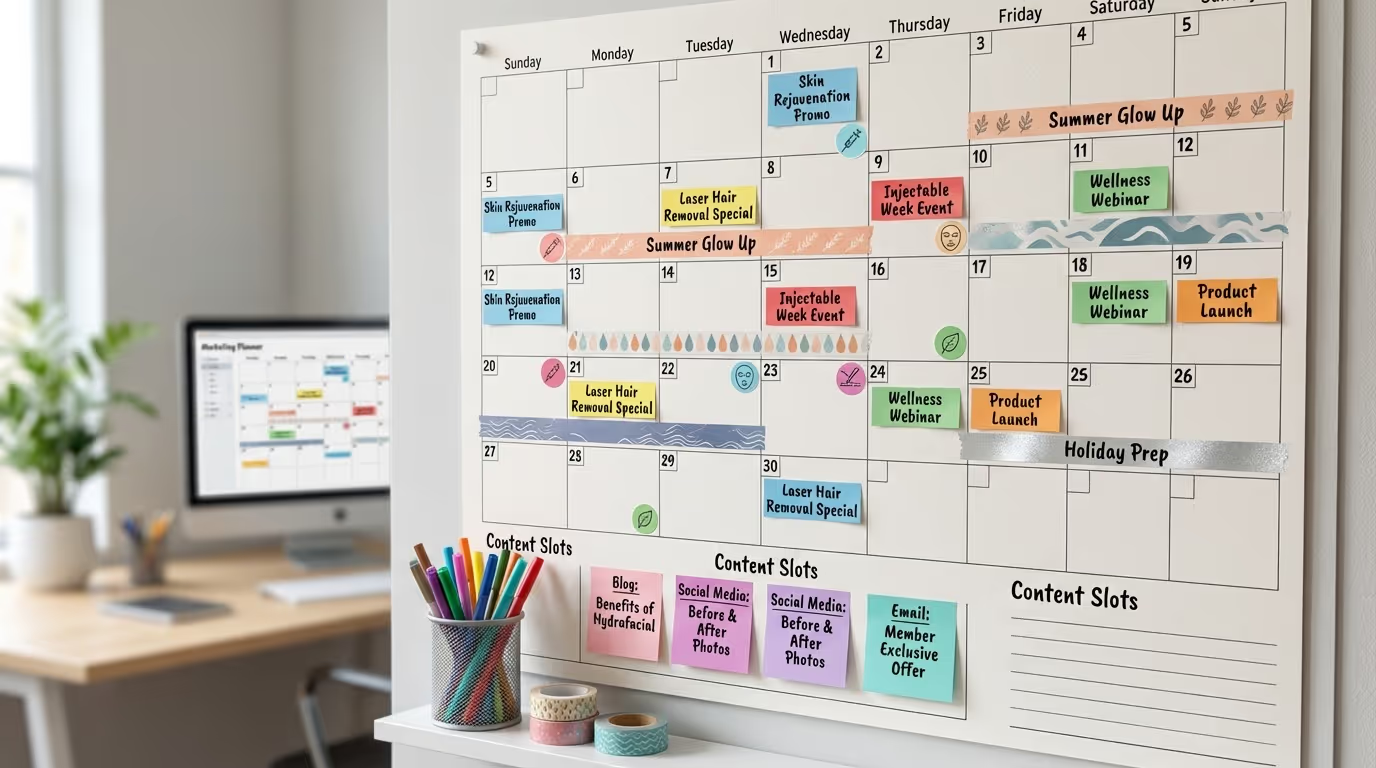
- Create a content calendar for social media (3-4 posts per week minimum)
- Begin SEO content creation targeting long-tail keywords
For the complete med spa marketing framework, read our how to market a med spa guide and med spa marketing strategies breakdown.
Common mistakes in med spa marketing:
| Mistake | Impact | Fix |
|---|---|---|
| Marketing the practice generically instead of individual services | Lower conversion rates, wasted ad spend | Build service-specific campaigns with dedicated landing pages |
| Discounting constantly to fill the calendar | Attracts low-LTV patients, erodes brand perception | Use value-adds instead of discounts; build membership programs |
| Ignoring retention marketing | 5-7x more expensive to acquire than retain | Implement email marketing, rebooking automation, loyalty programs |
| No before-and-after content strategy | Missing your most powerful conversion tool | Invest in professional photography and consistent documentation |
| Hiring a generalist marketing agency | They do not understand aesthetics compliance, patient psychology, or seasonal demand | Work with specialists who focus exclusively on medical aesthetics |
Plastic Surgery Practice Marketing
Plastic surgeons have inherent credibility advantages but face different marketing challenges.
Key marketing challenges:
- Higher CPCs due to high-value procedures (rhinoplasty, breast augmentation, facelifts)
- Longer patient decision cycles (3-12 months for surgical procedures)
- Before/after portfolio is critical and heavily scrutinized
- Need to market both surgical and non-surgical services
- Advertising compliance is more restrictive than other specialties
Marketing priorities:
- Before/after gallery as the centerpiece of the website
- Surgeon credibility content (credentials, experience, media appearances, published work)
- Video content showing consultations, procedure explanations, and recovery journeys
- SEO for procedure-specific keywords (high volume, high competition)
- Paid search with long-tail surgical keywords
- Reputation management (a single negative review for a surgeon is devastating)
Implementation steps:
- Build comprehensive procedure pages (2,000+ words each) targeting "[procedure] [city]" keywords
- Launch procedure-specific Google Ads campaigns with dedicated landing pages
- Create a YouTube channel with procedure education videos (the second-largest search engine)
- Implement patient referral program with tracking
- Build a consultation funnel with qualification forms and automated nurture sequences
- Invest in professional photography and videography (quarterly content production days)
For detailed plastic surgery marketing ideas, see our dedicated guide.
Common mistakes:
| Mistake | Impact | Fix |
|---|---|---|
| Relying solely on referrals from other physicians | Declining referral volumes as direct-to-consumer grows | Build direct patient acquisition channels (Google Ads, SEO, social) |
| Ignoring non-surgical revenue | Missing the fastest-growing segment | Market both surgical and non-surgical services |
| No video content | Missing the platform where patients research procedures | Launch YouTube + social video strategy |
| Generic surgeon bios | Does not differentiate from competitors | Build detailed provider pages with credentials, philosophy, and results |
Cosmetic Dermatology Marketing
Dermatologists have the advantage of medical credibility but often underinvest in marketing their cosmetic services.
Key marketing challenges:
- Balancing medical dermatology (insurance-based) with cosmetic services (cash-pay)
- Patients may not associate dermatologists with aesthetic treatments
- Competition from med spas offering the same non-surgical treatments at lower overhead
- Insurance-based patient flow creates complacency about marketing the cosmetic side
Marketing priorities:
- Position the dermatologist as the ultimate skin expert (credentials that med spas cannot match)
- Separate marketing for cosmetic services from medical dermatology
- Content marketing around skin health, aging, and prevention
- Leverage the medical practice's existing patient base for cosmetic service cross-selling
- Emphasize safety, expertise, and medical training as differentiators
Implementation steps:
- Create a separate cosmetic services section on your website (or a separate microsite)
- Build a cross-sell email campaign for existing medical patients: "Did you know we also offer..."
- Develop content that bridges medical and cosmetic: "What your dermatologist wants you to know about preventative aging treatments"
- Launch local SEO campaigns targeting "cosmetic dermatologist [city]"
- Train front desk to mention cosmetic services to medical patients at checkout
- Implement review generation specifically for cosmetic services
For related strategies, see our dermatology marketing guide, dermatology SEO, and dermatology advertising resources.
Multi-Specialty Aesthetics Centers
Larger practices that combine multiple specialties have the broadest service offerings but the most complex marketing needs.
Key marketing challenges:
- Unified brand identity across multiple service lines and providers
- Multiple providers with different specialties and credentials
- Budget allocation across many service categories
- Complex patient journeys that span surgical and non-surgical
Marketing priorities:
- Clear website architecture that guides patients to the right service and provider
- Individual provider marketing within the umbrella brand
- Service-line-specific campaigns with unified branding
- Patient journey mapping that connects entry-level services to higher-value treatments
- CRM and marketing automation to manage complex patient relationships
Implementation steps:
- Map the complete patient journey for each service line — from awareness to retention
- Build provider-specific landing pages and marketing campaigns
- Implement a CRM that tracks patients across service lines and providers
- Create service-line budgets based on profitability and growth potential
- Build cross-sell automations: when a patient completes Treatment A, recommend Treatment B based on clinical pathways
- Establish monthly marketing reviews by service line with ROI analysis
Universal Marketing Principles for Medical Aesthetics
Regardless of practice type, certain marketing principles are universal across medical aesthetics.
Trust Is the Foundation
Patients are putting their appearance — and in some cases, their health — in your hands. Every marketing touchpoint must build trust. In medical aesthetics, trust is not a nice-to-have. It is the buying criterion.
Trust signals ranked by patient impact:
| Trust Signal | Patient Impact | Where to Display |
|---|---|---|
| Before/after results gallery | Very High — the #1 decision driver | Website gallery, social media, ads, email, in-office |
| Google review count + rating | Very High — the first thing patients check | Google Business Profile, website header, landing pages |
| Provider credentials and experience | High — board certifications, training, years of experience | Website bios, ad copy, social media bios |
| Professional website and branding | High — patients equate digital quality with clinical quality | Your entire online presence |
| Patient video testimonials | High — more believable than written reviews | YouTube, social media, landing pages, email |
| Educational content | Medium-High — demonstrates expertise | Blog, YouTube, social media, email |
| Media appearances and publications | Medium — third-party validation | Website "As Seen In" section |
| Professional photography | Medium — signals quality and professionalism | Everywhere |
Implementation steps to maximize trust:
- Audit every patient touchpoint — does each one communicate competence, professionalism, and care?
- Invest in professional photography with consistent lighting, angles, and backgrounds
- Build a review generation system targeting 10+ new Google reviews per month
- Create provider-specific content that humanizes your team
- Publish educational content weekly that answers patient questions before they ask
Before/After Content Is King
In no other industry is visual proof as powerful as in medical aesthetics. Your before/after portfolio is your most important marketing asset.
Best practices for before/after content:
| Element | Standard | Why It Matters |
|---|---|---|
| Lighting | Same lighting setup for every pair | Inconsistent lighting makes results look fabricated |
| Angles | Same camera angle and distance | Changing angles exaggerates or minimizes results |
| Background | Neutral, clean, consistent | Distracting backgrounds reduce professionalism |
| Diversity | Range of ages, skin types, body types, genders | Patients need to see someone who looks like them |
| Context | Treatment performed, sessions, timeframe | Helps patients set realistic expectations |
| Disclaimers | "Results may vary" on every image | FTC and platform compliance requirement |
| Consent | Written patient consent for every image | HIPAA requirement — no exceptions |
Practices with robust before/after galleries convert website visitors at 2-3x the rate of those with thin or no galleries. This is the highest-ROI content investment you can make.
Scaling your B/A content:
- Photograph every patient (with consent) — make it part of your clinical workflow
- Organize by treatment type and patient profile
- Add new content to your website and social media weekly
- Repurpose for ads, email campaigns, and in-office displays
Provider Credibility Drives Decisions
Patients choose providers, not practices. Your marketing must make your providers visible, credible, and approachable.
Provider marketing essentials:
- Professional headshots and comprehensive bio pages for every provider
- Video content featuring providers explaining treatments and answering questions
- Provider-specific social media presence (patients want to follow their injector, not a brand)
- Credentials displayed prominently (not buried in a footer link)
- Media appearances, speaking engagements, and published work highlighted
- Patient testimonials that mention providers by name
Common mistake: Treating providers as interchangeable in your marketing. "Our team" language is weaker than "Dr. Chen" or "Sarah, our lead injector." Specificity builds trust.
Digital Marketing Channels: Where to Invest
Medical aesthetics marketing spans multiple channels. Here is how to think about each one and where to allocate your budget.
Channel Performance Comparison
| Channel | Speed to Results | Cost Per Lead | Lead Quality | Long-Term Value | Best For |
|---|---|---|---|---|---|
| Google Ads | Immediate | $40-$150 | Very High (active intent) | Medium | Immediate patient acquisition |
| Local SEO | 3-6 months | $15-$40 (once established) | Very High | Very High | Sustainable growth |
| Facebook/Instagram Ads | 1-2 weeks | $15-$60 | Medium (passive intent) | Medium | Awareness + demand creation |
| Email Marketing | Ongoing | $2-$10 | High (existing contacts) | Very High | Retention + reactivation |
| Organic Social | 3-6 months | Low (time investment) | Low-Medium | Medium | Brand trust + community |
| YouTube | 2-4 months | $20-$60 | High (research intent) | Very High | Education + authority |
| Content/Blog SEO | 4-12 months | $10-$30 (once established) | High | Very High | Authority + organic traffic |
Search Engine Optimization (SEO)
SEO is the long-term growth engine for medical aesthetics practices. The practices ranking on page one for "[treatment] [city]" keywords generate 50-150+ organic leads per month without ad spend.
SEO priorities for aesthetics practices:
- Google Business Profile optimization — The most important local SEO asset. Complete profile, regular posts, active review management, service categories aligned to your offerings
- Service pages — Dedicated, comprehensive pages for every treatment you offer (1,500-2,500 words each)
- Blog content — Educational articles targeting long-tail keywords across all treatment categories
- Technical SEO — Fast site speed, mobile optimization, proper schema markup for medical businesses
- Local citations — Consistent NAP (name, address, phone) across directories, health-specific directories, and review platforms
- Link building — Guest posts, local press, provider interviews, industry publications
Implementation steps:
- Conduct a comprehensive SEO audit of your current website
- Perform keyword research for your market and services
- Build or optimize service pages targeting "[treatment] [city]" keywords
- Set up Google Search Console and submit your sitemap
- Begin publishing 2-4 blog posts per month targeting long-tail keywords
- Build local citations across 50+ directories
- Launch a link building campaign (guest posts, local press, partnerships)
- Track rankings weekly and adjust strategy based on data
SEO compounds over time. A consistent investment over 12-18 months can reduce your cost per lead by 40-60% as organic traffic grows. For a complete SEO breakdown, read our SEO for medical spas guide.
Paid Search (Google Ads)
Google Ads capture patients with active purchase intent. When someone searches "Botox near me" or "CoolSculpting [city]," they are ready to book.
Google Ads benchmarks for medical aesthetics:
| Metric | Industry Average | Top Performers | Bottom Performers |
|---|---|---|---|
| Average CPC | $5-$25 | $3-$12 (optimized accounts) | $15-$40 (poor setup) |
| Conversion rate | 5-12% | 12-20% (dedicated landing pages) | 2-5% (homepage traffic) |
| Cost per lead | $40-$150 | $20-$60 | $150-$300+ |
| Target ROAS | 5-10x | 10-20x | Below 3x |
Implementation steps:
- Build dedicated landing pages for each campaign (never send traffic to your homepage)
- Create service-specific campaigns with tightly themed ad groups
- Build comprehensive negative keyword lists before launch
- Set up conversion tracking tied to actual bookings, not just form fills
- Implement call tracking (40-60% of med spa conversions come via phone)
- Launch remarketing campaigns to recapture visitors who did not convert
- Review search terms weekly and add negatives for irrelevant queries
- Optimize toward cost per booked appointment, not cost per click
For a detailed Google Ads playbook, see our Google Ads for med spas guide and Google Ads cost benchmarks.
Paid Social (Meta, TikTok)
Social media advertising builds awareness and generates demand from patients who are not actively searching but are interested in aesthetics.
Meta Ads (Facebook/Instagram):
| Element | Recommendation |
|---|---|
| Best for | Awareness, education, lead generation |
| Top creative | Provider videos, educational content, patient stories |
| Average cost per lead | $15-$60 |
| Key challenge | Health-related ad policies and creative restrictions |
| Budget minimum | $1,500/month for meaningful data |
| Audience targeting | Interest-based + lookalike audiences + retargeting |
TikTok Ads:
| Element | Recommendation |
|---|---|
| Best for | Reaching younger demographics (25-40), building brand awareness |
| Top creative | Short-form educational videos, treatment process clips, trend-based content |
| Average cost per lead | $10-$40 (lower than Meta, but lower lead quality) |
| Key challenge | Cosmetic surgery ad restrictions, younger audience may not convert |
| Budget minimum | $1,000/month for testing |
Social media advertising principles:
- Video outperforms static imagery by 2-3x — prioritize video creative
- Educational content outperforms promotional content — teach, do not sell
- Retargeting warm audiences converts at 3-5x the rate of cold audiences
- Creative fatigue is real — refresh ad creative every 2-4 weeks
- Test UGC-style (user-generated content) creative against polished brand content — UGC typically wins
For detailed strategies, read our med spa Facebook ads guide and med spa ad copy templates.
Email Marketing
Email is the most underutilized channel in medical aesthetics. Practices that implement systematic email marketing see 20-30% higher patient retention rates and 15-25% higher lifetime value per patient.
Email marketing priorities:
| Campaign Type | Frequency | Purpose | Expected Impact |
|---|---|---|---|
| Welcome sequence | Automated (5 emails / 10 days) | Convert new leads to first appointment | 5-15% conversion rate |
| Monthly newsletters | Monthly | Education, promotions, practice updates | 20-30% open rates |
| Treatment-specific drip | Automated (triggered by interest) | Nurture prospects toward booking | 8-12% conversion rate |
| Re-engagement campaigns | Quarterly | Bring back lapsed patients | 5-10% reactivation rate |
| Birthday/anniversary emails | Automated | Retention + special offers | 45-50% open rates |
| Post-treatment follow-up | Automated | Aftercare + review request + rebooking | Reduces no-shows 15-20% |
| Appointment reminders | Automated (48hrs + 2hrs before) | Reduce no-shows | Reduces no-shows by 30-40% |
Average email marketing ROI for medical aesthetics practices: $36-$42 per dollar spent. If you are not sending at least 2-4 emails per month to your patient list, you are leaving money on the table. For the complete email playbook, read our med spa email marketing guide.
Social Media (Organic)
Organic social media builds brand, community, and trust. It is not a direct lead generation channel for most practices, but it influences every patient's decision.
Platform priorities:
| Platform | Role | Content Focus | Posting Frequency |
|---|---|---|---|
| Primary social platform | Before/afters, provider content, behind-the-scenes | 4-5 posts + daily Stories | |
| TikTok | Growth platform | Short-form educational, treatment process, trends | 4-5 videos/week |
| Community platform | Patient groups, events, local engagement | 3-4 posts/week | |
| YouTube | Search + education platform | Long-form education, procedure explainers | 1-2 videos/week |
Content pillars for aesthetics social media:
- Educational content (40%) — Treatment explanations, myth-busting, provider tips
- Results and social proof (30%) — Before/afters, patient stories, reviews
- Behind the scenes (15%) — Practice culture, team, day-in-the-life
- Promotional (15%) — Offers, events, new treatments
For content ideas and posting strategies, see our social media resource collection.
Patient Journey Mapping for Aesthetic Treatments
Aesthetic patients do not book impulsively. Even for "minor" treatments like Botox, there is a research and consideration phase. Understanding this journey is critical for marketing that converts.
The Aesthetic Patient Journey
Stage 1 — Awareness (2-6 months before booking)
The patient becomes aware of a treatment through social media, a friend's results, or media coverage. They begin casual research.
Marketing role: Content marketing, social media, PR, and brand awareness advertising. Be present when patients start paying attention.
Implementation steps:
- Publish educational content targeting awareness-stage queries ("What is Botox?" "How does CoolSculpting work?")
- Run Facebook/Instagram awareness campaigns to your target demographic
- Create shareable social media content that introduces treatments
- Build UGC campaigns that reach new audiences organically
Stage 2 — Research (1-3 months before booking)
The patient actively researches treatments, compares providers, reads reviews, watches videos, and evaluates costs.
Marketing role: SEO, blog content, YouTube videos, before/after galleries, review management. Answer every question the patient has before they ever contact you.
Implementation steps:
- Create comprehensive treatment pages (2,000+ words) targeting "[treatment] [city]" keywords
- Publish blog content addressing every common question for each treatment
- Build YouTube procedure education videos
- Maintain a robust before/after gallery organized by treatment type
- Actively manage your Google reviews — respond to every review within 24 hours
Stage 3 — Evaluation (1-4 weeks before booking)
The patient narrows their options to 2-3 providers. They visit websites, read reviews, check social media, and may call or submit a form.
Marketing role: Website optimization, Google Ads, retargeting ads, fast follow-up on inquiries. This is where conversion happens.
Implementation steps:
- Optimize your homepage and service pages for conversion
- Run Google Ads targeting high-intent treatment keywords
- Launch retargeting campaigns for website visitors who did not convert
- Implement speed-to-lead protocols: respond to every inquiry within 5 minutes
- Ensure your website loads fast and works flawlessly on mobile
Stage 4 — Decision (booking)
The patient books a consultation or appointment. Speed of response is critical — practices that respond to inquiries within 5 minutes are 10x more likely to convert than those that respond in an hour.
Marketing role: Booking systems, response protocols, pre-appointment nurturing sequences.
Implementation steps:
- Implement online self-scheduling (50%+ of patients prefer to book online)
- Set up automated confirmation emails and SMS
- Build a pre-appointment welcome sequence that reinforces their decision
- Train front desk on conversion scripts for phone inquiries
Stage 5 — Experience (during treatment)
The in-practice experience either confirms or undermines all of your marketing. A patient whose experience matches the marketing promise becomes a loyal advocate. A patient whose experience falls short never returns.
Marketing role: Ensure the patient experience matches the marketing promise. Request reviews. Capture before/after photos. Plant seeds for future treatments.
Implementation steps:
- Create a "wow moment" checklist for every patient visit
- Photograph every patient (with consent) for your B/A library
- Introduce complementary treatments during the visit (provider-led cross-sell)
- Request reviews at checkout using your automated system
Stage 6 — Retention (post-treatment)
The patient becomes a repeat buyer or lapses. This stage determines lifetime value.
Marketing role: Follow-up sequences, membership programs, cross-selling, re-engagement campaigns, ongoing education.
Implementation steps:
- Build automated rebooking reminders for each treatment type
- Launch a membership program with monthly recurring revenue
- Implement loyalty rewards for repeat patients
- Create a referral program that incentivizes word-of-mouth
- Run quarterly reactivation campaigns for patients who have not visited in 6+ months
- Send monthly newsletters with educational content and relevant offers
Most practices invest heavily in stages 2-4 and neglect stages 1, 5, and 6. The practices that market across the full patient journey generate 2-3x higher lifetime value per patient.
Regulatory Considerations by Specialty
Medical aesthetics marketing operates under multiple regulatory frameworks. Violations can result in fines, license actions, and practice closures.
Universal Regulations
| Regulation | Requirement | Penalty for Violation |
|---|---|---|
| FTC | Truth in advertising — no false claims, no deceptive B/A images, no fake reviews, no guaranteed results | Fines up to $50,120 per violation, consent orders, corrective advertising |
| HIPAA | Patient privacy — written consent for all testimonials and B/A photos used in marketing | Fines from $100 to $1.5 million per category |
| CAN-SPAM | Email marketing compliance — unsubscribe option, physical address, honest subject lines | Up to $50,120 per non-compliant email |
| TCPA | SMS marketing compliance — prior consent, opt-out mechanism, send time restrictions | $500-$1,500 per non-compliant message |
| Platform policies | Google, Meta, TikTok each have specific healthcare advertising policies | Ad account suspension or permanent ban |
Specialty-Specific Considerations
Med spas: Supervision and ownership rules vary by state. Marketing must accurately reflect who is performing treatments and under whose medical supervision. Do not imply physician-level credibility if treatments are performed by non-physicians. Review your med spa compliance requirements by state.
Plastic surgery: Board certification claims must be accurate. "Board-certified plastic surgeon" (ABPS) carries specific meaning. Marketing that implies board certification without it is a regulatory violation. Review our plastic surgery advertising compliance guide for detailed requirements.
Dermatology: Distinguish medical dermatology claims (which may be regulated differently) from cosmetic claims. Do not imply cosmetic treatments are medically necessary.
Prescription medications: Semaglutide and other prescription medications have additional FDA and state pharmacy board regulations that affect marketing. Follow platform restrictions carefully — Google and Meta have specific policies for prescription drug advertising.
Building a Premium Brand in Medical Aesthetics
In a market with 40,000+ competitors, brand differentiation is the only sustainable competitive advantage. For a deep dive on brand building, read our medical spa branding guide and med spa branding guide.
Premium Positioning Strategy
Define your niche. Practices that try to be everything to everyone dilute their brand. The most successful aesthetics practices have a clear specialty or positioning:
- "The injectables experts" — focused on facial aesthetics
- "The body transformation practice" — GLP-1 + body contouring + skin tightening
- "The age-management center" — comprehensive anti-aging
- "The comprehensive aesthetics destination" — full-service for established practices
Visual brand consistency. Every touchpoint — website, social media, office decor, printed materials, uniforms, packaging — must communicate the same premium positioning. Inconsistency erodes trust. Review our med spa design ideas for visual brand consistency.
Pricing strategy signals brand. Discount-heavy marketing attracts price-sensitive patients who have low lifetime value and high cancellation rates. Premium pricing with clear value justification attracts committed patients who become long-term clients. Build specials and promotions around value-adds, not discounts.
Content quality reflects clinical quality. Patients unconsciously equate the quality of your marketing with the quality of your care. High-quality photos, well-produced videos, well-written content, and a modern website signal clinical excellence. A dated website implies dated techniques.
Differentiation Framework
Answer these three questions in your marketing, and you will stand apart from 90% of competitors:
- Why your practice? What makes your providers, approach, or results different from every other option?
- Why this treatment? Why is this specific treatment the right solution for this specific patient concern?
- Why now? What makes this the right time for the patient to take action?
Practices that clearly answer all three questions in their marketing convert at significantly higher rates than those that simply list services and prices.
Key Metrics and Benchmarks
You cannot improve what you do not measure. Here are the metrics every medical aesthetics practice should track, with industry benchmarks. For a deeper dive, read our med spa KPIs and marketing ROI guides.
Marketing Metrics
| Metric | Bottom Performer | Industry Average | Top Performer |
|---|---|---|---|
| Website conversion rate | 1-2% | 3-5% | 8-15% |
| Google Ads cost per lead | $150+ | $60-$150 | $30-$80 |
| Meta Ads cost per lead | $60+ | $20-$60 | $10-$35 |
| Email open rate | Below 15% | 20-25% | 30-40% |
| Consultation show rate | Below 50% | 60-70% | 80-90% |
| Consultation conversion rate | Below 30% | 40-55% | 65-80% |
| Review generation rate | <2/month | 5-10/month | 15-30/month |
| Organic traffic growth (monthly) | Declining | 5-10% | 15-25% |
Business Metrics
| Metric | Bottom Performer | Industry Average | Top Performer |
|---|---|---|---|
| Patient lifetime value | Below $800 | $1,200-$2,500 | $4,000-$8,000+ |
| Patient retention (12-month) | Below 25% | 30-40% | 55-70% |
| Revenue per new patient | Below $400 | $500-$800 | $1,200-$2,000 |
| Marketing spend as % of revenue | 15%+ | 10-15% | 8-12% |
| Return on ad spend | Below 3x | 3-5x | 8-15x |
| Rebooking rate | Below 30% | 40-50% | 65-80% |
| Revenue per provider hour | Below $200 | $300-$500 | $600-$1,000+ |
Tracking Requirements
At minimum, every aesthetics practice needs:
| Tool | Purpose | Cost |
|---|---|---|
| Google Analytics 4 | Traffic analytics, conversion tracking, audience data | Free |
| Google Search Console | Search performance, indexation, keyword rankings | Free |
| Call tracking (CallRail or similar) | Track phone conversions from ads | $45-$145/mo |
| CRM with marketing integration | Lead source tracking through to revenue | Varies ($97-$800/mo) |
| Monthly marketing dashboard | Cost per lead, conversion rates, ROI by channel | Built in CRM or Looker Studio (free) |
| Rank tracking (Ahrefs, SEMrush) | Monitor keyword rankings over time | $99-$249/mo |
Practices that track these metrics systematically outperform those that do not, because they can identify what is working, eliminate what is not, and allocate budget to the highest-performing channels.
Your Medical Aesthetics Marketing Action Plan
30-Day Quick Start
| Week | Action | Expected Outcome |
|---|---|---|
| Week 1 | Audit current website, GBP, reviews, and ad accounts | Clear baseline of where you stand |
| Week 1 | Set up Google Analytics 4 + call tracking if missing | Foundation for measurement |
| Week 2 | Optimize Google Business Profile completely | Improved local search visibility within 2-4 weeks |
| Week 2 | Launch review generation system | 10+ new reviews within 30 days |
| Week 3 | Build or optimize top 3 service pages | Higher conversion rates from organic traffic |
| Week 3 | Launch Google Ads on highest-revenue treatments | First paid leads within 7 days |
| Week 4 | Set up email automations (welcome sequence + appointment reminders) | Improved lead conversion and reduced no-shows |
| Week 4 | Begin social media posting cadence | Consistent brand presence |
90-Day Growth Plan
- Expand Google Ads to cover all major service lines with dedicated landing pages
- Launch Meta Ads for top-of-funnel demand generation
- Begin SEO content creation — publish 2-4 blog posts per month
- Build retargeting campaigns across Google Display and Meta
- Implement membership program for patient retention
- Launch referral program to incentivize word-of-mouth
- Set up monthly marketing reporting with cost per lead, conversion rates, and ROI by channel
- Review and optimize all campaigns based on 60-90 days of data
12-Month Strategic Roadmap
| Quarter | Focus | Target Outcome |
|---|---|---|
| Q1 | Foundation — website, GBP, Google Ads, email automations, reviews | 30-50 new leads/month, 15-25 new patients |
| Q2 | Expansion — Meta Ads, SEO content, social media, retargeting | 80-120 new leads/month, 35-55 new patients |
| Q3 | Optimization — refine based on data, scale winners, cut losers | 120-180 new leads/month, 50-80 new patients, cost per lead dropping |
| Q4 | Scale — add channels, automate, systemize | 150-250 new leads/month, 70-120 new patients, organic traffic contributing 30%+ of leads |
The medical aesthetics industry is growing fast, but competition is growing faster. The practices that invest in systematic, data-driven marketing will capture a disproportionate share of that growth. The ones that do not will get squeezed by competitors who do.
The difference between a practice that struggles to fill its calendar and one that runs a three-month waitlist is not clinical skill. It is aesthetics marketing infrastructure. Build the system. Measure everything. Optimize relentlessly. The practices that invest in systematic aesthetic marketing will capture a disproportionate share of this growing market.
Want to know exactly where your medical aesthetics marketing stands? Get a free marketing audit and we will benchmark your practice against top performers in your market — website performance, local SEO, review profile, advertising efficiency, and more — with actionable recommendations you can implement immediately.