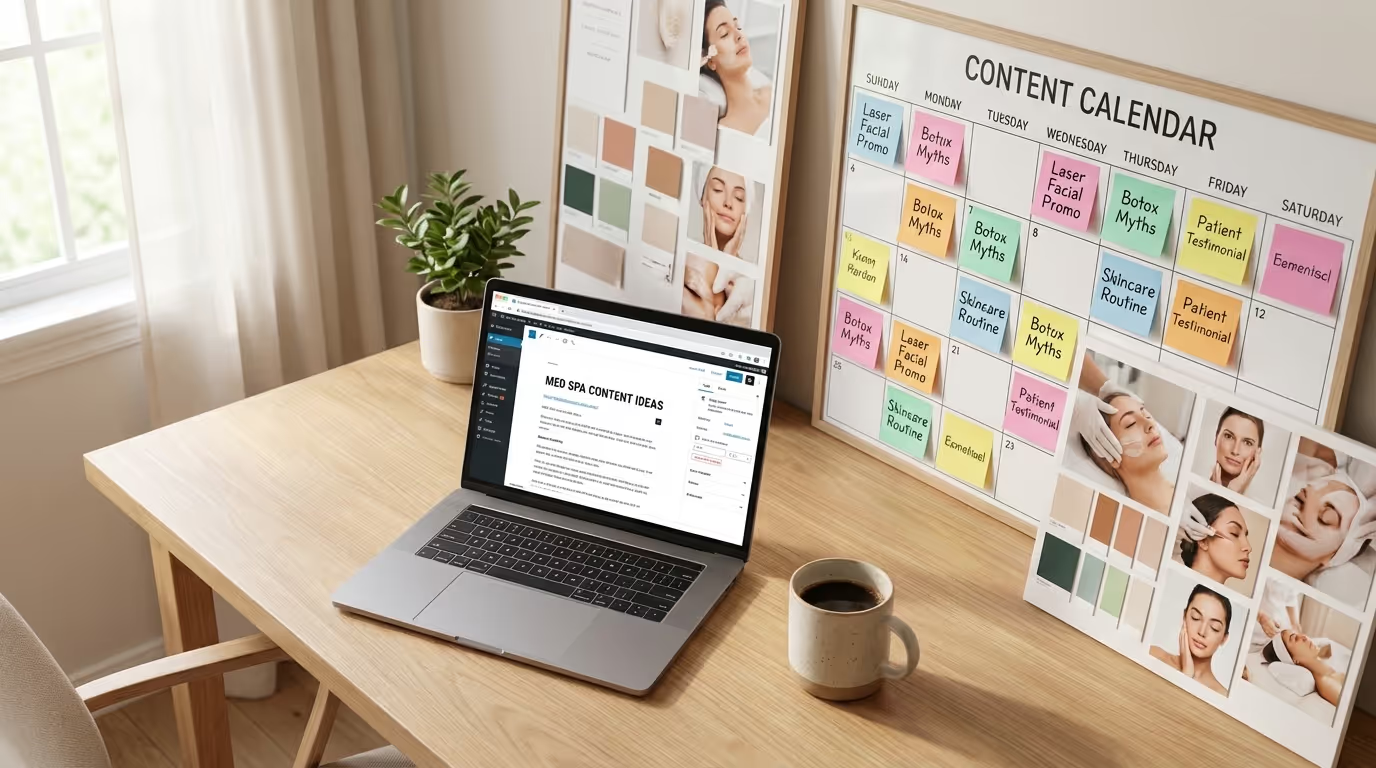

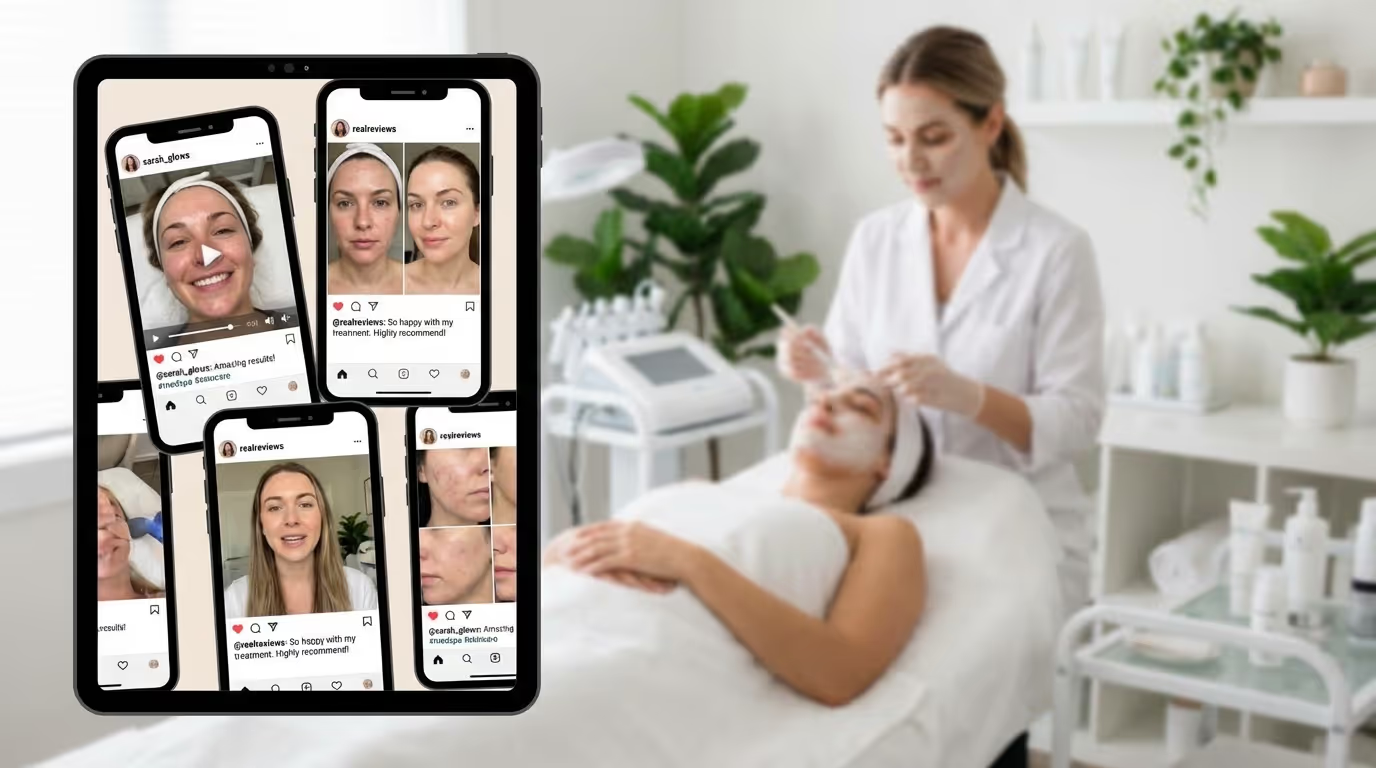
Your most expensive ad creative will never outperform a real patient pulling up their phone camera and saying, "I just got Botox at [your practice] and look at these results."
That is not an opinion. It is data. User-generated content converts 4 to 5 times higher than professional brand content in the aesthetics space. Why? Because people trust other people more than they trust businesses. A polished ad says, "We are great." A patient video says, "They are great." And that difference is everything when someone is deciding who to trust with a needle near their face or a laser on their skin.
Most med spas understand this conceptually. But when it comes to med spa UGC, very few have a system for actually generating, collecting, curating, and deploying content consistently. They get an occasional tagged post on Instagram, reshare it to stories, and call it a UGC strategy.
That is not a strategy. That is hoping. Effective med spa user generated content requires a system, not wishful thinking.
This guide covers how to build a real med spa UGC program — one that produces a consistent stream of authentic patient content you can use across social media, paid ads, your website, and email marketing. From the psychology of why UGC works to the exact systems, templates, legal frameworks, and deployment strategies that turn patient content into your highest-performing marketing asset.
Why UGC Matters More for Med Spas Than Almost Any Other Industry
Medical aesthetics sits at a unique intersection of high consideration, high emotion, and high trust requirements that makes user-generated content disproportionately powerful compared to virtually any other industry.
The Trust Gap in Aesthetic Marketing
High consideration. Nobody impulse-buys a $3,000 body contouring package or a $600 filler session. Patients research for days, weeks, sometimes months — comparing practices, reading reviews, watching videos, asking friends. During that research phase, they are not looking for your opinion about your services. They are looking for proof from people like them.
High emotion. Aesthetic treatments are deeply personal. They touch on self-image, confidence, aging, and identity. Patients want to see real results on real people who look like them, have similar concerns, and had a positive experience. Stock photos of models with flawless skin do not create that emotional connection — they create skepticism.
High trust requirement. You are asking someone to let you inject substances into their face, point a laser at their skin, or freeze their fat cells. This is not buying a pair of shoes online. Trust is not just important — it is the prerequisite. And trust comes from social proof, not from your brand messaging alone.
UGC for medical spas bridges all three gaps simultaneously: it reduces the consideration period by showing real results, creates emotional connection through relatable stories, and builds trust through authentic third-party validation. This is why med spa social proof through user-generated content outperforms any other content format.
The Numbers That Prove It
| Metric | Data Point | Source Context |
|---|---|---|
| Purchase influence | 79% of consumers say UGC significantly influences purchasing decisions | Cross-industry surveys |
| CTR improvement | UGC ads generate 4x higher click-through rates than brand-created ads | Meta advertising benchmarks |
| Authenticity perception | Consumers are 2.4x more likely to view UGC as authentic vs. brand content | Marketing trust studies |
| Conversion lift | UGC on product/service pages increases conversion rates by 29% | E-commerce and service benchmarks |
| Content demand | 56% of consumers want to see more UGC from brands before purchasing | Consumer behavior research |
| Cost per lead | UGC ads produce leads at $15-25 vs. $50-80 for brand creative in aesthetics | Med spa advertising benchmarks |
| Ad engagement | UGC ads see 2-4x lower cost per click vs. stock-photo brand ads | Meta and Google ad performance data |
In the med spa context, a single patient video testimonial can outperform a $5,000 professionally produced video. Not because the production quality is better — but because the authenticity is real, and authenticity is what moves people from "interested" to "booked."
The 7 Types of UGC That Work for Med Spas
Not all UGC is created equal. These are the seven types that actually drive bookings for aesthetic practices, ranked by impact.
1. Before-and-After Content
The most powerful UGC format in aesthetics. Period. A patient showing their own before-and-after results is more persuasive than any ad creative, any professional photo shoot, or any brand video you will ever produce.
What great before-and-after UGC looks like:
- Patient records a selfie video before treatment and another 2-4 weeks later showing results
- Side-by-side photo comparison posted to Instagram with a genuine caption about their experience
- TikTok or Reels "transformation" video with the patient narrating their journey
- Time-lapse photo series showing progressive results (especially powerful for skin treatments and body contouring)
How to encourage it:
- Ask patients during their follow-up appointment when results are visible: "Your results look incredible — would you be willing to share a quick before and after on your social media?"
- Take the before photo at their first appointment and offer to send it to them after results appear so they can create the comparison
- Provide a simple content prompt: "Show your before, show your after, tell people what you loved about the experience"
- Offer a meaningful incentive — $25-50 credit toward their next treatment for patients who create and post content
- Create a dedicated hashtag for your practice and ask patients to use it
Compliance note: Before-and-after content created by patients and posted on their own accounts is their content. However, if you reshare it or use it in ads, ensure you have written consent. Also be mindful of FTC guidelines — if you incentivized the content, that must be disclosed by the patient.
2. Video Testimonials
Patients speaking on camera about their experience — what they came in for, how they were treated, and how they feel about their results. Video testimonials are the closest thing to a personal recommendation at scale.
What great video testimonials look like:
- 30 to 90 seconds of a patient speaking naturally about their experience
- Filmed on a phone (not a professional camera — authenticity matters more than production value)
- Includes specific details: treatment received, provider name, how they felt before vs. after
- Shows genuine emotion — not scripted, not rehearsed, not reading from a card
Collection system:
- Identify the optimal collection moment: the follow-up appointment when results are visible and satisfaction is at its peak
- Have your provider or patient coordinator ask: "Would you be willing to record a quick 30-second video about your experience? We can do it right now."
- Provide guiding questions (not a script):
- What treatment did you get and why did you choose it?
- How was your experience at [practice name]?
- How do you feel about your results?
- Would you recommend [practice name] to a friend?
- Offer to hold the phone for them — many patients will talk on camera if they do not have to handle the logistics
- Send a post-treatment email or SMS with a prompt for patients who did not record in-person: "Would you be willing to record a 30-second video about your experience? Here are some questions you can answer..."
Performance data: Video testimonials generate 2-3x higher engagement rates than static photo testimonials on social media and 1.5-2x higher conversion rates when used in paid advertising.
3. Day-of Experience Content
Content created during the appointment — the waiting room ambiance, the treatment room, the process, the immediate result. This content demystifies the treatment experience and reduces fear for prospective patients.
What great day-of content looks like:
- Patient filming their Instagram story during their Botox appointment
- A quick selfie in the treatment chair with a caption like "Botox day at [practice]"
- Stories showing the "experience" — the ambiance, the products, the care, the interaction with staff
- Real-time reaction content ("I cannot believe how easy that was!")
How to create an environment that generates day-of content:
- Design an Instagram-worthy treatment experience — clean, well-lit rooms, branded elements patients want to photograph, aesthetically pleasing product displays
- Tell patients explicitly that they are welcome to take photos and videos: "Feel free to capture your experience — we love when patients share"
- Have a designated photo spot with good lighting and subtle branding visible (a neon sign, a branded wall, an artful product display)
- Create a practice-specific hashtag and display it in treatment rooms and at checkout
- Provide a ring light or selfie mirror in a common area
- Train your team to offer: "Want me to take a photo of you?" at key moments
Common mistake: Assuming patients know they can take photos in a medical setting. Most do not ask because they assume it is not allowed. Give explicit permission and encouragement.
4. Social Media Tags and Mentions
Organic mentions of your practice on social media — patients tagging you, checking in, or mentioning your practice name. These are low-effort for the patient and high-value for your brand because they expose your practice to the patient's entire social network.
System for maximizing tags and mentions:
- Make your Instagram handle visible everywhere in the practice — treatment rooms, waiting area, checkout desk, restroom mirrors
- Ask patients at checkout: "If you post anything about your visit today, tag us @[handle] — we love to see your results"
- Engage with every tag and mention: like, comment, reshare to stories. Patients who feel acknowledged create more content
- Create a recurring feature — "Patient of the Week" or "Results Spotlight" — that showcases tagged content (with permission)
- Monitor your hashtag and brand mentions daily using Instagram's activity tab or a social listening tool
5. Google Reviews as Content
Reviews are a form of UGC that most practices overlook as a content source. A detailed Google review is a testimonial that also helps your local SEO — double value from a single piece of content.
How to leverage reviews as marketing content:
- Screenshot standout reviews and share them on social media as graphics (with the reviewer's name visible as posted publicly)
- Create a "Reviews" highlight reel on Instagram with screenshots of recent five-star reviews
- Feature top reviews on your website's testimonial sections and service pages
- Use review quotes in email marketing campaigns as social proof elements
- Include review screenshots in retargeting ads for website visitors who did not book
- Pull review quotes for ad copy — "Patients say..." with real quotes
Performance data: Social media posts featuring patient reviews generate 15-25% higher engagement than standard brand posts. Service pages with embedded patient reviews convert 20-30% better than pages without them.
6. Staff-Captured Patient Moments
Content captured by your team (with patient permission) during the treatment process. This bridges the gap between professional brand content and pure patient-generated content.
Examples:
- Provider takes a quick video of a patient seeing their filler results for the first time
- Front desk captures a patient's reaction after their first facial treatment
- Team member films a "day in the life" that features real patients (with consent)
Implementation steps:
- Train 1-2 staff members as your "content captains" responsible for daily content capture
- Create a simple shot list: arrival reaction, treatment setup, mid-treatment moment, results reveal, checkout smile
- Always ask for verbal permission before filming, followed by written consent before posting
- Store content in a shared cloud folder organized by treatment type and date
- Aim for 2-3 staff-captured moments per day
7. Platform-Specific UGC
Content created specifically for a platform's native format — TikTok trends, Instagram Reels audio, before-and-after carousels.
What works on each platform:
| Platform | Best UGC Format | Content Style | Optimal Length |
|---|---|---|---|
| Instagram Reels | Before-and-after transformation with trending audio | Polished-casual | 15-30 seconds |
| Instagram Feed | Before-and-after carousel with detailed caption | Informative | 5-10 slides |
| Instagram Stories | Day-of experience, real-time reactions | Raw and spontaneous | 5-15 seconds per slide |
| TikTok | Treatment process videos, GRWM, transformation reveals | Casual, fun, authentic | 15-60 seconds |
| Longer testimonial videos, photo albums | Personal stories | 1-3 minutes | |
| Written reviews with specific details | Professional, detailed | 100-300 words |
Building Your UGC Collection System
Having a system beats hoping patients will spontaneously create content for you. The difference between med spas that have a steady stream of UGC and those that do not is not the quality of their patients or their results — it is whether they have a system.
Step 1: Identify Your Best UGC Candidates
Not every patient will create content. Focus on the ones who are most likely to say yes, and build from there.
High-potential UGC patient profiles:
| Profile | Why They Convert | How to Identify |
|---|---|---|
| Active social media users | Already comfortable creating content | Check if they tagged you or mention aesthetics on their profiles |
| Thrilled with results | Highly motivated to share | Provider and front desk can identify peak satisfaction patients |
| Long-term loyal patients | Strong relationship, feel like insiders | 5+ visits, consistently positive interactions |
| 25-40 age range | Most comfortable with video content | Demographic in your CRM |
| Referred by a friend | Already motivated by word-of-mouth | Tagged as referral source in CRM |
| First-time patients (great experience) | "New discovery" excitement | Post-first-treatment satisfaction check |
Target: Identify 15-20 high-potential UGC patients per month. If you convert 30-40% into content creators, that gives you 5-8 new UGC pieces monthly — enough to fuel your social media, ads, and website.
Step 2: Build the Ask Into Every Patient Touchpoint
UGC collection should not be ad hoc. Build it into your standard patient workflow at every natural touchpoint.
Before the appointment:
- Include in your appointment reminder sequence: "Feel free to capture your experience during your visit — we love when patients share."
During the appointment:
- Front desk at check-in: "Feel free to take photos or video during your visit — we love when patients share their experience."
- Provider after treatment: "Your results look amazing. Would you be open to sharing a quick photo or video of your experience?"
- Offer to take a photo for them: "Want me to grab a quick shot of your results?"
Post-appointment (automated via CRM):
- Day 1 SMS: "How are you feeling after your [treatment]? We hope you love your results!"
- Day 7 email: "Your results should be settling beautifully. We would love to see — share a photo or video with us by replying to this email or tagging us on Instagram @[handle]."
- Day 14 SMS: "Looking great? If you are loving your [treatment] results, we would love for you to share. Tag us @[handle] or reply with a photo. As a thank you, we will send you a $25 credit."
- Day 21 email: "Patient spotlight request" — a direct ask with a simple submission link
At follow-up appointments:
- "Your [treatment] results look incredible. Would you be willing to do a quick 30-second video sharing your experience? We can do it right now on your phone."
Step 3: Make It Ridiculously Easy
Every point of friction reduces your UGC collection rate. The easier you make it for patients to create and submit content, the more content you get.
Friction-reducing tactics:
- Provide lighting. Install a ring light or good-quality lighting in a specific area of your practice where patients can take photos and videos
- Give them a prompt. Do not ask patients to figure out what to say — provide 3-4 bullet points: What treatment did you get? How was the experience? How do you feel about your results?
- Offer to film for them. Many patients will talk on camera happily if someone else holds the phone and manages the logistics
- Create a branded filter or template. An Instagram Story template with your logo that patients can use when posting
- Build a simple submission form. A Google Form or Typeform where patients can upload photos and videos directly, with consent checkbox included
- Send the Google review link via text. One tap, straight to the review form — no searching required
- QR code at checkout. A QR code that opens directly to your Instagram or your UGC submission form
Step 4: Get Consent Right (Non-Negotiable)
This is critical. You need written, documented consent before using patient content in any marketing material. One unauthorized use of a patient's image can generate a legal complaint that costs more than 1,000 pieces of UGC would generate.
What your consent form should cover:
| Element | Details |
|---|---|
| Permission scope | Photos, videos, written testimonials, audio |
| Platforms | Social media, website, paid ads, email, print, presentations |
| Duration | Perpetual or time-limited (perpetual recommended with revocation rights) |
| Identifiability | Whether name, face, and likeness will be visible |
| Modification rights | Whether you can edit, crop, add text overlays, or combine with other content |
| Revocation | Patient's right to revoke consent at any time with written notice |
| Compensation | Whether any incentive was provided (critical for FTC compliance) |
Implementation:
- Create a simple, one-page digital consent form
- Use your CRM to manage consent — attach the signed form to the patient's contact record
- Train your team: no consent form = no using the content. No exceptions.
- Store consent records permanently — if you ever need to verify permission, the documentation should be instant to retrieve
- When using incentivized content in ads, ensure the patient includes FTC-required disclosure
HIPAA consideration: Before-and-after photos and treatment information are Protected Health Information (PHI). Patient-created UGC that they post publicly on their own social media is their own voluntary disclosure. But if you are requesting content, storing it, and using it for marketing, you need proper HIPAA authorization in addition to marketing consent. Your consent form should include HIPAA authorization language reviewed by a healthcare attorney.
Step 5: Organize and Catalog Your UGC Library
As you collect UGC, you need a system to organize it so you can actually find and use the right content at the right time. An unorganized folder of patient photos is almost as useless as no photos at all.
Catalog structure:
| Category | Options |
|---|---|
| Treatment type | Botox, filler, laser, body contouring, facial, skin rejuvenation, weight loss |
| Content format | Photo, video (short), video (long), review text, audio testimonial |
| Platform source | Instagram, TikTok, Google, direct submission, staff-captured |
| Consent status | Approved for social only, approved for ads, approved for website, approved for all, pending |
| Quality tier | A-tier (use in ads and website), B-tier (social media), C-tier (internal use only) |
| Patient demographic | Age range, gender, skin type, treatment concern |
| Date captured | For freshness tracking and seasonal relevance |
Tool recommendations:
- Simple approach: Google Drive folder structure with naming convention: [Date]-[Treatment]-[Type]-[PatientInitials]
- Intermediate: Notion or Airtable database with tags, filters, and linked consent forms
- Advanced: Dedicated UGC platform like Later, Dash Hudson, or TINT
Monthly target: Collect 10-20 new med spa patient content pieces per month for an active practice. This gives you enough UGC for medical spas to maintain a 30-40% content ratio on your social channels and refresh your ad creative quarterly.
Deploying UGC Across Your Marketing Channels
Collecting med spa user generated content is step one. Deploying med spa patient content strategically across every marketing channel is where the revenue comes from. Each channel has different requirements, audiences, and optimal formats.
Social Media Deployment
Instagram Feed:
- Share before-and-after UGC as carousel posts with your own caption adding treatment details and a call-to-action
- Mix UGC with educational content and brand posts — aim for 30-40% of feed posts being UGC
- Tag the patient (with permission) to increase reach to their network
- Use treatment-specific hashtags plus your brand hashtag
Instagram Stories:
- Reshare patient stories and tags immediately (they disappear in 24 hours — urgency)
- Create "Patient Spotlight" features with a branded story template
- Build permanent story highlights: "Results," "Real Patients," "Patient Stories," treatment-specific highlights
- Use interactive elements (polls, questions) to engage viewers with UGC content
Instagram Reels and TikTok:
- Patient transformation videos with trending audio (consistently the highest-performing format)
- "Get ready with me" style content featuring real patients
- Before-and-after reveals with dramatic transitions
- Provider + patient reaction content
- Post 3-5 Reels per week, with at least 2 being UGC-based
Social media calendar integration: Plan your UGC deployment weekly. Map which UGC pieces go to which platforms and which formats. Do not post the same UGC the same way on every platform — adapt the format to each platform's strengths.
Paid Advertising Deployment
UGC ads consistently outperform polished brand creative in the medical aesthetics space. This is the highest-ROI deployment of your UGC library.
Ad formats that convert:
| Format | Platform | Best For | Expected Performance vs. Brand Ads |
|---|---|---|---|
| Patient testimonial video (30-60 sec) | Meta (FB/IG) | Trust building, new audiences | 3-5x higher CTR |
| Before-and-after carousel | Meta (FB/IG) | Treatment-specific targeting | 2-4x lower CPC |
| "Talking head" patient story | Meta, TikTok | Warm audiences, retargeting | 2-3x higher conversion rate |
| Screenshot of Google review | Meta (FB/IG) | Social proof, cold audiences | 1.5-2x lower cost per lead |
| Provider + patient video | YouTube, Meta | Education + social proof combo | 2-3x higher watch time |
Performance benchmarks for UGC ads in med spa marketing:
| Metric | Brand Creative | UGC Creative | Improvement |
|---|---|---|---|
| Cost per click | $2.50-$4.00 | $0.80-$2.00 | 50-70% lower |
| Click-through rate | 0.8-1.5% | 2.5-5.0% | 3-4x higher |
| Cost per lead | $50-$80 | $15-$25 | 60-70% lower |
| Lead-to-consultation rate | 15-20% | 25-35% | 50-75% higher |
| Ad fatigue timeline | 7-14 days | 14-30 days | 2x longer lifespan |
UGC ad creative rotation strategy:
- Start with 3-5 UGC ad variations per campaign
- Let them run for 7-14 days to collect performance data
- Kill the bottom 1-2 performers
- Replace with new UGC creative from your library
- Refresh all creative every 30 days to prevent fatigue
- Build a "hall of fame" file of your top-performing UGC for seasonal re-runs
For the complete Facebook ads and Google Ads strategy, see our dedicated guides.
Website Deployment
Where to place UGC on your website:
| Page | UGC Placement | Purpose |
|---|---|---|
| Homepage | Hero section testimonial + results gallery | Immediate trust signal for all visitors |
| Service pages | Treatment-specific before-and-afters + patient quotes | Reduce treatment-specific hesitation |
| Testimonial page | Full gallery of reviews, videos, and before-and-afters | Dedicated social proof destination |
| Landing pages | Testimonial near the booking form | Overcome last-second booking hesitation |
| Provider bios | Patient quotes about specific providers | Build provider-specific trust |
| Pricing page | Value-focused testimonials ("worth every penny") | Counter price objection |
| Blog posts | Relevant patient stories within educational content | Real-world validation of information |
Website UGC best practices:
- Use video testimonials above the fold when possible — video converts 2x better than text
- Include the patient's first name and treatment type with every testimonial (with consent)
- Update website UGC quarterly to keep content fresh
- Use schema markup on testimonial pages for potential rich snippet display
- Lazy-load video content to maintain page speed
Email Marketing Deployment
UGC integration in email campaigns:
- Monthly newsletter: Include a "Patient Spotlight" section with a testimonial video or before-and-after
- Treatment-specific campaigns: Feature UGC from patients who had the specific treatment being promoted
- Rebooking reminders: Include patient quotes: "See what [patient name] said about her [treatment] results..."
- Welcome sequences: Build trust with new patients by showcasing real patient stories in emails 3-5
- Reactivation campaigns: Use fresh UGC to show lapsed patients what they are missing
- Drip campaigns: Sprinkle UGC throughout lead nurture sequences as social proof
Email UGC performance benchmarks:
- Emails with UGC see 15-25% higher click-through rates vs. brand-only emails
- Emails featuring patient video thumbnails see 30-40% higher click rates
- Welcome sequences with UGC generate 20% more booked consultations
The UGC Incentive Framework
Incentives increase UGC production dramatically — but they must be structured correctly to maintain authenticity and compliance.
Incentive Tiers
| UGC Type | Suggested Incentive | Cost per Piece | Expected Conversion Rate |
|---|---|---|---|
| Google review (text) | No incentive (against Google ToS to incentivize) | $0 | 15-25% with automated ask |
| Instagram tag/mention | Reshare to stories + personal thank-you DM | $0 | 20-30% with ask at checkout |
| Before-and-after photo | $25 treatment credit | $25 | 15-20% of asked patients |
| Short video testimonial (30 sec) | $50 treatment credit | $50 | 10-15% of asked patients |
| Detailed video testimonial (1-3 min) | $75-100 treatment credit | $75-100 | 5-10% of asked patients |
| Multi-piece package (photo + video + review) | $100-150 treatment credit | $100-150 | 5-8% of asked patients |
Important: Never incentivize Google reviews — this violates Google's terms and can get your reviews removed or your GBP penalized. You can ask for reviews, send reminders, and make it easy — but do not offer payment or credits.
FTC Compliance for Incentivized Content
If you provide any compensation — credits, discounts, free treatments, products — in exchange for content, the FTC requires disclosure.
Requirements:
- The patient must disclose the material connection in their post (e.g., "#gifted," "#sponsored," or "I received a credit for sharing this")
- The disclosure must be clear, conspicuous, and hard to miss (not buried in 30 hashtags)
- If you use the content in paid ads, the disclosure should remain visible
- Document the incentive provided in your records
Practical approach: When providing incentive, include in your instructions: "Please include #gifted or mention that you received a credit for sharing — it is required by FTC guidelines and it actually adds credibility to your post."
Med Spa UGC Mistakes That Kill Your Strategy
Mistake 1: Over-Editing Patient Content
If you take a patient's raw, authentic video and edit it into a polished brand piece with music, transitions, graphics, and your logo watermark — you destroy the authenticity that makes UGC work. The entire point of UGC is that it looks and feels real. Heavy production defeats the purpose.
What is acceptable: Trimming length, adding subtitles/captions, simple text overlays, minor color correction.
What kills authenticity: Adding background music, professional transitions, brand intro/outro sequences, heavy color grading, professional graphics overlays.
Mistake 2: Using UGC Without Documented Consent
Using patient content without documented consent is both a legal risk and a trust violation. One public complaint about unauthorized use of a patient's image can do more damage to your reputation than a hundred pieces of UGC can repair. Never, under any circumstances, use patient content without signed consent.
Mistake 3: Only Collecting UGC From "Perfect" Results
Not every piece of UGC needs to show a dramatic before-and-after transformation. A patient who says, "The experience was amazing, the team made me feel so comfortable, and my skin looks refreshed" is valuable even without a dramatic visual result. Comfort, trust, and experience are as important as visible results in the patient's decision-making process.
Diversify your UGC portfolio:
- 40% results-focused (before-and-afters, visible transformations)
- 30% experience-focused (comfort, team, ambiance, process)
- 20% trust-focused (provider expertise, safety, professionalism)
- 10% lifestyle-focused (how they feel post-treatment, confidence boost)
Mistake 4: Incentivizing Without Proper Disclosure
If you offer credits, discounts, or free treatments in exchange for content, that must be disclosed by the patient in their post. FTC guidelines require material connections between brands and endorsers to be clearly disclosed. Ignoring this exposes you to regulatory risk and, if discovered by patients, erodes trust.
Mistake 5: Ignoring Negative UGC
When a patient posts negative content — a bad review, a complaint on social media, a critical comment — ignoring it or deleting it makes things worse. Other prospective patients are watching how you respond. A professional, empathetic response to a negative review builds more trust than 10 positive reviews.
Response framework for negative UGC:
- Respond within 2-4 hours (speed shows you care)
- Acknowledge the concern without being defensive
- Take the detailed conversation private ("We would like to discuss this further — please call us at...")
- Resolve the issue genuinely
- If the issue is resolved, politely ask if they would consider updating their review
Mistake 6: Treating UGC as a One-Time Campaign
UGC is not a quarterly campaign. It is an ongoing system that runs every day. The practices with the best UGC libraries have collection built into their daily operations — every patient touchpoint includes a UGC opportunity. When you treat UGC as a campaign, you get bursts of content followed by droughts.
Mistake 7: Not Repurposing UGC Across Channels
A single patient video can be used in 10+ ways: Instagram Reel, TikTok post, Facebook ad, retargeting ad, website testimonial, email campaign, landing page, Stories highlight, blog post embed, and consultation room presentation. Most practices use a piece of UGC once and forget about it. Repurpose aggressively.
Measuring UGC Impact: The Dashboard
Track these metrics monthly to understand whether your UGC strategy is working and where to optimize.
Collection Metrics
| Metric | Target | How to Track |
|---|---|---|
| UGC pieces collected per month | 10-20 for active practice | UGC library catalog |
| Collection rate (pieces / patients asked) | 15-25% | Divide by total asks |
| Breakdown by format (photo / video / review) | Balanced mix | UGC library tags |
| Breakdown by treatment type | Proportional to treatment mix | UGC library tags |
| Consent forms on file | 100% of used content | CRM consent records |
Engagement Metrics
| Metric | Target | How to Track |
|---|---|---|
| Engagement rate on UGC posts vs. brand posts | UGC 2-3x higher | Social media analytics |
| Reach and impressions on UGC content | Growing month-over-month | Platform analytics |
| Shares and saves on UGC content | 2-3x higher than brand content | Platform analytics |
| Website traffic from UGC-driven social posts | Measurable and growing | Google Analytics UTM tracking |
Conversion Metrics
| Metric | Target | How to Track |
|---|---|---|
| Cost per lead on UGC ads vs. brand ads | UGC 50-70% lower | Ad platform reporting |
| Click-through rate on UGC ads | 2.5-5.0% | Ad platform reporting |
| Booking rate from UGC-heavy pages vs. standard | 20-30% higher | A/B testing |
| Lead-to-consultation rate from UGC ads | 25-35% | CRM pipeline tracking |
Revenue Attribution
| Metric | Target | How to Track |
|---|---|---|
| New patients citing social proof as decision factor | Track and trend | Intake form / "how did you hear about us" |
| Revenue from UGC ad campaigns | Growing and profitable | CRM source attribution |
| UGC ad ROAS | 3-5x minimum | Ad spend vs. attributed revenue |
Advanced UGC Strategies for Established Practices
Once your basic UGC system is producing 10-20 pieces per month, level up with these advanced strategies.
UGC Ambassador Program
Identify your top 5-10 patients who consistently create great content and formalize the relationship.
Ambassador perks:
- Priority booking access
- Quarterly complimentary add-on treatment
- VIP event invitations
- Early access to new services
- Personal relationship with practice owner and providers
Ambassador expectations:
- 2-4 UGC pieces per month
- Authentic content (not scripted or directed by the practice)
- Willingness to be featured in ads and on the website
- Honest — if they have constructive feedback, they share it privately first
Expected output: 5-10 ambassadors producing 2-4 pieces each = 10-40 additional UGC pieces per month.
UGC-Powered Referral Program
Connect your UGC strategy to your referral program for compounding growth.
How it works:
- Patient creates UGC and shares on social media
- Their friends see the content and ask about the practice
- Patient shares their referral link alongside their UGC
- New patient books through referral link
- Both patients receive referral credits
- New patient creates their own UGC, repeating the cycle
This creates a self-reinforcing loop where UGC drives referrals, which creates new patients, who create new UGC.
Seasonal UGC Campaigns
Align UGC collection pushes with your marketing calendar to build treatment-specific content libraries before peak seasons.
| Season | UGC Collection Focus | Usage Timing |
|---|---|---|
| January-February | New Year transformation stories | Q1 ads and social |
| March-April | Spring refresh results, wedding prep | Q2 campaigns |
| May-June | Summer body content, no-downtime treatment stories | Summer social and ads |
| September-October | Laser treatment results, skin rejuvenation stories | Fall marketing push |
| November-December | Holiday glow-up content, gift card testimonials | Holiday campaigns |
Influencer Hybrid Model
Bridge the gap between organic UGC and paid influencer content by working with micro-influencers (1,000-10,000 followers) who are also your patients.
Approach:
- Identify existing patients who have modest but engaged social followings
- Offer them an enhanced incentive for creating content that matches their normal posting style
- They create authentic content as a patient, not as a paid spokesperson — the authenticity is preserved because they genuinely chose your practice
- You get influencer-quality reach with UGC-level authenticity
Expected cost: $100-300 in treatment credits per content piece. Expected reach: 5,000-50,000 impressions per post depending on follower count and engagement rate.
Getting Started: Your 30-Day UGC Launch Plan
Week 1: Foundation
- Audit your existing UGC — search your practice name on Instagram, TikTok, and Google. Collect and catalog everything you already have
- Create your UGC consent form (digital, one page)
- Set up a cloud storage system with the catalog structure defined above
- Brief your entire team on the UGC collection workflow
- Install your photo spot with good lighting
- Create your practice hashtag and display it in treatment rooms
Week 2: Activate
- Start asking every patient for content at checkout and follow-up appointments
- Activate your post-treatment UGC automation in your CRM (Day 7 and Day 14 messages)
- Reshare your first UGC piece to social media
- Add patient testimonials to your homepage and top 3 service pages
- Post your practice's first UGC-focused Instagram Reel
Week 3: Deploy
- Create your first UGC ad — start with a testimonial video or before-and-after carousel on Meta
- Add UGC to your email marketing — include a patient spotlight in your next newsletter
- Create Instagram story highlights for UGC: "Real Results," "Patient Stories"
- A/B test a landing page with UGC vs. without UGC
- Begin tracking all UGC metrics defined above
Week 4: Measure and Optimize
- Review collection metrics: how much UGC did you collect? What formats? What treatments?
- Review deployment metrics: how did UGC perform vs. brand content on social? In ads? On the website?
- Identify what is working and double down — which ask method produced the most content? Which content type performed best?
- Set monthly UGC collection goals based on Week 1-4 data
- Plan your Month 2 UGC strategy with lessons learned
The Bottom Line on Med Spa UGC
Med spa UGC is the most cost-effective, highest-converting content format available to aesthetic practices. It costs almost nothing to produce, it builds trust faster than any brand campaign, and it performs better in paid advertising than content you spend thousands creating.
The data is clear: UGC ads generate 3-5x higher click-through rates, 50-70% lower cost per lead, and higher conversion rates at every stage of the patient funnel. Practices that deploy UGC systematically across their social media, website, ads, and email see measurably better results across every marketing channel.
The only thing standing between you and a steady stream of patient-generated content is a system. Build the collection system, get consent right, deploy across every channel, measure the impact, and optimize monthly.
Your patients are already your best marketers and your strongest source of med spa social proof. Give them the tools and the invitation to prove it.
Need help building a social media and content strategy that incorporates UGC, paid campaigns, and organic growth? We can audit your current approach and show you exactly where the gaps are.