
Most med spas fail at marketing for one reason: they treat it like a side project. A Groupon deal here, a boosted Instagram post there, maybe a website that looks like it was built in 2018. Then they wonder why the treatment rooms sit empty on a Tuesday afternoon.
Here is the truth nobody in the "general marketing" world will tell you: marketing a med spa is fundamentally different from marketing a restaurant, a law firm, or a SaaS product. Your patients are making high-consideration, appearance-related decisions. They are anxious about results, skeptical of claims, and comparing you against five other practices before they ever pick up the phone.
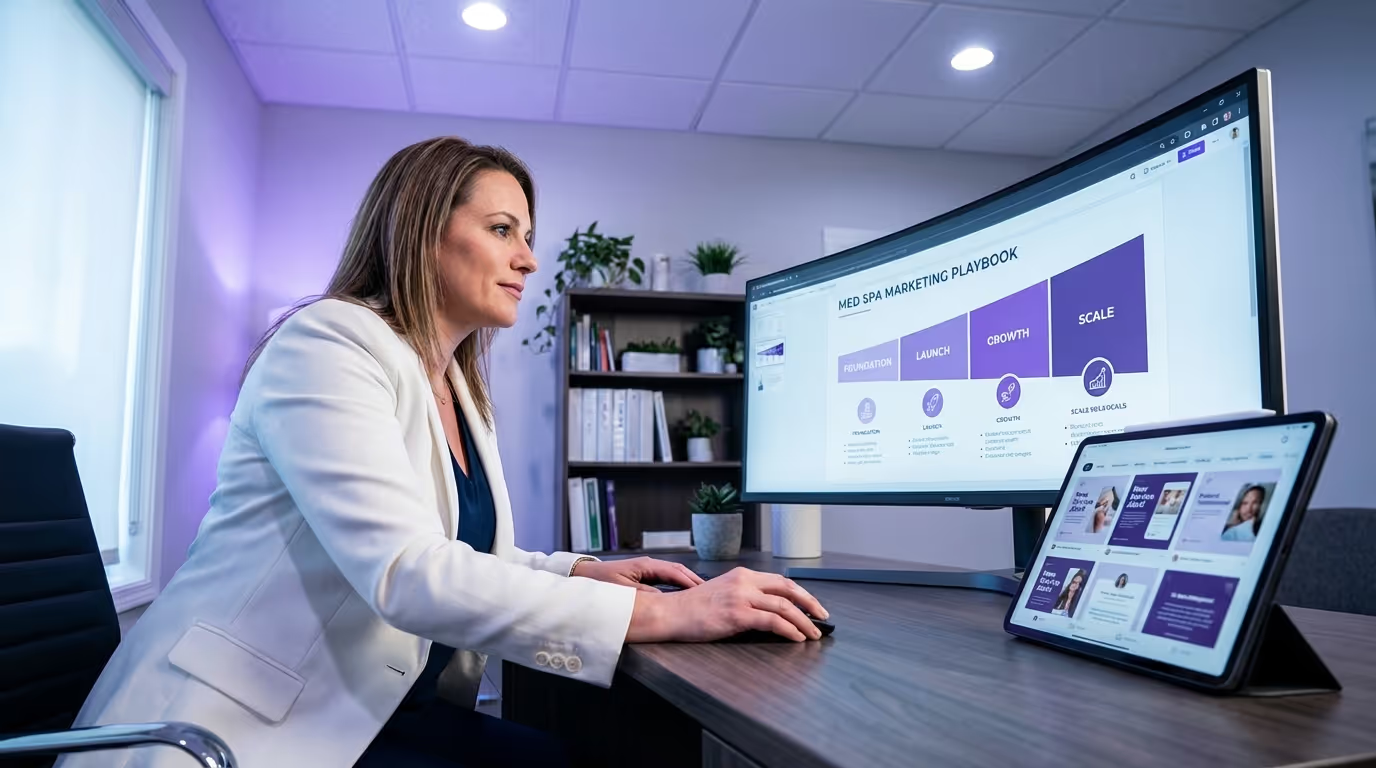
This playbook breaks down exactly how to market a med spa — covering everything from how to advertise a med spa on Google and Meta to med spa promotion strategies that build long-term patient loyalty. Phase by phase, tactic by tactic, so you stop guessing and start building a patient acquisition system that compounds over time. Each phase includes implementation steps, benchmarks to hit, and the common mistakes that keep practices stuck.
We work exclusively with med spas and medical aesthetics practices. One vertical. One obsession. That is how we win, and it is how your practice wins too.
Phase 0: Positioning — Before You Spend a Dollar on Ads
Timeline: 1 to 2 weeks
Before you touch a single ad platform or social media account, you need to answer one question that 90% of med spas get wrong: Why should a patient choose you over the practice three miles down the road?
"We offer Botox, fillers, and laser treatments" is not a positioning statement. It is a menu. Every med spa within a 20-mile radius offers the same thing. Your marketing will never work at scale until you carve out a clear position in your market. This is the foundation of your brand strategy.
Implementation Steps
- Audit your competitive landscape. Map every med spa, dermatology practice, and plastic surgery office within a 15-mile radius. What do they claim? What do they emphasize? Where are the gaps?
- Identify your differentiator. It falls into one of three categories:
- Specialization: "The body contouring experts of [City]" beats "full-service med spa" every time
- Credibility anchor: Board-certified dermatologist on staff, published research, proprietary protocols
- Experience differentiation: Luxury environment, membership model, concierge-level follow-up
- Write your positioning statement. Complete this phrase: "We are the only med spa in [City] that ___." If you cannot finish that sentence, your positioning needs work before anything else moves forward.
- Validate with data. Check keyword research to confirm demand exists for your positioning angle. Being the only med spa that offers underwater cryotherapy does not help if nobody is searching for it.
- Align your team. Every staff member should be able to articulate your positioning in one sentence. If they cannot, your patients definitely cannot.
Common Mistakes
- Positioning as "the best." Every practice claims to be the best. It is meaningless. Position on specificity, not superlatives.
- Changing positioning every quarter. Pick a lane and commit for at least 12 months. Repositioning too frequently confuses patients and wastes marketing spend.
- Ignoring competitor positioning. If three competitors already own "luxury med spa," do not try to be the fourth. Find white space.
Phase 1: Foundation — Brand, Website, and Google Business Profile
Timeline: 3 to 6 weeks
This phase is non-negotiable. Skip it and every dollar you spend on ads leaks out of a broken funnel. The foundation sets the floor for everything that follows.
Brand Identity That Signals Premium
Your brand is not your logo. It is the gut feeling a patient gets in the first three seconds of encountering your practice — online or in person. For med spas, that feeling needs to be: trustworthy, premium, and clinically credible. Read our complete medical spa branding guide for the full framework.
Implementation steps:
- Invest in professional logo design and color system (not Canva templates)
- Commission consistent photography — real staff, real facility, real results
- Create a brand voice guide so every touchpoint sounds like the same practice
- Design branded templates for social media, email, and print materials
- Ensure your interior design aligns with your brand promise — the in-office experience must match the online impression
Investment: $2,000 to $5,000 one-time for professional branding. This is not where you cut corners.
A Website Built to Convert, Not Just to Exist
Your website is not a brochure. It is your highest-performing salesperson — if it is built correctly. Most med spa websites fail because they prioritize aesthetics over conversion architecture. See our website design guide for the complete conversion framework.
Implementation steps:
- Speed optimization: Under 3 seconds load time. Every additional second kills 7% of conversions. Run your site through Google PageSpeed Insights and fix anything below 70 on mobile. See our website optimization guide.
- Build deep service pages: One page per treatment, 800 to 1,200 words minimum, with before/after photos, FAQs, pricing transparency, and a clear booking CTA. Our service page design guide covers the template.
- Social proof above the fold: Star ratings, review counts, and a testimonial within the first viewport on every page.
- Mobile-first design: 70% or more of your traffic comes from mobile. If your site is not flawless on a phone, you are losing the majority of potential patients.
- Online booking integration: Every page should be two clicks or fewer from a booked appointment. Embed booking software on every service page.
- Homepage design: Hero section with clear value proposition, trust signals, top services, and a prominent CTA.
Performance benchmarks:
| Metric | Poor | Average | Good | Excellent |
|---|---|---|---|---|
| Mobile PageSpeed score | Below 50 | 50 – 70 | 70 – 85 | 85+ |
| Visitor-to-lead conversion rate | Below 2% | 2% – 4% | 5% – 8% | 8%+ |
| Average time on site | Under 1 min | 1 – 2 min | 2 – 3 min | 3+ min |
| Bounce rate | Above 70% | 55% – 70% | 40% – 55% | Below 40% |
| Pages per session | 1 – 2 | 2 – 3 | 3 – 5 | 5+ |
Investment: $4,000 to $15,000 for a professional med spa website. Our website cost guide breaks down what to expect at each price point.
Google Business Profile: Your Free Patient Pipeline
Your Google Business Profile is the single most underrated asset in med spa marketing. It drives local map pack visibility, and for many practices, it generates more calls than the website itself.
Implementation steps:
- Claim and verify your GBP if you have not already
- Add every service as a product with descriptions and pricing ranges
- Upload 50 or more high-quality photos (facility, staff, treatment rooms, results)
- Publish posts weekly with offers, tips, or announcements
- Pre-populate the Q&A section with your most common patient questions (and answer them)
- Set up a review generation system that consistently brings in 5-star reviews
- Add your booking link directly to your GBP
Benchmarks: Profiles with 100 or more photos get 520% more calls than those with fewer than 10. Profiles with weekly posts appear in 70% more local searches than inactive profiles.
Common mistakes:
- Not completing every field. Google rewards completeness. Fill in every single field — services, products, attributes, hours, description, categories.
- Ignoring the Q&A section. If you do not populate it, patients (or competitors) will. Control the narrative.
- Using stock photos. Google can detect stock photos. Use real photos of your real practice.
Phase 2: Launch — Paid Advertising for Immediate Patient Flow
Timeline: Weeks 4 to 12 (overlaps with foundation build-out)
Once your foundation is solid, it is time to turn on the two ad channels that drive the fastest results for med spas: Google Ads and Meta Ads. Each serves a different purpose, and you need both.
Google Ads: Capture High-Intent Demand
Google Ads is where you intercept patients who are actively searching for treatments. Someone typing "Botox near me" or "best CoolSculpting in [City]" is a ready-to-book lead.
Implementation steps:
- Structure campaigns by treatment category: Separate campaigns for injectables, body contouring, skin rejuvenation, laser treatments. Never lump them together.
- Build a branded campaign: Bid on your own name. Competitors will if you do not.
- Manage negative keywords weekly: Exclude "training," "certification," "salary," "DIY," and other irrelevant terms.
- Create landing pages per service: Never send ad traffic to your homepage. Each ad group needs a dedicated landing page for that specific treatment.
- Set up conversion tracking: Track booked appointments, not just form submissions. Phone call tracking is essential — many med spa patients call after clicking an ad.
- Review ad costs and benchmarks for your market before setting expectations.
Budget and performance benchmarks:
| Market Size | Monthly Budget | Expected Leads | Cost Per Lead | Expected ROAS |
|---|---|---|---|---|
| Small market | $2,000 – $3,000 | 25 – 50 | $40 – $80 | 5 – 8x |
| Medium market | $3,000 – $5,000 | 40 – 75 | $50 – $100 | 4 – 6x |
| Large metro | $5,000 – $10,000 | 60 – 120 | $60 – $120 | 4 – 6x |
| Competitive metro (LA, Miami, NYC) | $10,000+ | 80 – 150 | $80 – $150 | 3 – 5x |
Meta Ads: Build Awareness and Nurture Demand
Meta Ads (Facebook and Instagram) work differently than Google. You are not capturing existing demand — you are creating it. For the complete strategy, see our Facebook Ads guide.
Implementation steps:
- Create before/after creative: Still the highest-performing ad format. Use real patient results with proper consent. See our ad copy guide for templates.
- Film video testimonials: 30 to 60 second patient stories outperform polished brand videos consistently.
- Launch lead form campaigns: Meta's native lead forms reduce friction. Offer a free consultation or treatment assessment.
- Build retargeting audiences: Show ads to people who visited your website but did not book. This audience converts at 3 to 5 times the rate of cold traffic.
- Test audience targeting: Women 28 to 55 within 15 miles is your starting point. Layer interests (beauty, skincare, fitness, spa services) and test lookalike audiences.
Budget: $2,000 to $4,000 per month. Meta is typically cheaper per lead than Google but requires more nurture to convert. Expected ROAS: 3 to 5x when combining prospecting with retargeting.
Common paid advertising mistakes:
- No conversion tracking. Flying blind. You must track booked appointments as conversions, not just clicks or form fills.
- Sending all traffic to the homepage. Your homepage is not optimized for any specific treatment keyword. Use dedicated landing pages.
- Not testing creative. Running the same ad for 6 months. Test new images, videos, and copy every 2 to 4 weeks.
- Giving up too soon. Google Ads needs 30 to 60 days of data before optimization is meaningful. Meta needs 2 weeks of learning phase per campaign.
Phase 3: Growth — SEO, Content, and Social Media
Timeline: Months 3 to 12 (ongoing)
Paid ads fill the schedule now. SEO and content marketing fill the schedule forever — without the ongoing ad spend. This phase builds the organic engine that reduces your cost per acquisition over time.
SEO: Own the Search Results in Your Market
Med spa SEO is the long game that pays the biggest dividends. When your practice ranks number one for "med spa in [City]" and all your core treatment terms, you are getting hundreds of free, high-intent leads every month.
Implementation steps (in priority order):
- Technical SEO: Site speed, mobile usability, schema markup for local business and medical procedures, XML sitemap. Run our SEO checklist.
- Local SEO: Google Business Profile optimization (Phase 1), local citations on 40 or more directories, location-specific landing pages if you serve multiple areas.
- On-page SEO: Treatment pages optimized for "[Treatment] + [City]" keywords. Each page needs 800 or more words, FAQs, internal links, and original imagery.
- Content marketing: Blog posts targeting informational keywords your patients search before booking (e.g., "how long does Botox last," "CoolSculpting vs. liposuction"). Publish 4 to 8 posts per month.
- Link building: Local partnerships, directory submissions, guest posts on health and wellness publications, press coverage.
Timeline and benchmarks:
| Month | Expected Progress | Key Metrics |
|---|---|---|
| 1 – 3 | Technical fixes, content foundation, GBP optimization | Site indexed properly, 10+ GBP posts |
| 4 – 6 | First keyword rankings appearing, organic traffic growing | 5+ keywords on page 1, 200+ organic visits/month |
| 7 – 9 | Significant organic traffic, first organic leads | 15+ keywords on page 1, 500+ organic visits/month |
| 10 – 12 | Organic becomes a meaningful lead channel | 25+ keywords on page 1, 1,000+ organic visits/month |
| 12+ | Compounding growth, organic dominance in market | Cost per organic lead: $15 – $40 |
Content Marketing: Educate to Earn Trust
Content is not about churning out generic blog posts. It is about answering the exact questions your ideal patients ask before they book — and doing it better than anyone else in your market. See our content ideas guide for topic inspiration.
Content pillars for med spas:
| Pillar | Purpose | Example Topics | Publishing Frequency |
|---|---|---|---|
| Treatment education | Answer pre-booking questions | What to expect, how it works, recovery | 2 – 3/month |
| Comparison content | Help patients choose | Treatment A vs. B, surgical vs. non-surgical | 1 – 2/month |
| Results and proof | Build trust with evidence | Case studies, before/after galleries | 1/month |
| Seasonal and trend | Capture timely searches | "Best treatments before summer," "[Year] trends" | 1 – 2/month |
| Location content | Rank for local terms | "[Treatment] in [City/Neighborhood]" pages | As needed |
Common content mistakes:
- Writing for Google, not patients. Content should be readable and engaging first, optimized second. Keyword stuffing is dead.
- Publishing inconsistently. Two posts per week for a month, then nothing for three months. Consistency beats volume.
- Not including internal links. Every blog post should link to 3 to 5 relevant service pages and other blog posts. This is how SEO for medical spas actually works.
- Ignoring patient questions. Your front desk team hears the same questions every day. Turn those into blog posts.
Social Media: Show, Do Not Tell
Social media for med spas is not about going viral. It is about building a portfolio of proof that patients review before they book. Think of Instagram and TikTok as your living before/after gallery and trust builder.
Implementation steps:
- Post 3 to 5 times per week across Instagram and TikTok
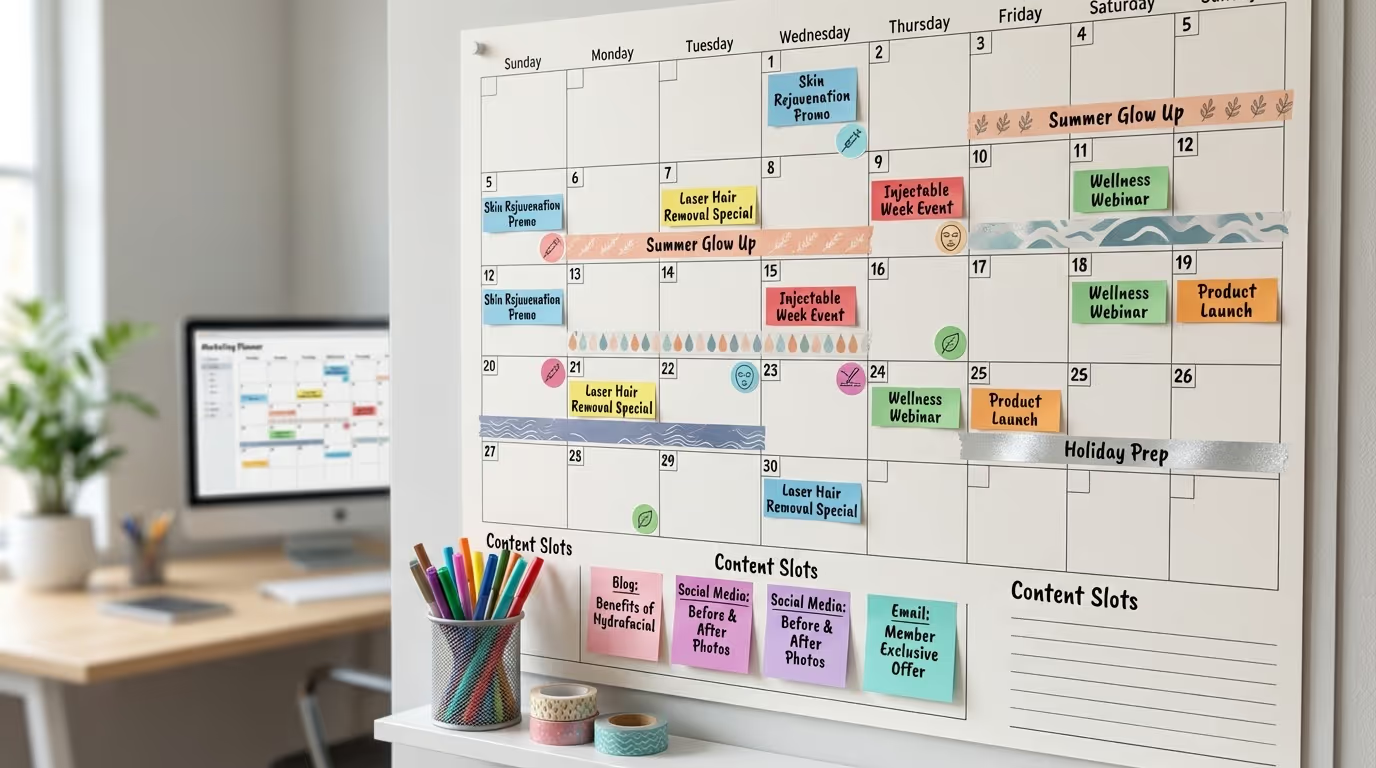
- Create a social media calendar with themed content days
- Use relevant hashtags to increase discovery
- Feature providers on camera — patients choose people, not logos
- Share social media post ideas that mix education, proof, and personality
- Consider influencer partnerships for reach in your local market
- Repurpose patient testimonials as UGC content
What to post (by content type):
| Content Type | Frequency | Purpose | Performance |
|---|---|---|---|
| Before/after transformations | 3 – 4x/week | Social proof | Highest engagement |
| Treatment process videos | 2 – 3x/week | Reduce anxiety, educate | High saves and shares |
| Provider introductions | 1x/week | Build personal connection | High profile visits |
| Patient testimonials (video) | 1 – 2x/week | Trust building | High conversion |
| Educational Reels (30 – 60 sec) | 2 – 3x/week | Authority | High reach |
| Promotions and offers | 1x/week max | Drive bookings | Moderate engagement |
Phase 4: Scale — Automation, Sequences, and Retargeting
Timeline: Months 6 to 18
Once your channels are generating consistent leads, the bottleneck shifts from traffic to conversion and retention. This is where marketing automation separates practices doing $100K per month from those doing $300K per month.
Email and SMS Sequences
Most med spas leave massive revenue on the table by not following up systematically. The data is clear: leads contacted within five minutes convert at 400% the rate of leads contacted after 30 minutes.
Essential sequences to build (see our email marketing guide and SMS marketing guide for templates):
| Sequence | Trigger | Purpose | Expected Impact |
|---|---|---|---|
| Speed-to-lead | New form/call | Instant response within 60 seconds | 40% increase in booking rate |
| Appointment reminders | Booking confirmation | 3-touch SMS sequence | 40 – 60% no-show reduction |
| Post-treatment follow-up | Appointment completed | Check-in, review request, rebook | 3 – 5x review volume |
| Reactivation | 90+ days no visit | Re-engage lapsed patients | 5 – 10% reactivation rate |
| Welcome sequence | First appointment | Introduce practice, build relationship | 25% increase in second visit rate |
| Drip campaign | Lead not yet booked | Nurture toward booking | 8 – 15% conversion over 45 days |
| Membership nurture | Active patient | Sell membership program | 15 – 25% enrollment rate |
CRM recommendation: GoHighLevel or similar all-in-one platform. See our best med spa software comparison for all options.
Retargeting: Close the Loop
Only 2 to 3 percent of website visitors book on their first visit. Retargeting brings back the other 97%.
Implementation steps:
- Install the Meta Pixel and Google Ads remarketing tag on your website today
- Build audience segments: all visitors (30-day), service page visitors (14-day), form abandoners (7-day)
- Create treatment-specific retargeting ads (before/after creative, testimonials)
- Allocate 15 to 20% of total ad budget to retargeting
- Set up YouTube retargeting for video testimonials shown to past service page visitors
Retargeting performance benchmarks:
| Audience | CPC | Conversion Rate | ROAS |
|---|---|---|---|
| All site visitors (30-day) | $1 – $3 | 3% – 5% | 5 – 8x |
| Service page visitors (14-day) | $1 – $2 | 5% – 8% | 8 – 12x |
| Form abandoners (7-day) | $0.50 – $1.50 | 8% – 12% | 10 – 15x |
| Video viewers (75%+ completion) | $0.50 – $2 | 3% – 6% | 6 – 10x |
Phase 5: Optimization — Test, Measure, and Improve Relentlessly
Timeline: Ongoing from Month 3+
Marketing without measurement is just spending. The practices that win long-term are the ones obsessed with their numbers. Track these KPIs weekly and optimize monthly.
Key Metrics to Track
| Metric | Target | Why It Matters | Track In |
|---|---|---|---|
| Cost per lead (CPL) by channel | $30 – $100 | Marketing efficiency | Ad platforms |
| Lead-to-booking conversion | 30% – 50% | Sales effectiveness | CRM |
| Cost per acquisition (CPA) | $50 – $200 | True cost per patient | CRM + ads |
| Patient lifetime value (LTV) | $3,000 – $8,000 | Long-term revenue | CRM |
| Return on ad spend (ROAS) | 4 – 8x | Campaign profitability | Ad platforms |
| Marketing ROI | 5 – 10x | Overall marketing effectiveness | Monthly calculation |
| Organic traffic growth | 10%+ monthly | SEO progress | Google Analytics |
| Review volume and rating | 5+/week, 4.7+ stars | Trust and local SEO | GBP |
A/B Testing That Moves the Needle
Do not test button colors. Test things that actually impact revenue:
| Test | Expected Impact | Timeline |
|---|---|---|
| Landing page headlines | 20% – 40% conversion lift | 2 – 4 weeks |
| Offer structure ("free consultation" vs. "$50 off") | 15% – 30% conversion lift | 2 – 4 weeks |
| Ad creative (video vs. static, before/after vs. lifestyle) | 20% – 50% CTR change | 2 weeks |
| Form length (3 fields vs. 5 fields) | 10% – 25% submission change | 2 weeks |
| CTA copy ("Book Now" vs. "Schedule Your Free Consultation") | 5% – 15% click change | 2 weeks |
Conversion Rate Optimization (CRO)
Small improvements in conversion rates compound into massive revenue gains:
| Improvement | Monthly Visitors | Before | After | Revenue Impact (at $400 avg.) |
|---|---|---|---|---|
| Website conversion: 3% to 5% | 2,000 | 60 leads | 100 leads | +$16,000/month |
| Lead-to-booking: 30% to 45% | 100 leads | 30 bookings | 45 bookings | +$6,000/month |
| Combined | 2,000 visitors | 18 patients | 45 patients | +$10,800/month |
Stack those improvements and you have doubled your patient volume without doubling your budget.
The Med Spa Marketing Budget Framework
Your marketing budget should scale with your revenue and growth stage:
| Revenue Stage | Marketing as % of Revenue | Monthly Budget | Focus |
|---|---|---|---|
| Pre-launch | 15% – 20% | $3,000 – $8,000 | Foundation, pre-opening ads |
| $0 – $50K/month | 12% – 18% | $3,000 – $9,000 | Google Ads, GBP, basic social |
| $50K – $100K/month | 10% – 15% | $5,000 – $15,000 | Add Meta Ads, SEO, content |
| $100K – $200K/month | 8% – 12% | $8,000 – $24,000 | Full channel mix, retargeting |
| $200K+/month | 6% – 10% | $12,000 – $20,000+ | Optimization, brand, expansion |
Channel allocation by growth stage:
| Channel | Launch | Growth | Scale |
|---|---|---|---|
| Google Ads | 40% | 30% | 25% |
| Meta Ads | 25% | 25% | 20% |
| SEO and content | 15% | 25% | 30% |
| Email/SMS | 5% | 10% | 10% |
| Social media | 10% | 5% | 5% |
| Retargeting | 5% | 5% | 10% |
Common Med Spa Marketing Mistakes — Complete List
| Mistake | Revenue Impact | The Fix |
|---|---|---|
| No positioning | Compete on price, low conversions | Define and commit to a clear market position |
| Slow website | 7% conversion loss per second of load time | Optimize to under 3 seconds |
| No tracking | Cannot optimize what you cannot measure | Set up full conversion tracking on week one |
| Homepage-only traffic | 2x lower conversion than dedicated landing pages | Build landing pages for every ad campaign |
| Inconsistent content | Zero SEO traction | Publish 4+ posts per month on a fixed schedule |
| Ignoring retention | 5 – 7x higher cost to replace vs. retain | Build automated retention sequences |
| DIY everything | Spreads owner too thin, subpar execution | Invest in specialists for high-impact channels |
| Groupon dependency | Attracts price shoppers with near-zero retention | Invest in Google Ads for high-intent patients |
| No review system | Invisible in local search | Automate review requests after every appointment |
| Chasing trends | Distracted from fundamentals | Master SEO, ads, and retention before trying anything new |
The Bottom Line: How to Market a Med Spa That Wins
Here is the reality of how to market a med spa successfully: it is not about finding one magic channel or one viral post. It is about building a system — positioning, foundation, paid traffic, organic growth, automation, and relentless optimization — that compounds month over month.
The practices that commit to this playbook see results like:
- 50 to 100 or more new patient leads per month within 90 days
- 4 to 6x return on ad spend from paid channels
- 40 to 60 percent reduction in cost per lead within 12 months as organic traffic grows
- Patient lifetime values of $5,000 or more through proper retention and rebooking systems
The practices that cherry-pick one tactic, never commit to a budget, or try to DIY their marketing on the side of running a practice — they stay stuck at the same revenue year after year.
Every strategy in this guide connects to a deeper resource. From marketing plans and marketing calendars to marketing checklists and promotion ideas — we have built the complete playbook because this is all we do. One vertical. One obsession.
Ready to Build Your Med Spa Marketing System?
You do not need another generic marketing agency that also works with dentists, chiropractors, and plumbers. You need a team that lives and breathes medical aesthetics marketing every single day.
At Aesthetix Media, we work exclusively with med spas and medical aesthetics practices. We have built the playbook above from the inside out — because it is the only playbook we run.
Book a free strategy call and we will audit your current marketing, identify the biggest gaps, and map out a 90-day plan to start filling your treatment rooms with high-value patients.
No generic advice. No fluff. Just a clear plan built for your market, your treatments, and your growth goals.