

You are spending money on marketing. You are posting on social media. You might even be running ads. And your calendar still has gaps you could drive a truck through.
The problem is not that marketing does not work for med spas. The problem is that most med spas make the same preventable mistakes over and over — and nobody tells them because their agency is too busy collecting the retainer to deliver honest feedback.
We work exclusively with med spas. That is all we do. And after auditing hundreds of med spa marketing setups across the U.S. and Canada, we see the same patterns destroying growth at otherwise great practices.
These are the 12 most common med spa marketing mistakes — including critical med spa advertising mistakes — and exactly how to fix each one before they cost you another dollar. We are not going to hold back. If you are making any of these, this is the wake-up call your practice needs.
Why Med Spa Marketing Mistakes Are So Expensive
Before we get into the list, let us quantify what is at stake.
The average med spa patient has a lifetime value of $3,500 or more. Some treatment categories — like body contouring, weight loss, and combination facial rejuvenation — push that number above $8,000. That means every patient you lose to a marketing mistake is not a $300 loss. It is a $3,500+ loss.
Now multiply that by the number of patients your competitors are capturing because they fixed these mistakes and you have not. For most practices, that number lands between 20 and 50 patients per month — translating to $70,000 to $175,000 in lost lifetime value every single month.
| Mistake Severity | Lost Patients/Month | Monthly LTV Impact | Annual LTV Impact |
|---|---|---|---|
| Making 2-3 mistakes | 10-20 | $35,000-$70,000 | $420,000-$840,000 |
| Making 4-6 mistakes | 20-35 | $70,000-$122,500 | $840,000-$1.47M |
| Making 7+ mistakes | 35-50+ | $122,500-$175,000+ | $1.47M-$2.1M+ |
These are not theoretical numbers. They are the reality we see when we audit practices that have been making these mistakes for 12-24 months. The compounding effect is brutal — and it is also why the practices that fix these mistakes see dramatic growth within 90 days.
For a deep dive into what healthy marketing economics look like, read our guide on med spa marketing ROI.
Mistake 1: Treating Marketing Like an Expense Instead of an Investment
This is the foundational mistake that creates all the others.
When you view marketing as a cost, you do things like hire the cheapest agency, cut ad spend during slow months, and evaluate performance based on how much you spent rather than how much you earned. You scrutinize your $5,000 marketing invoice while ignoring the $50,000 in revenue it generated.
Here is the math that matters. If you spend $5,000 per month on marketing and it generates 30 new patients with an average lifetime value of $3,500, your marketing just produced $105,000 in pipeline value. That is a 21x return. Would you cut that investment? Would you shop for a cheaper version of it?
How This Mistake Manifests
- Cutting ad spend during slow months. Slow months are when you need marketing most. Cutting spend when the calendar is empty is like closing the restaurant because nobody is eating — it guarantees the problem gets worse.
- Hiring the cheapest agency. A $500/month agency delivers $500/month results. Meanwhile, the practice down the street paying $3,000/month for a specialist is booking 40 new patients per month. You get what you pay for.
- Evaluating based on spend, not return. "We spent $8,000 on marketing last month" means nothing in isolation. "We spent $8,000 and generated $52,000 in first-visit revenue with a projected $280,000 in lifetime value" means everything.
- No marketing budget at all. Some practices literally have no marketing budget. They rely entirely on word-of-mouth and wonder why growth has stalled.
How to Fix It
Step 1: Calculate your current cost per patient acquisition. Total marketing spend divided by new patients acquired. If you do not know this number, that is mistake number 9 on this list.
Step 2: Calculate your average patient lifetime value. Total revenue from a cohort of patients divided by the number of patients. Most med spas find this is $2,500-$5,000+.
Step 3: Set your marketing budget at 10-15% of revenue for growth-stage practices, or 7-10% for established practices maintaining their position.
Step 4: Evaluate every marketing channel based on ROI, not cost. If a channel produces a 5x return, invest more. If it produces a negative return after 90 days, cut it. But give channels time — SEO for medical spas takes 4-6 months to show results, while Google Ads can produce leads in week one.
| Channel | Typical Time to ROI | Expected ROI at Maturity |
|---|---|---|
| Google Ads | 1-4 weeks | 3x-8x |
| Facebook/Instagram Ads | 2-8 weeks | 2x-6x |
| SEO | 4-6 months | 5x-15x (compounds) |
| Email/SMS Marketing | 1-2 weeks | 20x-40x |
| Social Media (organic) | 3-6 months | Difficult to attribute directly |
Common Mistakes Within This Mistake
- Comparing marketing spend to practices in different markets (a med spa in Manhattan has different economics than one in Tulsa)
- Evaluating monthly performance without considering patient lifetime value
- Confusing revenue with profit when calculating ROI
- Not accounting for the compounding effect of brand-building channels like content strategy and SEO
Mistake 2: Running Google Ads Without Dedicated Landing Pages
This one physically hurts to see, and we see it constantly. A med spa is paying $15-$40 per click on Google Ads for high-intent keywords like "Botox near me" or "CoolSculpting [city]" — and sending that traffic to their homepage.
Your homepage is designed to serve everyone: existing patients, job seekers, curious browsers, potential partners. It is not designed to convert a person who just searched for a specific treatment and is ready to book.
The Math That Proves This Is a Disaster
| Scenario | Ad Spend | CPC | Clicks | Conversion Rate | Leads | Cost Per Lead |
|---|---|---|---|---|---|---|
| Sending traffic to homepage | $5,000 | $25 | 200 | 2.5% | 5 | $1,000 |
| Sending traffic to landing page | $5,000 | $25 | 200 | 10% | 20 | $250 |
Same spend. Four times the results. The only difference is where you send the traffic.
Dedicated landing pages convert at 8-12% for med spa treatments. Homepages convert at 2-4% for the same traffic. On a $5,000/month ad budget, that is the difference between 5 booked consultations and 20. On a $10,000/month budget, it is the difference between 10 and 40.
How to Build Landing Pages That Convert
Step 1: Create a separate landing page for every treatment you advertise. If you run ads for Botox, fillers, CoolSculpting, and laser hair removal, you need four landing pages.
Step 2: Each landing page must include these elements:
- One treatment focus (never promote multiple treatments on one page)
- Headline matching the search intent ("Botox in [City] — Natural Results, Expert Injectors")
- Your offer above the fold ("Book Your Free Consultation Today")
- Zero navigation menu (remove all exit paths)
- Social proof specific to that treatment (reviews mentioning Botox, before/after photos of Botox results)
- A form or click-to-call CTA above the fold
- Trust signals (credentials, years of experience, number of procedures performed)
- FAQ section addressing objections
Step 3: Install conversion tracking on every landing page. Use call tracking numbers unique to each page so you can attribute phone calls to specific campaigns.
Step 4: A/B test continuously. Test headlines, images, CTA copy, form length, and offer structure. Small improvements compound — a 1% conversion rate improvement on $5,000/month ad spend adds 2 new patients per month.
For the complete Google Ads strategy for med spas including campaign architecture, keyword strategy, and budget allocation, read our dedicated guide. And if you are running Facebook Ads, the landing page principle applies equally — every ad should lead to a dedicated page, not your homepage.
Benchmarks to Hit
| Metric | Poor | Average | Good | Excellent |
|---|---|---|---|---|
| Landing page conversion rate | <3% | 3-6% | 6-10% | 10%+ |
| Mobile conversion rate | <2% | 2-5% | 5-8% | 8%+ |
| Form completion rate | <20% | 20-40% | 40-60% | 60%+ |
| Cost per lead (Google Ads) | >$300 | $150-$300 | $75-$150 | <$75 |
Mistake 3: Ignoring Local SEO Entirely
You know what is better than paying $30 per click for "med spa in [your city]"? Ranking organically for that keyword and getting those clicks for free.
Most med spas we audit have done almost nothing with local SEO. Their Google Business Profile is half-completed. They have zero location-specific content on their website. Their NAP (name, address, phone) is inconsistent across directories. And they are invisible in the map pack — the three local results that get 44% of all clicks for local searches.
Why Local SEO Is the Highest-ROI Channel for Med Spas
Local SEO compounds. Every month you invest in it, your foundation gets stronger. Ad spend stops producing the moment you stop paying. Local SEO produces traffic for years after the initial investment.
Here is what a strong local SEO strategy looks like after 12 months versus the same investment in Google Ads:
| Channel | 12-Month Investment | Leads at Month 12 | Leads if You Stop Investing |
|---|---|---|---|
| Google Ads | $60,000 | 40-60/month | 0 (immediately) |
| Local SEO | $42,000 | 30-50/month | 20-35/month (for 6-12+ months) |
The traffic does not vanish when you pause SEO. It slowly declines, but the assets you built — content, backlinks, reviews, citations — continue working.
How to Fix Your Local SEO
Step 1: Optimize your Google Business Profile completely.
- Claim and verify your listing if you have not already
- Select the right primary category (Medical Spa) and all relevant secondary categories
- Write a complete description using your city name and primary treatments
- Add 25+ photos (exterior, interior, treatment rooms, team, results)
- List every service individually with descriptions
- Post weekly updates (treatment highlights, seasonal offers, team news)
- Respond to every review within 24 hours
Step 2: Build dedicated treatment pages on your website.
- Create an individual page for every treatment you offer
- Target "[treatment] in [city]" as the primary keyword for each page
- Include 1,500-2,000 words of content per page
- Add FAQ sections with schema markup
- Link related treatment pages to each other
Step 3: Fix your citation profile.
- Get listed in the top 50 healthcare and local directories
- Ensure your NAP is identical across every listing (including formatting)
- Prioritize high-authority directories: Google Business Profile, Yelp, RealSelf, Healthgrades, Vitals, Zocdoc, BBB, Chamber of Commerce
Step 4: Build a review generation system.
- Send automated review requests after every appointment
- Target 15-20 new Google reviews per month
- Respond to every review personally
- Read our complete guide on how to get more med spa Google reviews
Step 5: Implement schema markup.
- Add LocalBusiness schema to every page
- Add MedicalBusiness schema with service details
- Add FAQ schema to treatment pages
- Add Review schema to pull ratings into search results
- Read our schema markup guide for implementation details
For the complete playbook, read our med spa local SEO guide. And for practices ready to go deeper, our med spa SEO checklist covers 50+ steps to rank higher.
Mistake 4: Posting on Social Media Without a Strategy
Posting three times a week on Instagram is not a social media strategy. It is a habit — and usually a bad one.
Here is what we see at most med spas: random mix of stock photos, treatment room selfies, holiday graphics from Canva, and the occasional before-and-after. No content calendar. No content pillars. No conversion mechanism. No tracking. Just posting because someone said you should.
The result? Low engagement, no follower growth, zero bookings from social, and a lingering feeling that social media is a waste of time. It is not a waste of time. You are just doing it wrong.
What Strategic Social Media Actually Looks Like
Social media for med spas should accomplish one of three things with every single post: build trust, educate potential patients, or drive bookings. If a post does not do at least one of these, it is wasting your time and diluting your brand.
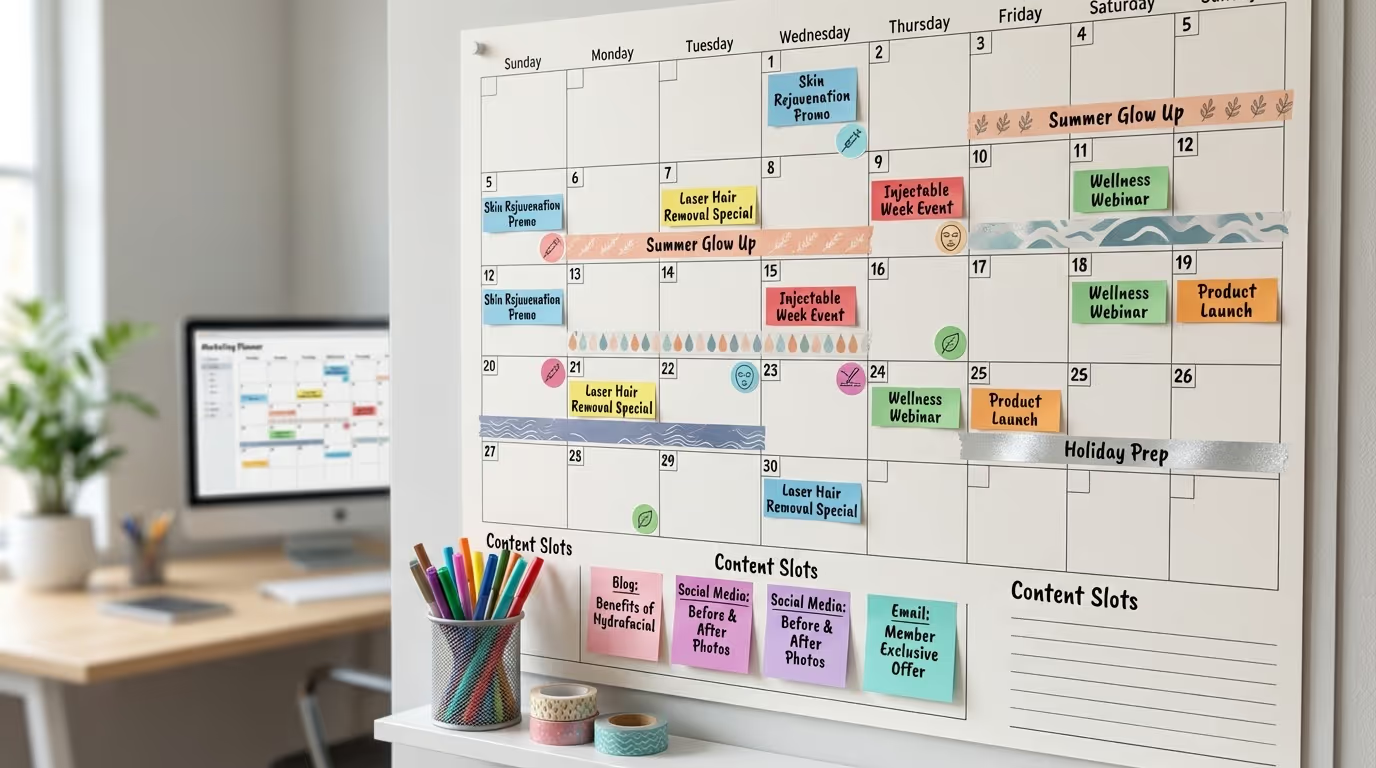
Step 1: Build a content calendar around four pillars.
| Content Pillar | % of Content | Examples | Goal |
|---|---|---|---|
| Educational | 35% | Treatment explainers, myth-busting, provider Q&As | Build trust and authority |
| Social proof | 30% | Before/afters, testimonials, reviews, case studies | Demonstrate results |
| Behind-the-scenes | 20% | Team culture, day-in-the-life, treatment processes | Humanize your brand |
| Direct offers | 15% | Limited availability, seasonal promotions, events | Drive bookings |
Step 2: Create platform-specific strategies.
- Instagram: Primary platform for med spas. Focus on Reels (transformation reveals, treatment explainers) and Stories (behind-the-scenes, polls, Q&As). Post 4-5 times per week.
- TikTok: Growth platform. Shorter, trend-driven content. Treatment videos, patient reactions, myth-busting. Post 3-5 times per week.
- Facebook: Community engagement. Longer-form posts, event promotion, targeted ads. Post 3-4 times per week.
Step 3: Include a call to action on every single post. Even educational content should end with a CTA. "Questions about Botox? DM us or book your free consultation — link in bio." Every post without a CTA is a missed opportunity.
Step 4: Track what matters. Stop measuring likes. Start measuring:
- Profile visits from posts
- Website clicks from your bio link
- DMs that lead to consultations
- Booked appointments attributed to social media
For a complete social media strategy, read our guides on med spa social media posts and how to create a med spa social media calendar. If you are considering working with creators, our med spa influencer marketing guide breaks down what works and what is a waste.
The UGC Advantage
User-generated content — real content from real patients — outperforms branded content by 3-5x on engagement metrics. Build a system to capture UGC: ask patients if they would record a quick testimonial video, encourage them to tag your practice in their posts, and repost patient content (with permission) to your feed.
Mistake 5: Using a Generic Marketing Agency
This is the mistake that ties all the others together. You hired an agency that also does dental offices, HVAC companies, restaurants, and e-commerce stores. They use the same playbook for everyone, and none of it is calibrated for the med spa industry.
A generic agency does not understand your treatment margins. They do not know that Botox patients have a different buyer journey than body contouring patients. They have never dealt with medical advertising compliance. They do not understand seasonal demand patterns in aesthetics. And they definitely do not know that your average patient lifetime value is $3,500+ — which changes every calculation about what you should be willing to pay to acquire a patient.
The Red Flags of a Generic Agency
| Red Flag | What It Means |
|---|---|
| They cannot name your top 3 local competitors | They have not done market research |
| They recommend the same strategy for Botox and CoolSculpting | They do not understand treatment-specific buyer journeys |
| They have never mentioned HIPAA or medical advertising compliance | They are a liability |
| They report on impressions and clicks but not booked appointments | They are hiding behind vanity metrics |
| They do not know what a patient lifetime value is | They cannot calculate ROI properly |
| They use the same landing page template for every client | They are not customizing for your market |
| They have never asked about your no-show rate | They do not understand the med spa revenue model |
How to Fix It
Step 1: Audit your current agency's work. Ask them to show you:
- Cost per patient acquired (not cost per lead — cost per actual booked patient)
- Patient lifetime value analysis for leads from their campaigns
- Treatment-specific campaign performance
- Competitive analysis for your local market
- HIPAA compliance measures in their advertising
If they cannot produce these, they are not the right partner.
Step 2: When evaluating agencies, look for:
- Exclusive or primary focus on med spas and medical aesthetics
- Case studies from practices similar to yours (same market size, service mix, growth stage)
- Understanding of treatment margins and patient economics
- Compliance awareness (FTC guidelines, medical advertising rules)
- Full-funnel thinking — not just lead generation but lead conversion and patient retention
Step 3: Read our honest breakdown of the best med spa marketing companies to understand what separates specialists from generalists.
If your agency cannot speak your language fluently, they are costing you money. Period.
Mistake 6: No Follow-Up System for Leads
You are generating leads. That is the good news. The bad news? You are letting most of them die.
Industry data shows that 78% of sales go to the first responder. The average med spa takes over 4 hours to respond to a new web lead. By that time, your prospect has already called your competitor who responded in 5 minutes.
The Speed-to-Lead Data
| Response Time | Lead Conversion Rate | Relative Performance |
|---|---|---|
| Under 1 minute | 391% higher than 5+ minutes | Best |
| 1-5 minutes | 100% (baseline for fast response) | Great |
| 5-30 minutes | 21x less likely to qualify | Mediocre |
| 30-60 minutes | Prospect has likely contacted competitor | Poor |
| 4+ hours (industry average) | Prospect is gone | Terrible |
This is not a marketing problem — it is a systems problem. And it is hemorrhaging revenue from your practice every single day.
How to Fix It
Step 1: Implement automated speed-to-lead workflows. When a new lead comes in — whether from a form, phone call, or social media message — they should receive an automated SMS within 60 seconds acknowledging their inquiry and offering next steps. This can be set up in any CRM including GoHighLevel, which we recommend for med spas.
Step 2: Build a human follow-up process. Your front desk should have a defined process to call every new lead within 5 minutes during business hours. After hours, the automated SMS serves as first contact, with a live follow-up first thing the next morning.
Step 3: Build a nurture sequence. Not every lead books on the first contact. A 30-day drip campaign that educates, builds trust, and presents offers will convert an additional 15-25% of leads that would have otherwise gone cold.
A well-designed nurture sequence looks like this:
| Day | Channel | Content |
|---|---|---|
| 0 | SMS | Instant acknowledgment + booking link |
| 0 | Welcome email with practice overview and what to expect | |
| 1 | SMS | Follow-up if no booking: "Still interested in [treatment]? Reply YES to schedule" |
| 3 | Educational content about their treatment of interest | |
| 7 | Before/after results + patient testimonial | |
| 14 | SMS | Limited-time offer or consultation reminder |
| 21 | FAQ addressing common objections | |
| 30 | Final follow-up with strong CTA |
Step 4: Track your lead response metrics. Measure time to first response, response rate, and nurture-to-booking conversion rate. If your first response takes longer than 5 minutes, fix it before you spend another dollar on lead generation.
For complete email and SMS strategies, read our guides on med spa email marketing and med spa SMS marketing.
Mistake 7: Competing on Price Instead of Value
"$7.99 per unit Botox!" "$199 CoolSculpting!" "50% off everything this month!"
If your marketing leads with discounts, you are training your patients to wait for sales and attracting the lowest-value segment of the market. You are also eroding your margins and devaluing the expertise of your providers.
Why Discounting Destroys Your Practice
There is a mathematical trap that discount-dependent practices fall into:
| Metric | Premium-Positioned Practice | Discount-Dependent Practice |
|---|---|---|
| Average Botox revenue per patient | $450 | $280 |
| Patient retention rate (12-month) | 72% | 38% |
| Average patient lifetime value | $4,200 | $1,100 |
| Referral rate | 35% | 8% |
| Profit margin per treatment | 65% | 28% |
Discount patients are not loyal patients. They came for the deal, and they will leave for the next deal. They do not refer friends because they are embarrassed they got a discount. They complain more. They no-show more. And they cost the same amount of provider time as a full-price patient.
How to Fix It
Step 1: Lead with value, not price. Your marketing should emphasize outcomes, expertise, technology, and experience. "Natural-looking Botox by board-certified injectors with 10,000+ treatments performed" sells better than "$9/unit" — and it attracts patients who value quality over price.
Step 2: Use introductory offers strategically. "$50 off your first Botox treatment" is better than "$7.99/unit" because it brings people in without setting a permanently low price expectation. The discount disappears after the first visit.
Step 3: Bundle treatments instead of discounting them. A "Total Rejuvenation Package" that combines Botox, filler, and a HydraFacial at a package price feels premium. The same treatments sold separately at 30% off feel cheap.
Step 4: Invest in brand-building that justifies premium pricing. Med spa branding that communicates premium quality — professional photography, sophisticated design, expert content — creates perceived value that supports higher prices. Your website design, your social media presence, and your physical space all contribute to the brand story.
Step 5: Build a pricing strategy that accounts for patient lifetime value, not just per-treatment margins. When you understand that a patient acquired at full price stays 2-3x longer than a discount patient, the math of premium positioning becomes undeniable.
For more on running effective promotions without devaluing your brand, read our guide on med spa specials and promotions.
Mistake 8: Neglecting Your Website After Launch
Your website was beautiful when it launched. That was three years ago. Since then, you have added two new providers, five new treatments, opened a second location, and changed your phone number. None of that is reflected on your website.
A med spa website is not a digital brochure you set and forget. It is your highest-converting sales asset — if it is maintained. An outdated website does not just look bad. It actively loses you patients because visitors assume your business is as neglected as your site.
The Signs Your Website Is Costing You Patients
| Symptom | Impact | Priority |
|---|---|---|
| Outdated provider bios or missing team members | Erodes trust when patients meet "surprise" staff | High |
| Treatments listed that you no longer offer | Confuses patients and wastes their time | High |
| New treatments not on the website | You are invisible for those treatment searches | Critical |
| Wrong phone number or address | Losing leads to dead connections | Critical |
| No new blog content in 6+ months | SEO stagnation and declining organic traffic | High |
| Before/after gallery has not been updated | Weak social proof, patients wonder if results are real | Medium |
| Mobile experience is broken or slow | Losing 72% of your traffic | Critical |
| Pricing information is outdated or missing | Patients self-disqualify or feel deceived | High |
How to Fix It
Step 1: Audit your website quarterly. Set a calendar reminder every 90 days to check:
- All treatments listed are current and complete
- All provider bios are up to date with current headshots
- Pricing ranges are accurate
- All forms, phone numbers, and booking links work
- The site loads in under 3 seconds on mobile
- Your Google reviews widget is displaying correctly
Step 2: Add fresh content monthly.
- New before-and-after photos (with patient consent)
- New patient testimonials
- 2-4 blog posts targeting treatment-related keywords
- Updated seasonal offers and promotions
Step 3: Monitor your website performance.
- Track your PageSpeed scores monthly (use Google PageSpeed Insights)
- Review your Google Analytics for declining traffic patterns
- Check Google Search Console for crawl errors and indexing issues
- Monitor your conversion rate by page
Step 4: Redesign every 3-4 years. Design standards and user expectations evolve. A website that looked cutting-edge in 2023 looks dated by 2026. Budget for a redesign cycle — the cost of a med spa website is an investment in your patient pipeline, not a sunk cost.
Your website should be a living, breathing representation of your practice. Treat it like your most important employee, because it works 24/7 and interacts with more potential patients than your entire front desk team combined.
Mistake 9: Not Tracking Marketing Attribution
"Where did you hear about us?" is not an attribution strategy. It is a guess. And it is wrong more than half the time — patients do not accurately remember or report how they found you.
Most med spas cannot tell you which marketing channel produced which patients. They know they spent $5,000 on Google Ads and $3,000 on Facebook Ads, but they cannot tell you which channel produced more bookings, higher-value patients, or better show rates.
Why Attribution Matters
Without attribution data, you are making every marketing decision blind. You might be pouring money into a channel that produces no-shows while starving the channel that produces your best patients.
Here is a real example from a practice we audited:
| Channel | Monthly Spend | Leads | Booked | Show Rate | Avg First Visit | 12-Month LTV |
|---|---|---|---|---|---|---|
| Google Ads | $5,000 | 45 | 32 | 88% | $680 | $4,200 |
| Facebook Ads | $4,000 | 62 | 28 | 61% | $380 | $1,800 |
| Instagram organic | $0 (time only) | 8 | 6 | 92% | $720 | $5,100 |
Without attribution, this practice thought Facebook was their best channel because it generated the most leads. With attribution, they discovered Google Ads produced 2.3x the lifetime value per dollar spent, and Instagram organic — which they were considering cutting back — produced the highest-value patients of all.
How to Fix It
Step 1: Implement call tracking. Use dedicated tracking numbers for each marketing channel. When a patient calls from a Google Ad, the number routes to your front desk but is tracked separately from calls that came through your website organically.
Step 2: Use UTM parameters on every link. Every ad, every email, every social media post should have UTM tags that tell Google Analytics exactly where the traffic came from.
Step 3: Set up conversion tracking in every platform. Google Ads, Meta Ads, Google Analytics — all need to track the same conversion events (form submissions, phone calls, booking completions).
Step 4: Connect your CRM to your marketing tools. The full journey from ad click to booked appointment to revenue needs to be traceable. This is where a med spa CRM like GoHighLevel becomes essential — it connects marketing touchpoints to patient records and revenue.
Step 5: Review attribution data weekly. Make it a standing meeting: review cost per lead, cost per booked appointment, show rates, and lifetime value by channel. Reallocate budget toward channels that produce the highest patient lifetime value, not just the most leads.
For a complete framework on what to measure and why, read our guide on med spa KPIs.
Mistake 10: Ignoring Email and SMS Marketing
You have a list of 3,000+ patient email addresses sitting in your CRM doing absolutely nothing. Meanwhile, email marketing generates an average of $36 for every $1 spent — making it the highest-ROI marketing channel that exists. And you are ignoring it.
Most med spas send one email per month, maybe. It is a generic newsletter with stock photos and vague content that gets a 12% open rate and zero clicks. That is not email marketing. That is email noise.
The Revenue You Are Leaving on the Table
A practice with 3,000 contacts should be generating $15,000-$30,000 per month in attributable revenue from email and SMS marketing alone. Here is how:
| Campaign Type | Frequency | Expected Revenue/Send | Monthly Total |
|---|---|---|---|
| Botox reminder (90-day cycle) | Automated, ongoing | $200-$500 per patient | $4,000-$8,000 |
| Treatment promotions | 2x/month | $3,000-$8,000 per send | $6,000-$16,000 |
| Reactivation campaigns | Monthly | $2,000-$5,000 per send | $2,000-$5,000 |
| Birthday/VIP offers | Automated, ongoing | $100-$300 per patient | $1,000-$3,000 |
| New patient welcome sequence | Automated, ongoing | Increases conversion by 20-30% | Varies |
How to Fix It
Step 1: Segment your list. Stop sending the same email to everyone. Segment by treatment interest, visit frequency, spend level, and time since last visit. A Botox patient and a body contouring patient need different messages.
Step 2: Build automated sequences. Set up these drip campaigns that run without manual effort:
- Welcome sequence for new patients (5 emails over 30 days)
- Botox reminder sequence (triggered at 80 days post-treatment)
- Reactivation sequence for patients inactive 90+ days
- Birthday offer automation
- Appointment reminders (48 hours and 2 hours before)
Step 3: Send 2-4 targeted emails per month. Mix educational content (treatment spotlights, provider Q&As, newsletter content) with direct offers. Each email should have one clear CTA.
Step 4: Add SMS to your mix. SMS has a 98% open rate versus email's 20-25%. Use SMS for time-sensitive promotions, appointment reminders, and flash offers. Read our SMS marketing guide for templates and compliance requirements.
Mistake 11: No Video Content
If you are not creating video content in 2026, you are invisible to half your potential patients. Video accounts for 82% of all internet traffic. Short-form video on Instagram Reels, TikTok, and YouTube Shorts is the fastest-growing content format, and med spas are uniquely positioned to dominate it.
Think about it: your business is inherently visual. Transformations, treatment processes, provider expertise, patient reactions — all of it is compelling video content. Yet most med spas are still posting static photos and text graphics.
The Types of Video That Drive Bookings
| Video Type | Platform | Length | Purpose | Expected Performance |
|---|---|---|---|---|
| Treatment reveal (before/after) | Instagram Reels, TikTok | 15-30 sec | Showcase results | Highest engagement |
| Treatment explainer | YouTube, Instagram | 60-120 sec | Educate and build trust | Highest conversion |
| Provider Q&A | Instagram Stories, YouTube | 60-180 sec | Build provider trust | Medium engagement, high trust |
| Patient testimonial | All platforms | 30-60 sec | Social proof | High conversion |
| Day-in-the-life | TikTok, Instagram Stories | 30-60 sec | Humanize brand | High engagement |
| Treatment process | Instagram Reels, TikTok | 15-45 sec | Satisfy curiosity | Very high engagement |
How to Fix It
Step 1: Start with three types of videos. Treatment explainers, before-and-after reveals, and provider-led education. These cover the three things potential patients want: to see results, understand the process, and trust the person doing the work.
Step 2: You do not need a production crew. An iPhone, a ring light, and a provider who is comfortable on camera is enough. Authenticity outperforms production value on social media.
Step 3: Batch your content. Film 4-5 clips in one session and you have content for 2-3 weeks. Set aside one hour per week for filming.
Step 4: Optimize for each platform. Vertical video (9:16) for Reels, TikTok, and Shorts. Horizontal (16:9) for YouTube long-form. Add captions to everything — 85% of social media video is watched without sound.
Step 5: Repurpose everything. One 3-minute treatment explainer video becomes: a YouTube video, 3 Instagram Reels, 2 TikTok clips, a blog embed, and an email newsletter feature. One shoot, seven pieces of content.
For content planning help, check our med spa content ideas guide and photography best practices to create a visual content system.
Mistake 12: Trying to Do Everything Yourself
You went to school to be a medical professional. You opened a practice to transform patients' lives. And now you are spending your evenings writing Instagram captions, tweaking Google Ads, and troubleshooting your website.
This is the most expensive mistake on this list — not because of what it costs directly, but because of what it costs in opportunity.
The Opportunity Cost Math
| Scenario | Hours/Week on Marketing | Clinical Revenue Lost/Week | Monthly Opportunity Cost |
|---|---|---|---|
| Owner-injector doing own marketing | 10-15 hours | $3,000-$9,000 | $12,000-$36,000 |
| Owner-injector managing in-house marketer | 5-8 hours | $1,500-$4,800 | $6,000-$19,200 |
| Owner-injector with specialist agency | 1-2 hours | $300-$1,200 | $1,200-$4,800 |
A single Botox appointment generates $300-$600. If you spend 10 hours per week on marketing tasks, that is $3,000-$6,000 per week in lost clinical revenue. In a month, you have burned $12,000-$24,000 in opportunity cost — far more than any agency fee.
But the cost goes beyond lost clinical revenue. When you are the marketing department, you are also:
- Making decisions based on limited knowledge (you are a provider, not a marketer)
- Unable to execute at the speed and scale needed for real results
- Constantly context-switching between clinical work and marketing tasks
- Not focusing on the strategic work only an owner can do (vision, partnerships, team building)
How to Fix It
Step 1: Calculate your true hourly clinical value. If you generate $500/hour in clinical work and spend 10 hours/week on marketing, that is $5,000/week — $20,000/month — you are diverting from revenue-generating activity.
Step 2: Decide between three models:
| Model | Monthly Cost | Best For | Limitations |
|---|---|---|---|
| In-house marketing hire | $4,000-$7,000 | Practices doing $1M+ revenue | Limited expertise, single point of failure |
| Fractional CMO | $3,000-$5,000 | Practices needing strategy, not execution | Requires execution team alongside |
| Specialist agency | $3,000-$9,500 | Most med spas | Must find the right partner |
Step 3: Your role shifts from executor to strategic decision-maker. Set the vision. Approve the strategy. Review the results. Let specialists handle SEO, ad management, content creation, email marketing, and social media.
Step 4: Build a marketing plan and marketing calendar that your team or agency executes. Use a marketing checklist to ensure nothing falls through the cracks. Your involvement should be strategic, not tactical.
The Compound Effect: How Multiple Mistakes Multiply Losses
Here is what makes this list dangerous: these mistakes do not operate in isolation. They compound.
A med spa making mistake 2 (no landing pages) AND mistake 6 (no follow-up system) does not lose patients at a 2x rate — they lose them at a 4-5x rate. The traffic that does not convert on the homepage also does not get followed up on, creating a double leak in the funnel.
A practice making mistake 3 (no local SEO) AND mistake 9 (no attribution) cannot even identify what is going wrong because they are invisible in organic search AND cannot measure the channels they are using.
The Most Destructive Combinations
| Mistake Combination | Compounding Effect |
|---|---|
| No landing pages + No follow-up system | Leads never convert AND never get nurtured |
| Generic agency + No attribution | Bad strategy AND no data to prove it is bad |
| Discounting + No email marketing | Attract deal-hunters AND cannot retain or reactivate them |
| No local SEO + Neglected website | Invisible in search AND unconvincing when found |
| No video + No social strategy | Zero brand awareness in the fastest-growing channels |
The practices that fix these med spa advertising mistakes and marketing errors systematically do not just grow. They dominate their markets. They fill their calendars with high-value patients. They build predictable revenue. And they stop worrying about where the next patient is coming from.
The Fix-First Framework: Where to Start
You probably identified several mistakes your practice is making. Here is the prioritized order to fix them:
Priority 1: Fix This Week (Highest immediate impact)
- Set up automated lead response (Mistake 6) — every day without this is lost revenue
- Add a booking CTA to your homepage above the fold (part of Mistake 8)
- Implement call tracking for your main marketing channels (Mistake 9)
Priority 2: Fix This Month (High impact, moderate effort)
- Build landing pages for your top 2-3 advertised treatments (Mistake 2)
- Claim and optimize your Google Business Profile (Mistake 3)
- Launch a review generation system (Mistake 3)
- Stop discounting and create a value-based introductory offer (Mistake 7)
Priority 3: Fix This Quarter (Foundational changes)
- Build a content calendar and start strategic social posting (Mistake 4)
- Implement email/SMS automation (Mistake 10)
- Audit your website for outdated content and performance (Mistake 8)
- Begin video content creation (Mistake 11)
- Evaluate your agency or marketing model (Mistakes 5 and 12)
Priority 4: Fix Within 6 Months (Long-term competitive advantage)
- Launch a full local SEO strategy with treatment pages and citations (Mistake 3)
- Build comprehensive attribution tracking across all channels (Mistake 9)
- Develop a marketing plan with budget allocation by channel (Mistake 1)
- Set marketing budget at 10-15% of revenue (Mistake 1)
How Many of These Mistakes Is Your Practice Making?
Most med spas we audit are making at least 5 of the 12 mistakes on this list. Some are making all of them. The average practice making 5+ mistakes is leaving $30,000-$75,000 per month in patient lifetime value on the table — that is $360,000 to $900,000 per year in lost growth.
The first step is knowing where you stand.
Get Your Free Marketing Audit and we will show you exactly which mistakes are costing you patients — and how to fix them, with a prioritized action plan built specifically for your practice.
We will audit your:
- Website performance and conversion architecture
- Local SEO presence and competitive positioning
- Advertising efficiency and landing page conversion rates
- Lead follow-up speed and nurture sequences
- Social media strategy and content effectiveness
- Email/SMS marketing utilization
- Marketing attribution and tracking setup
No pitch. No pressure. Just a clear-eyed look at what is working, what is broken, and what to fix first.