
There are two med spas in your market. Both have excellent providers. Both offer the same treatments. Both have been open for about the same amount of time.
One charges $15 per unit of Botox, runs a three-month waitlist, and patients drive 45 minutes to get there. The other charges $10 per unit, runs weekly promotions to fill the schedule, and loses patients to the practice up the road.
The difference between these two practices is not clinical skill. It is not location. It is not even marketing spend.
It is brand.
Medical spa branding is the most misunderstood concept in the aesthetics industry. Most practice owners think branding means a logo and some brand colors. They hire a designer on Fiverr, pick a font, choose a color palette, and call it done.
That is not branding. That is decoration.
Branding is the total system that shapes how patients perceive, experience, and talk about your practice. It is the reason one practice commands $15 per unit while the identical practice next door struggles at $10. It is the reason patients refer their friends to one practice and forget the name of the other.
This guide walks you through every step of building a complete med spa brand identity — from choosing a name to medical spa logo design to developing brand messaging that resonates. Not theory. Practical steps you can implement, whether you are launching a new practice or rebranding an existing one. Each section includes implementation steps, data and benchmarks, and the common mistakes that undermine even well-intentioned brand-building efforts.
Why Medical Spa Branding Matters More Than You Think
Before we get tactical, let us ground this in business reality.
Branding Is a Pricing Mechanism
The relationship between brand perception and pricing power is well-documented across every industry, but it is especially pronounced in aesthetics. Patients cannot evaluate the quality of your Botox injection the way they can evaluate the quality of a haircut. They do not know if you used 20 units or 22 units, or whether your injection technique was superior to the provider at the next practice.
What they can evaluate is how your brand makes them feel. And that feeling — professional, exclusive, trustworthy, premium — is what allows you to charge more.
| Brand Strength | Pricing Power | Patient Acquisition Cost | Retention Rate (12-month) |
|---|---|---|---|
| Weak brand (generic, inconsistent) | Below market — forced to compete on price | $180-$300 per new patient | 20-30% |
| Average brand (adequate, unremarkable) | Market rate — some pricing flexibility | $100-$180 per new patient | 35-45% |
| Strong brand (distinctive, consistent) | Above market — 15-25% premium | $60-$120 per new patient | 55-70% |
| Premium brand (aspirational, differentiated) | Significant premium — 25-50% above market | $40-$80 per new patient | 65-80% |
These numbers come from our work with med spas across the US and Canada. The pattern is consistent: strong brands spend less to acquire patients, charge more for services, and keep patients longer. The compounding effect over 12-24 months is massive. For additional context on how brand affects revenue, see our med spa revenue guide.
The Five Business Outcomes of Strong Branding
1. Strong brands reduce marketing costs over time. A recognizable, well-regarded brand generates word-of-mouth referrals, organic search traffic from branded queries, and higher conversion rates on paid advertising. Practices with strong brands spend 20-35% less per patient acquisition than practices without them. Your marketing budget goes further when your brand does part of the selling.
2. Strong brands survive competition. When a new med spa opens two miles away — and that will happen — your existing patients do not leave if they have an emotional connection to your brand. Brand loyalty is your moat. Read our guide on how to grow a med spa for strategies that complement brand building.
3. Strong brands attract strong providers. Top injectors and aestheticians want to work at practices with great reputations. Your brand helps you recruit talent, which improves outcomes, which strengthens the brand further. It is a virtuous cycle. For more on building your team, see our med spa hiring guide.
4. Strong brands increase practice valuation. If you ever plan to sell your med spa or expand to multiple locations, brand equity is a significant component of business valuation. A practice with a transferable brand is worth 1.5-3x more than one built entirely around the owner's personal name and reputation.
5. Strong brands enable premium pricing without resistance. When your brand communicates quality, expertise, and exclusivity at every touchpoint, patients accept premium pricing as expected rather than objectionable. Pricing objections decrease as brand perception increases. For more on structuring your pricing, read our med spa pricing strategy guide.
Step 1: Naming Your Medical Spa
Your name is the foundation of your brand — and the starting point of any med spa naming guide. It appears on every piece of marketing, every patient communication, every sign, every business card. Getting it right is worth serious thought.
Naming Approaches
Approach 1: Founder or Provider Name
Examples: "Dr. Chen Aesthetics," "The Sullivan Center," "Mitchell Medical Spa"
| Factor | Assessment |
|---|---|
| Pros | Builds personal brand equity. Creates accountability and expertise perception. Strong for physician-owned practices. |
| Cons | Creates succession and exit challenges. Limits multi-location scalability. New owner inherits someone else's name. |
| Best for | Solo physician-owned practices with no plans to sell or franchise. |
| Brand lifecycle | 3-10 years (limited by the founder's involvement) |
Approach 2: Location-Based Name
Examples: "Scottsdale Aesthetics," "Beacon Hill Med Spa," "Pacific Coast Medical Spa"
| Factor | Assessment |
|---|---|
| Pros | Immediately communicates location and service type. Strong for local SEO. Clear and straightforward. |
| Cons | Limits geographic expansion. Can be generic and unmemorable if the location name is common. |
| Best for | Single-location practices in markets with strong geographic identity (neighborhood names work better than city names). |
| Brand lifecycle | 5-15 years (limited by geographic expansion plans) |
Approach 3: Descriptive Name
Examples: "The Glow Studio," "Rejuvenate Medical Spa," "Renew Aesthetics"
| Factor | Assessment |
|---|---|
| Pros | Communicates benefit or experience. Can be memorable and distinctive. Works across locations. |
| Cons | Risk of being generic — "Rejuvenate" and "Renew" are used by hundreds of med spas nationally. Harder to protect legally. |
| Best for | Practices that want a scalable name with emotional resonance — but only if you find one that is not saturated. |
| Brand lifecycle | 10-20 years (but trademark protection may be limited) |
Approach 4: Invented or Abstract Name
Examples: "Aeterna Medical Spa," "Lumenis Aesthetics," "Vela Beauty"
| Factor | Assessment |
|---|---|
| Pros | Completely unique and trademarkable. No geographic or provider limitations. Can convey meaning through word roots. |
| Cons | No inherent meaning — requires more marketing investment to build recognition. Harder for patients to find via search without "med spa" paired. |
| Best for | Practices with ambitions for multi-location expansion, franchising, or eventual sale. |
| Brand lifecycle | 15-30+ years (the brand is the entity, not the person or place) |
Name Evaluation Checklist
Before you commit to a name, run it through this checklist:
| Criterion | Check | Why It Matters |
|---|---|---|
| .com domain available | Search GoDaddy, Namecheap | A .com is still the standard for credibility. Exact-match is ideal; adding "medspa" or city is acceptable. |
| Social media handles available | Check Instagram, Facebook, TikTok, LinkedIn | Consistent handles across platforms strengthen brand recognition. |
| Trademark available | Search USPTO trademark database | Ensure no one has registered the name in healthcare or beauty categories. |
| Easy to spell after hearing once | Say it aloud to 10 people, ask them to spell it | If they cannot spell it, you lose web traffic and referral accuracy. |
| Easy to pronounce | Say it in a sentence | If they cannot pronounce it, they will not refer you by name. |
| Works on a sign | Write in block letters, mock up at different sizes | Must fit on a building sign, business card, and 1-inch Instagram profile picture. |
| No negative associations | Google the name | Check for unfortunate acronyms, translations in other languages, or association with unrelated businesses. |
| Will age well | Imagine using it in 10 years | Avoid trend-dependent names. "The Botox Bar" sounds fun today but limits you if your service menu evolves. |
| Local SEO compatibility | Check keyword relevance | Including "med spa" or "aesthetics" in the name helps with local search visibility. |
Implementation Steps for Naming
- Brainstorm 20-30 name candidates across all four approaches
- Eliminate any that fail 3+ checklist criteria
- Narrow to 5 finalists
- Check trademark availability for all 5 (USPTO and state trademark databases)
- Check domain and social handle availability for all 5
- Test with 10-15 people in your target demographic: "If you saw this name on a building, what kind of business would you expect?"
- Choose the name that scores highest on memorability, brandability, and practical availability
- Secure the domain, social handles, and file for trademark protection immediately
Common Naming Mistakes
| Mistake | Why It Hurts | Example |
|---|---|---|
| Choosing a name already used by 50+ practices | No differentiation, impossible to trademark, confuses patients | "Rejuvenate Med Spa" (search it — there are dozens) |
| Using medical jargon patients do not understand | Patients cannot remember or spell it, hurts website discovery | "Dermatological Aesthetic Therapeutics Inc." |
| Making the name too long | Cannot fit on a sign, social handle, or business card | "The Comprehensive Center for Medical Aesthetics and Wellness" |
| Not checking domain availability first | Stuck with a mismatch between business name and web address | Business: "Lumenis Aesthetics" / Domain: luminaestheticsspa.com |
| Naming after a single treatment | Limits future service expansion | "The Botox Bar" cannot easily add body contouring |
Step 2: Brand Positioning
Positioning defines what your brand stands for in the minds of your patients — and, equally important, what it does not stand for.
The Positioning Statement
Complete this sentence:
"[Practice name] is the [type of practice] in [market] for [ideal patient] who wants [primary outcome]. Unlike [competitive alternative], we [key differentiator]."
Example: "Lumenis Aesthetics is the premier med spa in Denver for professional women who want natural, age-appropriate results. Unlike high-volume clinics that prioritize throughput, we limit our daily schedule to ensure every patient receives an unhurried, personalized consultation and treatment experience."
This statement will never appear in your marketing — it is an internal alignment tool. Every brand decision you make should be consistent with this statement.
Implementation Steps for Positioning
- Define your ideal patient profile in detail (demographics, psychographics, treatment interests, spending habits)
- List your top 3 competitors and their positioning (what are they known for?)
- Identify the gap — what do patients in your market want that competitors are not delivering?
- Draft your positioning statement
- Test it: read it to your team. If everyone immediately understands what makes you different, you have it right. If they need explanation, revise.
- Write it on a card and keep it visible during every brand decision
Defining Your Market Position
Where you sit on the market map determines your brand expression. There are four primary positions:
| Position | Price | Volume | Brand Expression | Patient Type | Risk |
|---|---|---|---|---|---|
| Accessible | Below market | High | Clean, friendly, approachable, efficient | Price-conscious, first-timers, younger | Commoditization, low margins, race to bottom |
| Mid-Market | Market average | Moderate | Professional, trustworthy, competent, welcoming | Mainstream patients who compare prices | Stuck in the middle — not cheap enough or premium enough |
| Premium | Above market | Lower | Elevated, sophisticated, curated, expert | Patients who value expertise over price | Must deliver premium experience or patients feel overcharged |
| Ultra-Luxury | Significantly above market | Low | Exclusive, bespoke, concierge, elite | High-net-worth individuals | Small market, high delivery cost, recession-sensitive |
Choose one position and commit to it. The most common branding mistake is trying to serve multiple positions simultaneously — running Groupon deals while positioning as "luxury." This confuses patients and erodes trust.
Common mistake: Most new med spas default to mid-market positioning because it feels "safe." The problem is that mid-market is the most competitive position with the least differentiation. If you can justify premium positioning (strong providers, distinctive experience, clear differentiation), it is often the more profitable path.
Step 3: Visual Identity
With your name and positioning established, you can build a visual identity that expresses your brand consistently across every touchpoint.
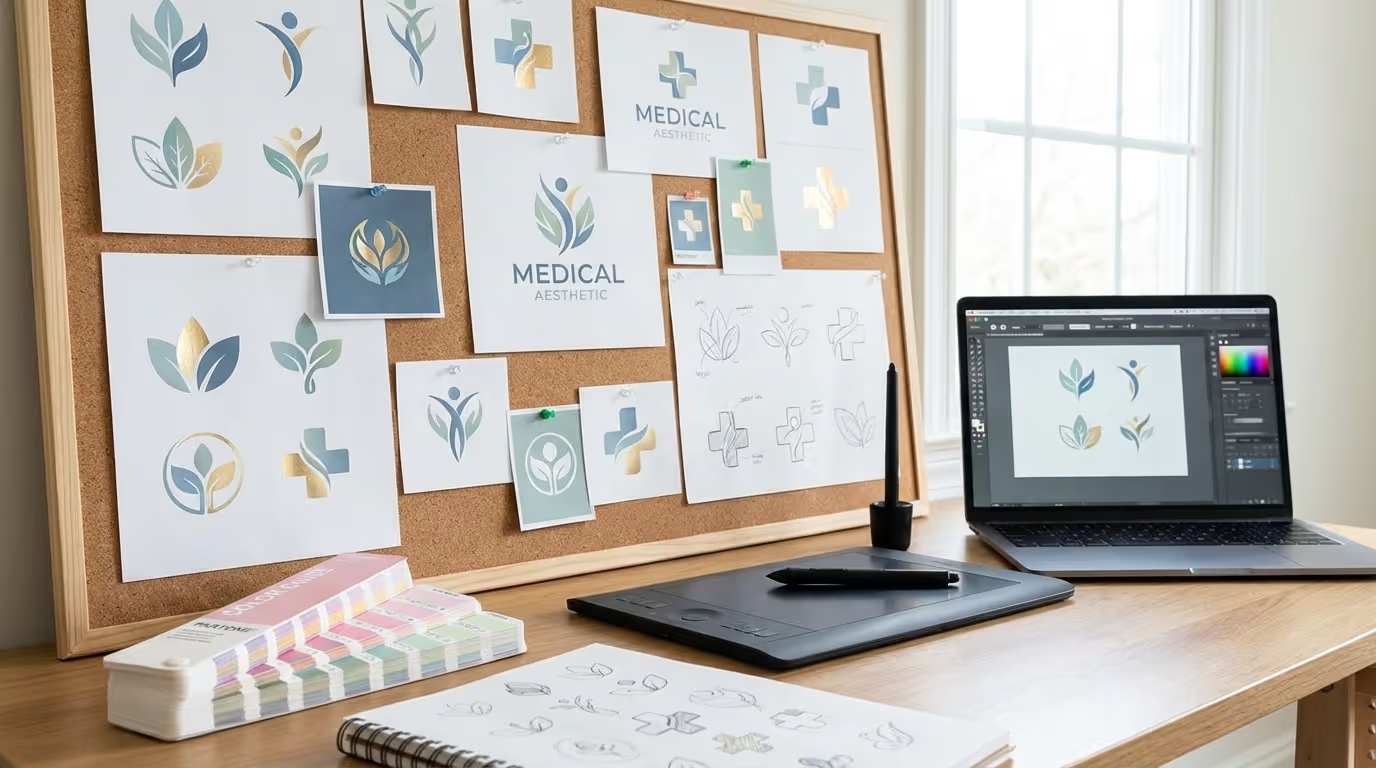
Logo Design
Your logo is the visual anchor of your brand. It should work at every size (from a building sign to a favicon), in every format (color, black, white, one-color), and on every background.
Logo types for med spas:
| Logo Type | Description | Best For | Examples |
|---|---|---|---|
| Wordmark | Practice name in a distinctive typeface | Clean, scalable, professional. Most common and versatile for med spas. | Most luxury brands use wordmarks because they are timeless |
| Wordmark + icon | Name paired with a simple graphic mark | Practices that want both a full logo and a standalone icon for social media | Icon used as social avatar, full logo on website and signage |
| Monogram | Initials designed as a logo | Practices with longer names that need a compact mark | Used on small applications, paired with full name on larger ones |
Logo design principles:
- Simplicity. Identifiable in one second at any size. Avoid complex illustrations, excessive detail, or more than two colors.
- Timelessness. No trendy elements that look dated in three years. A good logo should last a decade without redesign.
- Versatility. Test on white background, black background, photo overlay, business card, building sign, and Instagram profile circle.
- Relevance. Professional, clean, premium — appropriate for a medical aesthetic practice. No clip art, overly playful fonts, or elements that undermine medical credibility.
Investment benchmarks:
| Option | Cost | Quality | Turnaround | Recommended? |
|---|---|---|---|---|
| Logo generator (Canva, Looka) | $0-$100 | Low — generic, not unique | Hours | No — looks cheap, needs replacement within 1-2 years |
| Fiverr/budget freelancer | $50-$500 | Low-Medium — template-based, minimal strategy | 3-7 days | Rarely — occasional gems but mostly template work |
| Experienced freelance designer | $1,500-$5,000 | High — custom, strategy-informed | 2-4 weeks | Yes — best value for most med spas |
| Branding agency | $5,000-$25,000 | Very High — comprehensive brand system | 4-8 weeks | Yes — for established practices investing in premium positioning |
What to avoid: Designers who deliver 15 concepts without understanding your brand. You want someone who asks about your positioning, audience, and competitive landscape before opening design software.
Implementation Steps for Logo Design
- Compile 10-15 logos from other med spas or luxury brands that represent the feeling you want to convey
- Write a brief covering: your positioning statement, target patient, market position, and visual preferences
- Hire a designer or agency that specializes in healthcare or luxury brands
- Request 2-3 logo concepts (not 15 — too many choices paralyze decision-making)
- Evaluate each concept against the design principles: simplicity, timelessness, versatility, relevance
- Test the finalist on a building sign mockup, business card, social media profile, and website header
- Request all file formats: SVG (vector), PNG (transparent), JPG (web), PDF (print), and all color variations (full color, single color, white, black)
Color Palette
Your color palette creates instant emotional association with your brand. Choose it deliberately, not personally.
Build a three-tier palette:
| Tier | Purpose | Count | Examples |
|---|---|---|---|
| Primary | Your dominant brand color and its complement | 1-2 colors | Dark/neutral (charcoal, navy, black) OR one bold distinctive color |
| Secondary | Supporting colors for backgrounds, sections, variety | 2-3 colors | Complement primary palette, used in marketing materials |
| Accent | High-impact colors for CTAs, highlights, emphasis | 1-2 colors | Should pop against primary and secondary — used sparingly |
Color psychology relevant to med spas:
| Color Family | Emotional Association | Best For | Position Alignment |
|---|---|---|---|
| White/cream | Clean, pure, clinical, fresh | All positions — universal base | All |
| Navy/dark blue | Trust, authority, professionalism | Header, navigation, trust elements | Premium, mid-market |
| Black | Sophistication, luxury, exclusivity | Dark-mode sections, premium positioning | Premium, ultra-luxury |
| Gold | Prestige, quality, warmth | Accents, logos, premium signifiers | Premium, ultra-luxury |
| Teal/green | Health, renewal, balance, nature | Wellness-focused practices | Mid-market, accessible |
| Blush/rose | Femininity, softness, beauty | Female-focused practices | Premium, mid-market |
| Burgundy/plum | Luxury, richness, maturity | Premium brand accents | Premium, ultra-luxury |
| Electric/vibrant | Modern, energetic, innovative | CTAs, accents, youth-focused | Accessible, modern premium |
Common mistake: Choosing colors based on personal preference rather than brand strategy. Your favorite bright orange may not serve an "understated luxury" positioning at every touchpoint.
Implementation Steps for Color Palette
- Reference your market position — which color families align with your positioning?
- Analyze competitor color palettes — what is everyone else using? Differentiate.
- Select 1-2 primary colors, 2-3 secondary colors, and 1-2 accent colors
- Document exact values: hex codes (digital), RGB (screen), CMYK (print), and Pantone (professional printing)
- Create color application rules: which colors go where, what combinations are approved, minimum contrast ratios for accessibility
- Test the palette on your website, social media templates, print materials, and interior design
Typography
Font selection communicates brand personality as powerfully as color.
Your typography system needs two to three fonts:
| Font Role | Purpose | Characteristics | Examples |
|---|---|---|---|
| Heading/display | Headlines, titles, hero text | Most personality — premium serif or clean geometric sans | Playfair Display, Cormorant, Outfit, Montserrat |
| Body | Paragraphs, descriptions, general content | Highly readable at small sizes | Inter, Source Sans, Lato, Open Sans |
| Accent (optional) | Captions, labels, navigation, special elements | Simple and functional | Instrument Sans, DM Sans |
Typography rules:
- Never use more than three fonts across all brand materials
- Maintain consistent font weights (bold for headings, regular for body, light for captions)
- Ensure fonts are web-safe or available through Google Fonts/Adobe Fonts
- Avoid decorative or script fonts for anything other than accent use — they reduce readability
- Test readability on mobile at body text sizes (16px minimum for mobile websites)
Photography Style
Define a consistent photography style that matches your brand. This is often overlooked and creates some of the worst brand inconsistency.
| Element | Options | Recommendation |
|---|---|---|
| Lighting tone | Bright and airy / Dark and moody / Warm and natural | Match to your color palette and positioning |
| Color grading | Cool tones / Warm tones / True-to-life | Consistency matters more than the specific choice |
| Composition | Minimal with negative space / Detailed and styled | Minimal reads as premium; detailed reads as approachable |
| Subject styling | Full makeup / Natural beauty / Clinical clean | Match to your patient demographic expectations |
| Background | White/neutral / Lifestyle/environmental / Branded sets | White for B/A, lifestyle for social, branded for marketing |
Document this in a photography style guide so that every photo — whether taken by your team, a professional photographer, or pulled from stock — has the same visual feel. For tips on creating compelling visual content, read our med spa photography guide and med spa design ideas.
Brand Assets Package
When your visual identity is complete, compile these assets into a brand kit:
| Asset | Formats Required | Distribution |
|---|---|---|
| Logo (all variations) | SVG, PNG (transparent), JPG (web), PDF (print) | All team members, agencies, vendors |
| Color palette | Hex, RGB, CMYK, Pantone swatches | Design team, agencies, printers |
| Typography specification | Font names, weights, sizing hierarchy, Google Fonts links | Web developer, design team |
| Photography examples | JPG examples showing approved style | Content creators, photographers |
| Social media templates | Canva/Figma templates for posts, stories | Marketing team, social media manager |
| Email templates | HTML templates matching brand | Email marketing team |
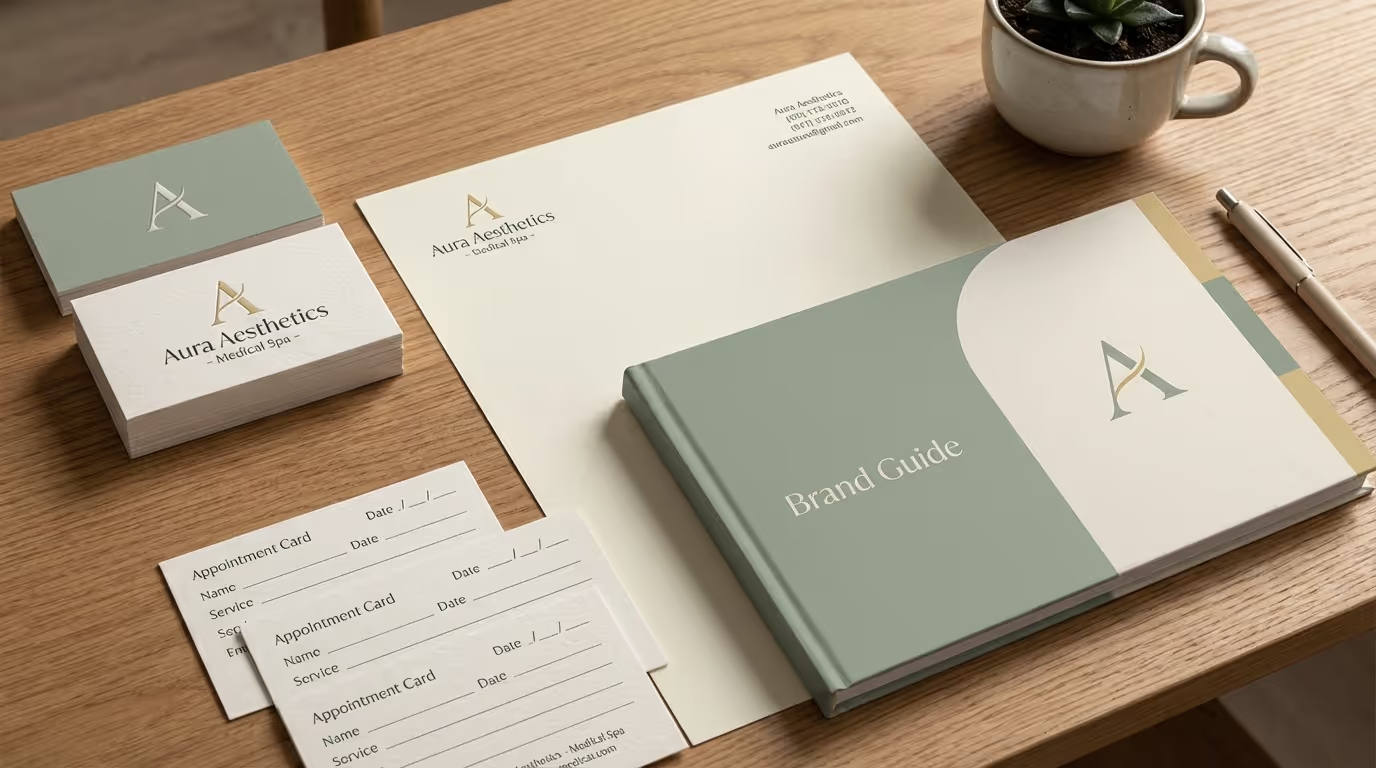
| Brand guidelines document | PDF with usage rules and examples | Everyone who creates content for the practice |
This brand kit ensures consistency whether materials are created by you, an employee, a freelancer, or an agency.
Step 4: Brand Messaging
Your visual identity is how your brand looks. Your messaging is how your brand sounds. Both must be aligned.
Brand Voice
Define your voice with four to five attributes that describe how your brand communicates:
| Attribute | Do | Do Not |
|---|---|---|
| Confident | "Our advanced filler techniques create natural-looking results that last." | "We think our filler treatments might work well for you." |
| Warm | "We understand that choosing aesthetic treatments is a personal decision." | "Procedures are performed in a clinical setting by qualified staff." |
| Expert | "Based on 15 years of injecting and 20,000+ treatments, we know that..." | "We have lots of experience with these treatments." |
| Honest | "Fillers are not permanent — here is what to expect and when you will need a touch-up." | "Our fillers will give you a youthful look forever." |
| Refined | "Your consultation includes a comprehensive assessment of your facial anatomy and goals." | "We will check you out and figure out what you need." |
Core Messaging Framework
Build a messaging hierarchy:
Tagline (5-8 words): Your brand's essence in a single phrase.
- "Where Science Meets Beauty"
- "Expert Aesthetics. Exceptional Results."
- "Your Best, Naturally."
Elevator pitch (2-3 sentences): What you say when someone asks "What does your practice do?"
Example: "We are a medical spa specializing in facial rejuvenation and body contouring for patients who want natural-looking, expert-level results. Our providers are among the most experienced injectors in the state, and we limit our daily schedule to ensure every patient receives personalized attention."
Key messages (3-5 statements):
- "We specialize in natural-looking results — enhancements that make you look refreshed, not overdone."
- "Every treatment is performed by a master-level provider with 10+ years of aesthetic experience."
- "We take a personalized approach — your treatment plan is designed for your unique anatomy and goals."
- "Our patients stay with us for years because we build relationships, not just treatment plans."
- "We use only FDA-approved products and the most advanced techniques available."
Supporting proof points: Data, credentials, and specifics that back up each key message. "10+ years" is a claim. "Board-certified with 22,000 injectable treatments performed" is proof.
Implementation Steps for Brand Messaging
- Define 4-5 voice attributes with "do" and "don't" examples for each
- Write your tagline (test 3-5 options with patients and staff)
- Craft your elevator pitch and practice saying it aloud
- Develop 3-5 key messages with supporting proof points
- Create a "brand voice cheat sheet" — a one-page reference that any content creator can follow
- Review all existing content (website, social, email) against the voice attributes and revise what does not match
- Train front desk and patient coordinators on key messaging (they are your brand ambassadors)
Messaging for Different Audiences
Your brand voice stays consistent, but your messaging shifts based on who you are talking to and where they are in the patient journey:
| Audience | Stage | Messaging Focus | Channels |
|---|---|---|---|
| New patients (awareness) | Discovering you | Lead with credibility and results, address common fears | Social media, blog, ads |
| Considering patients (evaluation) | Comparing providers | Detailed treatment info, testimonials, pricing transparency | Website, Google Ads, landing pages |
| Ready to book (decision) | Choosing you | Make booking easy, remove objections, provide incentive | Email, SMS, retargeting |
| Existing patients (retention) | Staying loyal | Celebrate results, introduce new treatments, reward loyalty | Email, membership program, in-office |
| Lapsed patients (re-engagement) | Coming back | Acknowledge absence, offer value, make return easy | Reactivation campaigns, SMS |
Common Messaging Mistakes
| Mistake | Impact | Fix |
|---|---|---|
| Using the same messaging for everyone | Feels irrelevant to most audiences | Segment messaging by patient stage |
| All features, no benefits | Patients do not care about your device name — they care about their results | Lead with outcomes, support with features |
| Claiming to be "the best" without proof | Sounds generic and arrogant | Replace superlatives with specifics ("22,000 treatments performed") |
| Copying competitor messaging | No differentiation — patients cannot tell you apart | Audit competitors and deliberately position differently |
| Inconsistent voice across channels | Confuses patients, undermines trust | Create a voice guide and enforce it across all content creators |
Step 5: Brand Experience Design
A brand is not just what you say and how you look. It is what you do. The patient experience is the ultimate expression of your brand.
Brand Touchpoints
Map every interaction a patient has with your practice and ensure each one reflects your brand:
Pre-visit touchpoints:
| Touchpoint | Brand Standard | Audit Question |
|---|---|---|
| Website appearance | Reflects positioning, fast, mobile-optimized | Does our website look like a practice that charges premium prices? |
| Phone greeting | Warm, professional, branded script | Would a caller know our brand values from the first 10 seconds? |
| Online booking process | Smooth, branded, mobile-friendly | Can a patient book in under 60 seconds? |
| Appointment confirmation | Branded email/SMS with practice personality | Does confirmation reinforce their decision to choose us? |
| Pre-visit communication | Clear instructions, warm tone, sets expectations | Does the patient know exactly what to expect before arriving? |
During-visit touchpoints:
| Touchpoint | Brand Standard | Audit Question |
|---|---|---|
| Exterior signage | Clean, visible, matches brand | Does our signage communicate the quality inside? |
| Reception greeting | Personal, warm — they know your name | Does the patient feel recognized and valued immediately? |
| Waiting area | Clean, comfortable, branded, minimal wait | Does the waiting area match the premium experience we market? |
| Consultation | Unhurried, thorough, educational | Does the consultation match our brand promise of personalized care? |
| Treatment experience | Comfortable, professional, consistent | Does the treatment experience justify our pricing? |
| Checkout | Smooth, no surprise charges, rebooking offered | Is checkout a positive touchpoint or a transactional afterthought? |
Post-visit touchpoints:
| Touchpoint | Brand Standard | Audit Question |
|---|---|---|
| Follow-up communication | Timely, helpful, caring | Do patients feel cared for after they leave? |
| Review request | Thoughtful, easy, well-timed | Are we making it effortless for satisfied patients to review us? |
| Rebooking communication | Branded, timely, personalized | Are rebooking prompts consistent with our brand voice? |
| Email marketing | Valuable, branded, relevant | Do our emails add value or just promote? |
| Social media interaction | Responsive, warm, on-brand | Do we respond to comments and DMs within 2 hours? |
| Loyalty program | Clear, valuable, easy to use | Does our loyalty program reward the behavior we want? |
Brand gap identification: Every touchpoint that falls short of your brand promise undermines the entire system. A patient who has a premium website experience but then receives a robotic automated text message experiences a brand gap. These gaps erode trust.
Implementation Steps for Brand Experience
- Map every patient touchpoint from first website visit to post-treatment follow-up
- Assign a brand standard to each touchpoint (what should this experience feel like?)
- Audit each touchpoint against the standard — score 1-5
- Prioritize fixing touchpoints that score below 3 (these are actively damaging your brand)
- Create SOPs for each touchpoint that include brand language and behavior standards (see our medical spa management guide for SOP frameworks)
- Train all staff on brand touchpoint standards quarterly
- Conduct a "secret shopper" audit every 6 months — call your own practice, visit your own website, go through the booking process
The Moments That Matter Most
Not all touchpoints are equal. Focus your brand experience energy on the moments with the highest emotional impact:
The first visit. This is the most anxious a patient will ever be at your practice. Every detail should communicate "You are in the right place." Implementation: create a "first visit experience" SOP that includes personalized greeting by name, practice tour, unhurried consultation, and follow-up contact within 24 hours.
The reveal moment. When a patient sees their results for the first time — in the mirror after filler, in photos at their follow-up — this is the emotional peak. Implementation: celebrate the result with them, document with professional photos, reinforce their decision.
The rebooking prompt. How and when you invite patients to book their next treatment sets the tone for the ongoing relationship. Implementation: provider recommends the next treatment and timeline during the appointment, patient coordinator confirms and books at checkout, automated reminder sent at the appropriate interval.
Step 6: Brand Consistency and Governance
A brand only works if it is consistent. One off-brand interaction is all it takes to introduce doubt.
Brand Guidelines Document
Create a document that covers:
| Section | Contents | Distribution |
|---|---|---|
| Logo usage | Minimum sizes, clear space, approved backgrounds, what NOT to do | All content creators |
| Color specifications | Hex, RGB, CMYK for every brand color + approved combinations | Design team, agencies |
| Typography rules | Font names, weights, sizing hierarchy, spacing | Web developer, content team |
| Photography guidelines | Style examples, dos and don'ts, B/A standards | Photographers, content team |
| Voice and tone | 4-5 voice attributes with examples | Everyone who writes for the brand |
| Templates | Social posts, emails, signage, print materials | Marketing team, front desk |
| What NOT to do | Examples of off-brand execution | All staff |
Common Consistency Failures
| Failure | How It Happens | Solution |
|---|---|---|
| Social media gone rogue | Staff posts with off-brand graphics, language, or content | Create templates and an approval process |
| Provider-created content | Providers make their own handouts with different fonts, colors, messaging | Provide branded templates for everything providers need |
| Third-party materials | Vendor materials (Allergan posters, product displays) clash with brand | Minimize vendor materials in patient areas or request brand-aligned alternatives |
| Inconsistent digital presence | Website says one thing, GBP says another, Instagram bio says a third | Audit every digital presence quarterly for accuracy and consistency |
| New hire not trained on brand | New employee answers phone differently, uses different language | Include brand training in onboarding SOP |
| Off-brand specials and promotions | "FLASH SALE 50% OFF!!!" from a practice positioning as premium | Create promotion guidelines that maintain brand positioning |
Implementation Steps for Brand Governance
- Create the brand guidelines document (or hire your branding agency to create it)
- Distribute to every team member and external partner
- Include brand training in employee onboarding
- Designate a "brand guardian" — one person who approves all public-facing materials
- Audit all digital properties quarterly (website, GBP, social profiles, directory listings, review sites)
- Audit all physical touchpoints semi-annually (signage, interior, printed materials, uniforms)
- Update the brand guidelines annually based on what has evolved
The ROI of Medical Spa Branding
How do you know if your branding investment is working? Track these metrics:
Brand Awareness Metrics
| Metric | How to Track | What Growth Indicates |
|---|---|---|
| Branded search volume | Google Search Console — queries containing your name | More people know you and are searching for you specifically |
| Direct website traffic | Google Analytics 4 — direct traffic channel | People typing your URL directly — they remember you |
| Social media following | Platform analytics | Growing audience aware of your brand |
| New patient source: "word of mouth" | Intake forms — "How did you hear about us?" | Your brand is being discussed and recommended |
Brand Perception Metrics
| Metric | How to Track | What Improvement Indicates |
|---|---|---|
| Average Google review score | Google Business Profile | Patient satisfaction matching brand promise |
| Net Promoter Score (NPS) | Post-visit survey | Patients willing to recommend you — brand loyalty |
| Qualitative review themes | Read reviews for brand-related language | Patients describing your practice in brand-aligned language |
| Patient satisfaction scores | Post-visit survey | In-practice experience matching marketing promise |
Brand Performance Metrics
| Metric | How to Track | What Growth Indicates |
|---|---|---|
| Average revenue per patient | CRM reporting | Stronger brand enables higher pricing and cross-sell |
| New patient conversion rate | CRM + analytics | Brand-aware patients convert at higher rates |
| Patient retention (6 and 12 month) | CRM reporting | Brand loyalty keeping patients coming back |
| Referral rate | Intake forms + referral program tracking | Patients are brand ambassadors |
| Price elasticity | Revenue trends after price increases | Can you raise prices without losing volume? |
| Cost per new patient acquisition | Marketing ROI tracking | Stronger brand = lower acquisition costs over time |
A strong brand does not happen overnight. It compounds. Over months and years of consistent execution, your brand becomes an asset that generates revenue, reduces costs, and builds enterprise value. For benchmarks on how much med spa owners make and how brand affects the bottom line, read our revenue analysis.
Brand-Building Timeline and Investment
| Phase | Timeline | Investment | Expected Outcome |
|---|---|---|---|
| Naming + trademark | 2-4 weeks | $1,000-$3,000 (trademark filing) | Protected, strategic name |
| Logo + visual identity | 3-6 weeks | $2,000-$15,000 | Professional brand system |
| Brand guidelines document | 1-2 weeks | Included with identity or $1,000-$3,000 | Consistency framework |
| Website reflecting brand | 4-8 weeks | $4,000-$15,000 | Digital brand expression |
| Brand training for team | 1-2 days | Internal time investment | Team alignment |
| Ongoing brand management | Continuous | 2-4 hours/month | Consistency over time |
| Total initial investment | 8-16 weeks | $8,000-$35,000 | Complete brand system |
This investment pays for itself through higher pricing power (15-25% premium), lower acquisition costs (20-35% reduction), and higher retention (30-50% improvement) within the first 12-18 months.
Your practice is not just a place people go to get injections. Your med spa brand identity is what patients choose to belong to. Build it that way — from your medical spa logo design to every patient touchpoint.
Ready to build a brand that commands premium pricing and attracts the patients you actually want? Book a Strategy Call — we will assess your current brand positioning, identify the gaps, and show you exactly how to close them.